2010 AUDI S6 warning
[x] Cancel search: warningPage 335 of 368

Emergency situations --------------=----Efffll
Connect POSITIVE (+) to POSITIVE (+) (red)
- Open the red cover on the posi tive po le ~ page 332,
fig . 238.
1. Connect one e nd of the pos itive cable (red) on the
jump
start bolt~
page 332, fig. 239 © (Bolts under red cover
= "positive") of the vehicle to be started @.
2 . Connect the other end to the pos itive terminal @ of the
booster battery ®·
Connect NEGATIVE(-) to NEGATIVE(-)
(black)
3 . Connec t one end to the negative te rmi nal @ of the
booster battery ®·
4. Conn ect t he other end o f the n ega tive cabl e (black) to t he
jump start bolt© (Bolts w it h hex head = "n egat ive") of
the vehic le to be s tarte d
@.
Starting the engine
- Start the engine of t he vehicle w ith the booster battery.
Run the engi ne at a moderate speed.
- Start e ng ine w it h discharged ve hicle battery in the usu al
ma nner .
- If the engine fai ls to star t: do no t ke ep the s tar ter
crank ing for lo nger than 10 secon ds. W ait for abou t
30 seco nds and then t ry again .
- Wi th engine running, remove jum per cable s from bot h
v eh icle s in t he exact
re vers e order.
- C lose the re d cove r on the positive pole.
Safety first
T he battery is vented to the outside to prevent gases from entering
t he ve hicl e inter ior. Make su re t hat t he ju mper clamps are we ll
connected with the ir
metal parts in full contact with the battery
terminals .
& WARNING
To avoid serious per sonal injury and damage to the vehicle, heed
all warnings and instructions of the jumper cable manufacturer . If
in doubt, call for road service .
• Jumper cables must be long enough so that the vehicles do not
tou ch.
• When connecting jumper cables , make sure that they cannot
get caught in any moving part s in the engine compartment .
• Before you che ck anything in the engine compartment , always
read and heed all WARNINGS~
page 269, "Engine compart
ment ".
0 Note
Improper hook-up of j umper cab les can ruin the generator.
• Always co nnect POSITIVE(+) to POSI TIVE(+), and NEGATIV E(- )
to NEGA TIVE( -) ground post of the battery manager cont rol unit.
• Check that all screw p lugs on the battery ce lls are sc rewed in
firmly. If not, tighten p lugs prior to connecting clamp on negative
battery terminal.
• Please note that the proced ure for connecting a jumper cable as
described above applies specifically to t he case of your vehicle being
jump started . When you a re giving a jump start to another vehicle, do
not connect the negative( -) cab le to the nega tive (-) te rm inal on the
discharged battery©~
page 332, fig. 239. Instead, securely
c onne ct the negative (- ) cab le to ei ther a so lid met al componen t th at
is f irm ly bolted to the eng ine b lock or to the eng ine b lock itself. If the
ba ttery tha t is bei ng charged does not ven t to t he ou tside, escap ing
battery gas could ignite and explode! •
Vehicle care Do-it-yourself service Technical data
Page 336 of 368
,..,___E_ m_ e_r -=g :.. e_ n_c -=y '-- s_i_t _u _a _ t_ i_ o _ n_ s ____________________________________________ _
Emergency towing with
commercial tow truck
General hints
Your Audi requires special handling for towing.
The following information is to be used by commercial tow truck
operators who know how to operate their equipment safely.
• Never tow your Audi, towing will cause damage to the engine
and transmission.
• Never wrap the safety chains or winch cables around the brake
lines.
• To prevent unnecessary damage, your Audi must be transported
with a flat bed truck.
• To load the vehicle on to the flat bed, use the towing loop found
in the vehicle tools and attach to the front or rear anchorage
~ page 334 and~ page 335 .
& WARNING
A vehicle being towed is not safe for passengers. Never allow
anyone to ride in a vehicle being towed, for any reason. •
Front towing Loop
Do not install the front towing loop until it is needed.
Fig. 240 Front
bumper: removing the
cover cap
Fig. 241 Front
bumper: screwing in
the towing loop
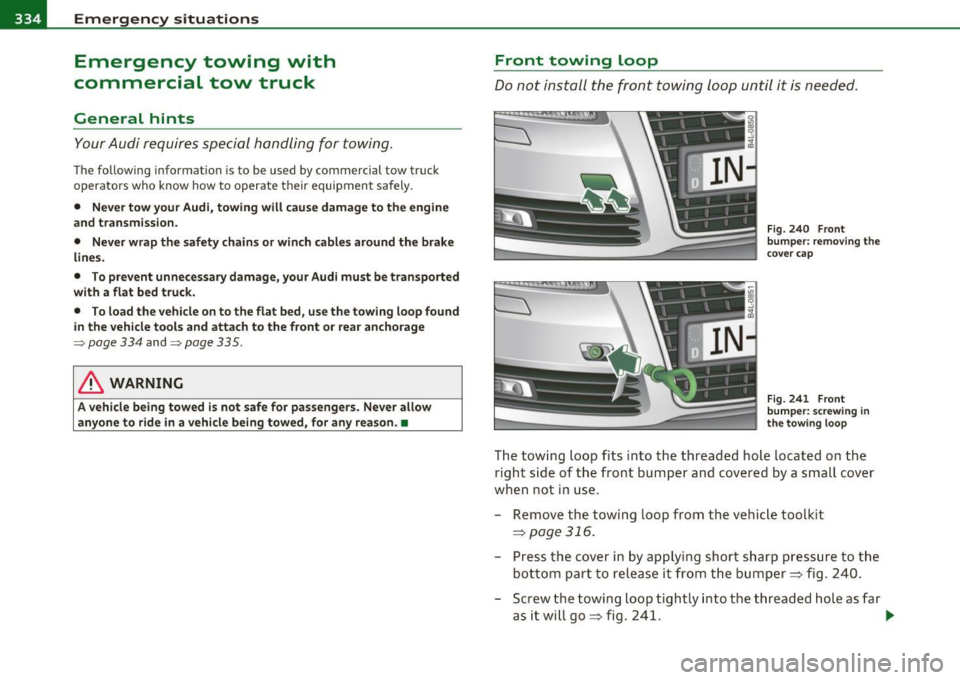
The towing loop fits into the threaded hole located on the
right side of the front bumper and covered by a small cover
when not in use.
- Remove the towing loop from the vehicle toolkit
=> page 316.
-Press the cover in by applying short sharp pressure to the
bottom part to release it from the bumper=> fig. 240.
- Screw the towing loop tightly into the threaded hole as far
as it will go=> fig. 241 . ..,
Page 337 of 368
Emergency situations --------------=---:.--___.VPII
When it is no longer needed, unscrew the towing loop and put it back
into the vehicle toolkit. Be sure to have the towing loop stored in the
vehicle at all times .
& WARNING
If the towing loop is not screwed in as far as it will go, the thread
ca n pull out when the vehicle is towed -potential risk of an
accident. •
Rear towing loop
Do not install the rear towing loop until it is needed.
Fig. 242 Rear
bumper: screwing in
the tow ing loop
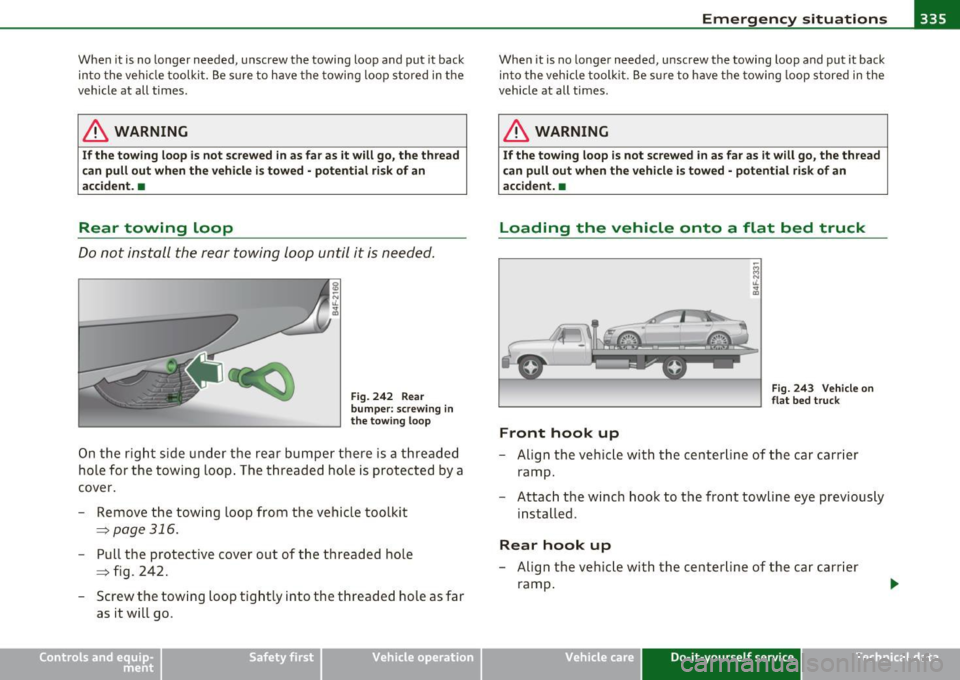
On the right side under the rear bumper there is a threaded
hole for the towing loop. The threaded hole is protected by a
cover.
- Remove the towing loop from the vehicle toolkit
=::;, page 316.
-Pull the protective cover out of the threaded hole
=;, fig. 242.
-Screw the towing loop tightly into the threaded hole as far
as it will go.
Vehicle OP-eration
When it is no longer needed, unscrew the towing loop and put it back
into the vehicle toolk it. Be sure to have the towing loop stored in the
vehicle at all times.
& WARNING
If the towing loop is not screwed in as far as it will go, the thread
c an pull out when the vehicle is towed · potential risk of an
accident. •
Loading the vehicle onto a flat bed truck
Front hook up
Fig. 243 Vehicle on
fl at bed truck
-Align the vehicle w ith the centerline of the car carrier
ramp.
- Attach the winch hook to the front towline eye previously
installed.
Rear hook up
- Align the vehicle with the centerline of the car carrier
ramp .
Vehicle care Do-it-yourself service iTechnical data
Page 339 of 368

_____________________________________________ E_ m_ e_r-= g ::.. e_ n_c-= y'- s_ i_t _u _a_ t_ i_ o _ n_ s __ ffl'II
& WARNING
• To reduce the risk of serious injury and vehicle damage.
-Always lift the vehicle only at the special workshop hoist and
floor jack lift points illustrated=>
page 336, fig. 244 and
=> page 336, fig. 245.
- Failure to lift the vehicle at these points could cause the
vehicle to tilt or fall from a lift if there is a change in vehicle
weight distribution and balance. This might happen, for
example, when heavy components such as the engine block or
transmission are removed .
• When removing heavy components like these, anchor vehicle
to hoist or add corresponding weights to maintain the center of
gravity. Otherwise , the vehicle might tilt or slip off the hoist ,
causing serious personal injury.
0 Note
• B e aw are of the following poi nts b efo re li fting the ve hicl e:
- The vehicle should never be lifted or jacked up from under
neath the engine oil pan, the transmission housing , the front or
rear axle or the body side members . This could lead to serious
damage.
- To avoid damage to the underbody or chassis frame, a rubber
pad must be inserted between the floor jack and the lift points.
- Before driving over a workshop hoist, check that the vehicle
weight does not exceed the permissible lifting capacity of the hoist.
- Before driving over a workshop hoist, ensure that there is
sufficient clearance between the hoist and low parts of the
vehicle. •
Safety first Vehicle care Do-it-yourself service Technical data
Page 341 of 368
______________________________________________ G_e_ n_e _ r_ a_ l_ in_ f_o _r_ m_ a_ t_ i _o_ n __ _
The safety compliance sticker
is your assurance that yo ur new vehicle complies with all applicable
Fede ral Motor Veh icle Safe ty Standards which were i n effect at the
time the vehicle was manufact ured . Yo u can fi nd this sticker on the
left doo r jamb.
It shows the mont h and year of prod uct io n and the
vehicle identification number of your veh icle (perforation) as well as
the Gross Vehicle Weight Rating (GV WR) and the Gross Axle Weight
Rating (GAWR).
The high voltage warning label
is located o n the loc k carrier.
The spark ignition system complies with the
Canadian standard ICES-002. •
Weights
Gross Vehicle Weight Rating
The Gross Vehicle Weight Rating (GVWR), and the Gross Axle Weight
Rating (GAWR) for front and rear are listed on a sticker on the left
door jamb.
T he Gross Vehicle Weight Rating includes the weight of the basic
vehicle pl us f ull f uel tank, oil and coo la nt, plus max im um load, whi ch
includes passenger we ight (150 lbs/68 kg per des ignated seating
position) and luggage weight.
Gross Axle Weight Rating
Th e Gross Axle Weight Ra ting is the maximum lo ad that can be
applied at each axle of the vehicle~&.
Vehicle capacity weight
The vehicle capacity weight (max. load) is listed on the dr iver's side B
pillar.
Safety first
Roof weight
Th e maxim um permiss ib le roof weight is 220 lb (100 kg ). T he roof
we ight is made up of the weight of the roof rac k system and t he
we ight of the object being transported~
page 88, "Loading the roof
rack".
& WARNING
• The actual Gross A xle Weight Rating at the front and rear a xles
s hould not exceed the permis sible weights , and their combination
must not exceed the Gros s Vehicl e Weight Rat ing .
• Exceeding permi ssible weight ratings can result in vehicle
damage, accidents and personal injury.
0 Note
• T he vehicle capac ity we ight figures apply when the load is distrib
uted evenly i n the vehicle (passengers and lug gage). When trans
porting a heavy load i n the luggage compartment, ca rry the load as
near to the rear axle as possible so that the ve hicle's handling is not
impa ired.
• Do not exceed the max imum permissible axle loads o r the
maximum gross veh icle weight. Always remember that the vehicle's
handling will be affecte d by the extra load. Therefore, adjust your
speed according ly .
• Always observe loca l reg ulat ions. •
Dimensions
The specifications refe r to the basic mode l. Differences may occur
depe nd ing on the mode l type a nd options ordered, for exam ple, t ire
sizes. .,_,
Do-it,yourself service Technical data
Page 347 of 368
______________________________________________ C _o_ n _ s_u_ m_ e_r_ I_n _f_ o_ r_m _ a_t_ i_ o _ n __ _
reliab ility. For deta iled vehicle maintenance cons ult your Warra nty &
Main tenan ce bookle t.
Under difficult operating conditions, for example at extremely low
outside temperatures, in very dusty regions, when towing a trailer
very frequently, etc., some service wo rk shou ld be performed
between the intervals specified. This app lies particu larly to:
• oil changes, and
• cleaning or rep lacing the air fi lter.
<£> For the sake of the environment
By regular ly maintaining your vehicle, you help make sure that emis
sion standards are mainta ined, t hus mi nimizing adve rse e ffects o n
the environment. •
Important considerations for you and your
vehicle
T he increasing use of electronics, sophisticated fuel injection and
em ission cont rol systems, and t he generally increasing techni cal
complex ity of today's automobiles, have stead ily reduced the scope
of mai ntenan ce and repairs w hich can be ca rried out by ve hicle
owners.
Also , safety and environm ental concerns p lace very strict
limits on the nature of repairs and adjustments to engine and trans
mission parts wh ich an owner can perform.
Maintenance, adj ustments and repairs usua lly req uire specia l tools,
test ing devices and other eq uipment available to specially t rained
workshop personnel in order to assure proper performance, re li
ability and safety of the vehicle and its many systems.
Improper maintenance, adjustments and repairs can impair the oper
ation and reliabili ty of your ve hicle and even void you r vehicle
warranty. Therefore, p roof of servicing in accordance with the main
t enance schedu le may be a condit ion fo r uphold ing a possible
warranty cla im made w it h in the warranty period .
Safety first
Above all, operational safety can be adversely affected, creating
unnecessary r is ks for you and you r passe ngers.
If in doubt about a ny servic ing, have it done by your authorized Audi
dealer or any other properly eq uipped and qualified works hop. We
st rongly urge you to give you r a utho rized Aud i dealer the opportunity
to perform a ll scheduled maintenance and necessary repairs. Your
dealer has t he facilities, o rigina l part s and trained spe ciali sts to keep
your vehicle running properly.
Performing limit ed maint enance yourself
The following pages describe a lim ited number of procedures which
can be perfo rmed on your vehicle w it h ordi na ry tools, should t he need
ar ise and trained personnel be unava ilab le. Before performing any of
t hese p rocedures, always tho roughly read all of the applicable text
and carefu lly follow the instructions given. Always rigorous ly observe
t he
WARNINGS p rov ided .
Before you ch eck anyth ing in the eng ine compartment, alwa ys read
and heed all WARNINGS~
& and~ & in "Working in the engine
compartmen t" on
page 277.
& WARNING
• Seriou s pe rs onal injury may occ ur as a result of improperly
perform ed maintenan ce, adju stments or repair s.
• Always be extremely careful when work ing on the vehicle.
Alway s foll ow commonly acc epted safety practic es and general
c ommon sense . N ever ri sk per son al injury .
• Do not attempt any of the maint enance, che cks or repair s
de scrib ed on the following p ages if you are not fully familiar with
the se or ot her procedure s with re spect to the vehicle , or are uncer
tain how to proceed .
• Do not do any work without the prop er tool s and equipment .
Ha ve the ne cessary work done by your authorized Audi dealer or
an other properly equipped and qu alified workshop. _,.
Do-it,yourself service Technical data
Page 348 of 368
___ C_ o_n_ s _ u_m_ e_ r_ I_ n_ f_o _r_ m_ a_ t_io _ n _____________________________________________ _
& WARNING (conti nu ed )
• The engine compartment of any motor veh icle is a potentially
hazardous area . Never reach into th e area around or touch the
radiator fa n. It is temperature controlled and can switch on
s uddenly -even when the engine is off and the ignition key has
been remo ved. The radiator fan switches on autom atically when
the coolant rea ches a certain temperature and will continue to run
until the coolant tempe rature drops.
• Always remove the ignition key before anyone gets under the
vehicle.
• Always support your vehicle with safety stands if it i s neces sary
to work unde rne ath the vehicle. The jac k supplied with the vehicle
is not adequate for thi s purpose and could collap se cau sing
serious personal injury.
• If you must work underneath the vehicle w ith the wheels on
the ground , always ma ke sure the vehicle is on level ground , th at
the whe els are alway s securely blocked and that the engine cannot
be started .
• Always make sure the transmi ssion selector l ever (automatic
tran smission) is in "P" (Park position ) and the par k brake is firmly
applied.
W For the sake of the environment
• Changing the engine settings will adversely affect e miss io n levels.
Th is is detrimenta l to the environment and increases fuel consump
ti on.
• Always observe enviro nmental regulations when disposing of old
eng ine o il, use d brake fl uid, dirt y engine coo lant, s pent ba tt er ies or
worn out t ires.
• Undep loyed a irbag modules and pretens ioners migh t be classified
as Perchlorate Mater ia l -spec ial handling may apply, see
www.dts c.ca .g ov/h azar douswas te/pe rchlo ra te . When the veh icle or
parts of the rest raint system including a irbag modu les sa fety belts
w ith pretens ioners are sc rapped, all applicable laws and regulat io ns must be observed
. Your authorized Aud i dealer is familiar with these
re qui remen ts and we recomme nd that you have your dealer perfo rm
this serv ice for you .•
Additional accessories,
modifications and parts
replacement
Additional accessories and parts
replacement
A lway s con sul t an autho rized Audi dealer before
purchasi ng a ccess ories.
Your vehicle incorporates the latest safety design feat ures ens uring a
hig h stand ard of active and passive s afe ty.
T hi s safety co uld be compromised by no n-app roved changes to the
vehicle. Fo r this reason, if parts have to be replace d, p lease observe
the following points when installing addit ional accessories :
Approved Audi accessories and genuine Aud i parts are available from
a u thor ized Aud i deal ers.
T hese dea lers a lso have the necessary fac ilities, tools and tra ined
speci alists to inst all the parts and ac cessor ies p ro p er ly.
& WARNING
Using the wrong spar e parts or u sing non-approved ac ce ss ories
can cause damage to the vehicle and serious personal injury .
• Use only acces sories expressly approved by Audi and genuine
Audi spare parts
• The se parts and acces sorie s have been specially designed to be
used on your vehicle . _,.
Page 349 of 368
_____________________________________________ C_o_ n_s _u_ m __ e_r _ I_ n_ f_o _r_ m_ a_ t_ i _o_ n __ __
& WARNING (co ntinued )
• Never install acces sorie s such a s telephone cradle s or beve rage
holder s on airbag covers or within the airbag deployment zones .
Doing so will inc rease the risk of injury if airbags are triggered in
an accident!
• Before you che ck anything in the engine compartment , always
read and heed all WARNINGS~
page 269.
0 Note
• If items o ther than genui ne Aud i spare pa rts, add-on equ ipment
and accessory items are used or if repair work is not performed
acco rding to specified me thods , this can res ult in seve re damage to
yo ur vehicle's engine and body (such as corros ion) and adversely
affe ct your vehicle's w arran ty.
• If emergency repairs must be performe d elsewhere, have the
vehicle exam ined by an authori zed A udi de alersh ip as soon a s
possible.
• Th e manufacturer ca nnot be held liab le for damage w hich occ urs
due to fai lure to comply with these stipulat ions. •
Technical Modifications
Our guid elines must be complied with when technical
modificati ons are made .
Always cons ult an a uth orized Audi dealer before starting wo rk o n any
mod ificat ions.
Th is w ill help ensure that veh icle function, perfo rmance and safety
a re no t imp aired ~& .
Attempting to work on e lectron ic compone nts and the software used
wit h them can cause malf unctio ns. Beca use o f the way electronic
compone nts are interco nnected w ith each o ther, suc h ma lfunct ions
can also have an a dverse affect on other systems that are not directly
Safety first
involved . Th is means that you risk bot h a substantial reduction in the
operation al safety o f yo ur veh icle and an incre ase d wear o f vehicle
parts~ &.
Authorized Audi dea lers will perform this work in a professiona l and
co mpe ten t manner o r, in special cases, refe r yo u to a p rofessional
company that specializes in s uch mod ifications.
& WARNING
Improper repairs and modifications can change the way vehicle
sy stems work and cause damage to the veh icl e and serious
personal injury .
0 Note
If emergency repai rs must be perfo rmed elsewhere, have the vehicle
ex amined by an auth o riz ed Audi dealers hip as soo n as poss ible. •
Declaration of Compliance,
Telecommunications and Electronic Systems
Ra dio Frequency Dev ices a nd Radioco mmunicati on
Eq uip m en t U ser Manual N otic e .
The man ufact urer is not responsible for any radio or TV interfere nce
caused by unauthorized modifications to this equipment .
Devices
The fo llow ing dev ices e ach c omply w it h F CC P art 15.19, FCC Part
1 5 .21 a nd RSS-Ge n Issue 1:
• Adaptive Cr uise Control
• Convenie nce key
• Audi s ide a ss ist
Do-it,yourself service Technical data