2010 AUDI S6 warning
[x] Cancel search: warningPage 323 of 368

What do I do now? -
------------------
& WARNING (continued)
• Do not loosen the wheel bolts more than one turn before you
raise the vehicle with the jack. -You risk an injury.
(I) Tips
• Never use the hexagonal socket in the handle of the screwdriver to
loosen o r tighten the wheel bolts .
• If a wheel bolt is very tight, you may find it easier to loosen by
carefully pushing down on the end of th e wheel bolt wrench with
one
foot only .
As you do so, hold on to the car to keep your balance and
take ca re not to slip .•
Raising the vehicle
The vehicle must be li~ed with the jack first before the
wheel can be removed.
Fig. 229 Changing a
wheel: mounting
points for the jack
Vehicle OP-eration
Fig. 230 Close-up:
proper positioning of
jack
- Activate the vehicle jack mode* (only vehicles with Adap
tive Air Suspension)=>
page 168.
-Engage the parking brake to prevent your vehicle from
rolling unintentionally.
- Move the
selector lever to position P.
-Position the jack below the door sill under the mounting
point
that is closest to the wheel to be changed
=> fig . 229.
- Extend the
jack under the lifting point on the door sill until
its arm is positioned directly under the lifting point=>& .
- Align the jack so that its arm©=> fig. 230 engages in the
designated lifting point in the door sill and the movable
base ® lies flat on the ground. The base® must be
vertical under the lifting point@.
- Wind the jack up further until the flat tire comes off the
ground =>& .
The jack must be installed only at the places indicated=> fig . 229.
There is exactly
one location for each wheel. The jack must not be
positioned at any other location
~ & .
Vehicle care Do-it-yourself service iTechnical data
Page 324 of 368
-What do I do now? .,,,.,__ ______________ _
An unstable surface under the jack can cause the vehicle to slip off the
jack. Always provide a firm base for the jack on the ground .
If neces
sary place a sturdy board or similar support under the jack. On hard,
slippery surfaces (such as tiles) use a rubber mat or similar to prevent
the jack from slipping=> &.
& WARNING
• You or your passengers could be injured while changing a
wheel if you do not follow these safety precautions:
-Positioning the jack under the vehicle at any other place than
those indicated above may damage the vehicle or may result in
personal injuries.
- A soft or unstable surface under the jack may cause the
vehicle to slip off the jack. Always provide a firm base for the
jack on the ground. If necessary, use a sturdy board under the
jack.
- On hard, slippery surface (such as tiles) use a rubber mat or
similar to prevent the jack from slipping.
• To help prevent injury to yourself and your passengers:
- Do not raise the vehicle until you are sure the jack is securely
engaged.
- Passengers must not remain in the vehicle when it is jacked
up.
- Make sure that passengers wait
in a safe place away from the
vehicle and well away from the road and traffic.
- Make sure jack position is correct, adjust as necessary and
then continue to raise the jack. •
Taking the wheel off/installing the spare
Follow these instructions step-by -step for changing the
wheel
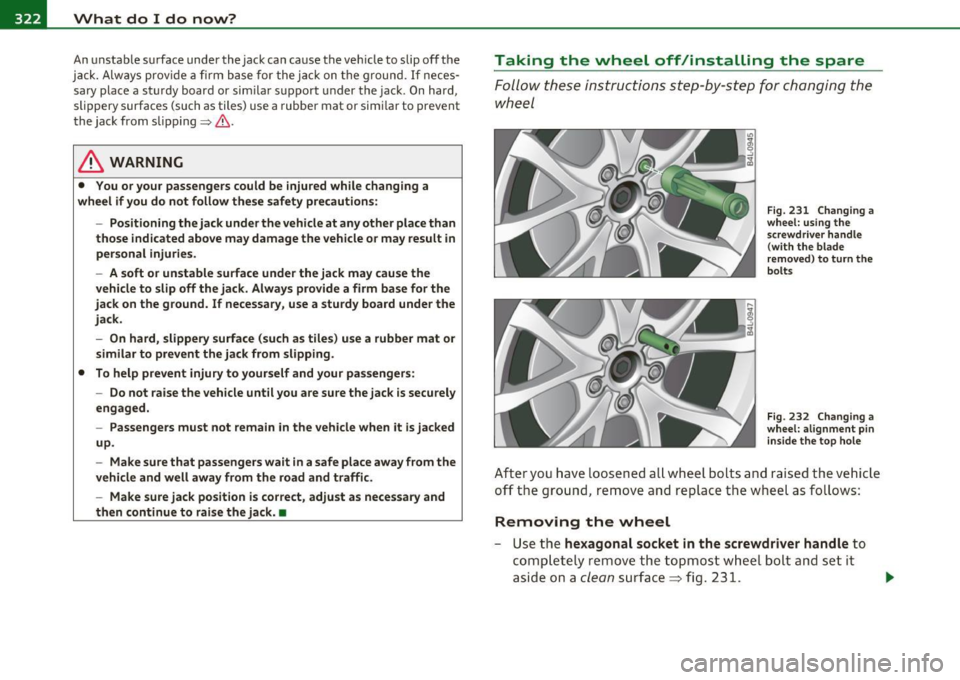
Fig. 231 Changing a
wheel: using the
screwdriver handle
(with the blade
removed) to turn the
bolts
Fig. 232 Changing a
wheel: alignment pin inside the top hole
After you have loosened all wheel bolts and raised the vehicle
off the ground, remove and replace the wheel as follows:
Removing the wheel
- Use the hexagonal socket in the screwdriver handle to
completely remove the topmost wheel bolt and set it
aside on a
clean surface => fig. 231.
Page 326 of 368
lffll.___W __ h_a_ t_ d_ o_ I_ d_o_ n_ o_w _ ? _____________________________________________ _
• Have the wheel bolt tightening torque checked with a torque
wrench as soon as possible by your authorized Audi dealer or a qual ified service station.
• With steel and alloy wheel rims, the wheel bolts are correctly
tightened at a torque of 90
ft lb (120 Nm).
• If you notice that the wheel bolts are corroded and difficult to
turn while changing a tire, they should be replaced before you check
the tightening torque.
• Replace the flat tire with a new one and have it installed on your
vehicle as soon as possible. Remount the wheel cover.
Until then, drive with extra care and at reduced speeds.
& WARNING
• If you are going to equip your vehicle with tires or rims which
differ from those which were factory installed, then be sure to
read the information =>
page 305, "New tires and replacing tires
and wheels".
• Always make sure the damaged wheel or even a flat tire and
the jack and tool kit are properly secured in the luggage compart
ment and are not loose in the passenger compartment.
• In an accident or sudden maneuver they could fly forward,
injuring anyone in the vehicle.
• Always store damaged wheel, jack and tools securely in the
luggage compartment. Otherwise, in an accident or sudden
maneuver they could fly forward, causing injury to passengers in
the vehicle. •
Page 327 of 368
Fuses and bulbs -_______________ __.PfWII
Fuses and bulbs
Fuses
Replacing a fuse
A problem in the electrical system may be caused by a
blown fuse.
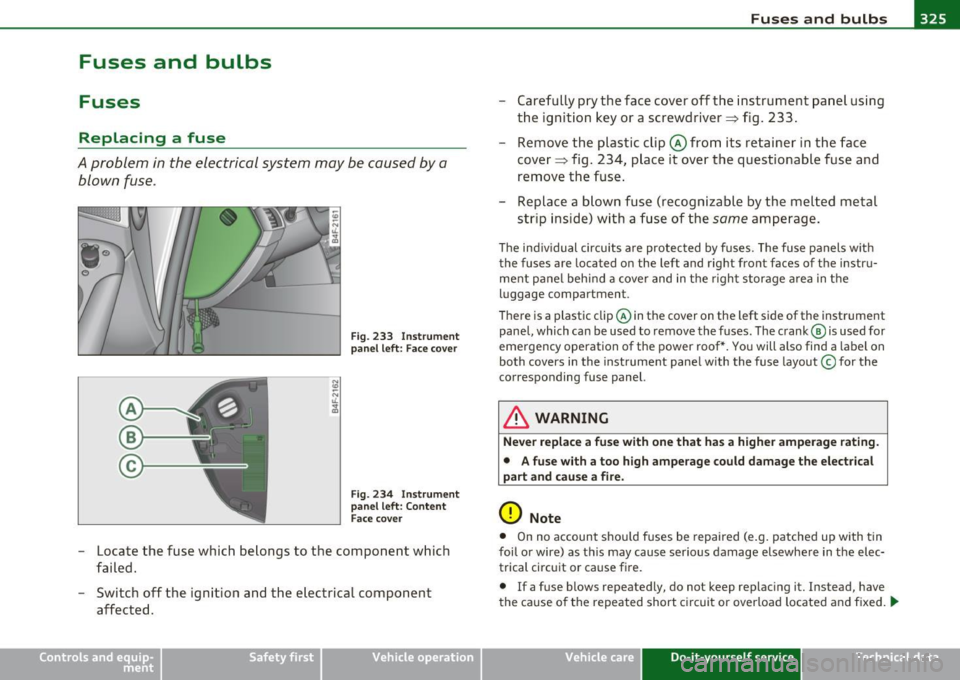
Fig. 233 Instrument
panel left: Face cover
Fig. 234 Instrument
panel left: Content
Face cover
-Locate the fuse which belongs to the component which
failed.
- Switch off the ignition and the electrical component
affected.
Vehicle OP-eration
- Carefully pry the face cover off the instrument panel using
the ignition key or a screwdriver::::::, fig. 233.
- Remove the plastic clip @from its retainer in the face
cover==> fig. 234, place it over the questionable fuse and
remove the fuse.
- Replace a blown fuse (recognizable by the melted metal
strip inside) with a fuse of the
same amperage.
The individual circuits are protected by fuses. The fuse panels with
the fuses are located on the left and right front faces of the instru
ment panel behind a cover and in the right storage area in the
luggage compartment.
Ther e is a plastic clip@ in the cover on the left side of the instrument
panel, which can be used to remove the fuses. The crank @ is used for
eme rgency operation of the power roof*. You will also find a label on
both covers in the instrument panel with the fuse layout © for the
corresponding fuse panel.
& WARNING
Never replace a fuse with one that has a higher amperage rating.
• A fuse with a too high amperage could damage the electrical
part and cause a fire.
0 Note
• On no account should fuses be repaired (e.g. patched up with tin
foil or wire) as this may cause serious damage elsewhere in the elec
trical circuit or cause fire.
• If a fuse blows repeatedly, do not keep replacing it. Instead, have
the cause of the repeated short circuit or overload located and fixed.
ti>
Vehicle care Do-it-yourself service iTechnical data
Page 331 of 368
_______________________________________________ F_u _s_ e_ s_ a_ n_ d_ b_u _ l_ b _ s __ _
No. Equipment
11 Pa rk in g System
12 Cigare tt e lig ht er r ea r
Fuse holder (brown)
1 Rear view
2 El ectr ic re ar lid (A va nt)
3 Electric rear lid (Avant)
4 Electric rear lid (Avant)
5 Co mmuni cation, An te n na amplifie r
6 Not used
7 M MI
8 Not used
9 Digital Tuner
10 Not used
11 Not used
12 No t used
Bulbs
Replacing Light bulbs
Amps
5
20
5
30
30
20
5
5
5
5
For your safety, we recommend that you have your autho
rized Audi dealer replace burned out bulbs for you.
It is becoming increas ingly more and mo re difficu lt to replace veh icle
light b ulbs since in many cases, other parts of t he car must first be
removed before yo u are able to get to the bu lb. This ap plies espe cially
to the light bu lbs in the front of your car which you can on ly reach
through the engi ne compa rtment.
Safety first
•
Sheet metal and bulb holders can have sharp edges that can cause
ser io us c uts, and parts mus t be cor re ct ly ta ken apar t and the n prop
erly put back together to he lp prevent breakage of parts and long
term damage from water t hat ca n enter housings that have not been
properly resealed .
For your safety, we recommend that you have your a uthorized Audi
dealer replace any bulbs fo r yo u, since yo ur dealer has t he pr oper
too ls, the correct bu lbs and t he expertise.
Gas discharge lamp s (Xenon lights) *:
Due to the high electr ica l voltage, have the bulbs replaced by a qual
ified technician. Headlights with Xenon light can be identified by the
high vol tage s ticker.
& WARNING
Contact with high-voltage components of the electrical system
and improper repla cement of g as discharge (Xenon ) headlight
bulb s can cause serious personal injury and dea th .
• Xenon bulbs are pres surized and can e xplode when being
c hanged.
• Changing Xenon lamp s requires the special training , instruc
tions and equipm ent .
• Only an authorized Audi dealer
or oth er qualified work shop
should change the bulbs in gas discharge lamps .
& WARNING
There are parts with sharp edge s on the opening s and on the bulb
holder s that can cau se serious cuts.
• If you are unce rtain about what to do, have the work
performed by an authorized Audi dealer or other qualified work
shop . Se rious personal injury m ay result from improperly
performed work. ..
Vehicle care Do-it-yourself service Technical data
Page 332 of 368
![AUDI S6 2010 Owners Manual lffl!I.___F_ u_ s_e _s_ a_n_ d_ b_u _ l_ b_ s _______________________________________________ _
(I] Tips
• If you must rep lace the light bulbs yourself, a lways remember
that the eng](/manual-img/6/57594/w960_57594-331.png "AUDI S6 2010 Owners Manual lffl!I.___F_ u_ s_e _s_ a_n_ d_ b_u _ l_ b_ s _______________________________________________ _
(I] Tips
• If you must rep lace the light bulbs yourself, a lways remember
that the eng")
lffl!I.___F_ u_ s_e _s_ a_n_ d_ b_u _ l_ b_ s _______________________________________________ _
(I] Tips
• If you must rep lace the light bulbs yourself, a lways remember
that the engine compartment of any vehicle is a hazardous area to
work in. Always read and heed all WARNINGS~
page 269, "Engine
compartment"~
& -
• It is best to ask your author ized Audi dea le r w henever you need to
change a bulb. •
Page 333 of 368
Emergency situations --------------=----EWI
Emergency situations
General
This chapter is intended for trained emergency crew s and working
personnel who ha ve the necessar y tools and equipment to perform
the se operations . •
Starting by pushing or towing
(D Note
Your vehicle is equipped with an a utomat ic transmission. Conse
que ntly, the eng ine can not be started by pushing or towing. •
Starting with jumper cables
If necess ary, the engine can be started by connecting it to
the battery of an other vehicle .
If the engine shou ld fai l to start because of a discharged or weak
battery, the battery can be co nnecte d to the battery of
another
vehicle, using a pair of jumper cable s to start the engine .
Jumper cables
Use only jumper cables of suffic ient ly large cross section to carry the
sta rter cur ren t safely . Refe r to the manufacture r's specifications.
Use on ly j umper cab les with
insulated te rm ina l clamps w hich are
distinct ly marked :
plus(+) cable in most cases colo red red
minus (-) cable i n most cases colored black.
Safety first
& WARNING
Batterie s contain electricity, acid, and gas . Any of these can cause
very serious or fatal injury . Follow the inst ructions below for safe
handling of your vehicle 's battery .
• Always shield your eyes and avoid leaning over the battery
whenever possible.
• A discharged battery can freeze at temperatures just below
32 °F (0 °C). Before connecting a jumper cable, you must thaw the
frozen battery completely , otherwise it could explode.
• Do not allow battery acid to contact eyes or skin . Flush any
contacted area with water immediately .
• Improper use of a booster battery to start a vehicle may cause
an explosion.
• Vehicle batteries generate e xplos ive gases. Keep spa rks, flame
and lighted cigarettes away from batteries.
• Do not try to jump start any vehicle with a low acid level in the
battery.
• The voltage of the booster battery must also h ave a 12 -Volt
rating. The capacity (Ah) of the booster battery should not be
lower than that of the discharged battery. Use of batter ies of
different voltage or sub stantially different "Ah " rating may cau se
an explosion and personal injury.
• Never charge a frozen battery . Ga s trapped in the ice may cause
an e xplosion.
• Never charge or use a battery that has been frozen. The battery
case may have be weakened.
• Use of batteries of different voltage or substantially different
capacity (Ah ) rating may cause an explosion and injury . The
capacity (Ah ) of the booster battery should not be lower than that
of the discharged battery. _..
Vehicle care Do-it-yourself service Technical data
Page 334 of 368
-Emergency situations PW..._-=----='----------------
& WARN ING (con tin ue d)
• Before you che ck anything in the engine compartment, always
read and heed all WARNINGS~
page 269, "Engine compart
ment ".
0 Note
• App lying a higher vo ltage booster battery will cause expens ive
damage t o sens it ive e lec tron ic compone nts, such as contro l units,
re lays, rad io, etc.
• The re must be no elect rical contact between the veh icles as othe r
w ise current could already start to flow as soon as the pos it ive( +)
t erminals a re connected.
[ i ] Tips
• T he discha rged ba ttery mus t be p roper ly connec ted to the
vehicle's electrical system. Whe n jump starting or charging the
b att ery, never connec t the negat ive g round cable to the batte ry nega
tive post because the battery manager system must be ab le to detect
the ba ttery's state of charge . Always connect the negative gro und
cable to the negative ground post of the batte ry manager contro l
unit. •
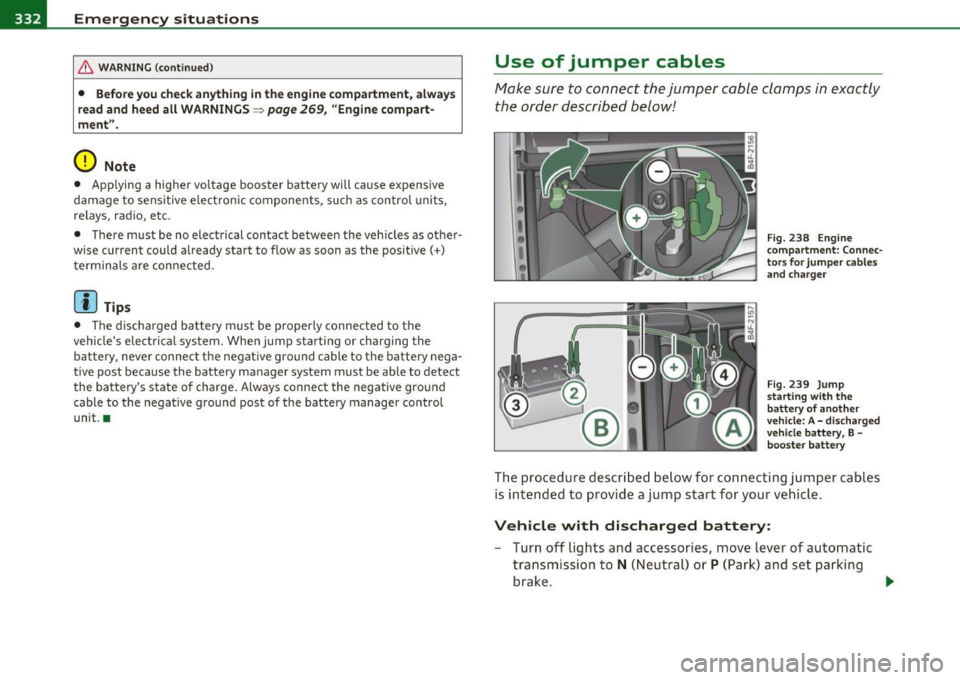
Use of jumper cables
fvfake sure t o con nect the j umpe r ca ble clamps i n ex a ctly
the order describ ed belo w!
Fig. 2 38 Engine
c omp artment : Co nnec
t o rs f or jump er cab les
a nd c harger
Fig. 239 Jump
st art in g wi th the
b att ery of ano th er
v eh icle : A -disch arged
v ehicle batt ery, B -
boo ste r battery
Th e p ra ced u re descri bed belo w for c onn ect ing jump er ca ble s
is int ende d to prov ide a jump star t for your veh icle.
Vehicle with d ischarged battery:
- Tur n off lights and accesso ries, move leve r of automatic
tra nsm ission to
N ( N eutral) o r P (P ark) and set pa rking
b rake.
~