Page 195 of 297

04 Comfort and driving pleasure
Blind Spot Information System*04
}}
* Option/accessory, for more information, see Introduction. 193
Introduction
BLIS camera
Indicator light
BLIS symbol
The Blind Spot Information System (BLIS) is an
information system that indicates the presence
of another vehicle moving in the same direction
as your vehicle in the side-view mirror\fs "blind
area."
CAUTION The BLIS system should only be repaired by
a trained and qualified Volvo service tech-
nician.
WARNING \b
BLIS is an information system, NOT a
warning or safety system.
\b BLIS does not eliminate the need for
you to visually confirm the conditions
around you, and the need for you to turn
your head and shoulders to make sure
that you can safely change lanes.
\b As the driver, you have full responsibility
for changing lanes in a safe manner. The system is based on digital camera tech-
nology. The cameras are located beneath the
side-view mirrors.
When one (or both) of the cameras have
detected a vehicle in the blind area (up to
approximately 10 ft. (3 meters) from the side of
your vehicle, and up to approximately 31 ft.
(9.5 meters) behind the side-view mirror), see
the illustration, the indicator light in the door
panel illuminates. The light will glow continu-
ously to alert the driver of the vehicle in the
blind area.NOTE The door panel indicator light illuminates on
the side of the vehicle where the system has
detected another vehicle. If your vehicle is
passed on both sides at the same time, both
lights will illuminate.
BLIS has an integrated function that alerts the
driver if a fault should occur with the system.
For example, if one or both of the system\fs
cameras are obscured, a message (see the
table on page 196) will appear in the informa-
tion display in the instrument panel. If this
occurs, clean the camera lenses. If necessary,
the system can be temporarily switched off (for
instructions, see page 195).
Areas monitored by BLIS Distance A = approx.
31 ft. (9.5 meters), Distance B = approx. 10 ft.
(3 meters) G031404 G01783
4
Page 230 of 297

06 Maintenance and specificationsEngine oil 06
228 Checking the engine oil
The oil level should be checked every time the
vehicle is refueled. This is especially important
during the period up to the first scheduled
maintenance service.
\b
See page 283 for oil specifications.
\b Refer to the Warranty and Service Records
Information booklet for information on the
oil change intervals.
Volvo recommends Castrol oil products.
CAUTION \b
Not checking the oil level regularly can
result in serious engine damage if the oil
level becomes too low.
\b Oil that is lower than the specified qual-
ity can damage the engine.
\b Volvo does not recommend the use of
oil additives.
\b Always add oil of the same type and
viscosity as already used.
\b Never fill oil above the
MAX mark. This
could cause an increase in oil consump-
tion.
Checking and adding oil Location of the filler cap and dipstick
NOTE
Before checking the oil:
\b
The car should be parked on a level sur-
face when the oil is checked.
\b If the engine is warm, wait for at least
10 – 15 minutes after the engine has
been switched off before checking the
oil. The oil level must be between the MIN and MAX
marks on the dipstickChecking the oil1.
Pull out the dipstick and wipe it with a lint-
free rag.
2. Reinsert the dipstick, pull it out, and check
the oil level. The level must be between the
MIN and MAX marks.
3. Add oil if necessary. If the level is close to the MIN mark, add approximately
0.5 US quarts (0.5 liters) of oil.
4. Recheck the level and add more oil if nec-
essary until the level is near the MAX mark. G031914 G02173
7
Page 249 of 297
06 Maintenance and specifications
Fuses06
}}
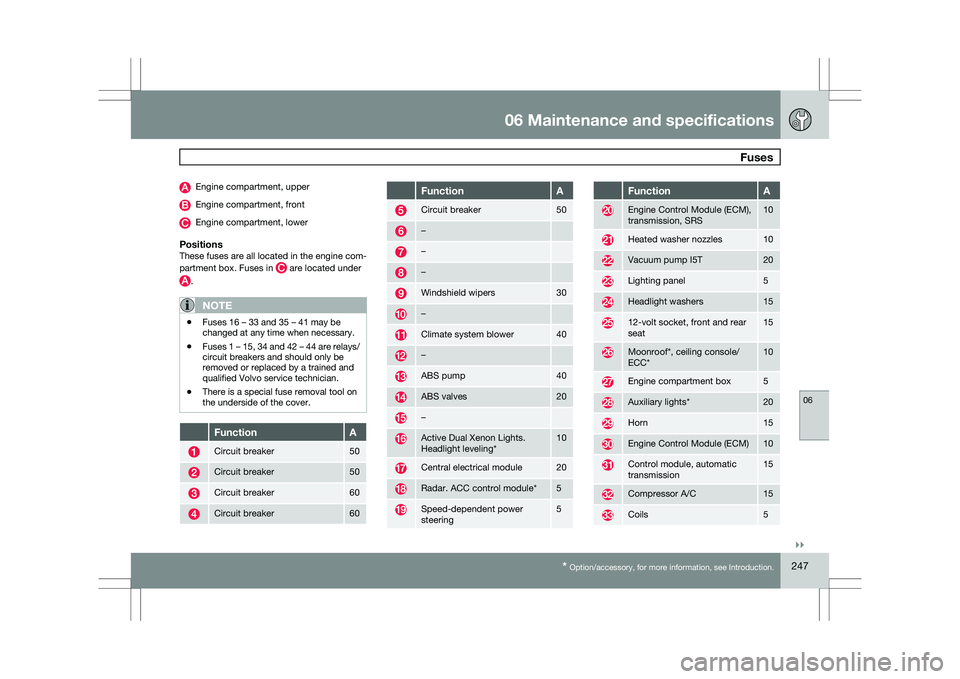
* Option/accessory, for more information, see Introduction. 247Engine compartment, upper
Engine compartment, front
Engine compartment, lower
PositionsThese fuses are all located in the engine com-
partment box. Fuses in
are located under
.
NOTE
\b
Fuses 16 – 33 and 35 – 41 may be
changed at any time when necessary.
\b Fuses 1 – 15, 34 and 42 – 44 are relays/
circuit breakers and should only be
removed or replaced by a trained and
qualified Volvo service technician.
\b There is a special fuse removal tool on
the underside of the cover. Function A
Circuit breaker 50
Circuit breaker 50
Circuit breaker 60
Circuit breaker 60 Function A
Circuit breaker 50
–
–
–
Windshield wipers 30
–
Climate system blower 40
–
ABS pump 40
ABS valves 20
–
Active Dual Xenon Lights.
Headlight leveling
* 10
Central electrical module 20
Radar. ACC control module* 5
Speed-dependent power
steering 5 Function A
Engine Control Module (ECM),
transmission, SRS 10
Heated washer nozzles 10
Vacuum pump I5T 20
Lighting panel 5
Headlight washers 15
12-volt socket, front and rear
seat 15
Moonroof*, ceiling console/
ECC* 10
Engine compartment box 5
Auxiliary lights* 20
Horn 15
Engine Control Module (ECM) 10
Control module, automatic
transmission 15
Compressor A/C 15
Coils 5
Page 275 of 297

06 Maintenance and specifications
Wheels and tires06
273
WARNINGIncorrect inflation pressure could lead to tire
failure, resulting in a loss of control of the
vehicle.
Changing wheels with TPMSPlease note the following when changing or
replacing the factory installed TPMS wheels/
tires on the vehicle:
\b
Only the factory-mounted wheels are
equipped with TPMS sensors in the valves.
\b If the vehicle is equipped with a temporary
spare tire, this tire does not have a TPMS
sensor.
\b If wheels without TPMS sensors are moun-
ted on the vehicle, TIRE PRESS SYST
SERVICE REQUIRED will be displayed
each time the vehicle is driven above
25 mph (40 km/h) for 10 minutes or more.
\b Once TPMS sensors are properly installed,
the warning message should not reappear.
If the message is still displayed, drive the
vehicle for several minutes at a speed of
20 mph (30 km/h) or faster to erase the
message.
\b Volvo recommends that TPMS sensors be
fitted on all wheels used on the vehicle.
Volvo does not recommend moving sen-
sors back and forth between sets of
wheels.
NOTE \b
If you change to tires with a different
recommended inflation pressure, the
TPMS system must be recalibrated to
these tires. This must be done by a
trained and qualified Volvo service tech-
nician.
\b If a tire is changed, or if the TPMS sen-
sor is moved to another wheel, the sen-
sor\fs seal, nut, and valve core should be
replaced.
\b When installing TPMS sensors, the
vehicle must be parked for at least
15 minutes with the ignition off. if the
vehicle is driven within 15 minutes, a
TPMS error message will be displayed.
CAUTION When inflating tires with TPMS valves, press
the pump\fs mouthpiece straight onto the
valve to help avoid bending or otherwise
damaging the valve.
Page:
< prev 1-8 9-16 17-24