2009 VOLVO XC60 height
[x] Cancel search: heightPage 16 of 297
01 SafetySeat belts 01
14 General information
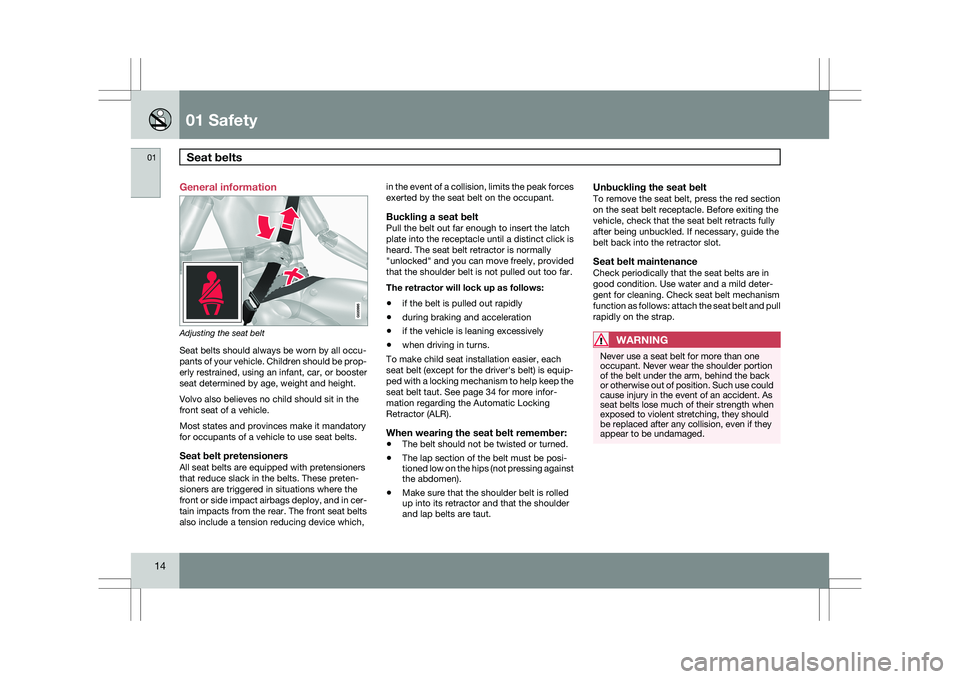
Adjusting the seat belt
Seat belts should always be worn by all occu-
pants of your vehicle. Children should be prop-
erly restrained, using an infant, car, or booster
seat determined by age, weight and height.
Volvo also believes no child should sit in the
front seat of a vehicle.
Most states and provinces make it mandatory
for occupants of a vehicle to use seat belts.
Seat belt pretensionersAll seat belts are equipped with pretensioners
that reduce slack in the belts. These preten-
sioners are triggered in situations where the
front or side impact airbags deploy, and in cer-
tain impacts from the rear. The front seat belts
also include a tension reducing device which, in the event of a collision, limits the peak forces
exerted by the seat belt on the occupant.
Buckling a seat beltPull the belt out far enough to insert the latch
plate into the receptacle until a distinct click is
heard. The seat belt retractor is normally
"unlocked" and you can move freely, provided
that the shoulder belt is not pulled out too far.
The retractor will lock up as follows:
\b
if the belt is pulled out rapidly
\b during braking and acceleration
\b if the vehicle is leaning excessively
\b when driving in turns.
To make child seat installation easier, each
seat belt (except for the driver\fs belt) is equip-
ped with a locking mechanism to help keep the
seat belt taut. See page 34 for more infor-
mation regarding the Automatic Locking
Retractor (ALR).
When wearing the seat belt remember:
\b The belt should not be twisted or turned.
\b The lap section of the belt must be posi-
tioned low on the hips (not pressing against
the abdomen).
\b Make sure that the shoulder belt is rolled
up into its retractor and that the shoulder
and lap belts are taut.
Unbuckling the seat beltTo remove the seat belt, press the red section
on the seat belt receptacle. Before exiting the
vehicle, check that the seat belt retracts fully
after being unbuckled. If necessary, guide the
belt back into the retractor slot.
Seat belt maintenanceCheck periodically that the seat belts are in
good condition. Use water and a mild deter-
gent for cleaning. Check seat belt mechanism
function as follows: attach the seat belt and pull
rapidly on the strap.
WARNING Never use a seat belt for more than one
occupant. Never wear the shoulder portion
of the belt under the arm, behind the back
or otherwise out of position. Such use could
cause injury in the event of an accident. As
seat belts lose much of their strength when
exposed to violent stretching, they should
be replaced after any collision, even if they
appear to be undamaged.
Page 21 of 297

01 Safety
Supplemental Restraint System (SRS)01
}}
19
Front airbag deployment
\b
The front airbags are designed to deploy
during certain frontal or front-angular col-
lisions, impacts, or decelerations, depend-
ing on the crash severity, angle, speed and
object impacted. The airbags may also
deploy in certain non-frontal collisions
where rapid deceleration occurs.
\b The SRS sensors, which trigger the front
airbags, are designed to react to both the
impact of the collision and the inertial
forces generated by it, and to determine if
the intensity of the collision is sufficient for
the seat belt pretensioners and/or airbags
to be deployed.
However, not all frontal collisions activate the
front airbags.
\b If the collision involves a nonrigid object
(e.g., a snow drift or bush), or a rigid, fixed
object at a low speed, the front airbags will
not necessarily deploy.
\b Front airbags do not normally deploy in a
side impact collision, in a collision from the
rear or in a rollover situation.
\b The amount of damage to the bodywork
does not reliably indicate if the airbags
should have deployed or not.WARNING \b
Do not use child safety seats or child
booster cushions/backrests in the front
passenger\fs seat. We also recommend
that occupants under 4 feet 7 inches
(140 cm) in height who have outgrown
these devices sit in the rear seat with the
seat belt fastened 1
.
\b Never drive with the airbags deployed.
The fact that they hang out can impair
the steering of your vehicle. Other
safety systems can also be damaged.
\b The smoke and dust formed when the
airbags are deployed can cause skin
and eye irritation in the event of pro-
longed exposure. Should you have questions about any compo-
nent in the SRS system, please contact a
trained and qualified Volvo service technician
or Volvo Customer Support:
In the USA
Volvo Cars of North America, LLC
Customer Care Center
P.O. Box 914 Rockleigh, New Jersey
07647-09141-800-458-1552
www.volvocars.us
In Canada
Volvo Cars of Canada Corp.
National Customer Service
175 Gordon Baker Road
North York, Ontario M2H 2N7
1-800-663-8255
www.volvocanada.com
1
See also the Occupant Weight Sensor information
on page 22.
Page 35 of 297
01 Safety
Child safety01
}}
33
Children should be seated safely
Volvo recommends the proper use of restraint
systems for all occupants including children.
Remember that, regardless of age and size, a
child should always be properly restrained in a
vehicle.
Your vehicle is also equipped with ISOFIX/
LATCH attachments, which make it more con-
venient to install child seats.
Some restraint systems for children are
designed to be secured in the vehicle by lap
belts or the lap portion of a lap-shoulder belt.
Such child restraint systems can help protect
children in vehicles in the event of an accident
only if they are used properly. However, chil-
dren could be endangered in a crash if the child
restraints are not properly secured in the vehi-
cle. Failure to follow the installation instructions
for your child restraint can result in your child
striking the vehicle\fs interior in a sudden stop.
Holding a child in your arms is NOT a suitable
substitute for a child restraint system. In an
accident, a child held in a person\fs arms can
be crushed between the vehicle\fs interior and
an unrestrained person. The child could also be
injured by striking the interior, or by being ejec-
ted from the vehicle during a sudden maneuver
or impact. The same can also happen if the
infant or child rides unrestrained on the seat.
Other occupants should also be properly
restrained to help reduce the chance of injuring
or increasing the injury of a child.
All states and provinces have legislation gov-
erning how and where children should be car-
ried in a vehicle. Find out the regulations exist-
ing in your state or province. Recent accident
statistics have shown that children are safer in
rear seating positions than front seating posi-
tions when properly restrained. A child restraint
system can help protect a child in a vehicle.
Here\fs what to look for when selecting a child
restraint system:
It should have a label certifying that it meets
applicable Federal Motor Vehicle Safety
Standards (FMVSS 213) – or in Canada,
CMVSS 213.
Make sure the child restraint system is
approved for the child\fs height, weight and
development – the label required by the stand-
ard or regulation, or instructions for infant
restraints, typically provide this information.
In using any child restraint system, we urge you
to carefully look over the instructions that are
provided with the restraint. Be sure you under-
stand them and can use the device properly
and safely in this vehicle. A misused child
restraint system can result in increased injuries
for both the infant or child and other occupants
in the vehicle.
When a child has outgrown the child safety
seat, you should use the rear seat with the
standard seat belt fastened. The best way to
help protect the child here is to place the child
on a cushion so that the seat belt is properly
located on the hips (see the illustration
on page
35). Legislation in your state or province may
mandate the use of a child seat or cushion in
combination with the seat belt, depending on
the child\fs age and/or size. Please check local
regulations.
A specially designed and tested booster cush-
ion can be obtained from your Volvo retailer.
USA: for children weighing 33 – 80 lbs.
(15 – 36 kg) and 38 – 54 inches (97 – 137 cm)
in height
Canada: for children weighing 40 – 80 lbs.
(18 – 36 kg) and 40 – 54 inches (102 – 137 cm)
in height
Page 36 of 297
01 SafetyChild safety 01
34
WARNING \b
Do not use child safety seats or child
booster cushions/backrests in the front
passenger\fs seat. We also recommend
that children under 4 feet 7 inches
(140 cm) in height who have outgrown
these devices sit in the rear seat with the
seat belt fastened.
\b On hot days, the temperature in the
vehicle interior can rise very quickly.
Exposure to these high temperatures
for even a short period of time can
cause heat-related injury or death.
Small children are particularly at risk. Automatic Locking Retractor/
Emergency Locking Retractor (ALR/
ELR)
To make child seat installation easier, each
seat belt (except for the driver\fs belt) is equip-
ped with a locking mechanism to help keep the
seat belt taut.
When attaching the seat belt to a child
seat:
1. Attach the seat belt to the child seat
according to the child seat manufacturer\fs
instructions.
2. Pull the seat belt out as far as possible. 3. Insert the seat belt latch plate into the
buckle (lock) in the usual way.
4. Release the seat belt and pull it taut around
the child seat.
A sound from the seat belt retractor will be
audible at this time and is normal. The belt will
now be locked in place. This function is auto-
matically disabled when the seat belt is
unlocked and the belt is fully retracted.
WARNING Do not use child safety seats or child
booster cushions/backrests in the front
passenger\fs seat. We also recommend that
children who have outgrown these devices
sit in the rear seat with the seat belt properly
fastened.
Volvo\fs recommendationsWhy does Volvo believe that no child should sit
in the front seat of a vehicle? It\fs quite simple
really. A front airbag is a very powerful device
designed, by law, to help protect an adult.
Because of the size of the airbag and its speed
of inflation, a child should never be placed in
the front seat, even if he or she is properly bel-
ted or strapped into a child safety seat. Volvo
has been an innovator in safety for over sev-
enty-five years, and we\fll continue to do our
part. But we need your help. Please rememberto put your children in the back seat, and
buckle them up.
Volvo has some very specific
recommendations:
\b
Always wear your seat belt.
\b Airbags are a SUPPLEMENTAL safety
device which, when used with a three-
point seat belt can help reduce serious
injuries during certain types of accidents.
Volvo recommends that you do not dis-
connect the airbag system in your vehicle.
\b Volvo strongly recommends that everyone
in the vehicle be properly restrained.
\b Volvo recommends that ALL occupants
(adults and children) shorter than 4 feet
7 inches (140 cm) be seated in the back
seat of any vehicle with a front passenger
side airbag.
Drive safely!
Page 47 of 297
01 Safety
Integrated booster cushion01
}}
* Option/accessory, for more information, see Introduction. 45
Integrated two-stage booster
cushion*
1
Volvo\fs optional integrated booster cushions
are located in the outboard seating positions.
These booster cushions have been specially
designed to help safeguard children in the rear
seat. They should be stowed (folded down into
the seat cushion) when not in use. When using
an integrated booster cushion, the child must
be secured with the vehicle\fs three-point seat
belt.
Use these booster cushions only with
children whose weight is between:
\b Stage 1: 48 – 80 lbs (22 – 36 kg)
\b Stage 2: 33 – 55 lbs 15 – 25 kg
and whose height is between:
\b Stage 1: 45 – 55 in. (115 – 140 cm)
\b Stage 2: 37 – 47 in. (95 – 120 cm)
In Canada, Transport Canada\fs
weight recommendation is 40 – 80 lbs
(18 – 36 kg).
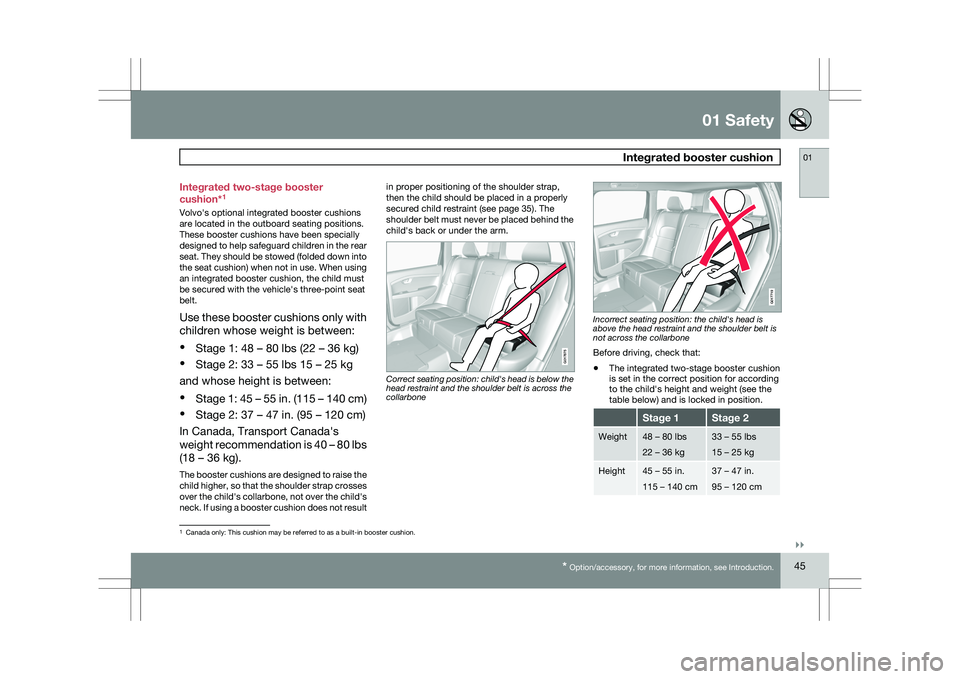
The booster cushions are designed to raise the
child higher, so that the shoulder strap crosses
over the child\fs collarbone, not over the child\fs
neck. If using a booster cushion does not result in proper positioning of the shoulder strap,
then the child should be placed in a properly
secured child restraint (see page 35). The
shoulder belt must never be placed behind the
child\fs back or under the arm.
Correct seating position: child's head is below the
head restraint and the shoulder belt is across the
collarbone Incorrect seating position: the child's head is
above the head restraint and the shoulder belt is
not across the collarbone
Before driving, check that:
\b
The integrated two-stage booster cushion
is set in the correct position for according
to the child\fs height and weight (see the
table below) and is locked in position. Stage 1 Stage 2
Weight 48 – 80 lbs
22 – 36 kg 33 – 55 lbs
15 – 25 kg
Height 45 – 55 in.
115 – 140 cm 37 – 47 in.
95 – 120 cm
1
Canada only: This cushion may be referred to as a built-in booster cushi\
on. G017875 G017719
Page 49 of 297
01 Safety
Integrated booster cushion01
47
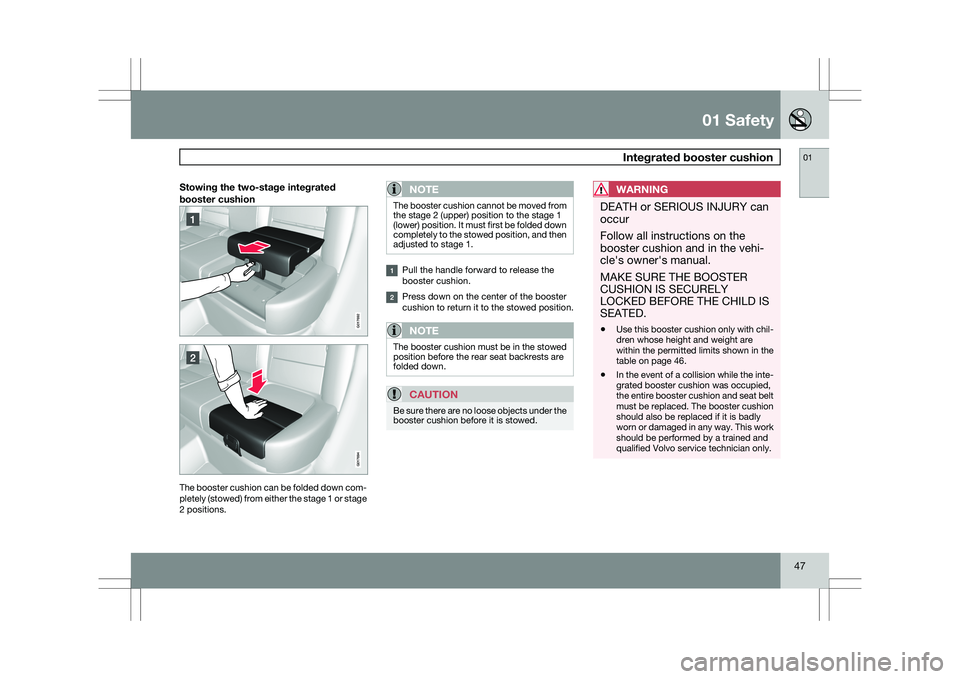
Stowing the two-stage integrated
booster cushionThe booster cushion can be folded down com-
pletely (stowed) from either the stage 1 or stage
2 positions.NOTE The booster cushion cannot be moved from
the stage 2 (upper) position to the stage 1
(lower) position. It must first be folded down
completely to the stowed position, and then
adjusted to stage 1.
Pull the handle forward to release the
booster cushion.
Press down on the center of the booster
cushion to return it to the stowed position.
NOTE
The booster cushion must be in the stowed
position before the rear seat backrests are
folded down.
CAUTION
Be sure there are no loose objects under the
booster cushion before it is stowed.
WARNING DEATH or SERIOUS INJURY can
occur
Follow all instructions on the
booster cushion and in the vehi-
cle\fs owner\fs manual.
MAKE SURE THE BOOSTER
CUSHION IS SECURELY
LOCKED BEFORE THE CHILD IS
SEATED.
\b
Use this booster cushion only with chil-
dren whose height and weight are
within the permitted limits shown in the
table on page 46.
\b In the event of a collision while the inte-
grated booster cushion was occupied,
the entire booster cushion and seat belt
must be replaced. The booster cushion
should also be replaced if it is badly
worn or damaged in any way. This work
should be performed by a trained and
qualified Volvo service technician only. G01769
2 G017694
Page 86 of 297

03 Your driving environmentSeats 03
84 \b
The right (passenger\fs side) section can be
folded down together with the center sec-
tion.
\b All three sections can be folded down
together. Release and lower the center head
restraint (see page 83) if the center and/or
right section of the backrest is to be low-
ered. The outboard head restraints fold
down automatically.
Pull up the backrest release control on the
respective section(s) and fold the sec-
tion(s) down.
NOTE
It may be necessary to move the front seats
forward or put their backrests in a more
upright position before folding down the
rear seat backrests.
WARNING \b
When the backrest(s) are returned to the
upright position, check that it is properly
locked in place. The red indicators
should not be visible.
\b Return the outboard head restraints to
the upright position.
\b Long loads should always be securely
anchored to help avoid injury in the
event of a sudden stop.
\b Always turn the engine off and apply the
parking brake when loading/unloading
the vehicle.
\b Place the transmission in the Park (
P)
position to help prevent inadvertent
movement of the gear selector.
\b On hot days, the temperature in the
vehicle interior can rise very quickly.
Exposure of people to these high tem-
peratures for even a short period of time
can cause heat-related injury or death.
Small children are particularly at risk.Rear center head restraint The center head restraint should be adjusted
according to the passenger\fs height. The
restraint should be carefully adjusted to sup-
port the occupant\fs head.
\b
Pull the head restraint up as required.
\b To lower, press and hold the button
(located at the center, between the back-
rest and the head restraint) while pressing
the head restrain down.
WARNING The center rear seat head restraint should
only be in its lowest position when this seat
is NOT occupied. When the center position
is occupied, the head restraint should be
correctly adjusted to the passenger’s
height. G000000
Page 88 of 297

03 Your driving environmentSteering wheel 03
86
* Option/accessory, for more information, see Introduction.
Adjusting
Adjusting the steering wheel
Lever for releasing/locking the steering
wheel
Possible positions
The steering wheel can be adjusted for both
height and reach:
1. Pull the lever toward you to release the steering wheel.
2. Adjust the steering wheel to the position that suits you.
3. Push back the lever to lock the steering wheel in place. If the lever is difficult to
push into place, press the steering wheel
lightly at the same time as you push the
lever.
WARNING Never adjust the steering wheel while driv-
ing.
With speed-dependent power steering* the
level of steering force can be adjusted, see
page 157.
Keypads
Keypads in the steering wheel
Cruise control, see page 158. Adaptive
cruise control*, see page 172.
Audio controls, see page 133.Horn
Horn
–
Press the steering wheel hub to sound the
horn. G02113
8 G031397 G031398