2009 VOLVO XC60 lock
[x] Cancel search: lockPage 268 of 297
06 Maintenance and specificationsWheels and tires 06
266
* Option/accessory, for more information, see Introduction.
WARNING \b
The jack must correctly engage the jack
attachment.
\b Be sure the jack is on a firm, level, non-
slippery surface.
\b Never allow any part of your body to be
extended under a vehicle supported by
a jack.
\b Use the jack intended for the vehicle
when changing a tire. For any other job,
use stands to support the vehicle.
\b Apply the parking brake and put the
gear selector in the Park (
P) position.
\b Block the wheels standing on the
ground, use rigid wooden blocks or
large stones.
\b The jack should be kept well-greased
and clean, and should not be damaged.
\b No objects should be placed between
the base of jack and the ground, or
between the jack and the attachment
bar on the vehicle.
Re-installing the wheel1. Clean the contact surfaces on the wheel
and hub.
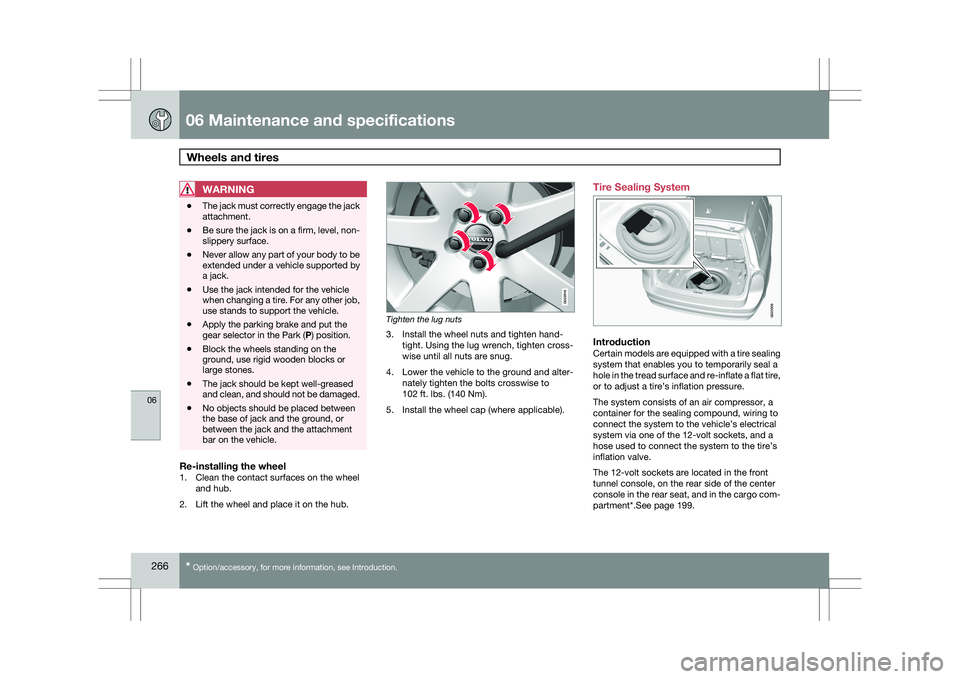
2. Lift the wheel and place it on the hub. Tighten the lug nuts
3. Install the wheel nuts and tighten hand-
tight. Using the lug wrench, tighten cross-
wise until all nuts are snug.
4. Lower the vehicle to the ground and alter- nately tighten the bolts crosswise to
102 ft. lbs. (140 Nm).
5. Install the wheel cap (where applicable). Tire Sealing System
IntroductionCertain models are equipped with a tire sealing
system that enables you to temporarily seal a
hole in the tread surface and re-inflate a flat tire,
or to adjust a tire’s inflation pressure.
The system consists of an air compressor, a
container for the sealing compound, wiring to
connect the system to the vehicle’s electrical
system via one of the 12-volt sockets, and a
hose used to connect the system to the tire’s
inflation valve.
The 12-volt sockets are located in the front
tunnel console, on the rear side of the center
console in the rear seat, and in the cargo com-
partment*.See page 199. G022916 G023309
Page 269 of 297
06 Maintenance and specifications
Wheels and tires06
}}
267
Accessing the tire sealing systemThe tire sealing system is stowed under the
floor of the cargo area. To access it:
1.
Fold up or remove any protective floor cov-
ering or carpet.
2. Open the floor hatch.
3. Remove the retaining screws.
4. Lift out the foam plastic block holding the jack and lug wrench.
5. Lift out the tire sealing system.
NOTE \b
The tire sealing system is only intended
to seal holes on the tire’s tread area, not
the sidewall.
\b Tires with large holes or tears cannot be
repaired with the tire sealing system.
WARNING \b
After using the tire sealing system, the
vehicle should not be driven farther than
approximately 120 miles (200 km).
\b Have the tire inspected by a trained and
qualified Volvo service technician as
soon as possible to determine if it can
be permanently repaired or must be
replaced.
\b The vehicle should not be driven faster
than 50 mph (80 km/h) while using a tire
that has been temporarily repaired with
the tire sealing system.
\b After using the tire sealing system, drive
carefully and avoid abrupt steering
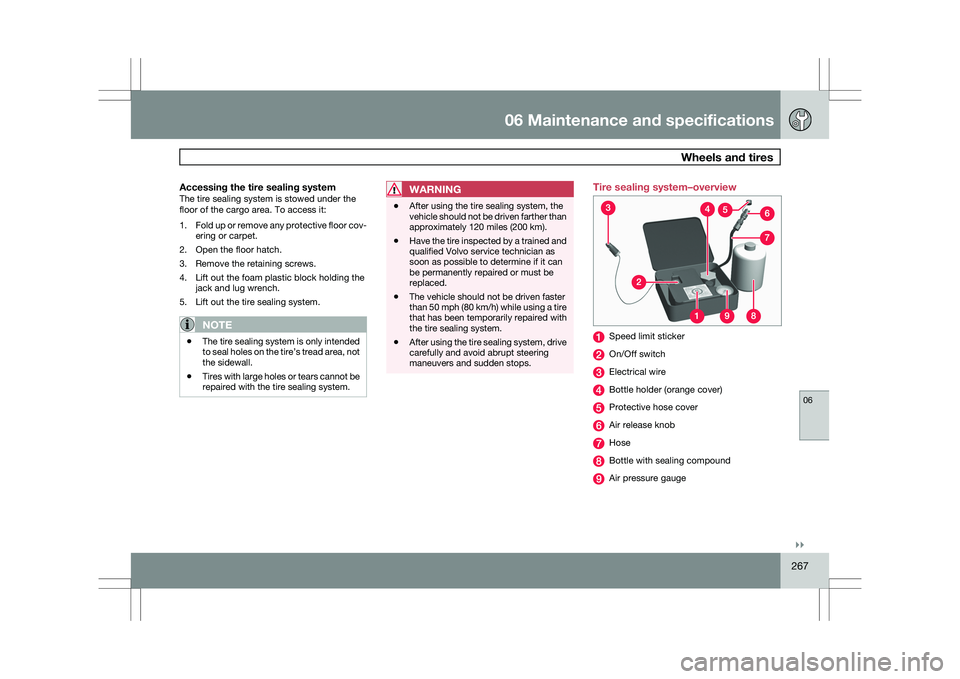
maneuvers and sudden stops. Tire sealing system–overview
Speed limit sticker
On/Off switch
Electrical wire
Bottle holder (orange cover)
Protective hose cover
Air release knob
Hose
Bottle with sealing compound
Air pressure gauge
Page 272 of 297
06 Maintenance and specificationsWheels and tires 06
270
CAUTION The compressor should not be used for
more than 10 minutes at a time to avoid
overheating.
WARNING
If the pressure remains below 22 psi
(1.8 bar) after approximately seven minutes,
turn off the compressor. In this case, the
hole is too large to be sealed and the vehicle
should not be driven.
11.
Switch off the compressor and disconnect
the electrical wire from the 12-volt
socket.
12. Unscrew the hose from the tire’s inflation valve and reinstall the valve cap.
13. Immediately drive the vehicle for approxi- mately 2 miles (3 km) at a maximum speed
of 50 mph (80 km/h) to distribute the seal-
ing compound in the tire.
NOTE \b
Safely stow the tire sealing system in a
convenient place as it will soon be used
again to check the tire’s inflation pres-
sure.
\b The empty bottle of sealing compound
cannot be removed from the bottle
holder. Consult a trained and qualified
Volvo service technician to have the
bottle removed and properly disposed
of.
WARNING If heavy vibrations, unsteady steering
behavior, or noises should occur while driv-
ing, reduce speed and park the vehicle in a
safe place. Recheck the tire for bumps,
cracks, or other visible damage, and
recheck its inflation pressure. If the pressure
is below 19 psi (1.3 bar), do not continue
driving. Have the vehicle towed to a trained
and qualified Volvo service technician.
Stage 2: Checking inflation pressure1. Connect the tire sealing system as descri-
bed in stage 1.
2. Refer to the inflation pressure tablesfor the
correct inflation pressure. If the tire needs
to be inflated, start the tire sealing system’s compressor. If necessary, release air from
the tire by turning the air release knob
counterclockwise.
CAUTION The compressor should not be used for
more than 10 minutes at a time to avoid
overheating.
WARNING
If you interrupt your trip for more than 1
hour, check the inflation pressure in the
damaged tire again before continuing.
Replacing the sealing compound
container
The sealing compound container must be
replaced if:
\b
the tire sealing system has been used to
repair a tire
\b the container’s expiration date has passed
(see the date on decal).
Page 273 of 297

06 Maintenance and specifications
Wheels and tires06
}}
271
NOTE\b
After use, the sealing compound bottle,
the hose, and certain other system
components must be replaced. Please
consult your Volvo retailer for replace-
ment parts.
\b If the sealing compound bottle’s expi-
ration date has passed, please take it to
a Volvo retailer or a recycling station
that can properly dispose of harmful
substances. Inflating tires
The tire sealing system can be used to inflate
the tires. To do so:
1. Park the car in a safe place.
2. The compressor should be switched off.
Ensure that the on/off switch is in position
0 (the 0 side of the switch should be
pressed down).
3. Take out the electrical wire and hose.
4. Remove the valve cap from the tire’s infla-
tion valve and screw the hose connector
onto the valve as tightly as possible by
hand.
5. Connect the electrical wire to the nearest 12-volt socket in the vehicle. 6. Start the vehicle’s engine.
WARNING \b
The vehicle’s engine should be running
when the tire sealing system is used to
avoid battery drain. Therefore, be sure
the vehicle is parked in a well ventilated
place, or outdoors, before using the sys-
tem.
\b Children should never be left unattended
in the vehicle when the engine is running. 7. Check the tire’s inflation pressure on the
gauge. Switch off the compressor briefly to
get a clear reading from the pressure
gauge.
8. Refer to the tire inflation tables for the cor-
rect inflation pressure. If the tire needs to
be inflated, start the tire sealing system’s
compressor (press the on/off switch to
position I). If necessary, release air from the
tire by turning the air release knob coun-
terclockwise.
CAUTION The compressor should not be used for
more than 10 minutes at a time to avoid
overheating. 9. Turn off the compressor (press the on/off
switch to position 0) when the correct infla-
tion pressure has been reached.
10. Unscrew the hose from the tire’s inflation valve and reinstall the valve cap.
11. Disconnect the electrical wire from the 12-volt socket.
Tire Pressure Monitoring System
(TPMS)–U.S models only
NOTE USA – FCC ID: KR5S122780002
This device complies with part 15 of the
FCC rules. Operation is subject to the fol-
lowing conditions: (1) This device may not
cause harmful interference, and (2) this
device must accept any interference
received, including interference that may
cause undesired operation.
The tire pressure monitoring system uses sen-
sors mounted in the tire valves to check infla-
tion pressure levels. When the vehicle is mov-
ing at a speed of approximately 20 mph
(30 km/h) or faster, these sensors transmit
inflation pressure data to a receiver located in
the vehicle.
Page 276 of 297
06 Maintenance and specificationsVehicle care 06
274 Washing the car
WARNING
Be sure that the compressor is not con-
nected to a 12-volt socket while replacing
the container.
The following points should be kept in mind
when washing and cleaning the car:
\b
The car should be washed at regular inter-
vals since dirt, dust, insects and tar spots
adhere to the paint and may cause dam-
age. To help prevent corrosion, it is partic-
ularly important to wash the car frequently
in the wintertime.
\b Avoid washing your car in direct sunlight.
Doing so may cause detergents and wax
to dry out and become abrasive. To avoid
scratching, use lukewarm water to soften
the dirt before you wash with a soft
sponge, and plenty of sudsy water.
\b Bird droppings: Remove from paintwork
as soon as possible. Otherwise the finish
may be permanently damaged.
\b A detergent can be used to facilitate the
softening of dirt and oil.
\b A water-soluble grease solvent may be
used in cases of sticky dirt. However, use
a wash place equipped with a drainage
separator. \b
Dry the car with a clean chamois and
remember to clean the drain holes in the
doors and rocker panels.
\b Tar spots can be removed with kerosene
or tar remover after the car has been
washed.
\b A stiff-bristle brush and lukewarm soapy
water can be used to clean the wiper
blades. Frequent cleaning of the wind-
shield and wiper blades improves visibility
considerably and also helps prolong the
service life of the wiper blades.
\b Wash off the dirt from the underside (wheel
housings, fenders, etc).
\b In areas of high industrial fallout, more fre-
quent washing is recommended.
\b After cleaning the engine, the spark plug
wells should be inspected for water and
blown dry if necessary.
NOTE When washing the car, remember to remove
dirt from the drain holes in the doors and
sills.
CAUTION \b
During high pressure washing, the
spray mouthpiece must never be closer
to the vehicle than 13" (30 cm). Do not
spray into the locks.
\b Dirt, snow, etc., on the headlights can
reduce lighting capacity considerably.
Clean the headlights regularly, for
example when refueling.
\b When washing or steam cleaning the
engine, avoid spraying water or steam
directly on the electrical components or
toward the rear side of the engine. Spe-
cial moonroof cautions:
\b Always close the moonroof and sun
shade before washing your vehicle.
\b Never use abrasive cleaning agents on
the moonroof.
\b Never use wax on the rubber seals
around the moonroof.
Exterior componentsVolvo recommends the use of special cleaning
products, available at your Volvo retailer, for
cleaning colored plastic, rubber, or ornamental
components such as chromed strips on the
exterior of your vehicle. The instructions for
using these products should be followed care-
Page 288 of 297
06 Maintenance and specificationsSpecifications 06
286 Electrical system
General information12 volt system with a voltage-regulated alter-
nator. Single pole system in which the chassis
and engine block are used as conductors. The
negative terminal is connected to the chassis.
Performance, battery
Engine 3.0T
Voltage (V) 12
Cold start capacity (A) 520 – 700
Reserve capacity (min) 100 – 135
WARNING
PROPOSITION 65 WARNING!
Battery posts, terminals, and related acces-
sories contain lead and lead compounds,
chemicals known to the state of California
to cause cancer and reproductive harm.
Wash hands after handling.
CAUTION
If the battery is replaced, replace it with a
battery of the same cold start capacity and
reserve capacity as the original (see the
decal on the battery).
Page 290 of 297

07 Index07
288 1, 2, 3 ...
12-volt sockets
........................................ 199
A Accessory installation warning
.................... 8
Active chassis system .............................157
Active yaw control ................................... 155
Adaptive cruise control ....172, 173, 174, 175
Airbags disconnecting the front passenger’s
side................................................. 22, 23
front.......................................... 18, 19, 20
inflatable curtain ................................... 28
side impact........................................... 26
Air conditioning ........................................ 129
Air distribution..........................................
127
Air distribution table................................. 131
Air vents................................................... 127
All Wheel Drive ......................................... 111
Anti-freeze ....................................... 204, 230
Anti-lock brake system ............................112
warning light ......................................... 74Approach lighting................................. 52, 92
Audio system
audio functions ................................... 136
CD player/changer
...................... 144, 145
Digital Audio Broadcasting (DAB) .......140
HD digital radio ................................... 139
menu control....................................... 135
overview.............................................. 133
radio functions .................................... 138
Sirius satellite radio ............141, 143, 144
sound settings .................................... 136
steering wheel keypad ........................133
USB/iPod® connector ........................134
Auto-dim rearview mirror ...........................99
Automatic locking retractor .......................34
Automatic transmission Geartronic ................................... 109, 110
general description .....................109, 110
oil ........................................................ 285
shiftlock override ................................ 110
Axle weight .............................................. 261B Battery
changing ..................................... 242, 243
maintenance ....................................... 242
remote control, replacing .....................56
specifications ...................................... 286
warning symbols.................................
242
Black box............................................. 7, 224
Blind Spot Information System
(BLIS)....................................... 193, 194, 195
Booster cushion, integrated ......................45
Booster cushions ....................................... 41
Brake lights ................................................ 88
emergency brake lights ........................88
Brake system checking fluid level ............................. 230
emergency brake assistance ..............113
fluid..................................................... 285
general information ............................. 112
Hill Descent Control ............................114
warning light ......................................... 76
Bulbs cargo area lighting .............................. 237
footwell lighting................................... 237
headlights ................................... 232, 234
Page 291 of 297

07 Index07
289
introduction......................................... 232
license plate lights
.............................. 237
side marker lights ............................... 235
specifications ...................................... 238
taillight ................................................ 236
C Camera, Park Assist................................
190
Capacity weight ....................................... 261
Cargo area changing bulbs ................................... 237
steel grid............................................. 213
Cargo area cover ..................................... 214
Cargo area net ......................................... 214
Catalytic converter ................................... 208
CD player/changer ...........................144, 145
Cell phone, hands-free connection .........147
Central locking system, introduction .........50
Chains ...................................................... 262
Check engine light ..................................... 74
Child restraints recalls and registration .........................44Child restraint systems
..............................35
booster cushions .................................. 41
convertible seats .................................. 39
infant seats........................................... 37
ISOFIX/LATCH anchors ........................42
top tether anchors ................................ 43
Child safety.......................................... 33, 34
booster cushions .................................. 41
child restraint systems ..........................35
convertible seats .................................. 39
infant seats........................................... 37
Child safety locks ...................................... 65
City Safety™............................................ 166
Climate system ........................................ 130
air distribution ............................. 127, 131
air vents.............................................. 127
Interior Air Quality System.................. 127
introduction
......................................... 126
passenger compartment filter ............126
refrigerant ........................................... 126
Clock, setting ............................................. 78
Cold weather driving ................................ 204
Collision warning system .........................160
Compass in rearview mirror .....................154
Conserving electrical current ...................203
Convertible seats ....................................... 39Coolant
............................................ 230, 285
Cooling system, general information .......203
Courtesy lighting .................................. 90, 91
Crash mode............................................... 32
Cruise control .................................. 158, 159
adaptive...................... 172, 173, 174, 175
Curb weight............................................. 261
Current, conserving ................................. 203
D Defroster..................................................
130
Detachable key blade................................ 55
Digital Audio Broadcasting (DAB) ............140
Dimensions .............................................. 281
Disconnecting the front passenger’s air-
bag....................................................... 22, 23
Dome lighting ....................................... 90, 91
Door mirrors ............................................... 98
Driver distraction warning ............................ 8
Driving economically
................................ 202
Driving in cold weather ............................204
Driving through water ..............................203