Page 40 of 402
26
1-1. Key information
Keys
The following keys are provided with the vehicle.
Vehicles without engine immobilizer system
Master keys
Key number plate
Vehicles with engine immobilizer system (type A) Master keys (with wireless
remote control function)
Operating the wireless remote
control function (→P. 2 8)
Va l e t k e y
Key number plate
Vehicles with engine immobilizer system (type B) Master keys
Va l e t k e y
Key number plate
Page 41 of 402
27
1-1. Key information
1
Before driving
n
Key number plate
Keep the plate in a safe place such as your wallet, not in the vehicle. In the
event that a key is lost, a new key can be made by your Toyota dealer using
the key number plate. ( →P. 332)
NOTICE
nTo prevent key damage (vehicles with engine immobilizer system)
l Do not subject the keys to strong shocks, expose them to high tempera-
tures by placing them in direct sunlight, or get them wet.
l Do not expose the keys to electromagnetic materials or attach any mate-
rial that blocks electromagnetic waves to the key surface.
Page 88 of 402
74
1-6. Theft deterrent system
Engine immobilizer system (if equipped)
nSystem maintenance
The vehicle has a maintenance-free type of engine immobilizer system.
n Conditions that may
cause the system to malfunction
l If the
key is in contact with a metallic object
lIf
the key is in close proximity to or touching a key to the security system
(key with a built-in transponder chip) of another vehicle
n Certifications for the engine immobilizer system
For vehicles sold in U.S.A.
FCC ID: MOZRI-20BTY
This device complies with Part 15 of the FCC Rules. Operation is subject to
the followin
g two conditions: (1) This device may not cause harmful interfer -
ence, and (2) this device must accept any interference received, including
interference that may cause undesire
d operation.
FCC WARNING:
Changes or modifications not expressly approved by the party responsible
for complia
nce could void the user’s authority to operate the equipment.
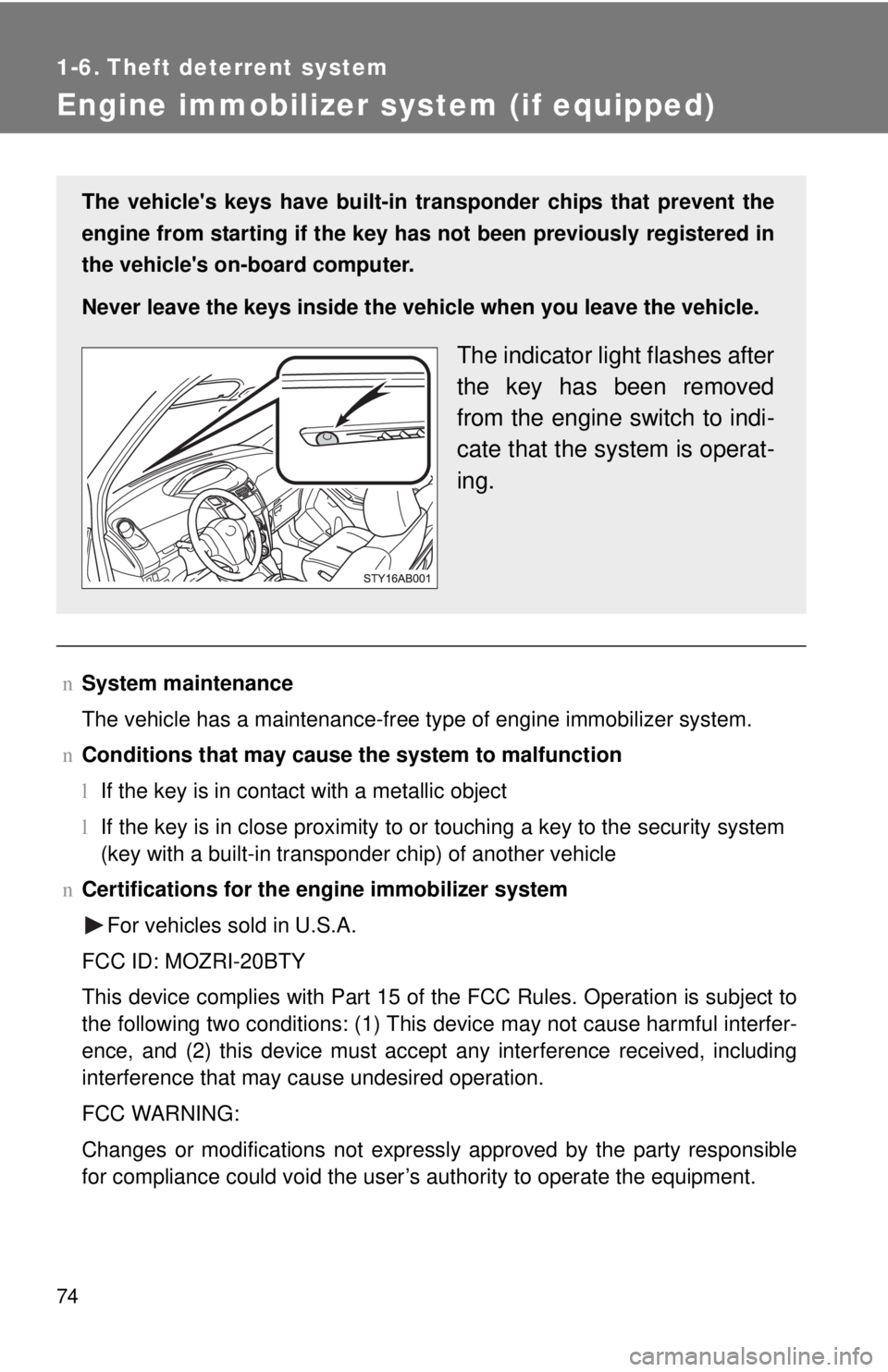
The vehicle's keys have built-in tran sponder chips that prevent the
engine from starting if the key has not been previously registered in
the vehicle's on-board computer.
Never leave the keys inside the vehicle when you leave the vehicle.
The indicator light flashes after
the key has been removed
from the engine switch to indi -
cate that the system is operat-
ing.
Page 89 of 402
75
1-6. Theft deterrent system
1
Before driving
For vehicles sold in Canada
This device complies with RSS-210 of Industry Canada. Operation is subject
to the following two conditions: (1) This device may not cause interference,
and (2) this device must accept any interference, including interference that
may cause undesired operation of the device.
NOTICE
n To prevent damage to the key
Do not modify, remove or disable the engine immobilizer system. If any
unauthorized changes or modifications are made, the proper operation of
the system cannot be guaranteed.
Page 139 of 402
126 2-1. Driving procedures
nTurning the key from ACC to LOCK
n S
teering lock release
nIf the engine does not st
art (vehicles with engine immobilizer system)
The engine immobilizer system may not have been deactivated. ( →P
. 74)
Manual transmission
Check that the parking brake is set.
Check that the shift lever is set in N. Firmly depress the brake pedal and clutch pedal.
Turn the engine switch to the START position and start the engine.
The engine will crank until it starts or for up to 20 seconds, which -
ever is less.
Continue depressing the brake pedal and clutch pedal until the
engine is completely st
arted.
Shift the shift lever to P (auto-
matic transmission) or N (man-
ual transmission).
(→P. 128, 130)
Push in the key and turn to the
LOCK position.
When starting the engine, the engine
switch may seem stuck in the LOCK posi-
tion. To free it, turn the key while turning
the steering wheel slightly in either direc-
tion.
Page 292 of 402
281
4-3. Do-it-yourself maintenance
4
Maintenance and care
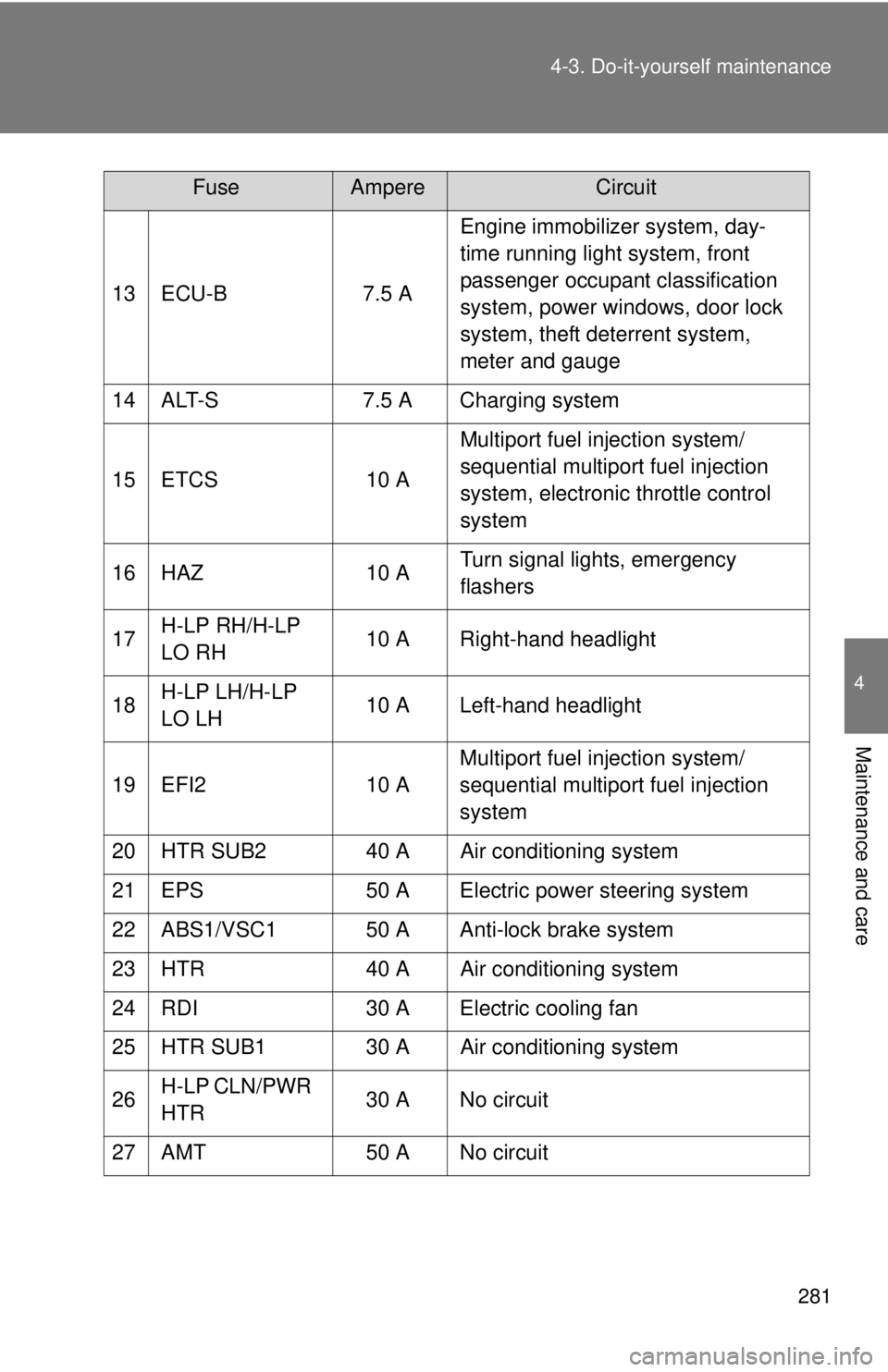
13 ECU-B
7.5 AEngine immobilizer system, day-
time running light system, front
passenger occupant classification
system, power windows, door lock
system, theft deterrent system,
meter and gauge
14 ALT-S 7.5 A Charging system
15 ETCS 10 AMultiport fuel injection system/
sequential multiport fuel injection
system, electronic throttle control
system
16 HAZ 10 ATurn signal lights, emergency
flashers
17 H-LP RH/H-LP
LO RH 10 A Right-hand headlight
18 H-LP LH/H-LP
LO LH 10 A Left-hand headlight
19 EFI2 10 AMultiport fuel injection system/
sequential multiport fuel injection
system
20 HTR SUB2 40 A Air conditioning system
21 EPS 50 A Electric power steering system
22 ABS1/VSC1 50 A Anti-lock brake system
23 HTR 40 A Air conditioning system
24 RDI 30 A Electric cooling fan
25 HTR SUB1 30 A Air conditioning system
26 H-LP CLN/PWR
HTR 30 A No circuit
27 AMT 50 A No circuit
FuseAmpereCircuit
Page 295 of 402

284 4-3. Do-it-yourself maintenance
9 ID/UP/MIR HTR 10 AMultiport fuel injection system/
sequential multiport fuel injection
system, outside rear view mirror
control, outside rear view mirror
heaters
10 IGN 7.5 A Multiport fuel injection system/
sequential multiport fuel injection
system, engine immobilizer sys-
tem, SRS airbag system, front pas-
senger occupant classification
system
11 MET 7.5 A Meter and gauge
12 WIP 25 A Windshield wiper
13 RR WIP 15 A Rear wiper
14 WSH 15 A Windshield washer
15 ECU-IG 10 A Daytime running light system, anti-
lock brake system, electric power
steering system, power windows,
door lock system, theft deterrent
system, electric cooling fan
16 GAUGE 10 A Charging system, turn signal lights,
emergency flashers, buck-up
lights, instrument panel light con-
trol, shift lock system, rear window
defogger, air conditioning system,
automatic transmission system
17 OBD2 7.5 A On-board diagnosis system
18 STOP 10 A Stop lights, high mounted stop-
light, multiport fuel injection sys-
tem/sequential multiport fuel
injection system, shift lock system,
anti-lock brake system
19 D/L 25 A Door lock system
20 FR FOG 15 A Front fog lights
FuseAmpereCircuit
Page 339 of 402
5
When trouble arises
329
5-2. Steps to take in an emergency
If the engine will not start
If the engine still does not start after following the correct starting
procedure ( →
P. 125) or releasing the steering lock ( →P. 126), confirm
the following points.
n The engine will not start even when the starter motor oper -
ates normally.
One of the following may be the cause of the problem.
l There
may not be sufficient fuel in the vehicle’s tank.
Refuel the vehicle.
l The eng
ine may be flooded.
Try to restart the engine once more following correct starting
pro
cedures. ( →P. 125 )
l V
ehicles with engine immobilizer system: There may be a
malfunction in the engine immobilizer system.
( → P. 7 4 )
n The
starter motor turns over slowly, the interior lights and
headlights are dim, or the horn does not sound or sounds at
a low volume.
One of the following may be the cause of the problem.
lThe battery
may be discharged. (→ P. 333)
l The
battery terminal connec tions may be loose or corroded.