Page 426 of 592
426
4-2. Maintenance
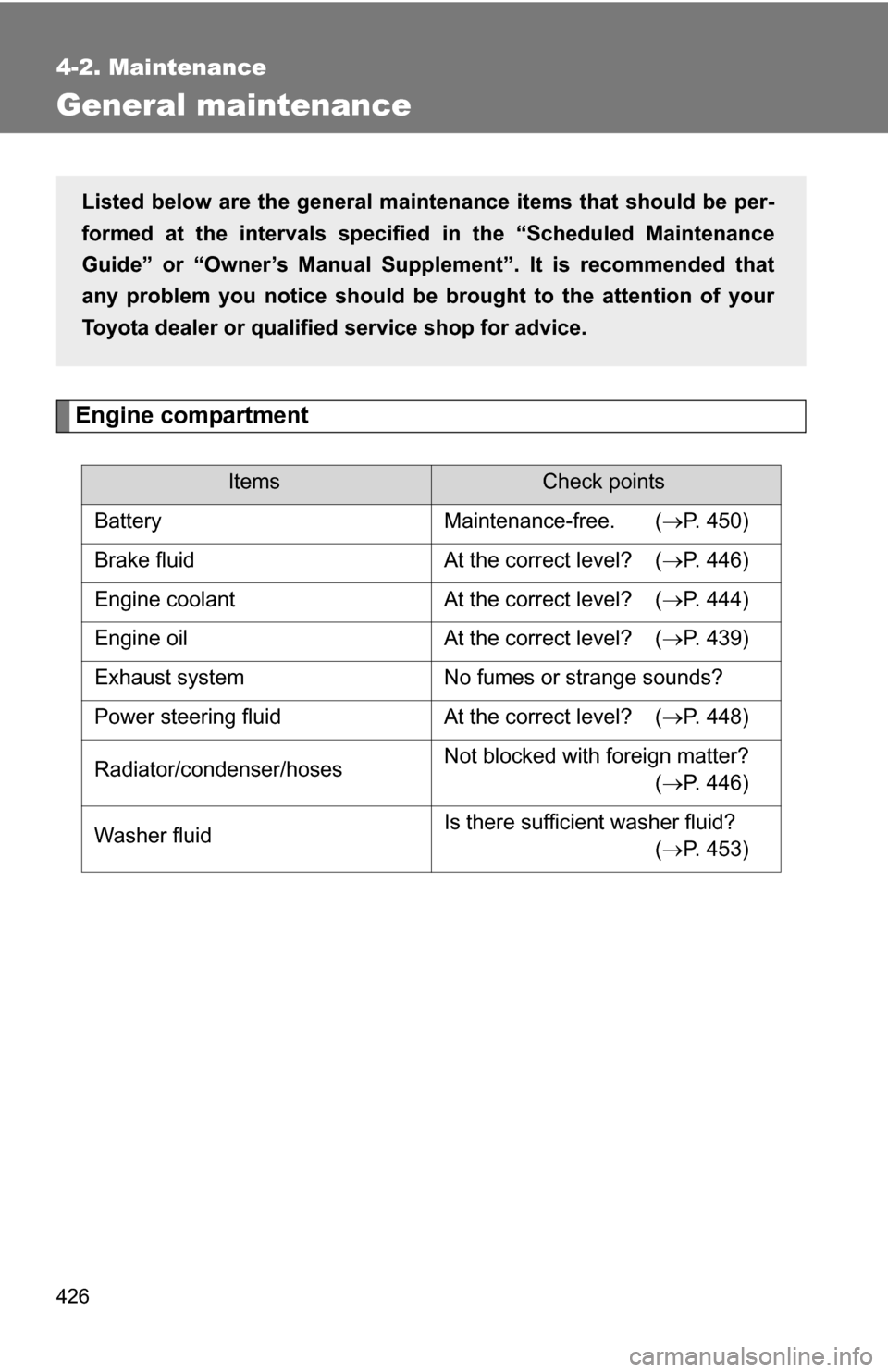
General maintenance
Engine compartment
ItemsCheck points
Battery Maintenance-free. ( P. 450)
Brake fluid At the correct level? ( P. 446)
Engine coolant At the correct level? ( P. 444)
Engine oil At the correct level? ( P. 439)
Exhaust system No fumes or strange sounds?
Power steering fluid At the correct level? ( P. 448)
Radiator/condenser/hoses Not blocked with foreign matter?
(P. 446)
Washer fluid Is there sufficient washer fluid?
(P. 453)
Listed below are the general maintenance items that should be per-
formed at the intervals specified in the “Scheduled Maintenance
Guide” or “Owner’s Manual Supp lement”. It is recommended that
any problem you notice should be brought to the attention of your
Toyota dealer or qualified service shop for advice.
Page 431 of 592
431
4-3. Do-it-yourself maintenance
4
Maintenance and care
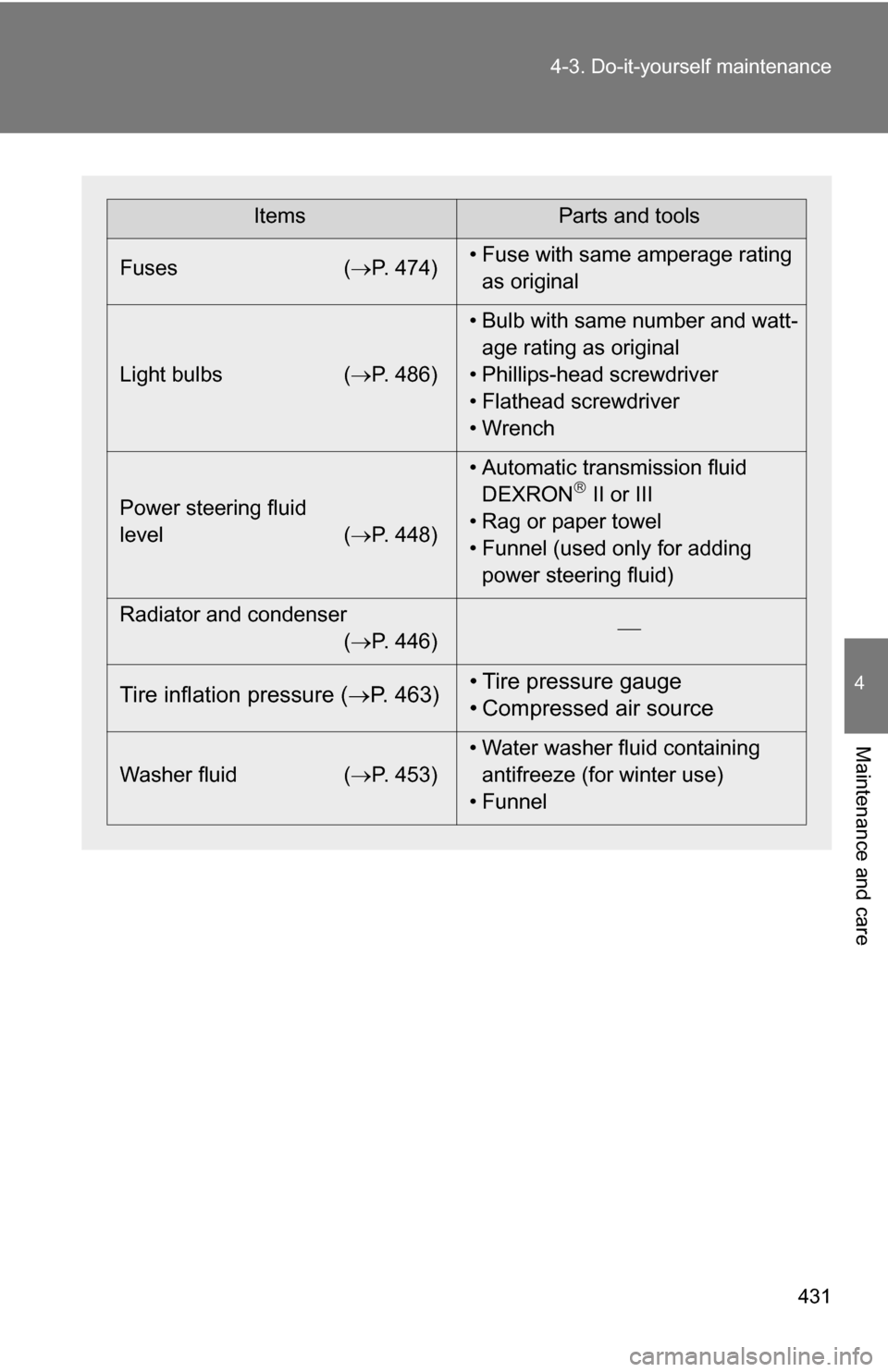
ItemsParts and tools
Fuses ( P. 474)• Fuse with same amperage rating
as original
Light bulbs ( P. 486)• Bulb with same number and watt-
age rating as original
• Phillips-head screwdriver
• Flathead screwdriver
• Wrench
Power steering fluid
level ( P. 448)• Automatic transmission fluid
DEXRON
II or III
• Rag or paper towel
• Funnel (used only for adding power steering fluid)
Radiator and condenser (P. 446)
Tire inflation pressure (
P. 463) • Tire pressure gauge
• Compressed air source
Washer fluid
(P. 453) • Water washer fluid containing
antifreeze (for winter use)
• Funnel
Page 438 of 592
438
4-3. Do-it-yourself maintenance
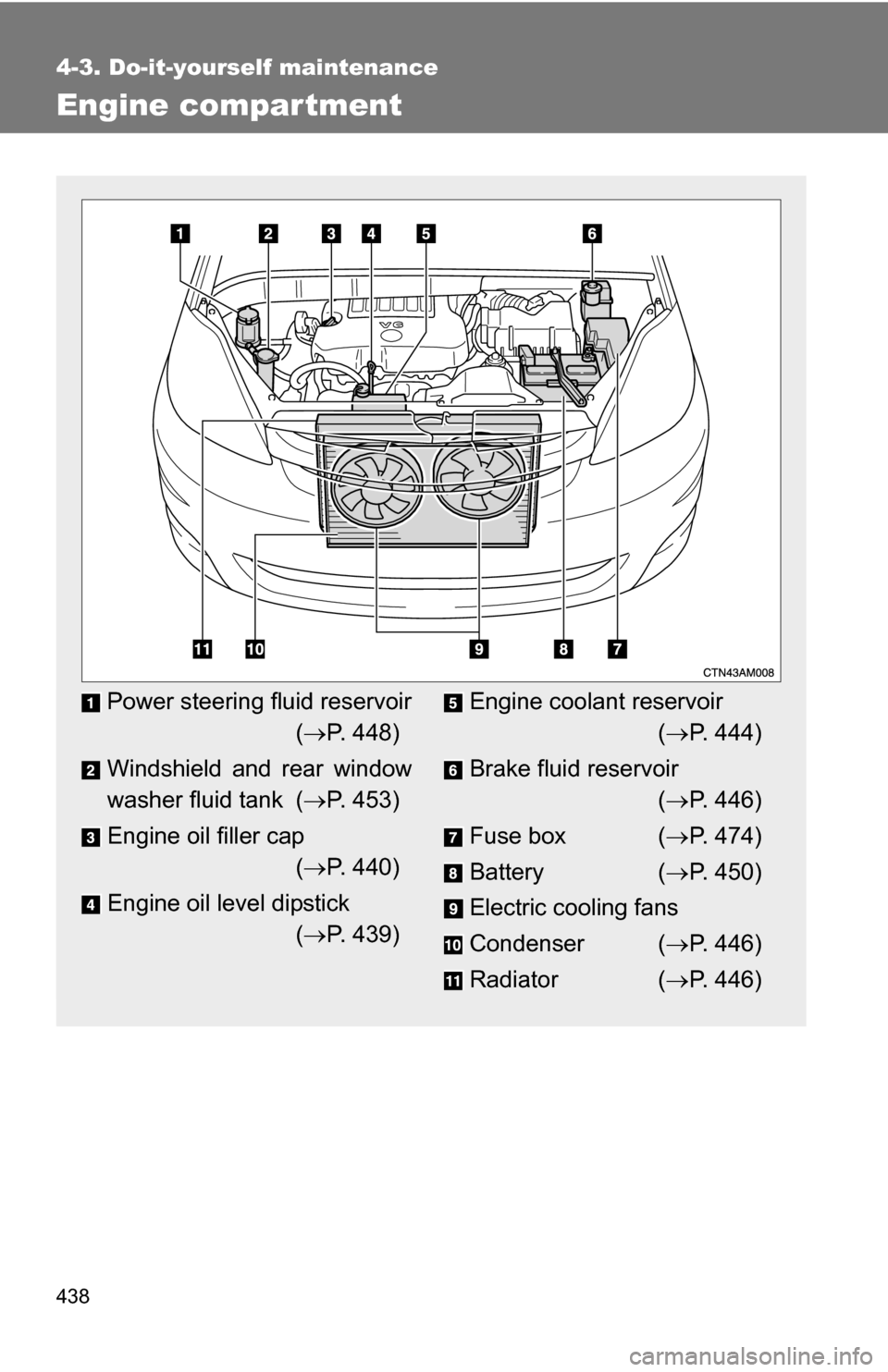
Engine compar tment
Power steering fluid reservoir( P. 448)
Windshield and rear window
washer fluid tank ( P. 453)
Engine oil filler cap ( P. 440)
Engine oil level dipstick ( P. 439)Engine coolant reservoir
( P. 444)
Brake fluid reservoir ( P. 446)
Fuse box ( P. 474)
Battery ( P. 450)
Electric cooling fans
Condenser ( P. 446)
Radiator ( P. 446)
Page 448 of 592
448 4-3. Do-it-yourself maintenance
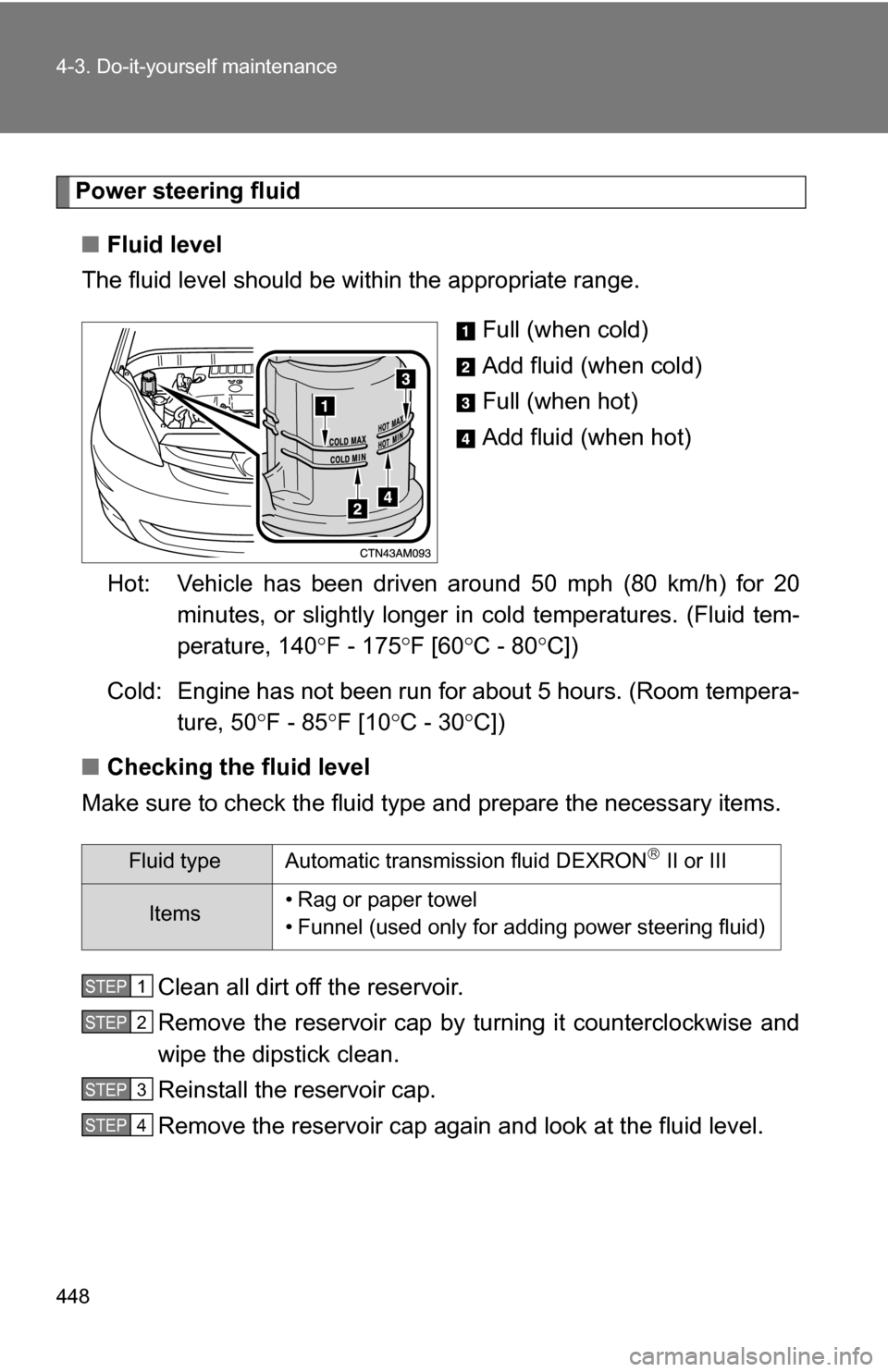
Power steering fluid■ Fluid level
The fluid level should be within the appropriate range.
Full (when cold)
Add fluid (when cold)
Full (when hot)
Add fluid (when hot)
Hot: Vehicle has been driven around 50 mph (80 km/h) for 20 minutes, or slightly longer in cold temperatures. (Fluid tem-
perature, 140 F - 175F [60C - 80 C])
Cold: Engine has not been run for about 5 hours. (Room tempera- ture, 50 F - 85F [10C - 30C])
■ Checking the fluid level
Make sure to check the fluid type and prepare the necessary items.
Clean all dirt off the reservoir.
Remove the reservoir cap by turning it counterclockwise and
wipe the dipstick clean.
Reinstall the reservoir cap.
Remove the reservoir cap again and look at the fluid level.
Fluid type Automatic transmission fluid DEXRON II or III
Items• Rag or paper towel
• Funnel (used only for adding power steering fluid)
STEP1
STEP2
STEP3
STEP4
Page 449 of 592
449
4-3. Do-it-yourself maintenance
4
Maintenance and care
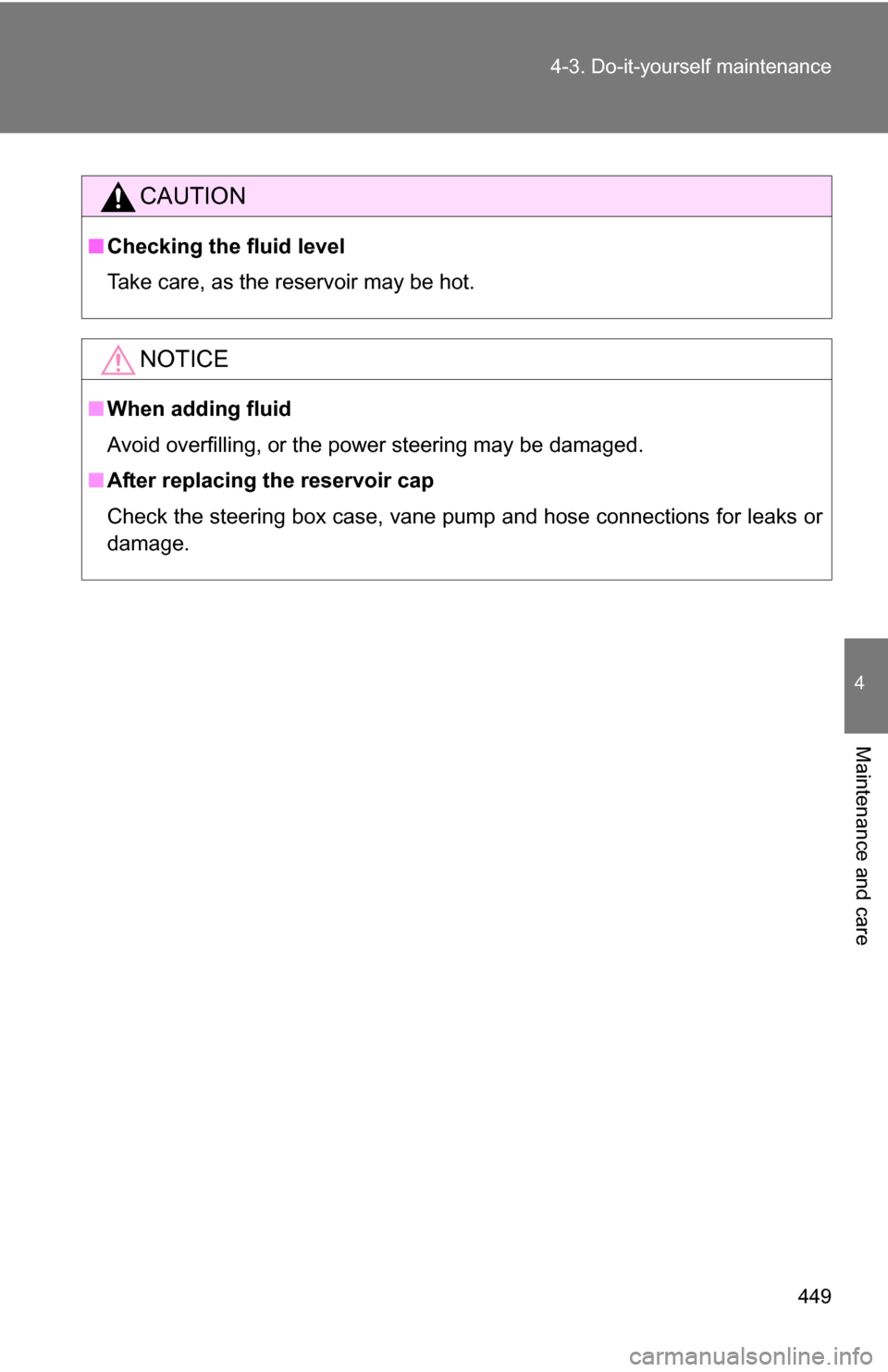
CAUTION
■
Checking the fluid level
Take care, as the reservoir may be hot.
NOTICE
■When adding fluid
Avoid overfilling, or the power steering may be damaged.
■ After replacing the reservoir cap
Check the steering box case, vane pump and hose connections for leaks or
damage.
Page 482 of 592
482 4-3. Do-it-yourself maintenance
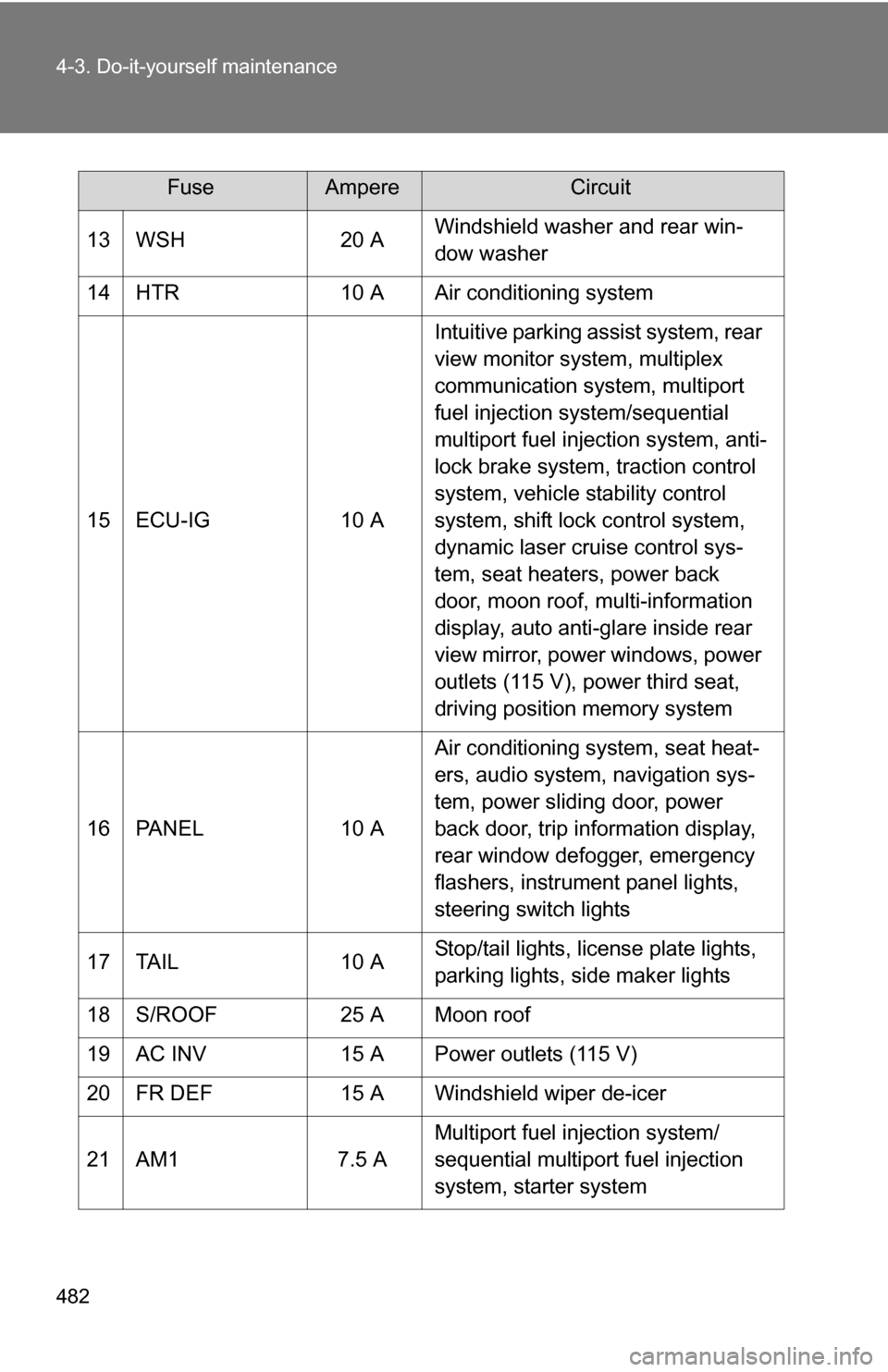
13 WSH20 AWindshield washer and rear win-
dow washer
14 HTR 10 A Air conditioning system
15 ECU-IG 10 AIntuitive parking assist system, rear
view monitor system, multiplex
communication system, multiport
fuel injection system/sequential
multiport fuel injection system, anti-
lock brake system, traction control
system, vehicle stability control
system, shift lock control system,
dynamic laser cruise control sys-
tem, seat heaters, power back
door, moon roof, multi-information
display, auto anti-glare inside rear
view mirror, power windows, power
outlets (115 V), power third seat,
driving position memory system
16 PANEL 10 AAir conditioning system, seat heat-
ers, audio system, navigation sys-
tem, power sliding door, power
back door, trip information display,
rear window defogger, emergency
flashers, instrument panel lights,
steering switch lights
17 TAIL 10 AStop/tail lights, license plate lights,
parking lights, side maker lights
18 S/ROOF 25 A Moon roof
19 AC INV 15 A Power outlets (115 V)
20 FR DEF 15 A Windshield wiper de-icer
21 AM1 7.5 AMultiport fuel injection system/
sequential multiport fuel injection
system, starter system
FuseAmpereCircuit
Page 548 of 592
548 6-1. Specifications
Brakes
*1: Minimum pedal clearance when depressed with a force of 110 lbf (490 N,50 kgf) while the engine is running
*2: Parking brake pedal travel when depressed with a force of 66 lbf (294 N, 30kgf)
Steering
Tires and wheels
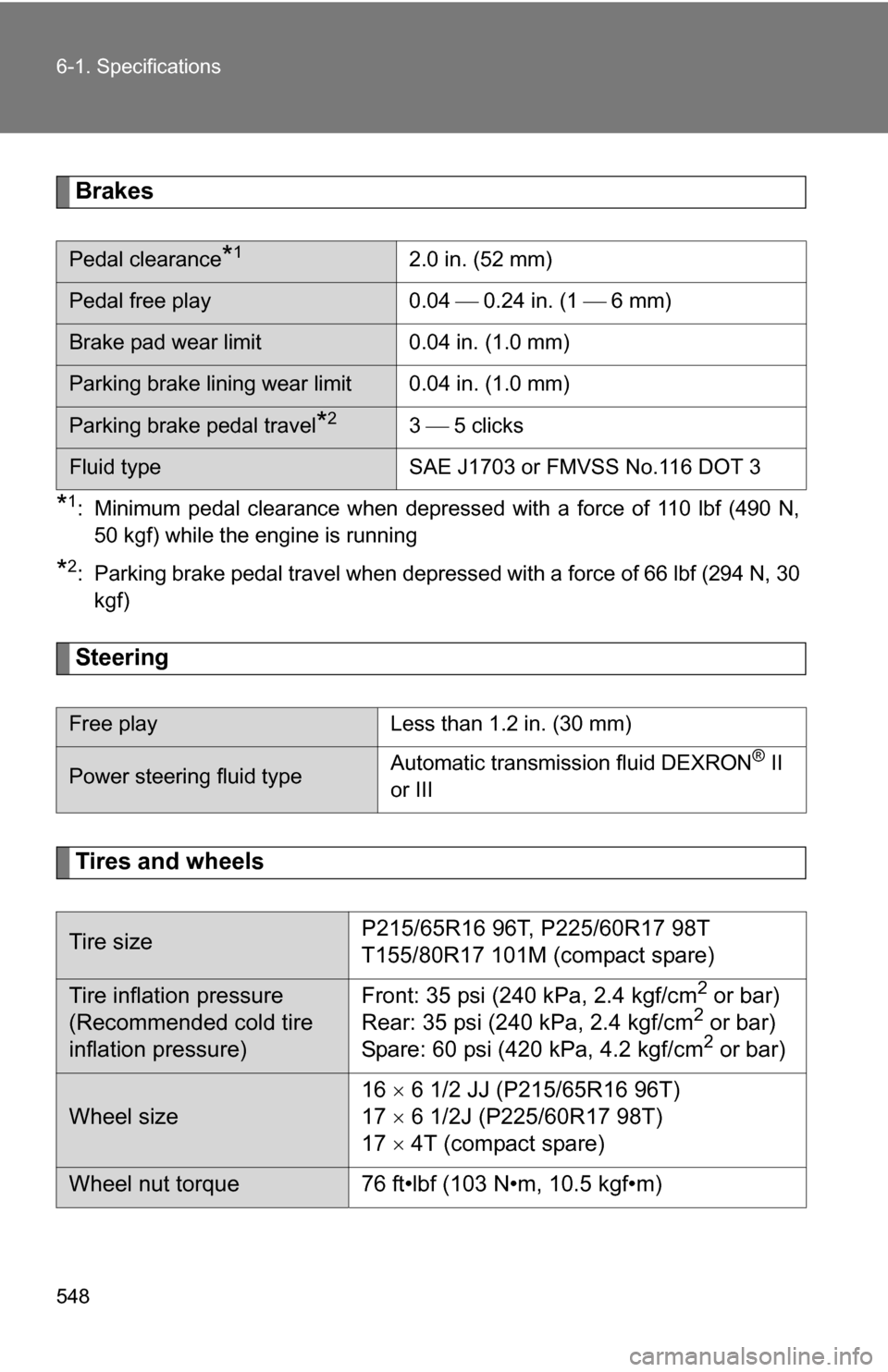
Pedal clearance*12.0 in. (52 mm)
Pedal free play 0.04 0.24 in. (1 6 mm)
Brake pad wear limit 0.04 in. (1.0 mm)
Parking brake lining wear limit 0.04 in. (1.0 mm)
Parking brake pedal travel*23 5 clicks
Fluid type SAE J1703 or FMVSS No.116 DOT 3
Free playLess than 1.2 in. (30 mm)
Power steering fluid type Automatic transmission fluid DEXRON® II
or III
Tire size P215/65R16 96T, P225/60R17 98T
T155/80R17 101M (compact spare)
Tire inflation pressure
(Recommended cold tire
inflation pressure)Front: 35 psi (240 kPa, 2.4 kgf/cm2 or bar)
Rear: 35 psi (240 kPa, 2.4 kgf/cm2 or bar)
Spare: 60 psi (420 kPa, 4.2 kgf/cm2 or bar)
Wheel size 16
6 1/2 JJ (P215/65R16 96T)
17 6 1/2J (P225/60R17 98T)
17 4T (compact spare)
Wheel nut torque 76 ft•lbf (103 N•m, 10.5 kgf•m)
Page 559 of 592
559
6-1. Specifications
6
Vehicle specifications
Warning: The temperature grades for this tire are established for a
tire that is properly inflated and not overloaded.
Excessive speed, underinflation, or
excessive loading, either sepa-
rately or in combination, can caus e heat buildup and possible tire fail-
ure.
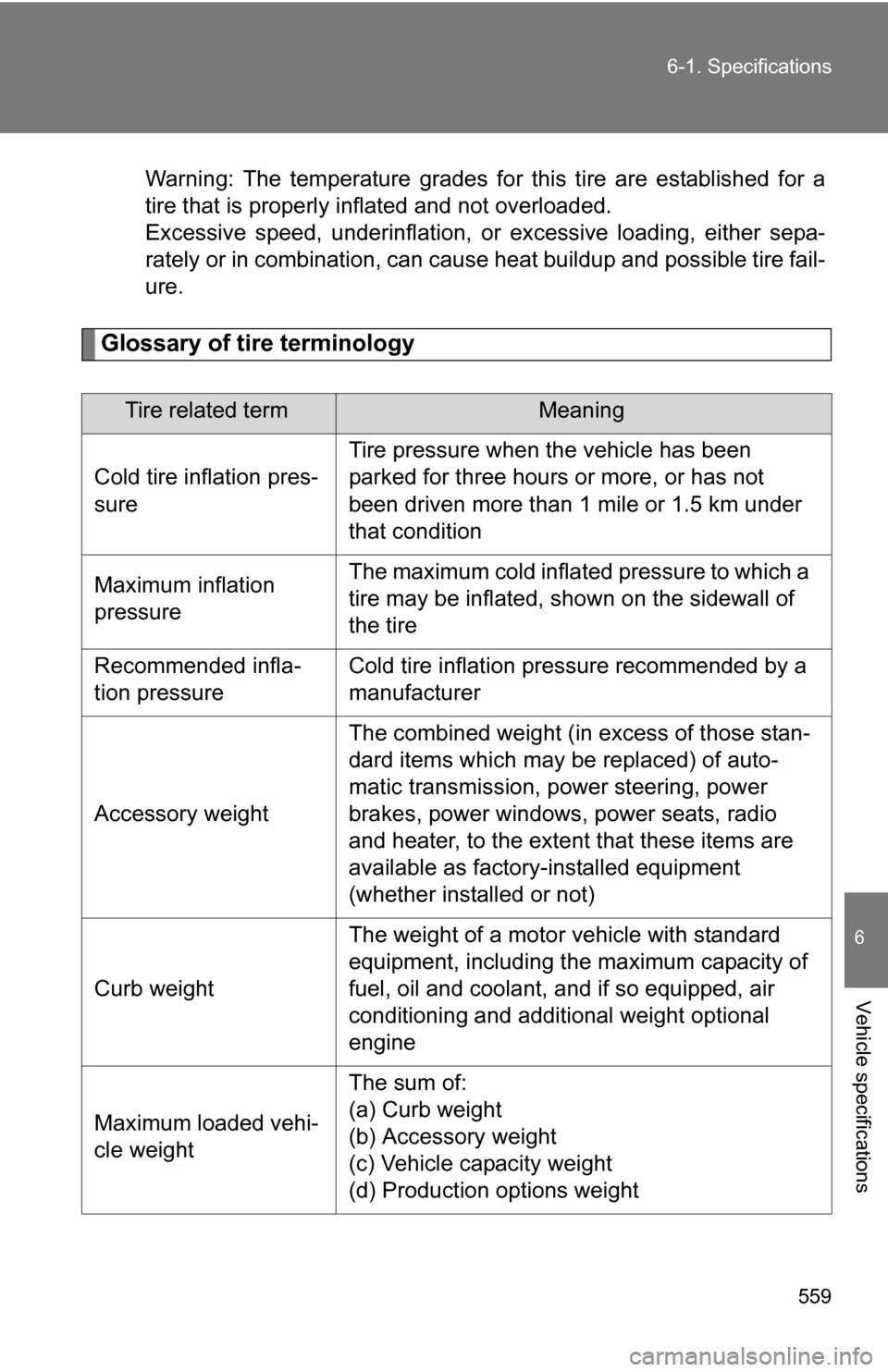
Glossary of tire terminology
Tire related termMeaning
Cold tire inflation pres-
sure Tire pressure when the vehicle has been
parked for three hours or more, or has not
been driven more than 1 mile or 1.5 km under
that condition
Maximum inflation
pressure The maximum cold inflated
pressure to which a
tire may be inflated, s hown on the sidewall of
the tire
Recommended infla-
tion pressure Cold tire inflation pressure recommended by a
manufacturer
Accessory weight The combined weight (in excess of those stan-
dard items which may be replaced) of auto-
matic transmission, power steering, power
brakes, power windows, power seats, radio
and heater, to the extent that these items are
available as factory-installed equipment
(whether installed or not)
Curb weight The weight of a motor vehicle with standard
equipment, including the maximum capacity of
fuel, oil and coolant, and if so equipped, air
conditioning and additional weight optional
engine
Maximum loaded vehi-
cle weight The sum of:
(a) Curb weight
(b) Accessory weight
(c) Vehicle capacity weight
(d) Production options weight