Page 77 of 592

77
1-3. Adjustable components (s
eats, mirrors, steering wheel)
1
Before driving
■“3RD SEAT” warning light (power third seat)
CAUTION
■When seats are moved
Observe the following precautions.
Failure to do so may result in death or serious injuries.
●When seats are to be moved, stop the vehicle on level ground, set the
parking brake and put the shift lever in P.
● Do not fold, adjust or otherwise move the seats while the vehicle is mov-
ing.
● When a seat is folded, adjusted, moved or removed, be careful that it does
not hit passengers or luggage.
● Be careful not to get your hands or feet pinched by any part of a seat.
● After a seat is folded, adjusted, moved or reinstalled, push it forward and
backward to make sure that it is properly locked in position.
● When returning or installing a seat, make sure the seat belts are not
twisted or caught in the seat.
● The seat belts for the second seats must be removed from their hangers
when the seat belts are in use.
■ Folding seats
●Do not sit on a folded seatback.
● Do not use a seat as a temporary table while the vehicle is moving.
● When a seat is used as a temporary table, make sure the seat is securely
locked in position.
The warning light comes on if the third
seat operation is not yet complete when
the engine switch is in the “ON” position.
Page 78 of 592
78 1-3. Adjustable components (seats, mirrors, steering wheel)
CAUTION
■Tumbling the second seats
●In order to prevent personal injury in a collision or sudden stop, do not
allow passengers to sit in the third seats when a second seat is tumbled.
● When tumbling the second seats, fix the seats securely by adjusting the
length of the seat's holding strap.
● Do not attach the holding strap to anything other than the assist grip to
hold the second seat.
● The holding strap must be stowed into the pocket when it is not in use.
■ Removing the second seats
●Do not leave a seat in the vehicle if it has been disengaged from the floor.
● Do not sit on or place anything on a seat that has been removed from the\
vehicle.
■ Stowing the third seats
●Make sure that the seat path is clear before moving the seat. Otherwise,
injury may result from contact with, or by being pinched by parts of the
seat.
● Manual third seats: Do not sit on the third seat when it is in the stowed
position with the seatback upright.
● Power third seats: Do not continue the stowing operation when the indica-
tor above the stowing switch and returning switch comes on or flashes. An
object or a person may be caught in the seat.
● Power third seats: During the stowing operation, to prevent the vehicle
from moving, do not shift the shift lever out of P with the engine switch in
the “ON” position.
Page 97 of 592
97
1-3. Adjustable components (s
eats, mirrors, steering wheel)
1
Before driving
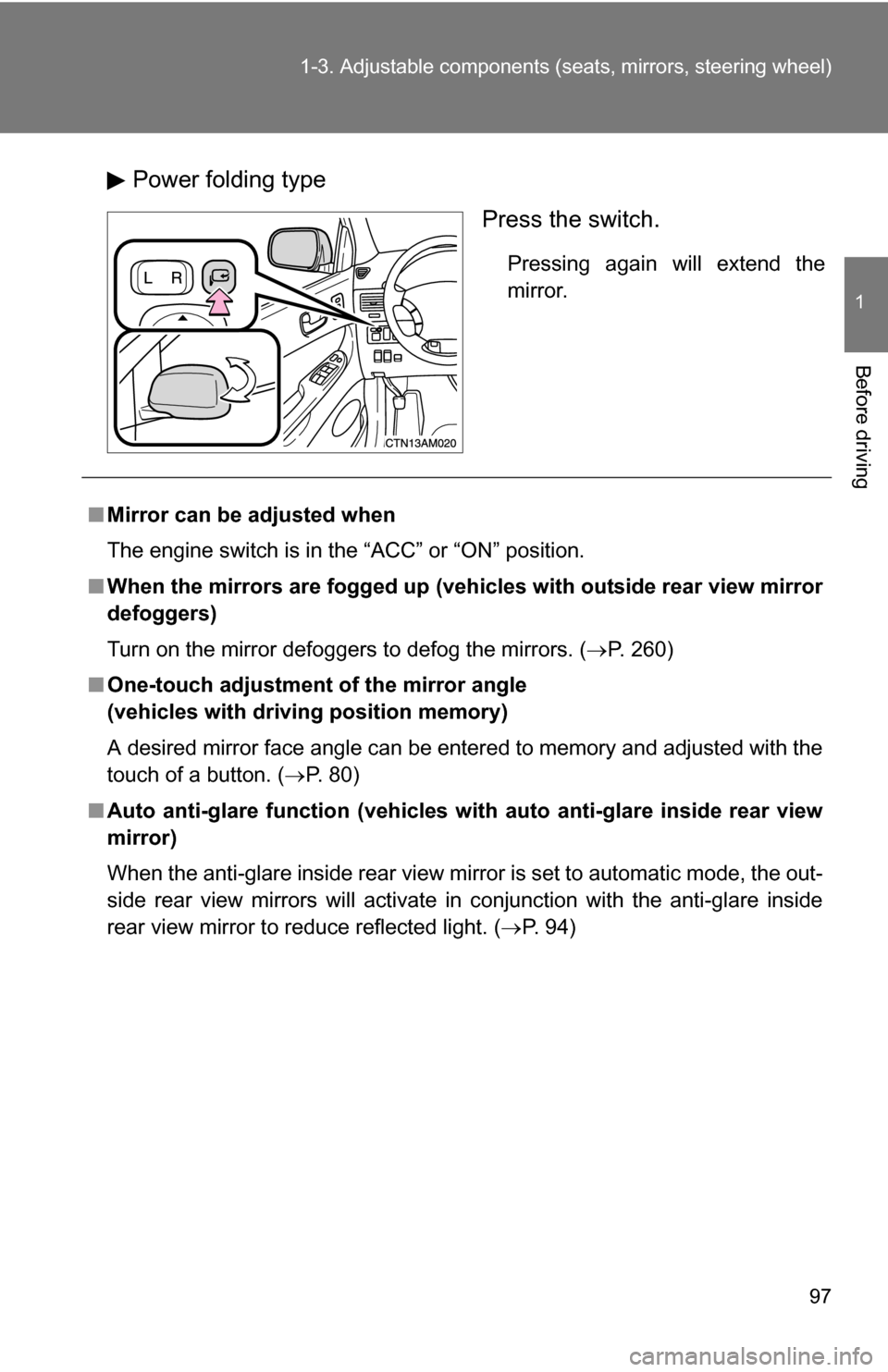
Power folding type
Press the switch.
Pressing again will extend the
mirror.
■Mirror can be adjusted when
The engine switch is in the “ACC” or “ON” position.
■ When the mirrors are fogged up (veh icles with outside rear view mirror
defoggers)
Turn on the mirror defoggers to defog the mirrors. ( P. 260)
■ One-touch adjustment of the mirror angle
(vehicles with driving position memory)
A desired mirror face angle can be entered to memory and adjusted with the
touch of a button. ( P. 80)
■ Auto anti-glare function (vehicles with auto anti-glare inside rear view
mirror)
When the anti-glare inside rear view mirror is set to automatic mode, the out-
side rear view mirrors wi ll activate in conjunction with the anti-glare inside
rear view mirror to reduce reflected light. ( P. 94)
Page 119 of 592

119
1-7. Safety information
1
Before driving
The main SRS airbag system components are shown above. The
SRS airbag system is controlled by
the airbag sensor assembly. The
airbag sensor assembly consists of a safing sensor and an airbag
sensor.
In certain types of severe frontal or side impacts, the SRS airbag sys-
tem triggers the airbag inflators. A chemical reaction in the inflators
quickly fills the airbags with non-toxic gas to help rest rain the motion
of the occupants.
■ SRS warning light
This warning light system monitors the airbag sensor assembly, front airbag
sensors, side and curtain shield airbag sensor assemblies, curtain shield air-
bag sensor assemblies, driver's seat position sensor, driver's seat belt
buckle switch, front passenger occupant classification system, “AIR BAG
ON” and “AIR BAG OFF” indicator lights, front passenger’s seat belt buckle
switch, front seat belt pretensioner assemblies, inflators, interconnecting wir-
ing and power sources. ( P. 505)
■ If the SRS airbags deploy (inflate)
●Bruising and slight abrasions may result from contact with a deploying
(inflating) SRS airbag.
● A loud noise and white powder will be emitted.
● Parts of the airbag module (steering wheel hub, airbag cover and inflator)
as well as the front seats, and parts of the front and rear pillars and roof
side rail, may be hot for several minutes. The airbag itself may also be
hot.
● The windshield may crack.
Page 161 of 592

161
2-1. Driving procedures
2
When driving
CAUTION
●
Do not drive the vehicle over or st op the vehicle near flammable materials.
The exhaust system and exhaust gases can be extremely hot. This may
cause a fire if there is any flammable material nearby.
● Do not let the vehicle roll backwards while the shift lever is in a driving
position, or roll forward while the shift lever is in R. Doing so may cause
the engine to stall or lead to poor brake and steering performance, result-
ing in an accident or damage to the vehicle.
● If the smell of exhaust is noticed inside the vehicle, open the windows and
check that the back door is closed. Large amounts of exhaust in the vehi-
cle can cause driver drowsiness and an accident, resulting in death or a
serious health hazard. Have the vehicle inspected by your Toyota dealer
immediately.
● Do not under any circumstances shift the shift lever to P or R while the
vehicle is moving. Doing so can cause significant damage to the transmis-
sion system and may result in a loss of vehicle control.
● Do not shift the shift lever to N while the vehicle is moving. Doing so may
cause insufficient engine braking and lead to an accident.
● Do not turn the engine off while driving. The power steering and brake
booster systems will not operate properly if the engine is not running.
● Use engine braking (downshift) to maintain a safe speed when driving
down a steep hill. Using the brakes continuously may cause the brakes to
overheat and lose effectiveness. ( P. 170)
● When stopped on an inclined surface, use the brake pedal and parking
brake to prevent the vehicle from rolling backward or forward and causing
an accident.
● Do not adjust the position of the steering wheel, the seat, or the inside or
outside rear view mirrors while driving. Doing so may result in a loss of
vehicle control that can cause accidents that may result in death or serious
injury.
● Always check that all passengers' arms, heads or other parts of their bod-
ies are not outside the vehicle, as this may result in death or serious injury.
● Do not drive the vehicle off-road.
This is not a AWD vehicle designed for real off-road driving. Proceed with
all due caution if it becomes unavoidable to drive off-road.
Page 165 of 592
165
2-1. Driving procedures
2
When driving
NOTICE
■
When driving the vehicle
Do not use the accelerator pedal or depress the accelerator and brake ped-
als together to hold the vehicle on a hill.
■ When parking the vehicle
Always put the shift lever in P. Failure to do so may cause the vehicle to
move or the vehicle may accelerate suddenly if the accelerator pedal is acci-
dentally depressed.
■ Avoiding damage to vehicle parts
●Do not turn the steering wheel fully in either direction and hold it there for a
long time. Doing so may damage the power steering pump.
● When driving over bumps in the road, drive as slowly as possible to avoid
damaging the wheels, underside of the vehicle, etc.
■ If you hear a squealing or scraping noise (brake pad wear limit indica-
tors)
Have the brake pads checked and replaced by your Toyota dealer as soon
as possible.
Rotor damage can result if the pads are not replaced when needed.
It is dangerous to drive the vehicle when the wear limits of the brake pads
and/or those of the brake discs are exceeded.
Page 216 of 592
216 2-4. Using other driving systems
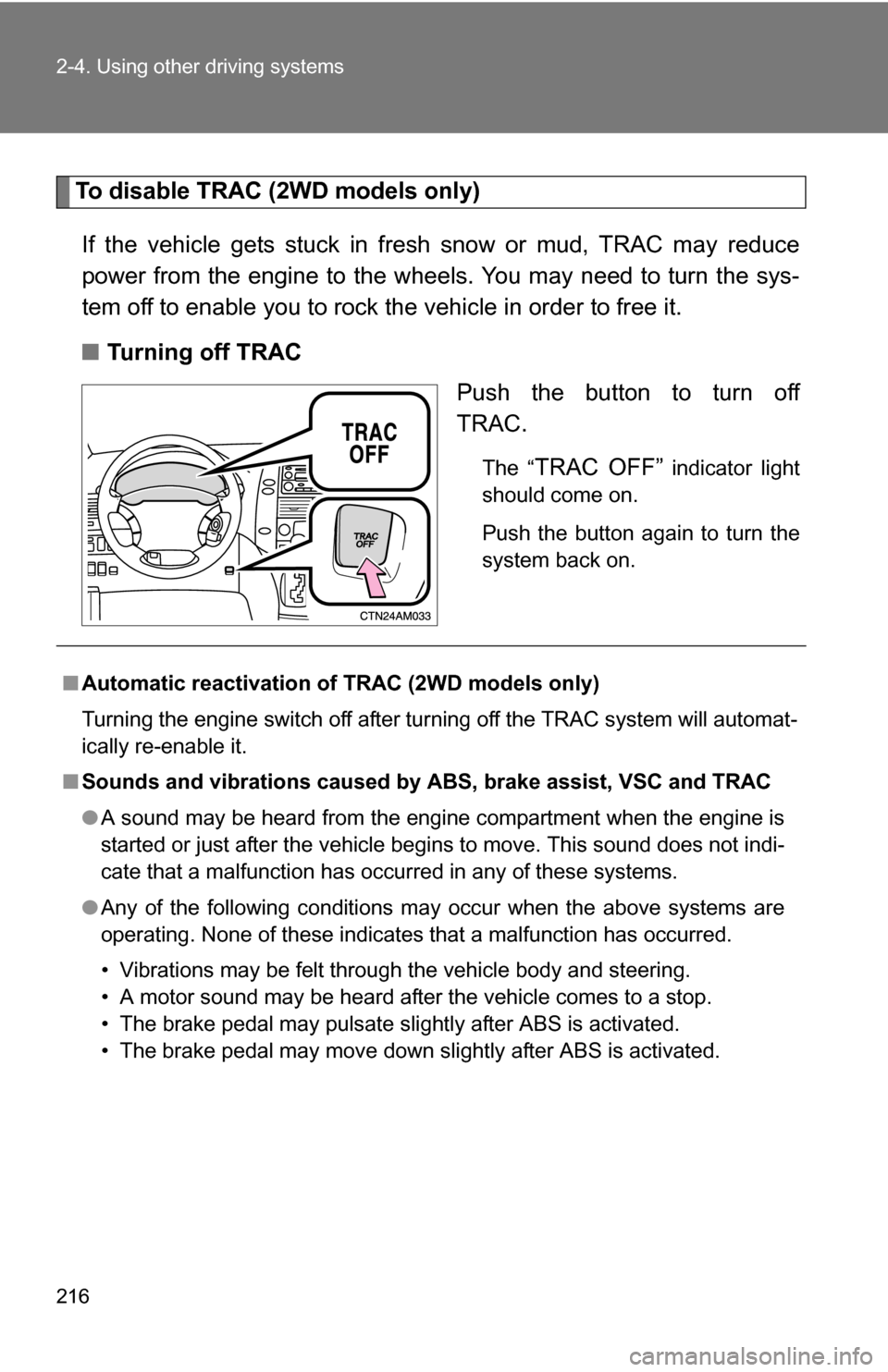
To disable TRAC (2WD models only)If the vehicle gets stuck in fresh snow or mud, TRAC may reduce
power from the engine to the wheels. You may need to turn the sys-
tem off to enable you to rock the vehicle in order to free it.
■ Turning off TRAC
Push the button to turn off
TRAC.
The “TRAC OFF” indicator light
should come on.
Push the button again to turn the
system back on.
■ Automatic reactivation of TRAC (2WD models only)
Turning the engine switch off after turning off the TRAC system will automat-
ically re-enable it.
■ Sounds and vibrations caused by ABS, brake assist, VSC and TRAC
●A sound may be heard from the engine compartment when the engine is
started or just after the vehicle begins to move. This sound does not indi-
cate that a malfunction has occurred in any of these systems.
● Any of the following conditions may occur when the above systems are
operating. None of these indicates that a malfunction has occurred.
• Vibrations may be felt through the vehicle body and steering.
• A motor sound may be heard after the vehicle comes to a stop.
• The brake pedal may pulsate slightly after ABS is activated.
• The brake pedal may move down slightly after ABS is activated.
Page 292 of 592
292
3-2. Using the audio system
Using the steering wheel audio switches (if equipped)
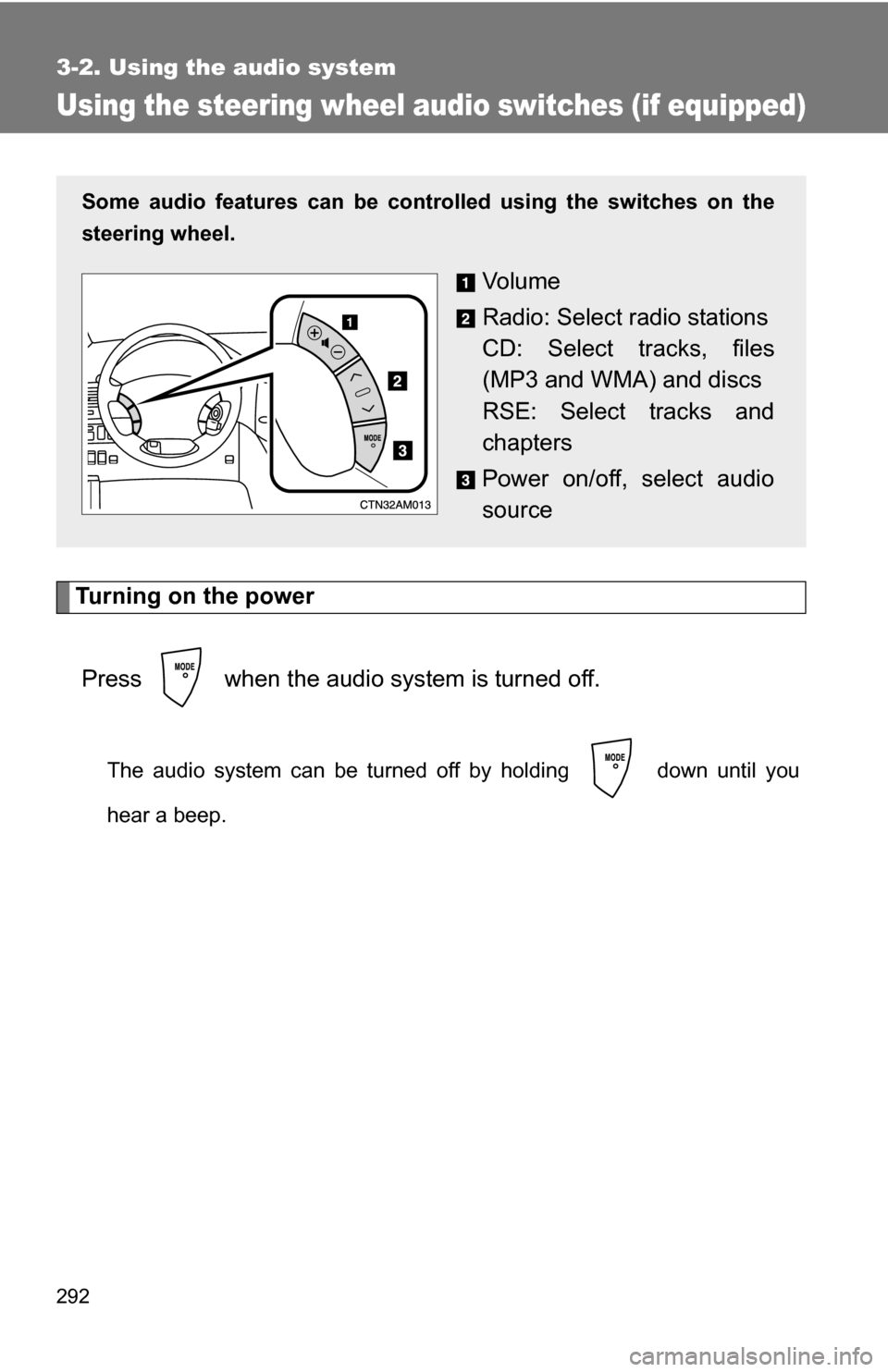
Turning on the powerPress when the audio system is turned off.
The audio system can be turned off by holding down until you
hear a beep.
Some audio features can be cont rolled using the switches on the
steering wheel.
Vo l u m e
Radio: Select radio stations
CD: Select tracks, files
(MP3 and WMA) and discs
RSE: Select tracks and
chapters
Power on/off, select audio
source