Page 97 of 592
97
1-3. Adjustable components (s
eats, mirrors, steering wheel)
1
Before driving
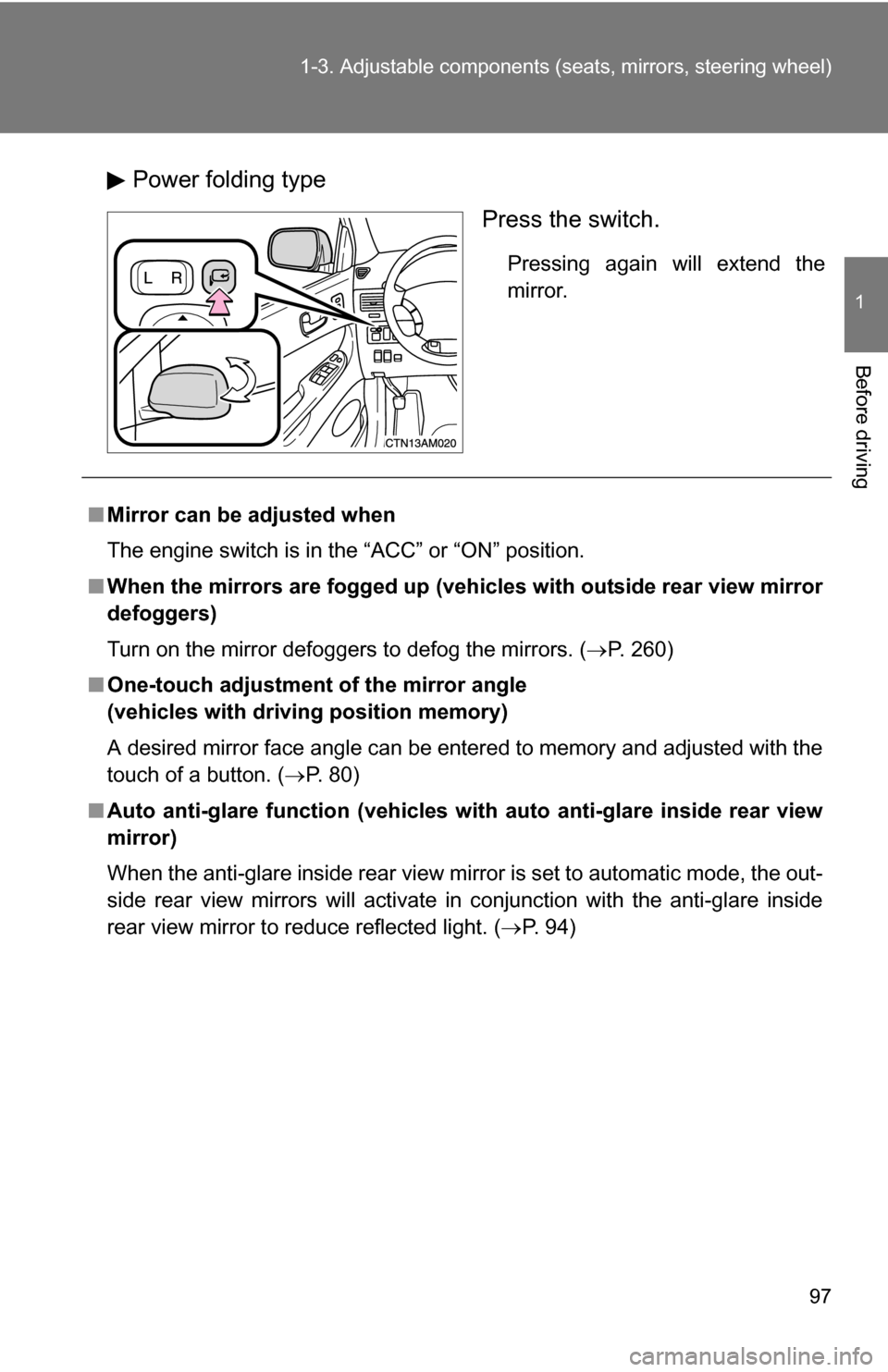
Power folding type
Press the switch.
Pressing again will extend the
mirror.
■Mirror can be adjusted when
The engine switch is in the “ACC” or “ON” position.
■ When the mirrors are fogged up (veh icles with outside rear view mirror
defoggers)
Turn on the mirror defoggers to defog the mirrors. ( P. 260)
■ One-touch adjustment of the mirror angle
(vehicles with driving position memory)
A desired mirror face angle can be entered to memory and adjusted with the
touch of a button. ( P. 80)
■ Auto anti-glare function (vehicles with auto anti-glare inside rear view
mirror)
When the anti-glare inside rear view mirror is set to automatic mode, the out-
side rear view mirrors wi ll activate in conjunction with the anti-glare inside
rear view mirror to reduce reflected light. ( P. 94)
Page 104 of 592
104 1-4. Opening and closing the windows
■The moon roof can be operated when
The engine switch is in the “ON” position.
■ Operating the moon roof af ter turning the engine off
The moon roof can be operated for approximately 45 seconds after the
engine switch is turned to the “ACC” or “LOCK” position. It cannot, however,
be operated once either front door is opened.
■ Jam protection function
If an object is detected between the moon roof and the frame while closing
or tilting down, travel is stopped and the moon roof opens slightly.
■ Sunshade
The sunshade can be opened and closed manually. However, the sunshade
will open automatically when the moon roof is opened.
■ Opening the moon roof by small degrees
Quickly push and release the switch.
■ When the battery is disconnected
The moon roof must be initialized in order to ensure proper operation.
Press and hold the “TILT UP” side of the switch until the moon roof tilts up
completely.
Page 112 of 592
112
1-6. Theft deterrent system
Alarm (if equipped)
The system sounds the alarm and flashes the lights when forcible
entry is detected.
■Triggering of the alarm
The alarm is triggered in the following situations.
●A locked door is unlocked or opened without the key or wire-
less remote control.
● The hood is opened while t he vehicle is locked.
● The battery is reconnected.
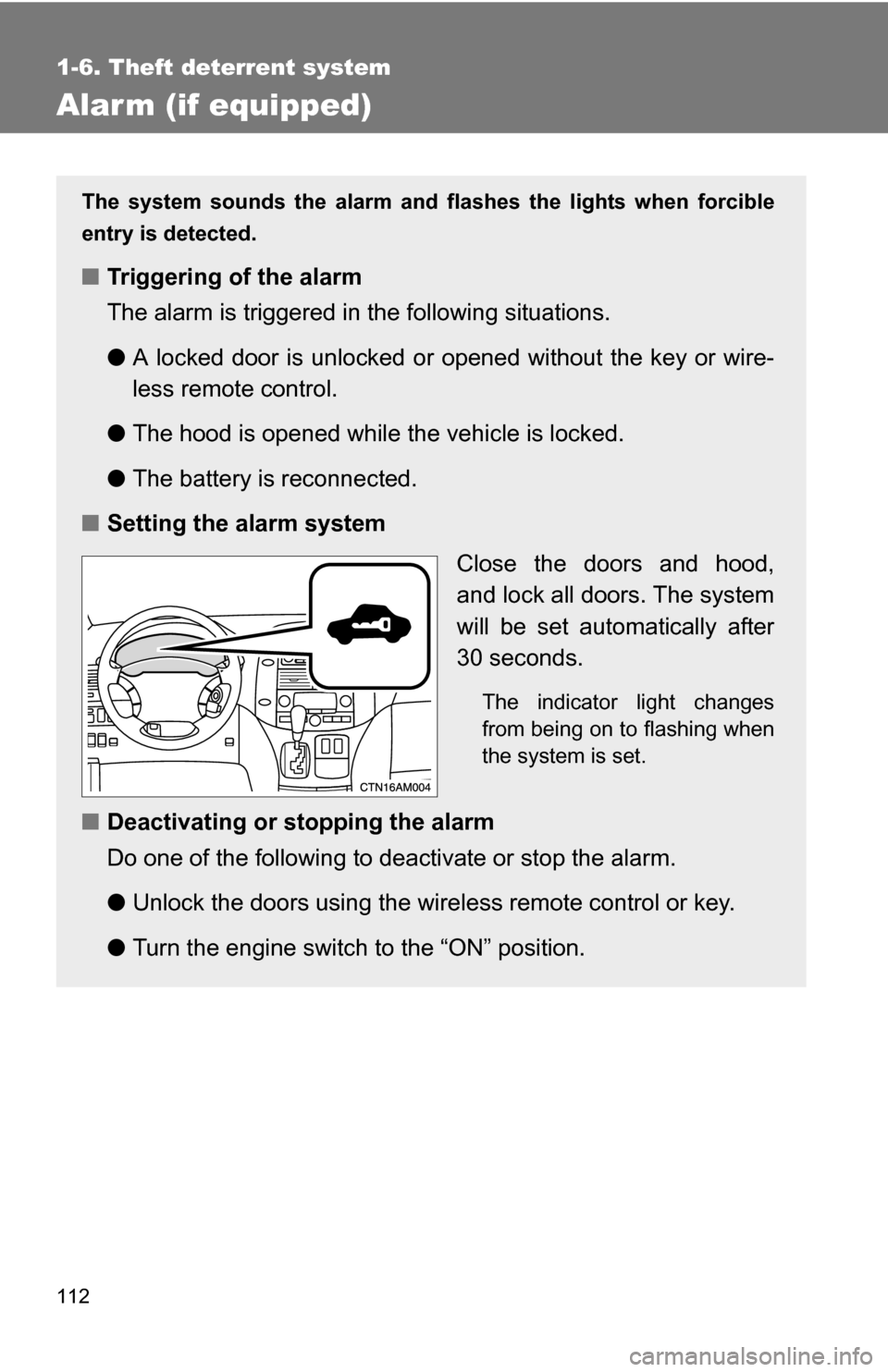
■ Setting the alarm system
Close the doors and hood,
and lock all doors. The system
will be set automatically after
30 seconds.
The indicator light changes
from being on to flashing when
the system is set.
■Deactivating or stopping the alarm
Do one of the following to deactivate or stop the alarm.
●Unlock the doors using the wire less remote control or key.
● Turn the engine switch to the “ON” position.
Page 137 of 592
137
1-7. Safety information
1
Before driving
■
Selecting an appropriat e child restraint system
● Use a child restraint system appropriate for the child until the child
becomes large enough to properly wear the vehicle’s seat belt.
● If a child is too large for a child restraint system, sit the child on a rear
seat and use the vehicle's seat belt. ( P. 84)
CAUTION
■Child restraint precautions
●For effective protection in automobile accidents and sudden stops, a child
must be properly restrained, using a seat belt or child restraint system
depending on the age and size of the child. Holding a child in your arms is
not a substitute for a child restraint system. In an accident, the child can be
crushed against the windshield, or between you and the vehicle's interior.
● Toyota strongly urges the use of a proper child restraint system that con-
forms to the size of the child, installed on the rear seat. According to acci-
dent statistics, the child is safer when properly restrained in the rear seat
than in the front seat.
● Never install a rear-facing child restraint system on the front passenger
seat even if the “AIR BAG OFF” indicator light is illuminated. In the event
of an accident, the force of the rapid inflation of the front passenger airbag
can cause death or serious injury to the child if the rear-facing child
restraint system is installed on the front passenger seat.
● A forward-facing child restraint system may be installed on the front pas-
senger seat only when it is unavoidable. A child restraint system that
requires a top tether strap should not be used in the front passenger seat
since there is no top tether strap anchor for the front passenger seat.
Adjust the seatback as uprights as possible and always move the seat as
far back as possible even if the “AIR BAG OFF” indicator light is illumi-
nated, because the front passenger airbag could inflate with considerable
speed and force. Otherwise, the child may be killed or seriously injured.
Page 145 of 592
145
1-7. Safety information
1
Before driving
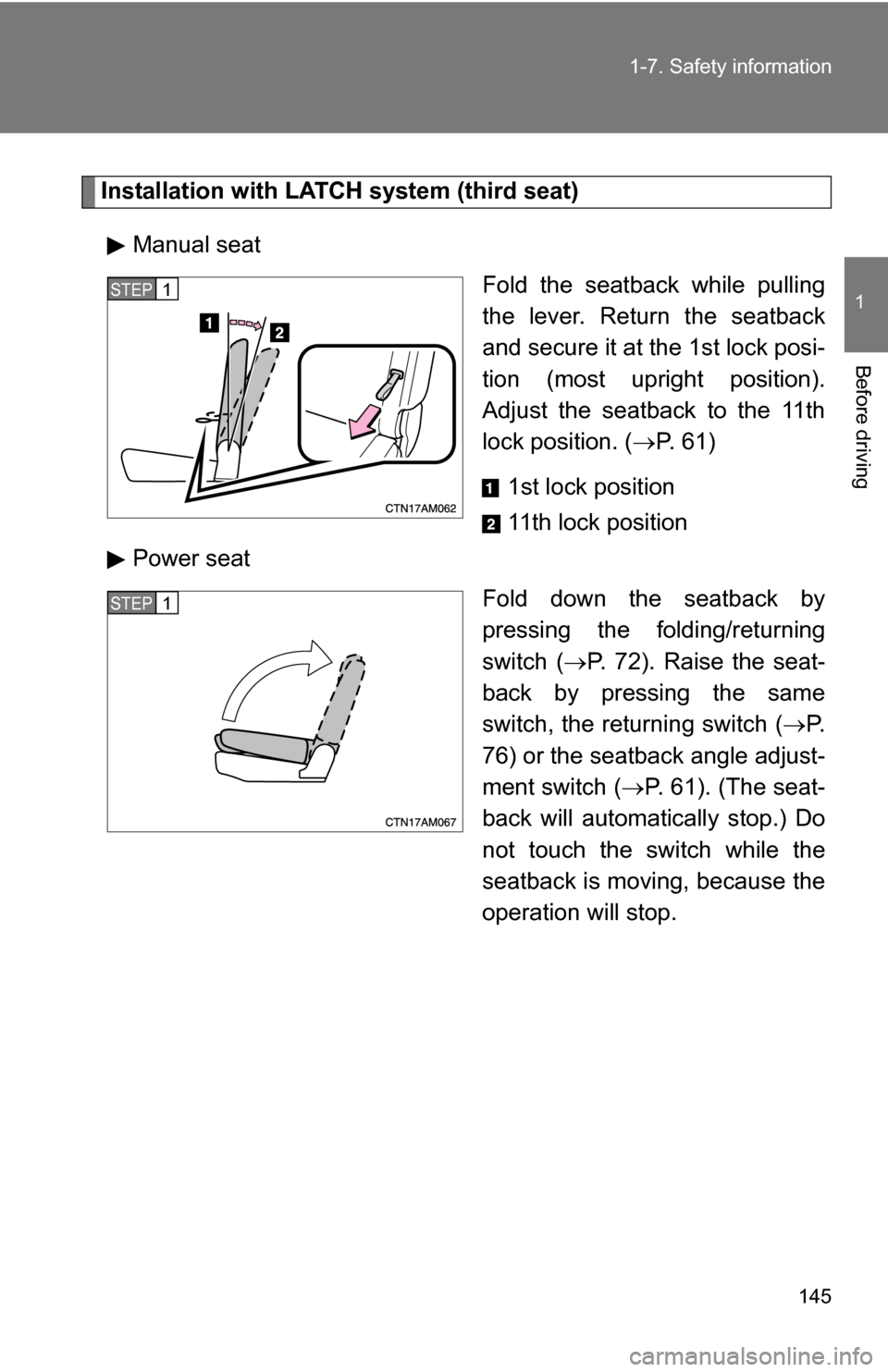
Installation with LATCH system (third seat)
Manual seat Fold the seatback while pulling
the lever. Return the seatback
and secure it at the 1st lock posi-
tion (most upright position).
Adjust the seatback to the 11th
lock position. (P. 61)
1st lock position
11th lock position
Power seat
Fold down the seatback by
pressing the folding/returning
switch (P. 72). Raise the seat-
back by pressing the same
switch, the returning switch ( P.
76) or the seatback angle adjust-
ment switch ( P. 61). (The seat-
back will automatically stop.) Do
not touch the switch while the
seatback is moving, because the
operation will stop.
STEP1
STEP1
Page 157 of 592
When driving2
157
2-1. Driving procedures ........ 158Driving the vehicle............ 158
Engine (ignition) switch .... 167
Automatic transmission .... 170
Turn signal lever .............. 172
Parking brake ................... 173
2-2. Instrument cluster and information display...... 174
Gauges and meters ......... 174
Indicators and warning lights .............................. 177
Trip information display .... 181 2-3. Operating the lights and
wipers ........................... 185
Headlight switch ............... 185
Fog light switch ................ 190
Windshield wipers and washer ........................... 191
Rear window wiper and washer ........................... 193
2-4. Using other driving systems ........................ 194
Cruise control ................... 194
Dynamic laser cruise control ............................ 197
Intuitive parking assist...... 209
Driving assist systems ..... 215
2-5. Driving information ........ 219 Cargo and luggage .......... 219
Vehicle load limits ............ 225
Winter driving tips ............ 226
Trailer towing ................... 229
Dinghy towing .................. 237
Page 170 of 592
170
2-1. Driving procedures
Automatic transmission
Select a shift position appropriate for the driving conditions.
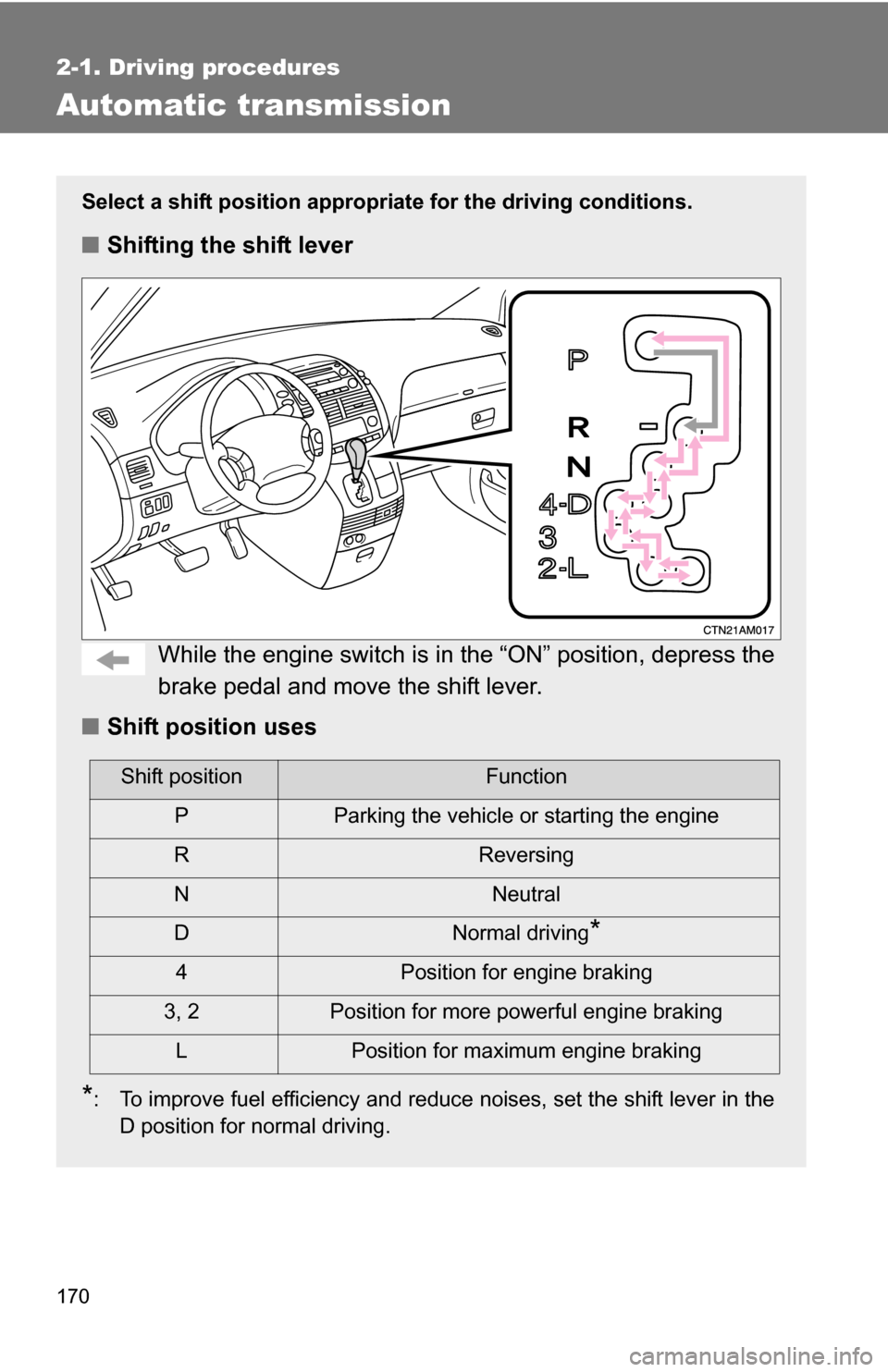
■Shifting the shift lever
While the engine switch is in the “ON” position, depress the
brake pedal and move the shift lever.
■ Shift position uses
*: To improve fuel efficiency and reduce noises, set the shift lever in the
D position for normal driving.
Shift positionFunction
P Parking the vehicle or starting the engine
R Reversing
N Neutral
D Normal driving
*
4 Position for engine braking
3, 2 Position for more powerful engine braking
L Position for maximum engine braking
Page 185 of 592
185
2
When driving
2-3. Operating the lights and wipers
Headlight switch
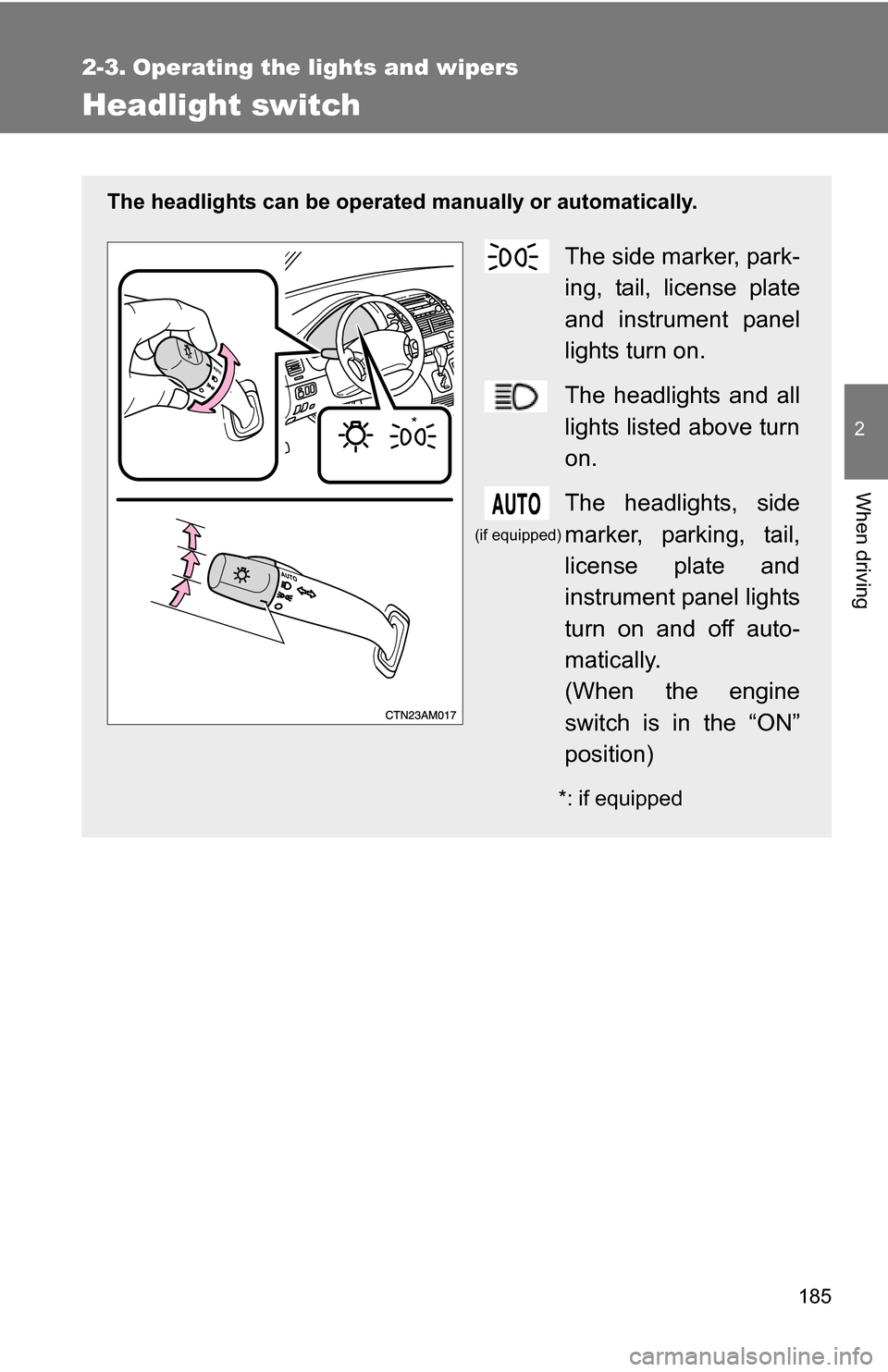
The headlights can be operated manually or automatically.
The side marker, park-
ing, tail, license plate
and instrument panel
lights turn on.
The headlights and all
lights listed above turn
on.
The headlights, side
marker, parking, tail,
license plate and
instrument panel lights
turn on and off auto-
matically.
(When the engine
switch is in the “ON”
position)
*: if equipped
*
(if equipped)