Page 237 of 608

237
2-5. Driving information
2
When driving
Vehicle load limits
■Total load capacity and seating capacity
These details are also described on the tire and loading information
label. (→P. 463)
CAUTION
■Overloading the vehicle
Do not overload the vehicle.
It may not only cause damage to the ti res, but also degrade steering and
braking ability, resulting in an accident.
Vehicle load limits include total load capacity, seating capacity,
towing capacity and cargo capacity.
■ Total load capacity: 1200 lb. (544 kg)
Total load capacity means the combin ed weight of occupants, cargo
and luggage.
■ Seating capacity: 5 or 7 occupants (Front 2, Rear 3 or 5)
Seating capacity means the maximum number of occupants whose
estimated average weight is 150 lb. (68 kg) per person.
■Towing capacity
2.7 L 4-cylinder (1AR-FE) engine
Without towing package: 1500 lb. (680 kg)
With towing package: 3500 lb. (1500 kg) 3.5 L V6 (2GR-FE) engine
Without towing package: 2000 lb. (900 kg)
With towing package: 5000 lb. (2000 kg)
Towing capacity means the maximu m gross trailer weight (trailer
weight plus its cargo weight) that your vehicle is able to tow.
■ Cargo capacity
Cargo capacity may increase or decrease depending on the weight
and the number of occupants.
Page 238 of 608

238
2-5. Driving information
Winter driving tips
Carry out the necessary preparations and inspections before driving
the vehicle in winter. Always drive the vehicle in a manner appropri-
ate to the prevailing weather conditions.
■ Pre-winter preparations
●Use fluids that are appropriate to the prevailing outside tem-
peratures.
• Engine oil
• Engine coolant
• Washer fluid
● Have a service technician inspect the level and specific grav-
ity of battery electrolyte.
● Have the vehicle fitted with four snow tires or purchase a set
of tire chains for the front tires.
Ensure that all tires are the same size and brand, and that chains
match the size of the tires.
■Before driving the vehicle
Observe the following according to the driving conditions.
●Do not try to forcibly open a window or move a wiper that is
frozen. Pour warm water over the frozen area to melt the ice.
Wipe away the water immediately to prevent it from freezing.
● To ensure proper operation of th e climate control system fan,
remove any snow that has accumulated on the air inlet vents
in front of the windshield.
● Remove any ice that has accumu lated on the vehicle chassis.
● Periodically check for and remove any excess ice or snow
that may have accumulated in the wheel well or on the
brakes.
Page 243 of 608
243
2-5. Driving information
2
When driving
Weight limits
Confirm that the gross trailer weig ht, gross vehicle weight, gross axle
weight and trailer tongue load are all within the limits.
lb. (kg)
● The gross trailer weight must never exceed towing capacity
described in the table above.
●The gross vehicle weight must
never exceed the GVWR indi-
cated the Certification Label.
● The gross axle weight on each
axle must never exceed the
GAWR indicated the Certifica-
tion Label.
Towing capacity
2.7 L 4-cylinder
(1AR-FE) engine3.5 L V6
(2GR-FE) engine
Without towing package 1500 (680) 2000 (900)
With towing package 3500 (1500) 5000 (2000)
Page 245 of 608
245
2-5. Driving information
2
When driving
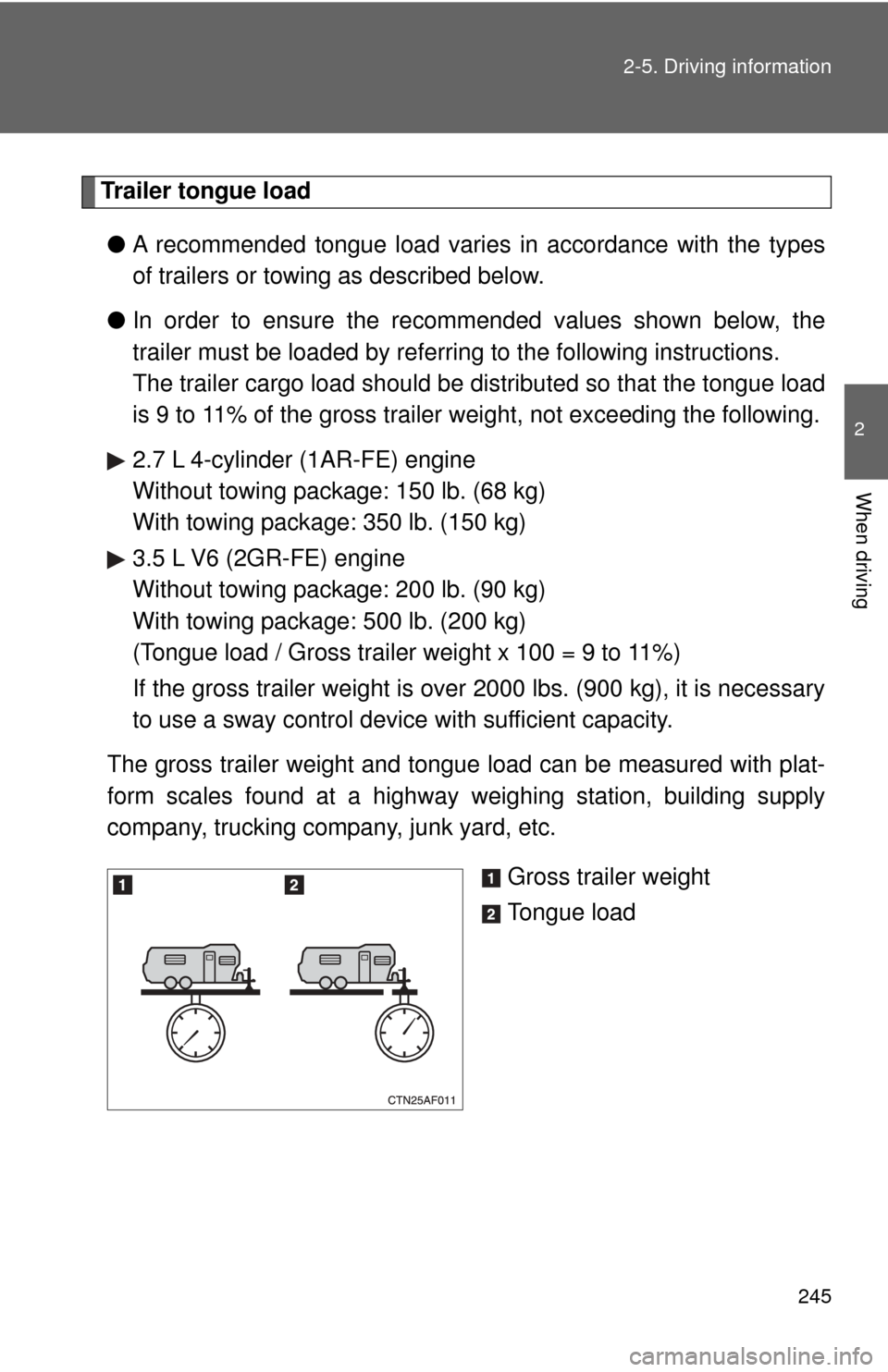
Trailer tongue load
● A recommended tongue load varies in accordance with the types
of trailers or towing as described below.
● In order to ensure the recommended values shown below, the
trailer must be loaded by referring to the following instructions.
The trailer cargo load should be di stributed so that the tongue load
is 9 to 11% of the gross trailer weight, not exceeding the following.
2.7 L 4-cylinder (1AR-FE) engine
Without towing package: 150 lb. (68 kg)
With towing package: 350 lb. (150 kg)
3.5 L V6 (2GR-FE) engine
Without towing package: 200 lb. (90 kg)
With towing package: 500 lb. (200 kg)
(Tongue load / Gross trailer weight x 100 = 9 to 11%)
If the gross trailer weight is over 2000 lbs. (900 kg), it is necessary
to use a sway control device with sufficient capacity.
The gross trailer weight and tongue l oad can be measured with plat-
form scales found at a highway weighing station, building supply
company, trucking company, junk yard, etc.
Gross trailer weight
Tongue load
Page 247 of 608

247
2-5. Driving information
2
When driving
●
Note that when making a turn, th e trailer wheels will be closer than
the vehicle wheels to the inside of the turn. Compensate by making
a larger than normal turning radius.
● Crosswinds and rough roads will adversely affect handling of your
vehicle and trailer, causing sway . Periodically check the rear to
prepare for being passed by large trucks or buses, which may
cause your vehicle and trailer to sway. If swaying occurs, firmly grip
the steering wheel, reduce speed immediately but gradually, and
steer straight ahead. Never increase speed. If you make no
extreme correction with the stee ring or brakes, your vehicle and
trailer will stabilize.
● Take care when passing other vehi cles. Passing requires consider-
able distance. After pass ing a vehicle, do not forget the length of
your trailer, and be sure you hav e plenty of room before changing
lanes.
● 2.7 L 4-cylinder (1AR-FE) engine: In order to maintain engine brak-
ing efficiency when driving on a long steep downgrade, do not use
overdrive. Transmission shift r ange position must be in 5 in S
mode.
● 3.5 L V6 (2GR-FE) engine: In order to maintain engine braking effi-
ciency when driving on a long st eep downgrade, do not use over-
drive. Transmission shift range position must be in 4 in S mode.
● Due to the added load of the trailer, your vehicle's engine may
overheat on hot days (at temperatures over 85°F [30°C]) when
driving up a long or steep grade. If the engine coolant temperature
gauge indicates overheating, immedi ately turn off the air condition-
ing (if in use), pull your vehicle off the road and stop in a safe spot.
( → P. 545)
Page 248 of 608
248 2-5. Driving information
●Always place wheel blocks under both the vehicle and the trailer
wheels when parking. Apply the parking brake firmly, and put the
transmission in P. Avoid parking on a slope, but if unavoidable, do
so only after performing the following:
Apply the brakes and keep them applied.
Have someone place wheel bloc ks under both the vehicle and
trailer wheels.
When the wheel blocks are in place, release the brakes slowly
until the blocks absorb the load.
Apply the parking brake firmly.
Shift into P and turn off the engine.
● When restarting after parking on a slope:
With the transmission in the P position, start the engine. Be
sure to keep the brake pedal pressed.
Shift into 3, 2, 1, or the R position (if reversing).
Release the parking brake and brake pedal and slowly pull or
back away from the wheel blocks. Stop and apply the brakes.
Have someone retrieve the blocks.
STEP1
STEP2
STEP3
STEP4
STEP5
STEP1
STEP2
STEP3
STEP4
Page 249 of 608

249
2-5. Driving information
2
When driving
■
Before towing
Check that the following conditions are met:
●The vehicle's tires are properly inflated. ( →P. 562)
● Trailer tires are inflated according to the trailer manufacturer's recom-
mendation.
● All trailer lights work.
● All lights work each time you connect them.
● The vehicle remains level when a loaded or unloaded trailer is hitched.
Do not drive if the vehicle is not level, and check for improper tongue
load, overloading, worn suspension, or other possible causes.
● The trailer cargo is securely loaded.
● The rear view mirrors conform to a ll applicable federal, state/provincial or
local regulations. If they do not, install rear view mirrors appropriate for
towing purposes.
■ Break-in schedule
If your vehicle is new or equipped with any new power train components
(such as an engine, transmission, differential and wheel bearing), Toyota
recommends that you do not tow a trailer until it has been driven for over
2000 miles (3200 km).
However, avoid full throttle acceleration.
■ Maintenance
●If you tow a trailer, your vehicle will require more frequent maintenance
due to the additional load. (See “Scheduled Maintenance Guide” or
“Owner’s Manual Supplement”.)
● Retighten the fixing bolts of the towing ball and bracket after approxi-
mately 600 miles (1000 km) of trailer towing.
Page 250 of 608

250 2-5. Driving information
CAUTION
■Trailer towing precautions
●Follow all the instructions described in this section. Failure to do so could
cause an accident resulting in death or serious injury.
● Exceeding the towing capacity, GVWR or GAWR can cause an accident
resulting in death or serious personal injuries.
■ To avoid accident or injury
●Do not exceed 45 mph (72 km/h) or the posted towing speed limit, which-
ever is lower. As instability (swaying) of the towing vehicle-trailer combina-
tion increases as speed increases, exceeding 45 mph (72 km/h) may
cause loss of control.
● Do not exceed the trailer hitch assembly weight, gross vehicle weight,
gross axle weight and trailer tongue load capacities.
● Never load more weight in the back than in the front of the trailer. About
60% of the load should be in the front half of the trailer, and the remaining
40% in the rear.
● Do not use cruise control when you are towing.
● Slow down and downshift before descending steep or long downhill
grades. Do not make sudden downshifts.
● Avoid holding the brake pedal down too long or applying the brakes too
frequently. This could cause the brakes to overheat and result in reduced
braking efficiency.
● Do not tow the vehicle with the compact spare tire installed.
■ Hitches
●If you wish to install a trailer hitch, contact your Toyota dealer.
● Use only a hitch that conforms to the gross trailer weight requirement.
● 2.7 L 4-cylinder (1AR-FE) engine: The towing capacity of 3500 lb. (1500
kg) can only be guaranteed when using a genuine Toyota hitch assembly
or equivalent.
● 3.5 L V6 (2GR-FE) engine: The towing capacity of 5000 lb. (2000 kg) can
only be guaranteed when using a genuine Toyota hitch assembly or equiv-
alent.
● Follow the directions supplied by the hitch manufacturer.

