Page 355 of 447
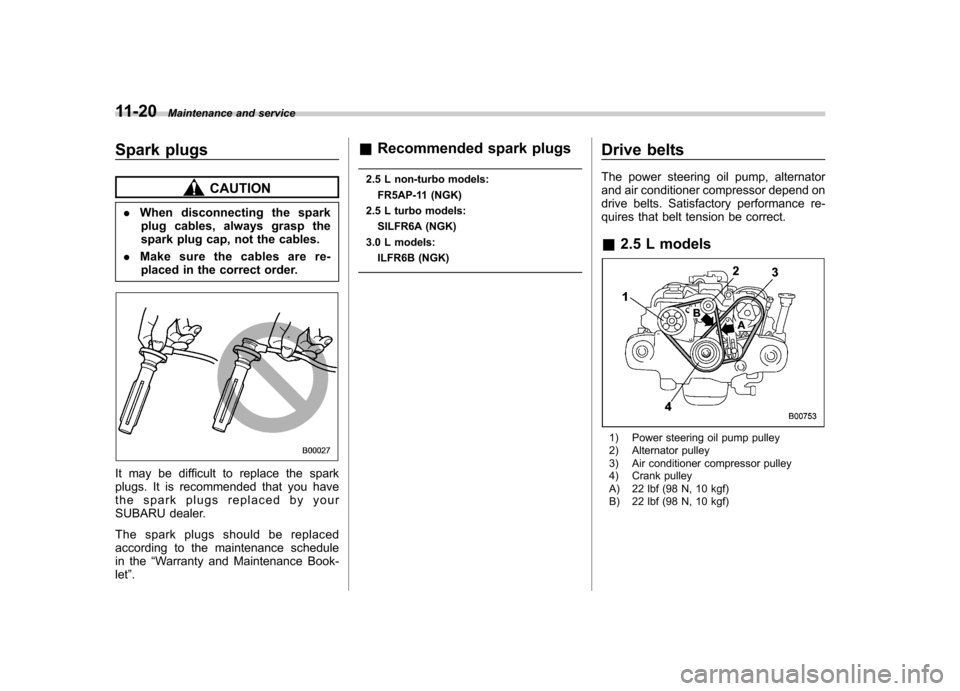
3. Release the secondary hood release
located under the front grille by moving the
lever toward the left.
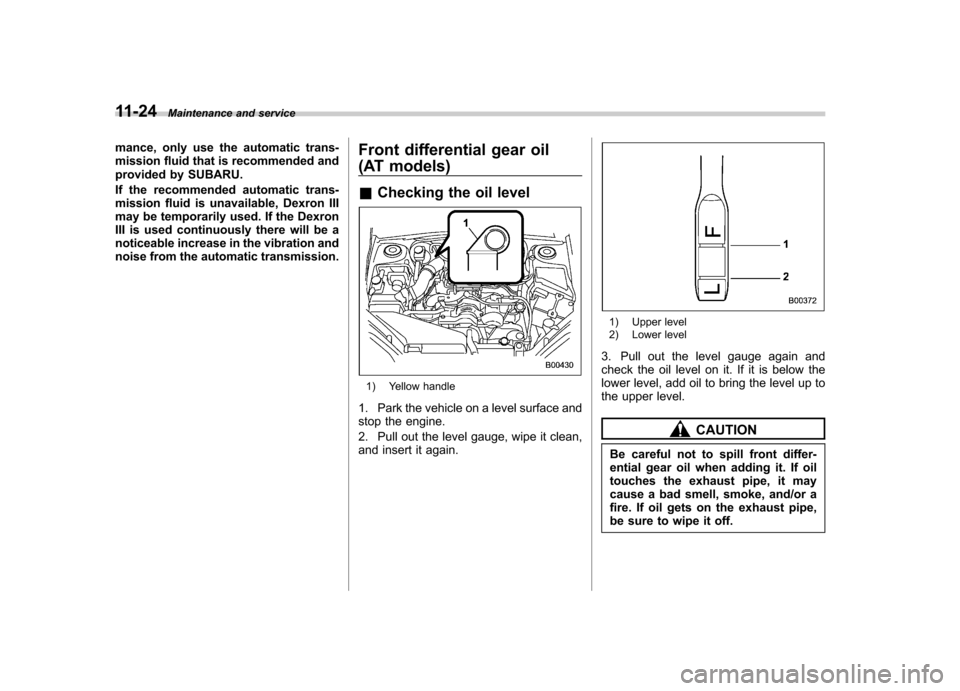
4. Lift up the hood, release the hood prop
from its retainer and put the end of the
hood prop into the slot in the hood.To close the hood:
1. Lift the hood slightly and remove the
hood prop from the slot in the hood and
return the prop to its retainer. 2.
In the case of OUTBACK models,
lower the hood to a height of approxi-
mately 5.9 in (15 cm) above its closed
position and then let it drop.
In the case of the models except OUT- BACK, lower the hood to a height of
approximately 12 in (30 cm) above its
closed position and then let it drop.
3. After closing the hood, be sure the
hood is securely locked.
If this does not close the hood, release it
from a slightly higher position. Do not push
the hood forcibly to close it. It could
deform the metal.
WARNING
Always check that the hood is
properly locked before you start
driving. If it is not, it might fly open
while the vehicle is moving and
block your view, which may cause
an accident and serious bodily in-
jury. Maintenance and service
11-5
Page 359 of 447
Engine oil NOTE .The engine oil consumption rate is
not stabilized, and therefore cannot be
determined until the vehicle has tra-
veled at least several thousand miles
(kilometers). Even after break-in, when
the vehicle is used under severe driv-
ing conditions such as those men-
tionedintheWarrantyandMainte-
nance Booklet, engine oil is consumed
or deteriorated more quickly than un-
der normal driving conditions. If you
drive your vehicle under these severe
conditions, you should check the oil
level at least at every second fuel fill-up
time, and change the oil more fre-
quently. Please refer to the Warranty
and Maintenance Booklet for more de-tails.. If the oil consumption rate seems
abnormally high after the break-in
period, for example more than 1 quart
per 1,200 miles or 1 liter per 2,000
kilometers, we recommend that you
contact your SUBARU dealer. &
Checking the oil level
Check the engine oil level at each fuelstop.
1. Park the vehicle on a level surface and
stop the engine. If you check the oil level
just after stopping the engine, wait a few
minutes for the oil to drain back into the oil
pan before checking the level.
2. Pull out the level gauge, wipe it clean,
and insert it again.
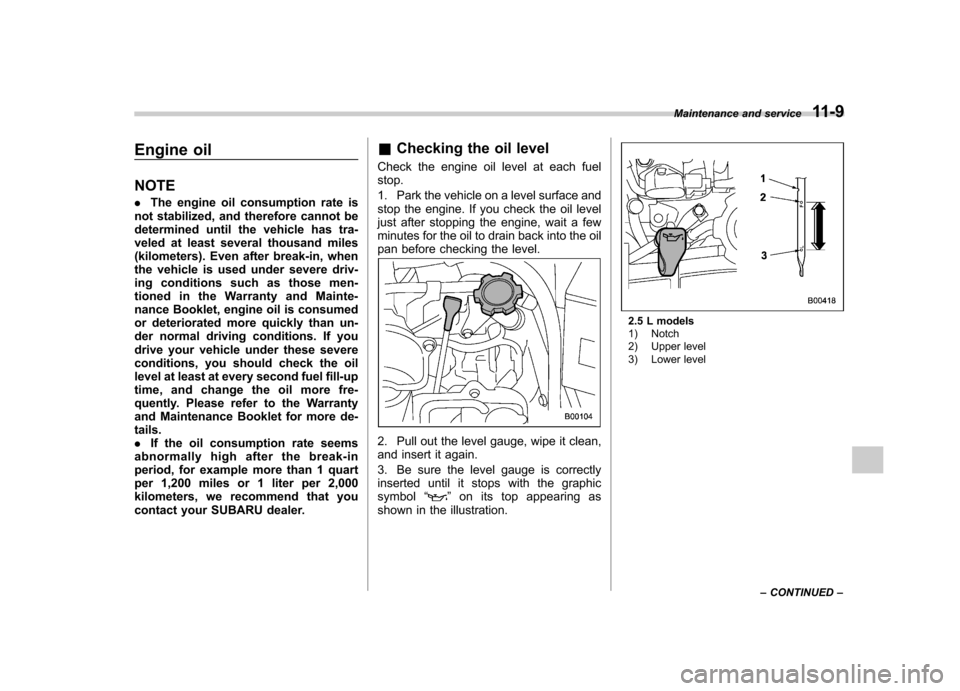
3. Be sure the level gauge is correctly
inserted until it stops with the graphic
symbol “
”on its top appearing as
shown in the illustration.
2.5 L models
1) Notch
2) Upper level
3) Lower level Maintenance and service
11-9
– CONTINUED –
Page 360 of 447
11-10Maintenance and service
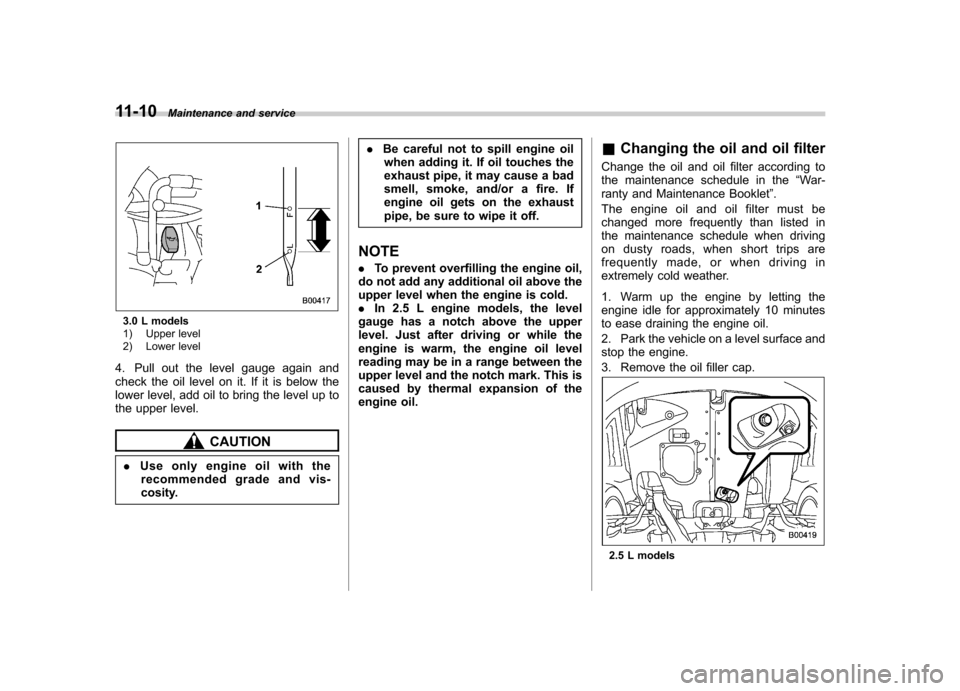
3.0 L models
1) Upper level
2) Lower level
4. Pull out the level gauge again and
check the oil level on it. If it is below the
lower level, add oil to bring the level up to
the upper level.
CAUTION
. Use only engine oil with the
recommended grade and vis-
cosity. .
Be careful not to spill engine oil
when adding it. If oil touches the
exhaust pipe, it may cause a bad
smell, smoke, and/or a fire. If
engine oil gets on the exhaust
pipe, be sure to wipe it off.
NOTE . To prevent overfilling the engine oil,
do not add any additional oil above the
upper level when the engine is cold.. In 2.5 L engine models, the level
gauge has a notch above the upper
level. Just after driving or while the
engine is warm, the engine oil level
reading may be in a range between the
upper level and the notch mark. This is
caused by thermal expansion of the
engine oil. &
Changing the oil and oil filter
Change the oil and oil filter according to
the maintenance schedule in the “War-
ranty and Maintenance Booklet ”.
The engine oil and oil filter must be
changed more frequently than listed in
the maintenance schedule when driving
on dusty roads, when short trips are
frequently made, or when driving in
extremely cold weather.
1. Warm up the engine by letting the
engine idle for approximately 10 minutes
to ease draining the engine oil.
2. Park the vehicle on a level surface and
stop the engine.
3. Remove the oil filler cap.
2.5 L models
Page 362 of 447
11-12Maintenance and service
9. Clean the rubber seal seating area of
the bottom of engine and install the oil
filter by hand turning. Be careful not to
twist or damage the seal.
10. Tighten the oil filter by the amount
indicated in the following table after the
seal makes contact with the bottom ofengine.
Model Oil filter
color Part
number Amount of
rotation
2.5 L models Black 15208AA100 1 rotation
Blue 15208AA12A 7/8
rotation
3.0 L models Black 15208AA031 3/4
rotationCAUTION
. Never over tighten the oil filter
because that can result in an oil leak.
. Thoroughly wipe off any engine
oil that has spilled over the
exhaust pipe and/or under-cover.
If left unremoved, the oil could
catch fire.
11. Reinstall the cover under the oil filter.
12. Pour engine oil through the filler neck. Oil capacity (guideline): 2.5 L models: 4.2 US qt (4.0 liters, 3.5 Imp qt)
3.0 L models: 5.8 US qt (5.5 liters, 4.8 Imp qt)
The oil quantity indicated above is only a
guideline. The necessary quantity of oil
depends on the quantity of oil that has
been drained. The quantity of drained oil
differs slightly depending on the tempera-
ture of the oil and the time the oil is left
flowing out. After refilling the engine with
oil, therefore, you must use the level
gauge to confirm that the level is correct.
13. Start the engine and make sure that no
oil leaks appear around the filter ’s rubber seal and drain plug.
14. Keep the engine idling until the engine
reaches the normal operating temperature
range, as indicated by the temperature
gauge on the combination meter. After
that, check the engine oil level again. For
further details about the check procedure,
refer to
“Checking the oil level ”in this
section. & Recommended grade and viscosity
CAUTION
Use only engine oil with the recom-
mended grade and viscosity.
Oil grade: –ILSAC GF-4, which can be identified
with the ILSAC certification mark (Star-
burst mark) – or API classification SM with the words
“ ENERGY CONSERVING ”
These recommended oil grades can be
identified by looking for either or both of
the following marks displayed on the oil
container.
Page 368 of 447

11-18Maintenance and service
& Replacing the air cleaner element
Replace the air cleaner element according
to the maintenance schedule in the“ Warranty and Maintenance Booklet ”. Un-
der extremely dusty conditions, replace it
more frequently. It is recommended that
you always use genuine SUBARU parts. ! Non-turbo models
1) Connector
2) Duct
3) Clamp
1. Unplug the connector that is attached
to the top of the air cleaner case.
2. Remove the hose that is located at the
bottom of the side surface of the air
cleaner case. 3. Undo the screw and pull the air duct
out of the air cleaner case.
4. Unsnap the two clamps holding the air
cleaner case cover.
5. Open the air cleaner case cover and
remove the air cleaner element.
6. Clean the inside of the air cleaner
cover and case with a damp cloth and
install a new air cleaner element.
7. To install the air cleaner case cover,
insert the three projections on the air
cleaner case cover into the slits on the
air cleaner case and then snap the two
clamps on the air cleaner case cover.
Page 370 of 447
11-20Maintenance and service
Spark plugs
CAUTION
. When disconnecting the spark
plug cables, always grasp the
spark plug cap, not the cables.
. Make sure the cables are re-
placed in the correct order.
It may be difficult to replace the spark
plugs. It is recommended that you have
the spark plugs replaced by your
SUBARU dealer.
The spark plugs should be replaced
according to the maintenance schedule
in the “Warranty and Maintenance Book-
let ”. &
Recommended spark plugs
2.5 L non-turbo models: FR5AP-11 (NGK)
2.5 L turbo models:
SILFR6A (NGK)
3.0 L models: ILFR6B (NGK) Drive belts
The power steering oil pump, alternator
and air conditioner compressor depend on
drive belts. Satisfactory performance re-
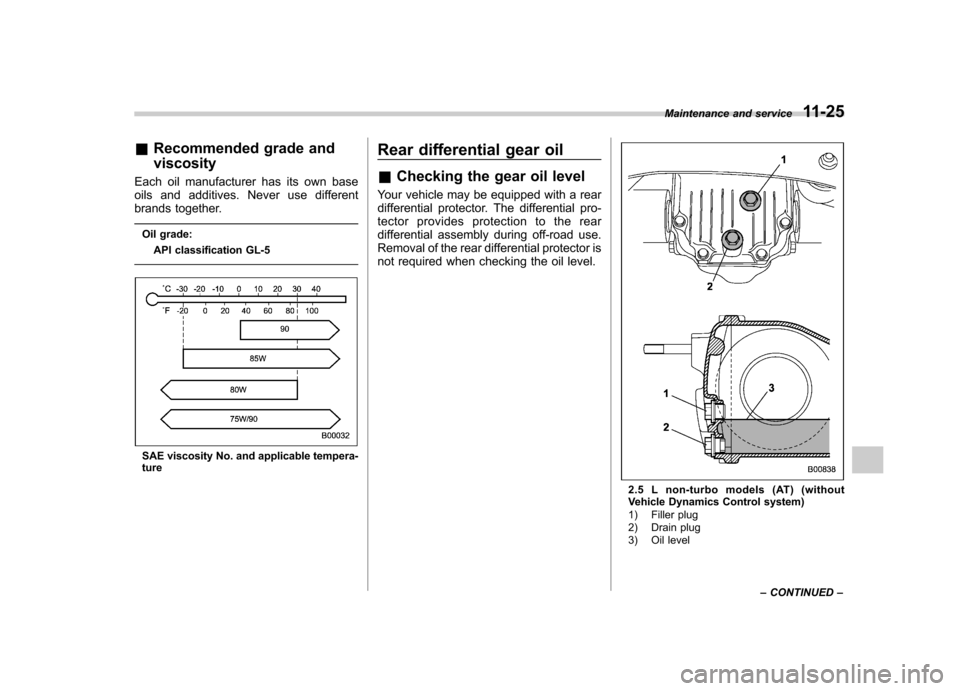
quires that belt tension be correct. &
2.5 L models
1) Power steering oil pump pulley
2) Alternator pulley
3) Air conditioner compressor pulley
4) Crank pulley
A) 22 lbf (98 N, 10 kgf)
B) 22 lbf (98 N, 10 kgf)
Page 374 of 447
11-24Maintenance and service
mance, only use the automatic trans-
mission fluid that is recommended and
provided by SUBARU.
If the recommended automatic trans-
mission fluid is unavailable, Dexron III
may be temporarily used. If the Dexron
III is used continuously there will be a
noticeable increase in the vibration and
noise from the automatic transmission. Front differential gear oil
(AT models) &
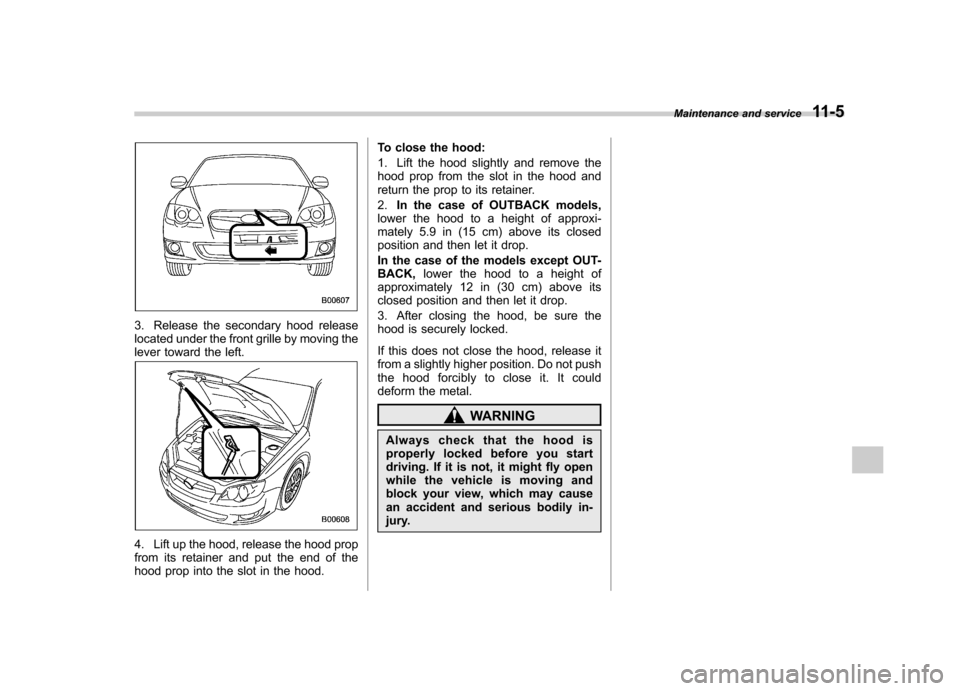
Checking the oil level
1) Yellow handle
1. Park the vehicle on a level surface and
stop the engine.
2. Pull out the level gauge, wipe it clean,
and insert it again.
1) Upper level
2) Lower level
3. Pull out the level gauge again and
check the oil level on it. If it is below the
lower level, add oil to bring the level up to
the upper level.
CAUTION
Be careful not to spill front differ-
ential gear oil when adding it. If oil
touches the exhaust pipe, it may
cause a bad smell, smoke, and/or a
fire. If oil gets on the exhaust pipe,
be sure to wipe it off.
Page 375 of 447
&Recommended grade and viscosity
Each oil manufacturer has its own base
oils and additives. Never use different
brands together.
Oil grade: API classification GL-5
SAE viscosity No. and applicable tempera- ture Rear differential gear oil &
Checking the gear oil level
Your vehicle may be equipped with a rear
differential protector. The differential pro-
tector provides protection to the rear
differential assembly during off-road use.
Removal of the rear differential protector is
not required when checking the oil level.
2.5 L non-turbo models (AT) (without
Vehicle Dynamics Control system)
1) Filler plug
2) Drain plug
3) Oil level Maintenance and service
11-25
– CONTINUED –