2009 SUBARU OUTBACK ECO mode
[x] Cancel search: ECO modePage 379 of 447
.When adding brake fluid, be care-
ful not to allow any dirt into the
reservoir.
. Never splash the brake fluid over
painted surfaces or rubber parts.
Alcohol contained in the brake
fluid may damage them.
. Be careful not to spill brake fluid
when adding it. If brake fluid
touches the exhaust pipe, it may
cause a bad smell, smoke, and/or
a fire. If brake fluid gets on the
exhaust pipe, be sure to wipe itoff.
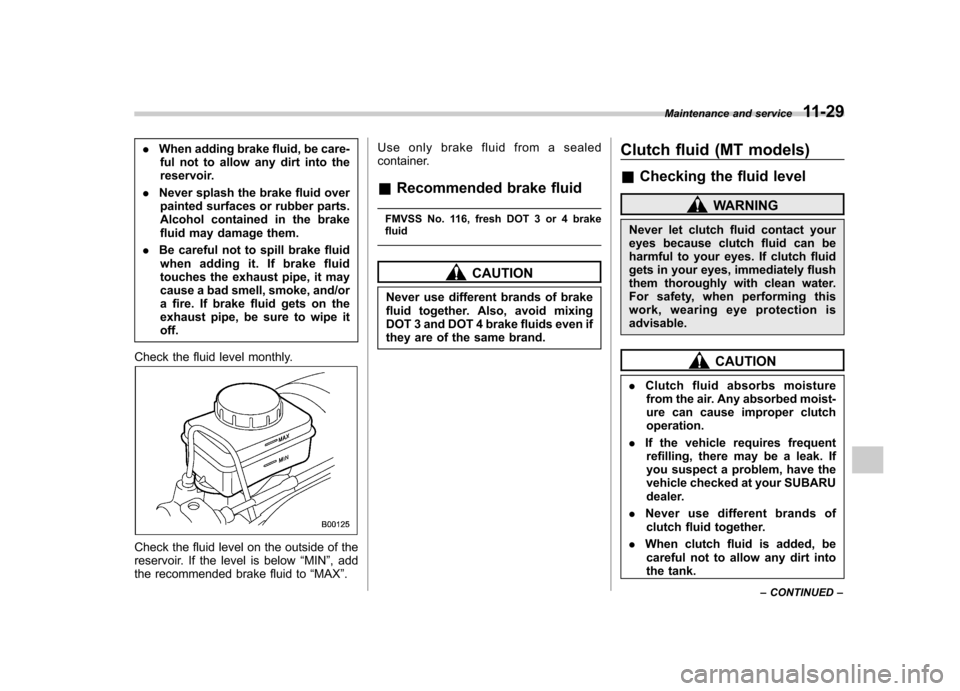
Check the fluid level monthly.
Check the fluid level on the outside of the
reservoir. If the level is below “MIN ”, add
the recommended brake fluid to “MAX ”. Use only brake fluid from a sealed
container.
& Recommended brake fluid
FMVSS No. 116, fresh DOT 3 or 4 brake fluid
CAUTION
Never use different brands of brake
fluid together. Also, avoid mixing
DOT 3 and DOT 4 brake fluids even if
they are of the same brand. Clutch fluid (MT models) &
Checking the fluid level
WARNING
Never let clutch fluid contact your
eyes because clutch fluid can be
harmful to your eyes. If clutch fluid
gets in your eyes, immediately flush
them thoroughly with clean water.
For safety, when performing this
work, wearing eye protection isadvisable.
CAUTION
. Clutch fluid absorbs moisture
from the air. Any absorbed moist-
ure can cause improper clutchoperation.
. If the vehicle requires frequent
refilling, there may be a leak. If
you suspect a problem, have the
vehicle checked at your SUBARU
dealer.
. Never use different brands of
clutch fluid together.
. When clutch fluid is added, be
careful not to allow any dirt into
the tank. Maintenance and service
11-29
– CONTINUED –
Page 417 of 447
12-8Specifications
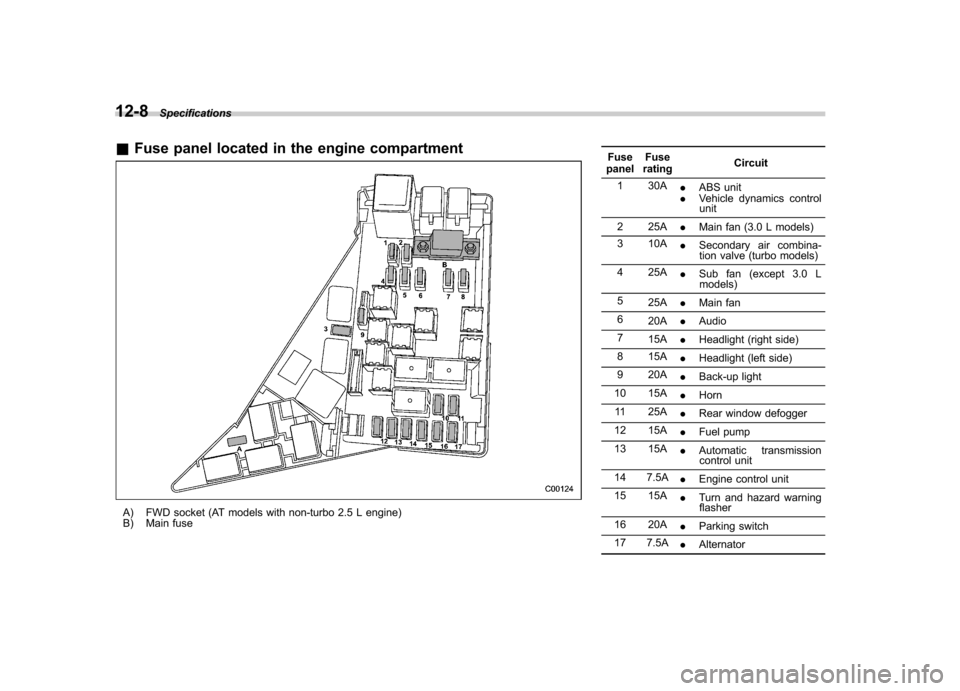
&Fuse panel located in the engine compartment
A) FWD socket (AT models with non-turbo 2.5 L engine)
B) Main fuse Fuse
panel Fuse
rating Circuit
1 30A .ABS unit
. Vehicle dynamics control
unit
2 25A .Main fan (3.0 L models)
3 10A .Secondary air combina-
tion valve (turbo models)
4 25A .Sub fan (except 3.0 L
models)
5 25A .Main fan
6 20A .Audio
7 15A .Headlight (right side)
8 15A .Headlight (left side)
9 20A .Back-up light
10 15A .Horn
11 25A .Rear window defogger
12 15A .Fuel pump
13 15A .Automatic transmission
control unit
14 7.5A .Engine control unit
15 15A .Turn and hazard warning
flasher
16 20A .Parking switch
17 7.5A .Alternator
Page 425 of 447

&Recommended tire inflation pressure
! Recommended cold tire inflation pressure
Recommended cold tire inflation pressure for your vehicle ’s tires is as follows,
Tire size P205/
55R16 89H P225/
60R16 97H P205/
50R17 88V 215/
45R17 91W P225/
55R17 95V 215/
45R18 89Y P215/
45R18 89W
Wheel size 16 66.5JJ 17 67JJ 18 67JJ
Pres- sure Front
32 psi
(220 kPa,
2.2 kgf/cm
2) 32 psi
(220 kPa,
2.2 kgf/cm2) 33 psi
(230 kPa,
2.3 kgf/cm2) 35 psi
(240 kPa,
2.4 kgf/cm2) 32 psi
(220 kPa,
2.2 kgf/cm2) 33 psi
(230 kPa,
2.3 kgf/cm2)
Rear 30 psi
(210 kPa,
2.1 kgf/cm
2) 30 psi
(210 kPa,
2.1 kgf/cm2) 32 psi
(220 kPa,
2.2 kgf/cm2) 33 psi
(230 kPa,
2.3 kgf/cm2) 30 psi
(210 kPa,
2.1 kgf/cm2) 32 psi
(220 kPa,
2.2 kgf/cm2)
Rear at trailertowing –32 psi
(220 kPa,
2.2 kgf/cm
2) –
32 psi
(220 kPa,
2.2 kgf/cm2) –
Tem-poraryspare tire Size
T135/
80R16 T155/
70D17 T135/
80R16 T135/
70D17
*1
T135/
80R16*2
T155/
70D17 T155/70D17
Pres- sure 60 psi (420 kPa, 4.2 kgf/cm
2)
*1: 2.5 GT Limited model
*2: 3.0 R model Consumer information and Reporting safety defects
13-5
– CONTINUED –
Page 427 of 447

whitewall, bears white lettering
or bears manufacturer, brand,
and/or model name molding that
is higher or deeper than the
same molding on the other side-
wall of the tire, or (2)The outward facing sidewall
of an asymmetrical tire that has
a particular side that must al-
ways face outward when mount-
ing on a vehicle.
. Accessory weight
The combined weight (in excess of
those standard items which may be
replaced) of floor mats, leather
seats and cross bars to the extent
that these items are available as
factory-installed equipment
(whether installed or not). . Curb weight
The weight of a motor vehicle with
standard equipment including the
maximum capacity of fuel, oil, and
coolant and air conditioning. . Maximum loaded vehicle weight
The sum of curb weight, accessory
weight, vehicle capacity weight and production options weight.
. Normal occupant weight
150 lbs (68 kg) times the number of
occupants (3 occupants). . Occupant distribution
Distribution of occupants in a vehi-
cle, 2 in front, 1 in rear seat.. Production options weight
The combined weight of those
installed regular production options
weighing over 5.1 lbs (2.3 kg) in
excess of those standards items
which they replace, not previously
considered in curb weight or acces-
sory weight. . Vehicle capacity weight
The total weight of cargo, luggage
and occupants that can be added to
the vehicle. . Vehicle maximum load on a tire
Load on an individual tire that is
determined by distributing to each
axle its share of the maximum
loaded vehicle weight and dividing
by two. . Vehicle normal load on a tire
Load on an individual tire that is determined by distributing to each
axle its share of the curb weight,
accessory weight, and normal oc-
cupant weight and dividing by two. &
Tire care –maintenance and
safety practices
. Check on a daily basis that the
tires are free from serious damage,
nails, and stones. At the same time,
check the tires for abnormal wear.. Inspect the tire tread regularly
and replace the tires before their
tread wear indicators become visi-
ble. When a tire ’s tread wear
indicator becomes visible, the tire
is worn beyond the acceptable limit
and must be replaced immediately.
With a tire in this condition, driving
at even low speeds in wet weather
can cause the vehicle to hydro-
plane. Possible resulting loss of
vehicle control can lead to anaccident. . To maximize the life of each tire
and ensure that the tires wear
uniformly, it is best to rotate the
Consumer information and Reporting safety defects
13-7
– CONTINUED –
Page 439 of 447

Front turn signal/Parking and front side marker ............. 11-53
Fuel ........................................................................... 7-3
Economy hints ......................................................... 8-2
Filler lid and cap ...................................................... 7-5
Gauge ............................................................ 3-6, 3-26
Requirements .......................................................... 7-3
Fuses ...................................................................... 11-47
Fuses and circuits ...................................................... 12-6
G
GAWR (Gross Axle Weight Rating) .............................. 8-15
Gear position indicator ................................................ 3-39
Glove box ................................................................... 6-5
GVWR (Gross Vehicle Weight Rating) .......................... 8-15
H
Hazard warning flasher ........................................... 3-5, 9-2
Head restraint adjustment Front seat ............................................................... 1-7
Rearseat ............................................................... 1-10
Headlight Flasher ................................................................. 3-47
Indicator light ......................................................... 3-40
Headlights ........................................................ 3-46, 11-51
Heater operation (manual climate control system) ............ 4-5
High beam indicator light ............................................ 3-40
High mount stop light ................................................. 11-59
High/low beam change (dimmer) .................................. 3-46
Horn ......................................................................... 3-59
Hose and connections ............................................... 11-14 I
Ignition switch
............................................................. 3-3
Light ...................................................................... 3-5
Illumination brightness control ...................................... 3-48
Immobilizer ................................................................. 2-3
Indicator light (security indicator light) ................. 2-4, 3-38
Indicator light
Cruise control ................................................ 3-40, 7-49
Cruise control set ........................................... 3-40, 7-50
Front fog light ......................................................... 3-40
Headlight ............................................................... 3-40
High beam ............................................................. 3-40
Immobilizer ............................................................. 2-4
S# PREP .............................................................. 3-39
Security .......................................................... 2-4, 3-38
Selector lever position ............................................. 3-39
Selector lever/Gear position ..................................... 3-40
Shift-up ................................................................. 3-38
SPORT mode ........................................................ 3-38
Traction control system OFF .................................... 3-37
Turn signal ............................................................ 3-40
Vehicle Dynamics Control OFF ......................... 3-38, 7-40
Vehicle Dynamics Control operation .................. 3-37, 7-40
Information display ...................................................... 3-41
Inside mirror .............................................................. 3-56
Interior lights ............................................................... 6-2
Internal trunk lid release handle .................................... 2-25
JJack. ......................................................................... 9-18
Jack handle ............................................................... 9-19 Index
14-5
Page 446 of 447

GAS STATION REFERENCE
& Fuel:
! 2.5 L non-turbo models
Use only unleaded gasoline with an octane rating of 87 AKI or
higher .
! 2.5 L turbo models
Use premium unleaded gasoline with an octane rating of 91
AKI or higher . For temporary purposes if premium unleaded
gasoline is not available, you may use regular unleaded
gasoline with an octane rating of 87 AKI or higher. For optimum
engine performance and driveability, it is required that you use
premium grade unleaded gasoline. ! 3.0 L models
Use unleaded gasoline with an octane rating of 91 AKI or
higher . Regular unleaded gasoline with an octane rating of 87
AKI or higher may be used. However for optimum engine
performance and driveability, it is recommended that you use
91 AKI or higher grade unleaded gasoline. You may experience
reduced output, poor accelerator response, and reduced fuel
economy when using gasoline with an octane rating lower than
91 AKI, depending on your driving habits and conditions. If you
experience any of these conditions while using a lower octane
rated fuel, you may want to return to using 91 AKI octane rated
fuel as soon as possible. Additionally, if your vehicle knocks
heavily or persistently, or if you are driving with heavy loads
such as when towing a trailer, the use of 91 AKI or higher grade
unleaded gasoline is required. &
Fuel octane rating
This octane rating is the average of the Research Octane and
Motor Octane numbers and is commonly referred to as the Anti
Knock Index (AKI). Refer to “Fuel ”section in this manual.
& Fuel capacity:
16.9 US gal (64 liters, 14.1 Imp gal) & Engine oil:
Use only API classification SM with the words “ENERGY
CONSERVING ”or ILSAC GF-4, which can be identified with
the ILSAC certification mark (Starburst mark).& Engine oil capacity:
2.5 L models: 4.2 US qt (4.0 liters, 3.5 Imp qt)
3.0 L models: 5.8 US qt (5.5 liters, 4.8 Imp qt)