2009 SKODA YETI warning light
[x] Cancel search: warning lightPage 102 of 271

Heating and air conditioning system
101
Using the system
Safety
Driving Tips
General Maintenance
Breakdown assistance
Technical Data
Recirculated air mode In recirculated air mode air is sucked out of the interior of the vehicle and then fed back into the interior.Recirculated air mode prevents polluted air
outside the vehicle from getting into the
vehicle, for example when driving through a
tunnel or when standi
ng in a traffic jam.
Switching recirculated air mode on– Press the button
⇒page 99, fig. 109
the warning light lights up in the
button.
Switching recirculated air mode off– Press again the button - the warning light in the button goes out. The recirculated air mode is switched off automatically if the air distribution control is in position
⇒page 99, fig. 109
. You can also switch recirculated air mode on
again from this setting by re
peatedly pressing button .
WARNING
You should not leave recirculated air mode on over a longer period of time, as “stale” air may result in fatigue in the driver and occupants, divert your atten- tion and also cause the windows to mist up. The risk of having an accident increases. Switch recirculated air mode off as soon as the windows begin misting up.Using the air conditioning system economicallyThe compressor on the air conditioning syst
em uses power from the engine when in
cooling mode which will effect the fuel consumption. It recommended to open the windows or the
doors of a vehicle for which the interior
has been strongly heated through the effect
of direct sunlight in order to allow the
heated air to escape. The cooling system should not be switched
on while travelling when the window is
open.
The desired interior temperature can also be achieved without switching in the cooling system just by switching to fresh air mode.
For the sake of the environment
When you economize on fuel, you
also reduce pollutant emissions.
Operational problemsIf the cooling system does not operate at outside temperatures higher than +5 °C, there is a problem in the system. The reasons for this may be:•
The fuse on the air conditioning system has blown. Check the fuse, replace it if
necessary
⇒page 233.
•
The cooling system has switched off auto
matically for a short time because the
coolant temperature of the engine is too hot
⇒page 17.
If you are not able to rectify the operational
problem yourself, or if the cooling capacity
decreases, switch the cooling system off. Contact a specialist garage.Climatronic* (automatic air conditioning)Description The Climatronic system is a combination of an automatic heating, fresh air and cooling system which provides optimal comfort for the occu-pants of the car.The Climatronic maintains fully automatically a convenience temperature. This is achieved by automatically varying the temperature of the outflowing air, the blower stages and the air distribution. The system also takes into account sunlight which elim- inates the need to alter the settings manually. The
automatic mode
⇒page 103
ensures maximum wellbeing of the occupants at all times of the year. Description of Climatronic system The cooling operates only if the following conditions are met:•
engine running,
A4
AC
sgg.6.book Page 101 Thursday, September 24, 2009 2:32 PM
Page 103 of 271

Heating and air conditioning system
102
•
outside temperature above approx. +2°C,
•
switched on.
If the cooling system is switched on, the temperature and air humidity drops in the vehicle. The wellbeing of the occupants of the
car is enhanced as a result of this partic-
ularly at high outside temperatures and a
high air humidity. The system prevents the
windows misting up during the cold season of the year. The heating effect is dependent upon the c
oolant temperature, thus
full heat output
only occurs when the engine has reached its operating temperature. It is possible to briefly activate recirculat
ed air mode in order to enhance the cooling
effect
⇒page 104.
The air inlet in front of the windscreen must
be free of ice, snow or leaves in order to
ensure that the heating and cooling systems operate properly. The AC compressor is switched off at a hi
gh coolant temperature in order to provide
cooling at a high load of the engine. After switching on the cooling
Condensation
from the evaporator of the air condi-
tioning may drip down and form a puddle be
low the vehicle. This is quite normal and
not an indication of a leak! Recommended setting for all periods of the year:•
Set the desired temperature, we recommend 22 °C.
•
Press the button
⇒page 103, fig. 110
.
•
Move the air outlet vents
3 and
4, so that the air flow is
directed slightly upwards.
WARNING
•
For your own safety and that of other road users, ensure that all the
windows are free of ice, snow and mistin
g. Please familiarize yourself about
how to correctly operate th
e heating and ventilation systems, how to demist
and defrost the windows, as well as with the cooling mode.•
You should not leave recirculated air mode on over a longer period of time,
as “stale” air may result in fatigue in the driver and occupants, divert your attention and also cause the windows to mist up. The risk of having an accident increases. Switch recirculated air mode off as soon as the windows begin misting up.
Note
•
If the cooling system has not been switched on for a lengthy period, odours may
be produced at the evaporator because of
deposits. Switch the cooling system on at
least once a month for approximately 5 minut
es at the highest blower stage - also
during the cold season of the year - in order to remove such odours. Also open a window for a short time.•
We recommend that you do not smoke in
the vehicle when the recirculating air
mode is operating since the smoke which is
drawn at the evaporator from the interior
of the vehicle forms deposits in the evapor
ator of the air conditioning system. This
produces a permanent odour when the air conditioning system is operating which can only be eliminated through considerable
effort and expense (replacement of
compressor).•
The used air streams out through the air
removal openings in the luggage compart-
ment.•
On vehicles equipped with a factory-fitted
radio* or navigation*, the information
of the Climatronic is also shown on the display. This function can be switched off, see operating instructions of the ra
dio* or the navigation system*.
•
Using the cooling economically
⇒page 101.
•
Operational problems
⇒page 101.
AC
AUTO
sgg.6.book Page 102 Thursday, September 24, 2009 2:32 PM
Page 104 of 271

Heating and air conditioning system
103
Using the system
Safety
Driving Tips
General Maintenance
Breakdown assistance
Technical Data
Overview of the control elements The controls enable a separate setting of the temperature for the left and right side.Fig. 110 Climatronic: Control elementsThe buttons
Defrost windscreen intensively Air flow to the windows Air flow to head Air flow in the footwell Recirculated air mode
with air quality sensor
Rear window heater
Buttons / control dial
Setting of the temperature for the left side, operation of the seat heating of the left front seat* Automatic mode Switching off Climatronic Setting the blower speed Button for direct switching on/off of auxiliary heating (auxiliary heating)* ⇒ page 105 Switching on/off of the temperature setting in dual mode
Switching cooling on and off Setting of the temperature for the right side, operation of the seat heating of the right front seat*Note
Below the top row of buttons is located the interior temperature sensor. Do not glue or cover over the sensor, otherwise it co
uld have an unfavourable effect on the
Climatronic.Automatic mode The automatic mode is used in orde
r to maintain a constant tempera-
ture and to demist the windows in the interior of the car.Switching automatic mode on– Set a temperature between +18 °C and +26 °C. – Move the air outlet vents
3 and
4 ⇒page 95, fig. 106
, so that the air flow is directed
slightly upwards.
– Press the button . In the right or left top corner a warning light lights up,
depending on which unit was last selected.
If the warning light in the top right corner of the button lights up, the Climatronic operates in “HIGH” mode. The “HIGH” mode is the standard setting of the Climatronic. When pressing again the button , the Cl
imatronic changes into the “LOW” mode
and the warning light in the top left corner lights up. The Climatronic uses only in this mode the lower blower speed. However taking
into account the no
ise level, this is
more comfortable, yet be aware that the effectiveness of the air conditioning system is reduced particularly if th
e vehicle is fully occupied.
By pressing again the button , yo
u change into the “HIGH” mode.
The automatic mode is switched off by pres
sing the button for the air distribution or
increasing or decreasing the blower speed. The temperature is nevertheless regulated.
A1
A2
A3
A4
A5
A6
A7A8
AUTO
A9
OFF
A10
A11
A12
DUAL
A13
AC
A14
AUTO
AUTO
AUTOAUTO
sgg.6.book Page 103 Thursday, September 24, 2009 2:32 PM
Page 105 of 271

Heating and air conditioning system
104
Switching cooling on and offSwitching cooling on and off–Press the button
⇒page 103, fig. 110
. The warning light lights up in the button.
– When you again press the switch , the cooling system is switched off. The
warning light in the button goes out. Only
the function of the ventilation remains
active when no lower temperature than the outside temperature can be reached.
Setting temperatureYou can separate the interior temperature for the left and right side separately. – You can set the temperature for both sides
after switching on the ignition with the
control dial .
– If you wish to set the temperature for the right side, turn the control dial . The
warning light in the button lights up,
this indicates that differing tempera-
tures for the left and right side can be set.
If the warning light in the button lights up, the temperature for both sides cannot be set with the control dial . You can
reinitiate this functi
on by pressing the
button . The warning light in the button which indicates the possibility to set differing temperatures for the left and right side, goes out. You can set the interior temperature between +18°C and +26°C. The interior temper- ature is regulated automatically within this
range. If you chose a temperature lower
than +18°C, a blue symbol lights up at the
start of the numerical
scale. If you chose a
temperature higher than +26°C, a red symbol lights up at the end of the numerical scale. In both limit positions the Climatroni
c operates at maximum cooling or heating
capacity, respectively. The temperatur
e is not controlled in this case.
Lengthy and uneven distri
bution of the air flow out of the vents (in particular at the leg
area) and large differences in temperature, for example when getting out of the vehicle, can result in chills in sensitive persons.
Recirculated air mode In recirculated air mode air is sucked out of the interior of the vehicle and then fed back into the interior. When the automatic air distribution control is switched on, an air quality sensor measures the concentration of pollutants in the drawn-in air.Recirculated air mode prevents polluted air outside the vehicle from getting into the vehicle, for example when driving through a tunn
el or when standing in a traffic jam. If
a considerable increase in concentration of
pollutants is recognized by the air quality
sensor, when the automatic air distribution co
ntrol is switched on, the air distribution
control will temporarily be switched off. If
the concentration of po
llutants decreases to
the normal level, the air distribution control
is automatically switched off so that fresh
air can be guided into
the vehicle interior.
Switching recirculated air mode on– Press the button repeatedly
until the warning light on the left side of the
button lights up.
Switch on automatic air distribution control– Press the button repeatedly
until the warning light on the right side of the
button lights up.
Switch off automatic air distribution control temporarily– If the air quality sensor does not switch on
the air distribution control automatically
when there is a nauseating smell, you can
switch it on yourself by pressing the
button *. The warning light lights up
in the button on the left side.
Switching recirculated air mode off– Press the button or press the button repetitively, until the warning
lights in the button go out.
WARNING
You should not leave recirculated air mode on over a longer period of time, as “stale” air may result in fatigue in the driver and occupants, divert your atten-
AC
AC
A7
A14
DUALDUALA7
DUAL
AUTO
sgg.6.book Page 104 Thursday, September 24, 2009 2:32 PM
Page 106 of 271

Heating and air conditioning system
105
Using the system
Safety
Driving Tips
General Maintenance
Breakdown assistance
Technical Data
tion and also cause the windows to mist up. The risk of having an accident increases. Switch recirculated air mode off as soon as the windows begin misting up.
Note
If the windscreen mists up, press the button
⇒page 103, fig. 110
. After the
windscreen has been demisted, press the button .•
The automatic air distribution control operates only if the outside temperature is
higher than approx. 2°C.Controlling blower There are a total of seven blower stages available.The Climatronic system controls the blower st
ages automatically in line with the inte-
rior temperature. You can also
, howev er, a dapt the bl ower stage s ma nua lly to sui t y our
particular needs. – Press again the button on the left side (reduce blower speed) or on the right
side (increase blower speed).
If you switch off the blower, the Climatronic is switched off. The set blower speed is displayed above the button when the respective number of warning lights come on.
WARNING
•
“Stale air” may result in fatigue in the driver and occupants, reduce atten-
tion levels and also cause the windows to mist up. The risk of having an accident increases.•
Do not switch the Climatronic system off for longer than necessary.
•
Switch the Climatronic system on as soon as the windows mist up.
Defrosting windscreenDefrosting windscreen - switching on– Press the button
⇒page 103, fig. 110
.
Defrosting windscreen - switching off– Once again press the button or the button . The temperature control is controlled automatically. More air flows out of the air outlet vents
1 and
2.
Auxiliary heating (auxiliary heating and ventilation)*Description and important information The auxiliary heating (auxiliary he
ating and ventilation) heats or
supplies the interior of the vehicl
e with fresh air independent of the
engine.Auxiliary heating (auxiliary heating) The auxiliary heating (auxiliary heating) functions in connection with the Climatic or Climatronic. It can be used when stationary, when engi
ne is switched off for preheating of the
vehicle as well as while driving (only during the heating phase of the engine). The auxiliary heating (auxiliary heating) wa
rms up the coolant during the combustion
of fuel from the vehicle tank. The coolant warms up the air, which (if the blower speed is not set to zero) flows into the occupant compartment. Auxiliary ventilation The auxiliary ventilation enables fresh air to flow into the vehicle interior by switching off the engine, whereby the interior temperature is effectively decreased (e.g. with the vehicle parked in the sun).
WARNING (continued)
A1AUTO
AUTO
sgg.6.book Page 105 Thursday, September 24, 2009 2:32 PM
Page 108 of 271
Heating and air conditioning system
107
Using the system
Safety
Driving Tips
General Maintenance
Breakdown assistance
Technical Data
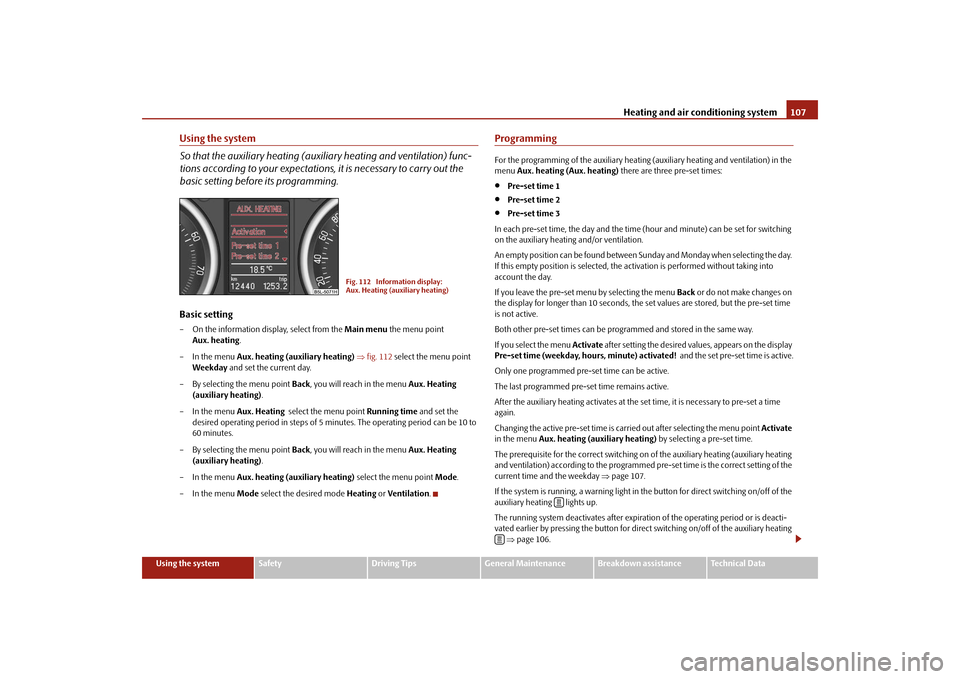
Using the system So that the auxiliary heating (auxiliary heating and ventilation) func- tions according to your expectations, it is necessary to carry out the basic setting before its programming.Basic setting– On the information display, select from the
Main menu
the menu point
Aux. heating
.
– In the menu
Aux. heating (auxiliary heating)
⇒fig. 112
select the menu point
Weekday
and set the current day.
– By selecting the menu point
Back
, you will reach in the menu
Aux. Heating
(auxiliary heating)
.
– In the menu
Aux. Heating
select the menu point
Running time
and set the
desired operating period in steps of 5 min
utes. The operating period can be 10 to
60 minutes.
– By selecting the menu point
Back
, you will reach in the menu
Aux. Heating
(auxiliary heating)
.
– In the menu
Aux. heating (auxiliary heating)
select the menu point
Mode
.
– In the menu
Mode
select the desired mode
Heating
or Ventilation
.
ProgrammingFor the programming of the auxiliary heating
(auxiliary heating and ventilation) in the
menu
Aux. heating (Aux. heating)
there are three pre-set times:
•
Pre-set time 1
•
Pre-set time 2
•
Pre-set time 3
In each pre-set time, the day and the time
(hour and minute) can be set for switching
on the auxiliary heating and/or ventilation. An empty position can be found between Su
nday and Monday when selecting the day.
If this empty position is selected, the activation is performed without taking into account the day. If you leave the pre-set menu by selecting the menu
Back
or do not make changes on
the display for longer than 10 seconds, the set values are stored, but the pre-set time is not active. Both other pre-set times can be prog
rammed and stored in the same way.
If you select the menu
Activate
after setting the desired values, appears on the display
Pre-set time (weekday, hours, minute) activated!
and the set pre-set time is active.
Only one programmed pre-set time can be active.The last programmed pre-set time remains active.After the auxiliary heating activates at the set time, it is necessary to pre-set a time again. Changing the active pre-set time is carried out after selecting the menu point
Activate
in the menu
Aux. heating (auxiliary heating)
by selecting a pre-set time.
The prerequisite for the correct switching on of the auxiliary heating (auxiliary heating and ventilation) according to the programmed
pre-set time is the correct setting of the
current time and the weekday
⇒page 107.
If the system is running, a warning light in th
e button for direct switching on/off of the
auxiliary heating lights up. The running system deactivates after expirati
on of the operating period or is deacti-
vated earlier by pressing the button for direct switching on/off of the auxiliary heating ⇒page 106.
Fig. 112 Information display: Aux. Heating (auxiliary heating)
sgg.6.book Page 107 Thursday, September 24, 2009 2:32 PM
Page 111 of 271

Starting-off and Driving
110
•
You should not switch on any major elec
trical components during the heating
period otherwise
the vehicle battery will
be drained unnecessarily.
- start engine Applies to all models: Position
To lock the steering
, with the ignition key withdrawn, turn the steering wheel until the
steering locking pin is heard to
engage. You should always lock the steering as a general
rule if you leave your vehicle. This acts as
a deterrent against possible theft of your
vehicle
⇒
.
Position
Move the steering wheel back and forward a little if the ignition key cannot, or cannot easily be turned into this position, in order to release the steering lock. Position
The engine is started in this position. At the same time, major electrical components are switched off for short periods. The igni
tion key moves back into position when
one releases the key. The ignition key must be turned back into
position each time before starting the
engine again. The starter repeat lock in th
e ignition lock prevents the starter being
engaged when the engine is r
unning and thus getting damaged.
Ignition key withdrawal lock (automatic gearbox) You can only withdraw the ignition key after switching off the ignition if the selector lever is in position
P.
WARNING
•
When driving, the ignition key must always be in the position (ignition
switched on) without the engine running. This position is indicated by the warning lights coming on. If this is not the case, it could result in unexpected locking of the steering wh
eel - risk of accident!
•
Only remove the ignition key from the ignition lock when the vehicle has
come to a standstill (by applying the handbrake or moving the selector lever into the position P). The
steering lock can engage imme
diately - risk of acci-
dent!
•
Always withdraw the ignition key if yo
u are going to leave the vehicle, even
for a short time. This is particularly important if children are left in the vehicle. The children might otherwise start the engi
ne or switch on el
ectrical equipment
(e.g. power windows) - risk of accident or injury!Starting the engineGeneral You can only start the engine only using an original ignition key.•
Place the gearshift lever into neutral (or
place the selector lever to the position
P or
N in the case of an automatic gearbox) and put on the handbrake firmly before starting the engine.•
The clutch pedal should be fully depressed when starting the engine - the starter
then only has to crank the engine.•
Let go of the key as soon as the engine starts otherwise there may be damage to
the starter. The engine running noises may louder at first be louder for a short time after starting the cold engine until oil pressure can be
built up in the hydraulic valve clearance
compensation. This is quite normal and is not an operating problem. If the engine does not start ... You can use the battery of anothe
r vehicle as a jump-start aid
⇒page 229.
It is only possible to tow-start vehicles fi
tted with a manual gearbox. The tow-starting
distance must not be more than 50 metres
⇒page 231.
WARNING
•
Never run the engine in non ventilated
or enclosed areas. The exhaust gases
of the engine contain besides the odorless and colourless carbon monoxide a poisonous gas - hazard! Carbon mono
xide can cause unconsciousness and
death.
A3
A1A2A3
A2
A1
A2
WARNING (continued)
sgg.6.book Page 110 Thursday, September 24, 2009 2:32 PM
Page 112 of 271

Starting-off and Driving
111
Using the system
Safety
Driving Tips
General Maintenance
Breakdown assistance
Technical Data
•
Never leave your vehicle unattended with the engine running.Caution
•
The starter may only be operated (ignitio
n key position ), if the engine is not
running. If the starter is immedi
ately operated after switchin
g off the engine, the starter
or the engine can be damaged.•
Avoid high engine revolutions, full throttle and high engine loads as long as the
engine has not yet reached its normal oper
ating temperature - risk of damaging the
engine!•
Vehicles which are fitted with an exhaust gas catalytic converter should not be tow-
started over a distance of more than 50 metres.
For the sake of the environment
Never warm up the engine when the vehicle
is standing. Drive off right away. Through
this the engine reaches its operating temperature more rapidly and the pollutant emis- sions are lower.Petrol enginesThese engines are fitted with a starter system which selects the correct fuel-air mixture for every external air temperature.•
Do not operate accelerator before and when starting engine.
•
Interrupt the attempt at starting after 10
seconds if the engine does not start right
awayand wait for about 30 seconds before repeating the attempt.•
It is possible that the fuse on the electric
al fuel pump is defect if the engine still
does not start. Check the fuse and replace it if necessary
⇒page 233.
•
Contact the nearest specialist garage to obtain professional assistance.
It may be necessary, if the engine is
very hot
, to slightly depress the accelerator after
the engine has started.
Diesel enginesGlow plug system Diesel engines are equipped with a glow plug system, the preglow period being controlled automatically in
line with the coolant temperature and outside tempera-
ture. The preglow indicator light
comes on after the ignition has been switched on.
You should not switch on any major electrical components during the heating period otherwise the vehicle battery
will be drained unnecessarily.
•
You should start the engine immediately after the glow plug warning light
has
gone out.•
The glow plug warning light will come on for about one second if the engine is at a
normal operating temperature or if the outside temperature is above +5°C. This means that you can start the engine
right away
.
•
Interrupt the attempt at starting after 10 seconds if the engine does not start right
awayand wait for about 30 seconds before repeating the attempt.•
It is possible that the fuse
on the diesel preglow system is defect if the engine still
does not start. Check the fuse and replace it if necessary
⇒page 233.
•
Contact the nearest specialist garage to obtain professional assistance.
Starting the engine after
the fuel tank has run dry
It may take longer than normal to start the
engine after refuelling if the fuel tank has
run completely dry - up to one minute. This is
because the fuel system must first of all
be filled while the attempting to start the engine.Switching off the engine– The engine can be switched off by turnin
g the ignition key from position into
⇒ page 109, fig. 114
.
WARNING
•
Never switch off the engine before the ve
hicle is stationary - risk of accident!
WARNING (continued)
A3
A1
sgg.6.book Page 111 Thursday, September 24, 2009 2:32 PM