2009 SKODA SUPERB heating
[x] Cancel search: heatingPage 75 of 294

Lights and Visibility
74
Top up with wash liquid
⇒page 234.
Winter position If the windscreen wipers are in rest posi
tion, they cannot be folded out from the
windscreen. For this reason we recommend
adjusting the windscreen wipers in
winter so that they can be folded out fr
om the windscreen easi
ly. You can set this
rest position as follows:•
Switch on the windscreen wipers.
•
Switch off the ignition. The windscreen wi
pers remain in the position in which
they were when switching off the ignition. You can also use the service po
sition as a winter position.
WARNING
•
Properly maintained windscreen wiper
blades are essential for clear visi-
bility and safe driving
⇒page 74.
•
Do not use the windscreen washer sy
stem at low temperatures, without
heating the windscreen beforehand. Otherwise the window cleaner could freeze on the windscreen and re
strict the view to the front.
•
The rain sensor only operates as a
support. The driver is not released
from the responsibility to set the function of the windscreen wipers manu- ally depending on the visibility conditions.
Caution
In frosty weather, please first of all chec
k whether the windscreen wiper blades are
not frozen to the windscreen before swit
ching them on. Switching on windscreen
wipers when the blades are frozen to the windscreen may result in damage both to the blades and the motor of the windscreen wipers!
Note
•
If the slower or the faster wiper setting is switched on
⇒page 73, fig. 73
and the vehicle speed decreases to below 4
km/h, the lower wiper step is switched
on automatically. At a speed increase of
more than 8 km/h the previous wiper
setting is established again.
•
If there is an obstacle on the windscreen, the wiper will try to push away the
obstacle. If the obstacle continues to bloc
k the wiper, the wiper stops after 5 cycles,
in order to avoid a damage to the wiper.
Remove the obstacle and and switch on
the wiper again.Headlight cleaning system*The headlights are being cleaned after the
windscreen has been sprayed for the first
time and fifth time, the low beam or ma
in beam are switched on and the wind-
screen wiper lever was held in the position
⇒page 73, fig. 73
for about 1
second. The headlight washer nozzles are moved fo
rward out of the bumper by the water
pressure for cleaning the headlights. You should remove stubborn dirt (such
as insect residues) from the headlight
lenses at regular intervals, for example when refuelling. Please refer to the following guidelines. You should remove any snow from the fixtures of the washer nozzles and clear ice in winter with a de-icing spray in order to ensure proper operation of the cleaning system.Replacing wiper blades for the windscreen wipers
A2
A3
A5
Fig. 74 Wiper blade for the windscreen wiper
s2dk.1.book Page 74 Wednesday, April 8, 2009 12:23 PM
Page 77 of 294

Lights and Visibility
76
Switching on the automatic dimming – Press the button - the warning light lights up
⇒
page 75, fig. 75
.
Switching off the automatic dimming – Press again the button - the warning light goes out .If the automatic dimming is sw
itched on, the mirror dims
automatically
depending on the light striking the mirror
from the rear. The mirror has no lever on
the bottom edge of the mirror. When the interior lights are switched on or the reverse gear is engaged, the mirror alwa
ys moves back into the basic position.
Note
•
Automatic mirror dimming operates only pr
operly if the sun screen* for the rear
window in the housing on the luggage comp
artment cover is not in use or the light
striking the interior rear-view mirror
is not affected by other objects.
•
Do not affix any stickers in front of the li
ght sensor, so that you do not impair the
automatic dimming function or put it out of operation.•
If you switch off the automatic dimming interior rear-view mirror, also the exte-
rior mirror dimming
is switched off.
Exterior mirror with entry lighting* The lighting is positioned on the bo
ttom edge of the exterior mirror.
The light beam is aimed at the entry area of the front doors after the car is unlocked. The light comes on after the doors have been locked or on opening the front door. The lighting goes out about 30 seconds after
the doors are closed or if the ignition
is switched on. If the doors remain open, the lighting go
es out automatically after about 10 minutes
provided the ignition
is not switched on.
Exterior mirrorYou can adjust the exterior mirrors electrically*.The exterior mirror heater only oper
ates when the engine is running and
up to an outside temperature of +20 °C. Heating of the external mirror – Turn the rotary knob to position
⇒
fig. 76
.
Adjusting left and right exterior mirrors simultaneously – Turn the rotary knob to position
. The movement of the mirror surface
is identical to the movement of the rotary knob.
Adjusting the right-hand exterior mirror – Turn the rotary knob to position
. The movement of the mirror
surface is identical to the movement of the rotary knob.
Switching off operating control – Turn the rotary knob to position
.
Folding in both exterior mirrors* – Turn the rotary knob to position
.
AB
AA
AB
AA
Fig. 76 Inner part of door: Rotary knob
s2dk.1.book Page 76 Wednesday, April 8, 2009 12:23 PM
Page 86 of 294

Seats and Stowage
85
Using the system
Safety
Driving Tips
General Maintenance
Breakdown assistance
Technical Data
•
Before folding the seat backrest back into the secure position, place the
rear lateral seat belt behind the edge of the side trim panel. Take suitable measures to prevent that
the seat belt is jammed between the seat backrest
and the side trim panel and is thus damaged.Rear seat armrest– You can fold down the armrest to enhance occupant comfort
⇒
fig. 86
.
Seat heaters*You can electrically heat the seat ba
ckrests and the surfaces of the front
seats and the two outer rear seats. – You can switch on and regulate the
seat heating of the driver or front
passenger seat by pressing the surfac
e of the regulator at the point at
which the symbol is located
⇒
fig. 87
.
– You can switch on and adjust the heat
ers of the left or right rear seats
by pressing the regulator
⇒
fig. 88
.
– With one press, you can switch the
heating to highest intensity which
is indicated by the lighting up of the three warning lights in the switch.
WARNING (continued)
Fig. 86 Rear seats: Armrest
Fig. 87 Dash panel: Regu- lator for front seat heatingFig. 88 Centre console at rear: Regulator for heating the rear seats
s2dk.1.book Page 85 Wednesday, April 8, 2009 12:23 PM
Page 87 of 294

Seats and Stowage
86
– With repeated pressing of the switch, the intensity of the heating is
down-regulated up to the switch-off. The intensity of the heating is indicated by the number of illuminated warning lights in the switch.
WARNING
If you have a subdued pain and/or temperature sensitivity, e.g. through medication, paralysis or because of chronic illness (e.g. diabetes), we recommend not to use the seat heating. This can lead to burns on the back, the posterior and the legs which are diff
icult to heal. If the seat heating is
used, we recommend to make regular br
eaks in your journey when driving
long distances, so that in specific cases as mentioned above the body can recuperate from the stress of the journey. Please consult your doctor, who can evaluate your specific condition.
Caution
•
You should not kneel on the seats or otherwise apply pressure at specific points
in order to avoid damaging the heating elements of the seat heaters.•
Do not use the seat heating if the seats are not occupied by persons or if objects
are fastened or stored on them, for exampl
e a child seat, a bag etc. A fault of the
heating elements in the seat heating can occur.•
Do not clean the seats moist
⇒page 216.
Note
•
The seat heating should only be switched
on when the engine is running. This
has a significant effect of sa
ving on the battery capacity.
•
If the on-board voltage drops, the seat
heating is switched off automatically, in
order to provide sufficient electrical energy for the engine control.PedalsConcerning a secure depressi
ng of the pedal, you should use only footmats from
the Škoda genuine
accessories.
Operation of the pedals must not be hindered!
WARNING
•
Greater pedal distances may be needed when there is a fault in the brake
system.•
Do not place any footmats or other additional floor coverings in the area
of the pedals in order to ensure that all the pedals can be fully depressed and are able to return unobstructed to thei
r initial position - risk of accident!
•
There must be no objects on the floor which could roll under the pedals.
You would then no longer be able to
apply the brakes, operate the clutch or
accelerator - risk of accident!luggage compartmentLoading the luggage compartmentPlease observe the following in the inte
rest of having good handling char-
acteristics of
your vehicle:
– Distribute the items of luggage as evenly as possible. – Place heavy objects as far forward as possible.– Attach the items of luggage to the lashing eyes or the safety net*
⇒
page 87.
In the event of an accident, there is such a
high kinetic energy which is produced by
small and light objects that they can caus
e severe injuries. The magnitude of the
kinetic energy depends on the speed at wh
ich the vehicle is travelling and on the
weight of the object. The speed at which the
vehicle is travelling
is in this case the
more significant factor. Example: In the event of a frontal collision at a speed of 50 km/h, an unsecured object with a weight of 4.5 kg produces
an energy, which corresponds to 20 times
its own weight. This means that it results in a weight of approx. 90 kg. You can
s2dk.1.book Page 86 Wednesday, April 8, 2009 12:23 PM
Page 88 of 294
Seats and Stowage
87
Using the system
Safety
Driving Tips
General Maintenance
Breakdown assistance
Technical Data
imagine the injuries that can occur, if this “bullet” is flying through the interior compartment and hits an occupant.
WARNING
•
Store the objects in the luggage comp
artment and attach them to the
lashing eyes.•
Loose objects in the passenger compartment can be thrown forward
during a sudden manoeuvre or in case
of an accident and can injure the
occupants or other oncoming traffic. This risk is still increased, if the objects which are flying around are hit by a depl
oyed airbag. In this case, the objects
which are thrown back can injure the occupants - hazard.•
Please note that the handling properti
es of your vehicle may be affected
when transporting heavy objects as a result of the displacement of the centre of gravity. The speed and style
of driving must be adjusted accord-
ingly.•
The items carried in the luggage compar
tment should be stored in such
a way that no objects are
able to slip forw
ard if there are any sudden driving
or braking manoeuvres undertaken - risk of injury!•
Never drive with the boot lid fully opened or slightly ajar otherwise
exhaust gases may get into the interior of the vehicle - risk of poisoning!•
On no account exceed the permissi
ble axle loads and the permissible
gross weight of the vehi
cle - risk of accident!
•
Never transport occupants in the luggage compartment!Caution
Please ensure that the heating elements of the rear window heater are not damaged as a result of objects sliding in this area.
Note
Tyre pressure must be adjusted to the load
⇒page 235, fig. 210
.
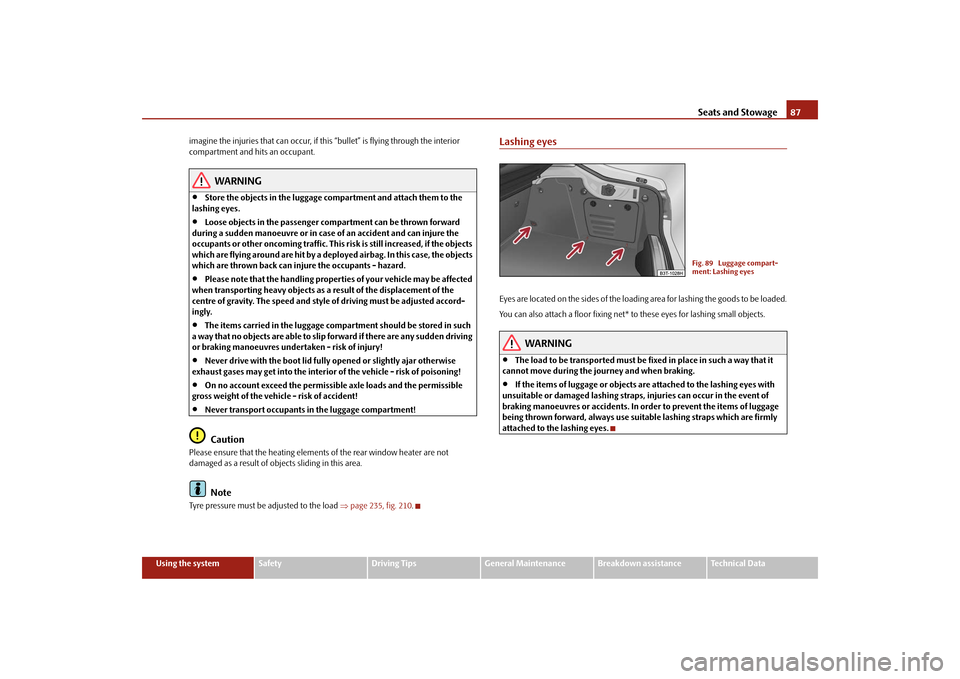
Lashing eyesEyes are located on the sides of the loading area for lashing the goods to be loaded. You can also attach a floor fixing net*
to these eyes for lashing small objects.
WARNING
•
The load to be transported must be fixed in place in such a way that it
cannot move during the journey and when braking.•
If the items of luggage or objects ar
e attached to the lashing eyes with
unsuitable or damaged lashing straps,
injuries can occur in the event of
braking manoeuvres or accidents. In
order to prevent the items of luggage
being thrown forward, always use suit
able lashing straps which are firmly
attached to the lashing eyes.
Fig. 89 Luggage compart- ment: Lashing eyes
s2dk.1.book Page 87 Wednesday, April 8, 2009 12:23 PM
Page 91 of 294

Seats and Stowage
90
Caution
Please ensure that the heating elements of the rear window heater are not damaged as a result of objects placed in this area.
Note
Opening the tailgate also lifts up the luggage compartment cover.Remove variable* loading floor
The variable loading floor makes handling of bulky items of luggage easier. You can remove the variable loading floor if necessary. – Unlock the loading floor by turning the safety eyes to the left by
approx. 90°
⇒
fig. 96
.
– Fold together the loading floor and take it out by moving in direction
of arrow.
– Unlock the carrier rail by turning the arbor-mounted fixing eyes
to the right by approx. 90°
⇒
fig. 97
.
WARNING
Pay attention when installing the variable loading floor that the carrier rail and the variable loading floor are correc
tly fastened. If this is not the case,
there is risk of injury for the occupants.
Note
The maximum load of the variable loading floor is 75°kg.Divide the luggage compartmen
t with variable loading floor*
The luggage compartment can be divided with the variable loading floor.
Fig. 96 Luggage compart- ment: remove variable loading floorFig. 97 Luggage compart-ment: Install carrier rails
AA
AB
AC
Fig. 98 Luggage compart-ment: Separation of the luggage compartment
s2dk.1.book Page 90 Wednesday, April 8, 2009 12:23 PM
Page 97 of 294

Seats and Stowage
96
WARNING
•
Please do not place anything on top of the dash panel. Such objects
might slide or fall down when driving
(when accelerating or cornering) and
may distract you from concentrating on the traffic situation - risk of acci-dent!•
Ensure that when driving no objects from the centre console of from
other storage possibilities may get into
the footwell of the driver. You would
then no longer be able to apply the br
akes, operate the clut
ch or accelerator
- risk of accident!Storage compartment on the front passenger sideOpening and closing the storage compartment on the front passenger side – Press the button
⇒
fig. 107
- the lid folds down.
– Raise the lid and press it until the catch is heard to engage.In the storage compartment are pin holders.
WARNING
The storage compartment mu
st always be closed when driving for safety
reasons.Cooling of storage compartment on front passenger side The compartment is fitted with an isolatable entry for cooled air.– Open the air supply by pulling on the lever in direction of arrow
⇒
fig. 108
.
– The air supply closes by pressing the lever.Opening the air supply when the air conditioning system is switched on allows cooled air to flow into the storage compartment. Opening the air inlet when the air conditioning system is on causes fresh or interior air to flow into the storage compartment. We recommend that you close the air supply
if it is operating in the heating mode
or if you are not using the cooling system for the storage compartment.
Fig. 107 Dash panel: Storage compartment on the front passenger side
Fig. 108 Storage compart-ment: Using cooling system
s2dk.1.book Page 96 Wednesday, April 8, 2009 12:23 PM
Page 105 of 294
Air conditioning system
104
Air conditioning systemIntroductionDescription and informationIf the cooling system is switched on, the temperature and air humidity drops in the vehicle. The wellbeing of the occupants of
the car is enhanced as a result of this
particularly at high outside temperatures and a high air humidity. The system prevents the windows misting up during the cold season of the year. The heating effect is dependent upon th
e coolant temperature, thus full heat
output only occurs when the engine
has reached its operating temperature.
It is possible to briefly activate recirc
ulated air mode in order to enhance the
cooling effect - Climatic
⇒page 108, Climatronic
⇒page 111.
The air inlet in front of the windscreen must be free of ice, snow or leaves in order to ensure that the heating and cooling systems operate properly. After switching on the cooling
Condensation
from the evaporator of the air condi-
tioning may drip down and form a puddle
below the vehicle. This is quite normal
and not an indication of a leak!
WARNING
•
For your own safety and that of other road users, ensure that all the
windows are free of ice, snow and mistin
g. Please familiarize yourself about
how to correctly operate th
e heating and ventilation systems, how to demist
and defrost the windows, as well as with the cooling mode.•
You should not leave recirculated air mode on over a longer period of
time, as “stale” air may result in fatigue in the driver and occupants, divert your attention and also cause the windows to mist up. The risk of having an accident increases. Switch recirculated air mode off as soon as the windows begin misting up.
Note
•
The used air streams out through the air removal openings in the luggage
compartment.•
If the cooling system has not been switched on for a lengthy period, odours may
be produced at the evaporator because of
deposits. Switch the cooling system on
at least once a month for approximately 5 mi
nutes at the highest blower stage - also
during the cold season of the year - in order to avoid such odours. Also open a window for a short time.•
We recommend that you do not smoke in the vehicle when the recirculating air
mode is operating since the smoke which is drawn at the evaporator from the inte-rior of the vehicle forms deposits in the
evaporator of the air conditioning system.
This produces a permanent odour when th
e air conditioning system is operating
which can only be eliminated through co
nsiderable effort and expense (replace-
ment of compressor).•
Please refer to the information regarding the recirculated air mode for Climatic
⇒ page 108 or for Climatronic
⇒page 111.
Using the air conditioning system economicallyThe compressor on the air co
nditioning system uses po
wer from the engine when
in cooling mode which will effect the fuel consumption. It recommended to open the windows or the doors of a vehicle for which the inte- rior has been strongly heated through the ef
fect of direct sunlight in order to allow
the heated air to escape. The cooling system should not be switched on while travelling when the window is open. The desired interior temperature can also be achieved without switching in the cooling system just by switching to fresh air mode.
s2dk.1.book Page 104 Wednesday, April 8, 2009 12:23 PM