2009 SKODA SUPERB heating
[x] Cancel search: heatingPage 115 of 294

Air conditioning system
114
Using the system So that the auxiliary heating (auxiliary heating and ventilation) func- tions according to your expectations, it is necessary to carry out the basic setting before its programming.Basic setting – On the information display, select from the
Main menu
the menu
point
Aux. heating
.
– In the menu
Aux. heating (auxiliary heating)
⇒
fig. 130
select the
menu point
Weekday
and set the current day.
– Return to a higher level by selecting the menu point
Back
, i. e. in the
menu
Aux. Heating (auxiliary heating)
.
–In the menu
Aux. Heating
select the menu point
Running time
and
set the desired operating period in steps of 5 minutes. The operating period can be 10 to 60 minutes.
– By selecting the menu point
Back
, you will reach in the menu
Aux. Heating (auxiliary heating)
.
– In the menu
Aux. heating (auxiliary heating)
select the menu point
Mode
.
– In the menu
Mode
select the desired mode
Heating
or
Ventilation
.
ProgrammingFor the programming of the auxiliary heatin
g (auxiliary heating and ventilation) in
the menu
Aux. heating (Aux. heating)
there are three pre-set times:
•
Pre-set time 1
•
Pre-set time 2
•
Pre-set time 3
In each pre-set time, the day and the time (hour and minute) can be set for switching on the auxiliary heating and/or ventilation. An empty position can be found between
Sunday and Monday when selecting the
day. If this empty position is selected,
the activation is performed without taking
into account the day. If you leave the pre-set menu by selecting the menu
Back
or do not operate the
display for longer than 10°seconds, the set values are stored, but the pre-set time is not active. Both other pre-set times can be programmed and stored in the same way.If you select the menu
Activate
after setting the desired values, appears on the
display
Pre-set time (weekday, hours, minute) activated! (Pre-set time
(weekday, hour, minute) activated!
and the set pre-set time is active.
Only one programmed pre-set time can be active.The last programmed pre-set time remains active.After the auxiliary heating activates at the set time, it is necessary to pre-set a time again. Changing the active pre-set time is carried out after selecting the menu point Activate
in the menu
Aux. heating (auxiliary heating)
by selecting a pre-set time.
The prerequisite for the correct switching
on of the auxiliary heating (auxiliary
heating and ventilation) according to th
e programmed pre-set time is the correct
setting of the current time and the weekday
⇒page 114.
Fig. 130 Information display: Aux. heating
s2dk.1.book Page 114 Wednesday, April 8, 2009 12:23 PM
Page 116 of 294

Air conditioning system
115
Using the system
Safety
Driving Tips
General Maintenance
Breakdown assistance
Technical Data
If the system is running, a warning light in
the button for direct switching on/off of
the auxiliary heating lights up. The running system deactivates after expiration of the operating period or is deac- tivated earlier by pressing the button for di
rect switching on/off of the auxiliary
heating
⇒page 113.
The random pre-set time can be deactivated by selecting the menu point
Deactive
in the menu
Activate
.
After selecting the menu point
Fac to r y s e tt ing
in the menu
Aux. heating
(auxiliary heating)
, it is possible to change to the factory setting.
Radio remote control The auxiliary heating (auxiliary heating and ventilation) can be switched on or off with the remote control.– For switching on, press the button . – For switching off, press the button .The transmitter and the battery are housed in the housing of the remote control. The receiver is located in
the interior of the car.
If the battery is properly charged, the ef
fective range is up to 600 m. For switching
on or off the auxiliary heating, hold the
remote control vertically with the antenna
⇒fig. 131
towards the top. You must not cover over the antenna with the
fingers or the palm of th
e hand. Obstacles between the radio remote control and
the vehicle, bad weather co
nditions and a weaker batt
ery can clearly reduce the
range. The auxiliary heating can only be switched
on or off with the radio remote control,
if the distance between the radio remote
control and the vehicle is at least 2 m.
Warning light in the radio remote control The warning light in the radio remote control
⇒fig. 131
indicates after a keystroke
if the remote control signal was received
by the auxiliary heating and if the battery
is adequately charged.
Caution
There are electronic components in the radio remote control, protect the remote control against water, severe
shocks and direct sun rays.
Fig. 131 Auxiliary heating: Radio remote control
ONOFF
AA
Display warning light
Importance
Lights up green for 2 seconds.
The auxiliary heating was switched on.
Lights up red for 2 seconds.
The auxiliary heating was switched off.
Slowly flashes green for 2 seconds.
The ignition signal was not received.
Quickly flashes green for 2 seconds.
The auxiliary heating is blocked, e. g because the tank is nearly empty or there is a fault in the auxiliary heating.
Flashes red for 2 seconds.
The switch off signal was not received.
Lights up orange for 2 seconds, then green or red.
The battery is weak, however the switching on or off signal was received.
Lights up orange for 2 seconds, then flashes green or red.
The battery is weak, however the switching on or off signal was not received.
Flashes orange for 5 seconds.
The battery is discharged, however the switching on or off signal was not received.
s2dk.1.book Page 115 Wednesday, April 8, 2009 12:23 PM
Page 119 of 294

Starting-off and Driving
118
Ignition lockPetrol engines - ignition switched off, engine
off, the steering can be locked.
- ignition switched on - start engine Diesel engines - interruption of fuel supply, ignition sw
itched off, engine off, the steering can
be locked. - heating glow plugs on, ignition switched on•
You should not switch on any major elec
trical components during the heating
period otherwise the vehicle batt
ery will be drained unnecessarily.
- start engine Applies to all models: Position
To lock the steering
, with the ignition key withdrawn, turn the steering wheel until
the steering locking pin is heard to engage. You should always lock the steering as a general rule if you leave your
vehicle. This acts as a deterrent against possible theft
of your vehicle
⇒
.
Position
Move the steering wheel back and forward a little if the ignition key cannot, or cannot easily be turned into
this position, in order to
release the steering lock.
Position
The engine is started in this position. At
the same time switched on low beam or
main beam or other electrical compon
ents with major power consumption are
briefly switched off. The ignition key
moves back into position when one
releases the key. The ignition key must be turned back into position each time before starting the engine again. The starter repeat lock in th
e ignition lock prevents the starter being
engaged when the engine is r
unning and thus getting damaged.
Ignition key withdrawal lock (automatic gearbox) You can only withdraw the ignition key after switching off the ignition if the selector lever is in position
P.
WARNING
•
When driving, the ignition key must always be in the position (igni-
tion switched on) without the engine running. This position is indicated by the warning lights coming on. If this is not the case, it could result in unex- pected locking of the steerin
g wheel - risk of accident!
•
Only remove the ignition key from the ignition lock when the vehicle has
come to a standstill (by applying the handbrake or moving the selector lever into the position P). The steering lock
can engage immediately - risk of acci-
dent!•
Always withdraw the ignition key if
you are going to leave the vehicle,
even for a short time. This is particularly important if children are left in the vehicle. The children might
otherwise start the engine
or switch on electrical
equipment (e.g. power windows) - risk of accident or injury!
Fig. 134 Ignition lock posi- tions
A1A2A3A1A2A3
A1A2
A3
A2
A1
A2
s2dk.1.book Page 118 Wednesday, April 8, 2009 12:23 PM
Page 121 of 294

Starting-off and Driving
120
You should not switch on any major elec
trical components during the heating
period otherwise the vehicle battery
will be drained unnecessarily.
•
You should start the engine immediately after the glow plug warning light
has gone out.•
The glow plug warning light will come on for about one second if the engine is
at a normal operating temperature or if the outside temperature is above +5°C. This means that you can start the engine
right away
.
•
Interrupt the attempt at starting after 10 seconds if the engine does not start
right awayand wait for about 30 se
conds before repeating the attempt.
•
It is possible that the fuse on the diesel
preglow system is defect if the engine
still does not start. Check the fuse and replace it if necessary
⇒page 256.
•
Contact the nearest specialist garage to obtain professional assistance.
Starting the engine after the fuel tank has run dry It may take longer than normal to start the
engine after refuelling
if the fuel tank has
run completely dry - up to one minute. This is because the fuel system must first of all be filled while the attempting to start the engine.Switching off the engine– The engine can be swit
ched off by turning the ignition key from posi-
tion into
⇒
page 118, fig. 134
.
WARNING
•
Never switch off the engine before the
vehicle is stationary - risk of acci-
dent!•
The brake booster only operates when the engine is running. Greater
physical effort for braking is required
when engine is switched off. Because
if you do not stop as normal, this can cause an accident and severe injuries.
Caution
you should not switch the engine off right
away at the end of your journey after the
engine has been operated for a lengthy peri
od at high loads but should be allowed
it to run at idling speed for about 2 minut
es. This prevents any accumulation of heat
when the engine is switched off.
Note
•
The radiator fan may continue running fo
r a further 10 minutes or so after the
engine and the ignition have
been switched off. The coolant fan may, however, also
switch on again after some time if the coolant temperature rises because of an accumulation of heat in the engine or
if the engine is warm and the engine
compartment is additionally
heated by strong sunlight.
•
This is why particular care is required when carrying out any work in the engine
compartment
⇒page 223, “Working in the engine compartment”.
Shifting (manual gearbox)
A1
Fig. 135 The shift pattern: 5- speed or 6-speed manual gearbox
s2dk.1.book Page 120 Wednesday, April 8, 2009 12:23 PM
Page 123 of 294

Starting-off and Driving
122
WARNING
•
Please note that the handbrake mu
st be fully released. A handbrake
which is only partially released can re
sult in the rear brakes overheating
which will have a negative effect on th
e operation of the brake system - risk
of accident! In addition this can result in premature wear of the rear brake pads.•
Never leave children unattended in th
e vehicle. The children might, for
example, release the handbrake or take
the vehicle out of gear. The vehicle
might then move off - risk of accident!
Caution
After the car has come to a stop, always firs
t of all apply the handbrake firmly before
then additionally engaging a gear (manual gearbox) or moving the selector lever into position
P (automatic gearbox).
Rear parking aid*The parking aid provides a warning of obstacles behind the vehicle.The audible parking aid determines the distance between the rear bumper and an obstacle located behind the
vehicle with the aid of ultr
asound sensors. The tones
of the parking aid can be adapted in the menu of the information display* ⇒ page 30. The sensors are integrated in the rear bumper. Range of sensors The clearance warning begins at a distance of about 160 cm from the obstacle (area ⇒fig. 138
). The interval between the warning signals becomes shorter as the
clearance is reduced. A continuous tone sounds from a distance
of approx. 30 cm (area ) - danger area.
You should not reverse any further after this signal sounds!
If the vehicle is
equipped with a factory-fitted towing device*, the border of the danger area starts - continuous tone - 5 cm further behind
the vehicle. The vehi
cle can be extended
through an installed deta
chable towing device.
On vehicles equipped with a factory-fitted radio* or navigation*, the distance to the obstruction is shown graphically on the di
splay. On vehicles with a factory-fitted
towing device, the sensors are deactivated wh
en towing a trailer. The driver is also
informed of the radio* or the navigation
* by a graphic display (vehicle towing a
trailer) on the display. The radio* or navi
gation*, which is factory-fitted, can be set
so that the play function volume decreases when activating the parking aid, see Owner's Manual radio* or navigation*. This
improves the audibili
ty of the parking
aid. Activating The parking aid is activated automatically when
reverse gear
is engaged and the
ignition is turned on. This is confir
med by a brief acknowledgement signal.
Deactivating The parking aid is deactivated
by removing the reverse gear.
WARNING
•
The parking aid is not a substitute fo
r the driver paying proper attention
and it is always the driver's responsibility to take care when parking the vehicle or carrying out similar manoeuvres.•
You should therefore satisfy yourself, before reversing, that there is no
small obstacle, such as a rock, thin po
st, trailer drawbar etc., behind your
Fig. 138 Parking aid: Detec- tion range of rear sensors
AA
AB
s2dk.1.book Page 122 Wednesday, April 8, 2009 12:23 PM
Page 133 of 294
Automatic gearbox DSG*
132
•
If you are stopping at a hill (downhill section), never try to hold the car
stationary with the gear engaged by me
ans of the “accelerator”, this means
by letting the clutch slip. This can lead
to overheating of the
clutch. If there is
a risk of overheating of the clutch due
to overload, the clut
ch is opened auto-
matically and the vehicle rolls backward - risk of accident!•
If you must stop at a slope, depress
and hold the brake pedal, so that you
can prevent the vehicle from rolling back.
Caution
•
The double clutch on the automatic gear
box DSG is equipped with an overload
protection. If you make use of the uphill func
tion on a vehicle which is stationary or
driving slowly uphill, it will result in an
increase of thermal stress of the clutches.
•
An overheating of the clutches can be de
tected by the flashing of the selector
level indicator and the “jerk” of the clut
ches, finally the clutches are opened. The
power transmission from the engine to the front wheels is interrupted and as a result of this the vehicle can no longer be
driven. If the clutch opens automatically,
depress the brake pedal, wait a few se
conds and only then continue driving.
Selector lever positions
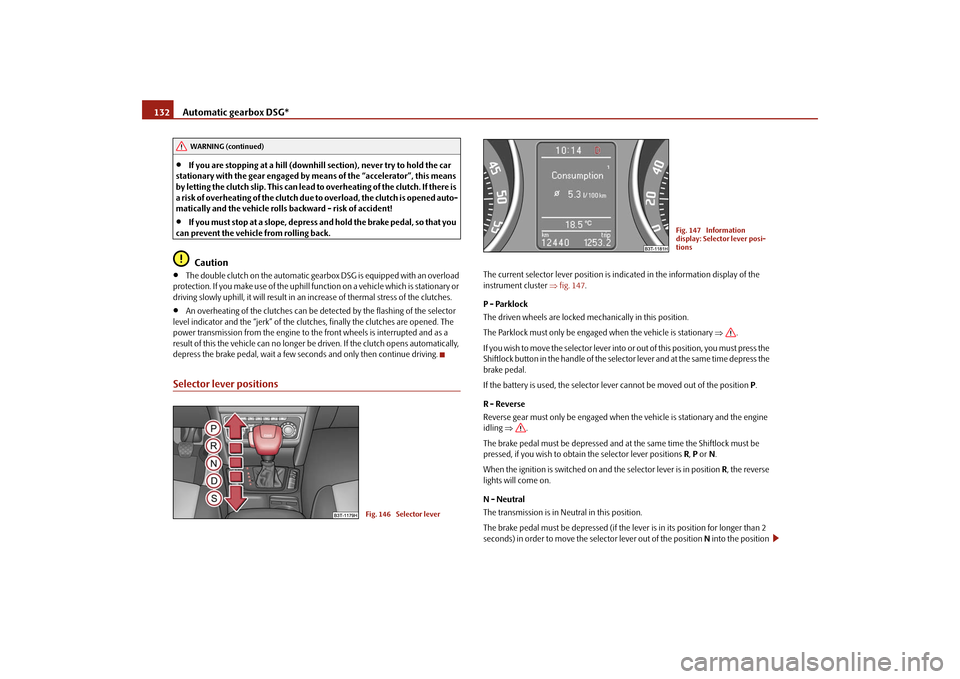
The current selector lever position is indicated in the information display of the instrument cluster
⇒fig. 147
.
P - Parklock The driven wheels are locked mechanically in this position. The Parklock must only be engage
d when the vehicle is stationary
⇒
.
I f y o u w i s h t o m o v e t h e s e l e c t o r l e v e r i n to
or out of this position, you must press the
Shiftlock button in the handle of the selector lever and at the same time depress the brake pedal. If the battery is used, the selector leve
r cannot be moved out of the position
P.
R - Reverse Reverse gear must only be engaged when
the vehicle is stationary and the engine
idling
⇒
.
The brake pedal must be depressed and at the same time the Shiftlock must be pressed, if you wish to obtain the selector lever positions
R, P or N.
When the ignition is switched on and the selector lever is in position
R, the reverse
lights will come on. N - Neutral The transmission is in Neutral in this position. The brake pedal must be depressed (if the lever is in its position for longer than 2 seconds) in order to move the selector lever out of the position
N into the position
WARNING (continued)
Fig. 146 Selector lever
Fig. 147 Information display: Selector lever posi-tions
s2dk.1.book Page 132 Wednesday, April 8, 2009 12:23 PM
Page 195 of 294

Intelligent Technology
194
•
when driving with snow chains
•
when driving in deep snow or on a loose surface
•
when it is necessary to rock a ca
r free when it has become stuck.
then you should switch on the ESP again.
WARNING
It is also not possible for the ESP to overcome the physical limits of the vehicle. Even if a vehicle fitted with ESP you should still always adapt your style of driving to the condition of the
road surface and the traffic situation.
This particularly applies when driving on slippery and wet roads. The increased safety offered must not tempt you to take greater risks than other- wise - risk of an accident!
Note
•
All four wheels must be fitted with the same tyres in order to achieve problem-
free operation of the ESP. Differing rolling
circumferences of the tyres can lead to an
undesirable reduction in the engine output.•
Changes to vehicle (e.g. on engine, on the brakes, on chassis or other assign-
ment of tyres and wheels) can influence the function of the ESP
⇒page 241,
“Accessories, changes and replacement of parts”.Electronic Differential Lock (EDL)* The electronic differential lock pr
events an individual wheel from
slipping.Models fitted with ESP are equipped with electronic differential lock (EDL). General The EDL makes it much easier, and sometimes at all possible, to start off, accelerate and climb a steep hill when the conditio
ns of the road surface are unfavourable.
Operating principle The EDL is activated automatically, that is
without any action on the part of the
driver. It monitors the speeds of the driven wheels with the aid of the ABS sensors. Should only
one
drive wheel begin spinning on a slippery surface there will be an
appreciable difference in the speed of the driven wheels. The EDL function brakes the slipping wheel and the differential transmits a greater driving force to the other driven wheel. This control proces
s is also accompanied by noises.
Overheating of the brakes The EDL switches off
automatically if unusually severe
stresses exist in order to
avoid excessive heat generation in the
disc brake on the wheel which is being
braked. The vehicle can continue to be driv
en and has the same characteristics as a
vehicle not fitted with EDL. The EDL switches on again
automatically as soon as the brake has cooled down.
WARNING
•
Depress the accelerator carefully when accelerating on uniformly slip-
pery road surfaces, such as ice and sn
ow. The driven wheels might still spin
despite the EDL and affect the stability
of the vehicle - risk of an accident!
•
You should always adapt your style of driving to the condition of road
surface and to the traffic situation even
when your vehicle is fitted with EDL.
The increased safety offered must not tempt you to take greater risks than otherwise - risk of an accident!
Note
•
If the ABS or ESP warning light comes on,
this may also indicate a fault in the
EDL. Please have the car inspected as s
oon as possible by a specialist garage.
•
Changes to vehicle (e.g. on engine, on
the brakes, on chassis or other assign-
ment of tyres and wheels) can in
fluence the function of the EDL
⇒page 241,
“Accessories, changes and
replacement of parts”.
s2dk.1.book Page 194 Wednesday, April 8, 2009 12:23 PM
Page 210 of 294

Towing a trailer
209
Using the system
Safety
Driving Tips
General Maintenance
Breakdown assistance
Technical Data
should be attached to folding arms. Adjust
the mirrors so that they provide you with
an adequate field of view to the rear. Headlights Before starting off with a hitched trailer, also check the setting of the headlights. Alter the setting as necessary with th
e aid of the headlight beam adjuster
⇒ page 66, “Headlamp range adjustment*
”.
Detachable ball head The ball rod is detachable on vehicles which feature a factory-fitted towing device. It is stowed together with separate fitting instructions in the spare wheel well in the luggage compartment of the vehicle. Further information on the towing device
⇒page 210.
Note
•
We recommend that you also have yo
ur vehicle inspected between service
intervals if you tow a trailer frequently.•
The handbrake on the towing vehicle
must be put on when coupling and
decoupling the trailer.Driving Tips Particular caution is required when towing a trailer.– Do not, as far as possible, drive
with your vehicle unladen and the
trailer laden.
– Do not make full use of the legal maximum speeds. This applies in
particular to downhill sections.
– Apply the brakes in good time.– Keep a check on the coolant temper
ature gauge if the outside temper-
ature is high.
Distribution of weight The distribution of the weight is very poor
if your vehicle is
unladen and the trailer
is laden. Maintain a particularly low speed if you cannot avoid driving with this combination. Driving speed Do not drive faster than 80 km/hour for safety reasons. This also applies for coun- tries in which higher speeds are allowed. The fact that the driving stability of the vehicle + trailer combination reduces with increasing speed means that the legally allowed speed should not be used when there are unfavourable road, weather or wind
conditions, particul
arly near accident
black spots. You must always reduce your speed immedi
ately as soon as you detect even just
the
slightest swaying
of the trailer. On no account attempt to stop the trailer from
“swaying” by
accelerating.
Apply the brakes in good time! If the trailer is fitted with a
trailer brake
, apply the
brakes gently at first and then brake firmly
. This will avoid brake jolts resulting from
the trailer wheels locking. Shift down gears
in good time before negotiating a down-
hill section to allow the engine to also act as a brake. Engine overheating Please keep a check on the coolant temperature gauge if you have to negotiate a lengthy slope in a low gear at a high engine speed when the outside temperature is very high
⇒page 18, “Coolant temperature gauge”.
If the needle of the coolant temperature gauge moves into the right-hand area or even the red area of the scale, reduce yo
ur speed immediately. Stop and switch off
the engine if the warning light
in the instrument cluste
r begins flashing. Wait a
few minutes and check the level of coolant in the coolant expansion bottle ⇒ page 227, “Inspecting the coolant level”. Please refer to the following guidelines
⇒page 38, “Coolant temperature/ Coolant
quantity
”.
The coolant temperature can be reduced by switching on the heating.Any increase in the cooling effect of the coolant fan through shifting down a gear and increasing the engine speed is not possible since the fan speed is independent
s2dk.1.book Page 209 Wednesday, April 8, 2009 12:23 PM