2009 SKODA SUPERB oil level
[x] Cancel search: oil levelPage 17 of 294

The brief instruction
16
– Grasp the bonnet at the bottom part
of the radiator grille and lift it
towards the top so that it is held
opened by the gas pressure support.
Further information
⇒page 222, “Opening and closing the bonnet.”.
Inspecting the engine oil level Engine oil
must not be
refilled.
Engine oil
can
be refilled.
Engine oil
must
be refilled.
Further information
⇒page 224, “Check engine oil level”.
Fig. 16 Dipstick
AAABACs2dk.1.book Page 16 Wednesday, April 8, 2009 12:23 PM
Page 31 of 294
Instruments and Indicator/Warning Lights
30
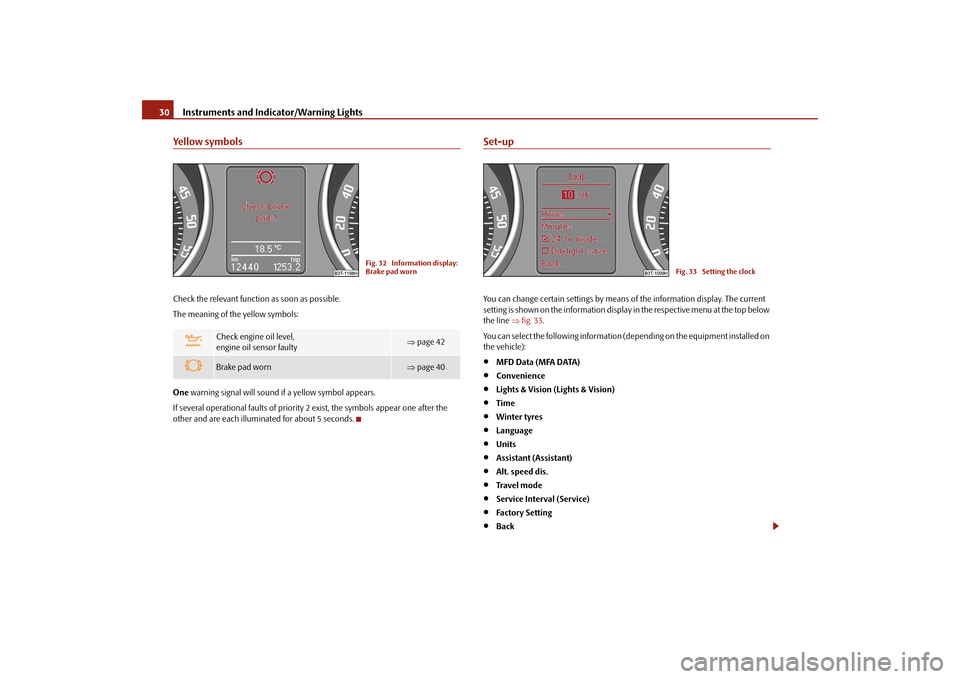
Yellow symbolsCheck the relevant function as soon as possible. The meaning of the yellow symbols: One
warning signal will sound if a yellow symbol appears.
If several operational faults of priority 2 exist, the symbols appear one after the other and are each illuminated for about 5 seconds.
Set-upYou can change certain settings by means of the information display. The current setting is shown on the information display
in the respective menu at the top below
the line
⇒fig. 33
.
You can select the following information (d
epending on the equipment installed on
the vehicle):•
MFD Data (MFA DATA)
•
Convenience
•
Lights & Vision (Lights & Vision)
•
Time
•
Winter tyres
•
Language
•
Units
•
Assistant (Assistant)
•
Alt. speed dis.
•
Tra v e l m o d e
•
Service Interval (Service)
•
Factory Setting
•
Back
Check engine oil level, engine oil sensor faulty
⇒ page 42
Brake pad worn
⇒page 40
Fig. 32 Information display: Brake pad worn
Fig. 33 Setting the clock
s2dk.1.book Page 30 Wednesday, April 8, 2009 12:23 PM
Page 35 of 294
Instruments and Indicator/Warning Lights
34
WARNING
•
If you do not pay attention to the warning lights coming on and the corre-
sponding descriptions and warning notes, this may result in severe body injuries or majo
r vehicle damage.
•
The engine compartment of your car is
a hazardous area. There is a risk
of injuries, scalding, accidents and fire when working in the engine compartment, e.g. inspecting and replenis
hing oil and other fluids. It is also
essential to obse
rve all warnings
⇒page 223, “Working in the engine
compartment”.
Note
•
The arrangement of the indicator lights
depends on the model version. The
symbols shown in the following functional description are to be found as indicator lights in the instrument cluster.•
Operational faults are shown in the inst
rument cluster as red symbols (priority
1 - danger) or yellow symbols (priority 2 - warning).Turn signal system
Either the left
or right
indicator light flashes depending on the position of the
turn signal lever. The indicator light flashes at twice its normal rate if a turn signal light fails. This does not apply when towing a trailer.
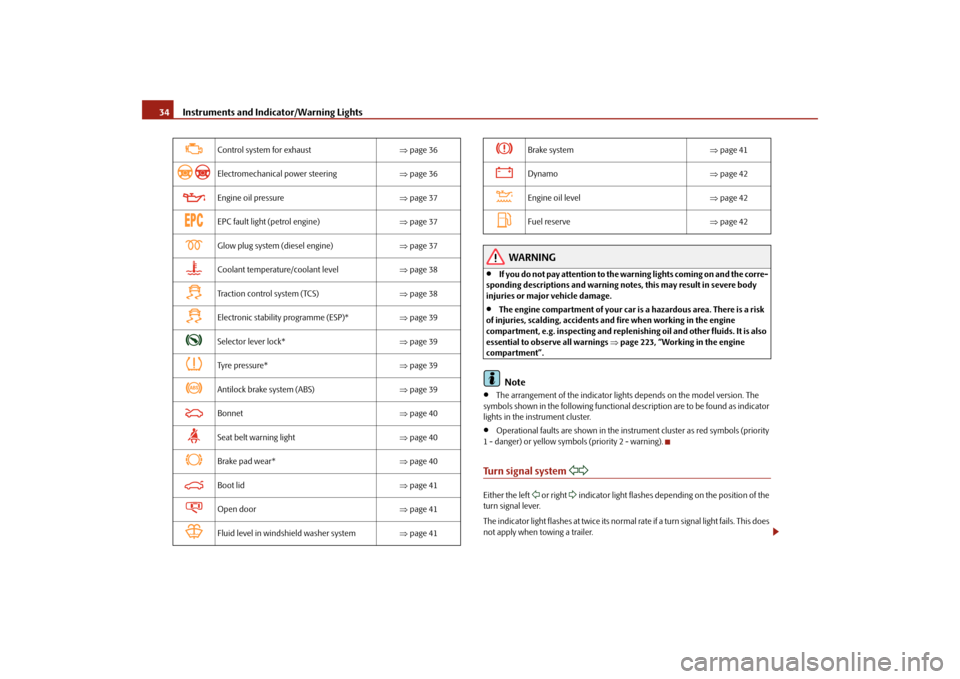
Control system for exhaust
⇒page 36
Electromechanical power steering
⇒page 36
Engine oil pressure
⇒page 37
EPC fault light (petrol engine)
⇒page 37
Glow plug system (diesel engine)
⇒page 37
Coolant temperature/coolant level
⇒page 38
Traction control system (TCS)
⇒page 38
Electronic stability programme (ESP)*
⇒page 39
Selector lever lock*
⇒page 39
Tyre pressure*
⇒page 39
Antilock brake system (ABS)
⇒page 39
Bonnet
⇒page 40
Seat belt warning light
⇒page 40
Brake pad wear*
⇒page 40
Boot lid
⇒page 41
Open door
⇒page 41
Fluid level in windshield washer system
⇒page 41
Brake system
⇒page 41
Dynamo
⇒page 42
Engine oil level
⇒page 42
Fuel reserve
⇒page 42
s2dk.1.book Page 34 Wednesday, April 8, 2009 12:23 PM
Page 38 of 294

Instruments and Indicator/Warning Lights
37
Using the system
Safety
Driving Tips
General Maintenance
Breakdown assistance
Technical Data
•
If the
red
warning light lights up
, this indicates a complete failure of the
power steering and the steering assist has failed (significantly higher steering forces). Further information
⇒page 198.
WARNING
Contact your specialist garage if
the power steering is defective.
Note
•
If the yellow warning light
goes out after starting the engine again and a short
drive, it is not necessary to visit a specialist garage.•
If the battery has been disconnected
and reconnected, the yellow warning light
comes on after switching on the ignition. The warning light must go out after driving a short distance.Engine oil pressure
The warning light
comes on for a few seconds
3) when the ignition is switched
on. Stop the vehicle and switch the engine off
if the warning light does not go off
after the engine has started or flashes while driving. Check the oil level and top up with oil as necessary
⇒page 225.
An audible signal sounds three times as an additional warning signal.Do not continue your journey
if for some reason it is not possible under the
conditions prevailing to top up with oil.
Keep the engine switched off
and obtain
professional assistance from a specialist garage, otherwise it could lead to severe engine damage.
Do not drive any further
if the warning light flashes even if the oil is at the correct
level. Do not run the engine not at idling
speed either. Contact the nearest specialist
garage to obtain professional assistance. The following text will be displayed in the information display*:
Oil Pressure Engine off! Owner's manual
WARNING
•
If you must stop for technical reasons, then park the vehicle at a safe
distance from the traffic and switch off the engine and switch on the hazard warning light system.•
The red oil pressure light
is not an oil level indicator! One should
therefore check the oil level at regular intervals, preferably after every refu- eling stop.EPC fault light
(petrol engine)
The
(Electronic Power Control) warning light comes on for a few seconds when
the ignition is switched on. If the warning light
does not go out or lights up
after starting the engine, a fault
exists in the engine control. The engine management system selects an emergency programme which enables you to drive to the nearest specialist garage by adopting a gentle style of driving. The following text will be displayed in the information display*:
Engine fault Workshop! (Engine fault workshop!)
Glow plug system
(diesel engine)
The warning light
lights up for a
cold
engine when switching on the ignition
(pre-heat position)
2 ⇒page 118. Start the engine after the indicator light goes out.
The glow plug indicator light will come on
for about 1 second if the engine is at a
normal operating temperature
or if the outside temperature is above +5°C. This
means that you can start the engine
right away
.
3)The warning light
on vehicles fitted with information display does not come on after
switching the ignition on, but only if a fault exists or the engine oil level is too low.
s2dk.1.book Page 37 Wednesday, April 8, 2009 12:23 PM
Page 43 of 294

Instruments and Indicator/Warning Lights
42
level has dropped below the MIN marking, do not drive any further - risk of accident! Obtain professional assistance.Alternator
The warning light
comes on after the ignition has been switched on. It should go
out after the engine has started. If the warning light does not go out after the engine has started, or comes on when driving, drive to the nearest specialist garage. The vehicle battery will be discharged in this case so switch off all non-essential electrical components.
Caution
If the warning light
comes on when driving and in addition the warning light
(cooling system fault) also comes on in display, you must then stop the car imme- diately and switch the engine
off - risk of engine damage!
Engine oil level
Warning light
lights up
If the warning light
lights up, the quantity of oil in the engine is probably too low.
Check as soon as possible
the oil level or top up
⇒page 225 with engine oil.
A peep sounds as an additional warning signal.The following text will be displayed in the information display*:
Check oil level!
The warning light will go out if the bonnet
is left open for more than 30 seconds. If
no engine oil has been replenished, th
e warning light will come on again after
driving about 100 km.
Warning light
flashes
A fault on the engine oil level sensor is indicated additionally by an audible signal and the warning light coming on several times after the ignition has been switched on. In this case have the engine inspected without delay by a specialist garage.The following text will be displayed in the information display*:
Oil sensor Workshop!
Fuel reserve
The warning light
comes on, if the fuel level is still below 9 litres.
An audible signal sounds as an additional warning signal.The following text will be displayed in the information display*:
Please refuel! Range...kmNote
The Text in the information display* goes out only after refuelling and driving a short distance.
WARNING (continued)
s2dk.1.book Page 42 Wednesday, April 8, 2009 12:23 PM
Page 197 of 294

Intelligent Technology
196
WARNING
Even with this function the vehicle ca
nnot steer itself! The
driver is further-
more responsible for the steering of the vehicle!BrakesWhat has a negative effect on braking efficiency?Wear-and-tear Wear-and-tear to the brake pads is greatly dependent on the operating conditions of the vehicle and your style of driving. Particularly if you drive a great deal in towns and over short distances or if you adopt a
sporty style of driving, it may be neces-
sary to have the thickness of the brake
pads inspected at a specialist garage
between the service inspections. Wet roads or road salt There may be a certain delay before the br
akes take full effect under certain condi-
tions such as when driving through water,
during heavy rain
showers or after the
vehicle has been washed in
an automatic vehicle wash, since the brake discs and
brake pads may be moist or even have a
coating of ice on them in winter. You
should dry the brakes as soon as possib
le by applying and releasing the brakes
several times. There also may be a certain delay before the
full braking efficiency is available when
driving on roads which have been treated wi
th road salt if yo
u have not used the
brakes for some considerable time beforeha
nd. The layer of salt on the brake discs
and brake pads must first be rubb
ed off when you apply the brakes.
Corrosion Corrosion on the brake discs and dirt on th
e bake pads occur if
the vehicle has been
parked for a long period and if you do
not make much use of the braking system.
We recommend cleaning the brake discs by
firmly applying the brakes at a fairly
high speed if you do not make much use of the braking system or if surface corro- sion is present
⇒
.
Faults in the brake surface If you notice that the braking distance
has suddenly become longer and that the
brake pedal can be depressed further, it is
possible that a brake circuit of the dual-
circuit brake system has failed. Drive, in such cases, to the nearest specialist garage without delay in order to have the problem rectified. Drive at a reduced speed while on your way to the dealer and adapt your style of driving to the higher brake pedal pressure required. Low brake fluid level An insufficient level of brake fluid may result in problems in the brake system. The level of the brake fluid is monitored electronically
⇒page 41, “Brake system
”.
WARNING
•
Only apply the brakes for the purpos
e of drying and cleaning the brake
discs if the traffic conditions permit this. Do not place any other road users in jeopardy.•
When retrospectively mounting a front
spoiler, solid wheel hubs etc. one
must ensure that the air supply to the front wheel brakes is not reduced otherwise the braking sy
stem could run too hot.
•
Allow for the fact that new brake pads
do not achieve th
eir full braking
efficiency until approximately 200 kilo
metres. New brake pads must be first
“run in” before they develop their optimal friction force. You can, however, compensate for this slightly reduced
braking force by increasing the pres-
sure on the brake pedal. This guidelin
e also applies to any new brake pads
installed at a future date.
Caution
•
Never allow the brakes to ru
b by applying slig
ht pressure if you do not wish to
brake the vehicle. This causes the brakes to overheat and can also result in a longer braking distance and excessive wear.•
Before negotiating a steep downhill sect
ion, please reduce your speed, shift
down into the next lower gear (manual ge
arbox) or select a lower driving stage
(automatic gearbox). This enables you to make full use of the braking power of the
s2dk.1.book Page 196 Wednesday, April 8, 2009 12:23 PM
Page 205 of 294

Driving and the Environment
204
Avoiding full throttle Driving more slowly means saving fuel.Sensitive use of the accelera
tor will not only significantly reduce fuel consumption
but also positively influence environmen
tal pollution and wear of your vehicle.
You should avoid fully exploi
ting the top speed of your vehicle wherever possible.
Fuel consumption, pollutant emissions and vehicle noises increase disproportion- ally at high speeds. The
⇒fig. 195
shows the ratio of fuel consumption to the speed of your vehicle.
You will cut your fuel consumption by half
if you only make use three-quarters of
the possible top speed of your vehicle.Reducing idling Idling also costs fuel.It is worthwhile switching off the engine in
a traffic jam or when waiting at a level
crossing or at traffic lights with a length
y red phase. Even after just 30 - 40 seconds
you will have saved more fuel than that
is needed when you start the engine up
again. If an engine is only idling it takes much
longer for it to reach its normal operating
temperature. Wear-and-tear and pollutant em
issions, though, are particularly high
in the warming-up phase. This is why you
should drive off right after starting the
engine. Do avoid high engine re
volutions at this time, however.
Regular servicing A poorly tuned engine consumes an unnecessarily high amount of fuel.Having your vehicle serviced regularly at a specialist garge enables you to satisfy one
of the requirements for economical moto
ring even before you set off on your
journey. Keeping your vehicle properly servic
ed not only has a positive effect on the
safety of your vehicle and maintaining its value, but also saves on
fuel
.
A poorly tuned engine can result in a fu
el consumption which is 10% higher than
normal. The foreseen maintenance work should be undertaken exactly according to the Service schedule by a specialist garage. Also check the
oil level
after refueling.
Oil consumption
is dependent to a consid-
erable extent on the load and speed of
the engine. Oil consum
ption could be as
high as 0.5 litres/1 000 km depending on your style of driving. It is quite normal that a new engine ha
s a higher oil consumption at first, and
reaches its lowest level only
after a certain running in
time. It is therefore not
possible to correctly assess the oil cons
umption of a new vehicle until after you
have driven about 5 000 km.
For the sake of the environment
•
You can achieve additional improvements
in your fuel economy by using high-
lubricity oils.•
Check the ground below your car at regula
r intervals to detect any leakages in
good time. Please have your
vehicle inspected by a specialist garge if you find any
stains caused by oil or
other fluids on the floor.
Fig. 195 Fuel consumption in litres/100 km. and speed in km/h.
s2dk.1.book Page 204 Wednesday, April 8, 2009 12:23 PM
Page 225 of 294

Inspecting and replenishing
224
−Always separate the car batter
y from the electrical system.
− Do not smoke. − Never carry out any work close to naked flames. − Always keep a working fire
extinguisher at hand.
Caution
When replenishing fluids in the engine, always ensure that the fluids are on no account mixed up. This may result in ma
jor operating problems and also vehicle
damage!Overview of the engine compartment The main inspection pointsFig. 202 Diesel engine 1.9 litre/77 kW
Coolant expansion bottle . . . . . . . . . . . . . . . . . . . . . . . . . . . . . . . . . . . Windshield washer fluid reservoir . . . . . . . . . . . . . . . . . . . . . . . . . . . Engine oil filler opening . . . . . . . . . . . . . . . . . . . . . . . . . . . . . . . . . . . . . Engine oil dipstick . . . . . . . . . . . . . . . . . . . . . . . . . . . . . . . . . . . . . . . . . . Brake fluid reservoir . . . . . . . . . . . . . . . . . . . . . . . . . . . . . . . . . . . . . . . . Battery (below a cover) . . . . . . . . . . . . . . . . . . . . . . . . . . . . . . . . . . . . . Note
The location of the inspection points in
the engine compartment of petrol and
diesel engines is practically identical.Engine oilCheck engine oil level The dipstick indicates the level of oil in the engine.Checking the oil level – Ensure that the vehicle is positioned on a level surface. – Switch the engine off. – Open the bonnet
⇒
page 223.
WARNING (continued)
A1
227
A2
234
A3
225
A4
224
A5
228
A6
229
Fig. 203 Dipstick
s2dk.1.book Page 224 Wednesday, April 8, 2009 12:23 PM