2009 SKODA SUPERB fuel pressure
[x] Cancel search: fuel pressurePage 5 of 294

Contents 4Side airbags* . . . . . . . . . . . . . . . . . . . . . . . . . . . . . . . . .
Head airbags* . . . . . . . . . . . . . . . . . . . . . . . . . . . . . . . .
Deactivating an airbag . . . . . . . . . . . . . . . . . . . . . . . . Transporting children safely
. . . . . . . . . . . . . . . . . .
What you should know about transporting children!
Child seat . . . . . . . . . . . . . . . . . . . . . . . . . . . . . . . . . . . .
Attaching a child seat using the “ISOFIX” system .
Attaching child seat using the “Top Tether” system
Driving Tips
. . . . . . . . . . . . . . . . . . . . . . . . . . . . . .
Intelligent Technology
. . . . . . . . . . . . . . . . . . . . . . . .
Electronic stability programme (ESP)* . . . . . . . . . .
Brakes . . . . . . . . . . . . . . . . . . . . . . . . . . . . . . . . . . . . . . .
Brake booster . . . . . . . . . . . . . . . . . . . . . . . . . . . . . . . .
Antilock brake system (ABS) . . . . . . . . . . . . . . . . . . .
Brake Assist* . . . . . . . . . . . . . . . . . . . . . . . . . . . . . . . . .
Uphill-Start off-Assist* . . . . . . . . . . . . . . . . . . . . . . . .
Electromechanical power steering . . . . . . . . . . . . .
Tyre inflation pressure-control system* . . . . . . . . .
Diesel particle filter* (diesel engine) . . . . . . . . . . . .
Driving and the Environment
. . . . . . . . . . . . . . . . .
A new engine . . . . . . . . . . . . . . . . . . . . . . . . . . . . . . . . .
New tyres . . . . . . . . . . . . . . . . . . . . . . . . . . . . . . . . . . . .
New brake pads . . . . . . . . . . . . . . . . . . . . . . . . . . . . . .
Catalytic converter . . . . . . . . . . . . . . . . . . . . . . . . . . . .
Driving in an economical and environmentally
conscious manner . . . . . . . . . . . . . . . . . . . . . . . . . . . .
Environmental compatibility . . . . . . . . . . . . . . . . . . .
Motoring abroad . . . . . . . . . . . . . . . . . . . . . . . . . . . . .
Avoiding damage to your vehicle . . . . . . . . . . . . . .
To w i n g a t r a i l e r
. . . . . . . . . . . . . . . . . . . . . . . . . . . . . . . .
Towing a trailer . . . . . . . . . . . . . . . . . . . . . . . . . . . . . . .
General Maintenance
. . . . . . . . . . . . . . .
Taking care of your vehicle and cleaning the
vehicle
. . . . . . . . . . . . . . . . . . . . . . . . . . . . . . . . . . . . . . . . .
General . . . . . . . . . . . . . . . . . . . . . . . . . . . . . . . . . . . . . .
Care of the exterior of vehicle . . . . . . . . . . . . . . . . . .
Care of the interior of vehicle . . . . . . . . . . . . . . . . . .
Fuel
. . . . . . . . . . . . . . . . . . . . . . . . . . . . . . . . . . . . . . . . . . . .
Petrol . . . . . . . . . . . . . . . . . . . . . . . . . . . . . . . . . . . . . . . .
Diesel . . . . . . . . . . . . . . . . . . . . . . . . . . . . . . . . . . . . . . . .
Refuelling . . . . . . . . . . . . . . . . . . . . . . . . . . . . . . . . . . . .
Inspecting and replenishing
. . . . . . . . . . . . . . . . . .
Engine compartment . . . . . . . . . . . . . . . . . . . . . . . . .
Engine oil . . . . . . . . . . . . . . . . . . . . . . . . . . . . . . . . . . . .
Cooling system . . . . . . . . . . . . . . . . . . . . . . . . . . . . . . .
Brake fluid . . . . . . . . . . . . . . . . . . . . . . . . . . . . . . . . . . .
Battery . . . . . . . . . . . . . . . . . . . . . . . . . . . . . . . . . . . . . . .
Windshield washer system . . . . . . . . . . . . . . . . . . . .
Wheels and Tyres
. . . . . . . . . . . . . . . . . . . . . . . . . . . . . .
Wheels . . . . . . . . . . . . . . . . . . . . . . . . . . . . . . . . . . . . . .
Accessories, changes and replacement of partsAccessories and replacement parts . . . . . . . . . . . . .
Technical changes . . . . . . . . . . . . . . . . . . . . . . . . . . . .
Vehicles of the group N1 . . . . . . . . . . . . . . . . . . . . . .Breakdown assistance
. . . . . . . . . . . . . .
Breakdown assistance
. . . . . . . . . . . . . . . . . . . . . . . .
First-aid box* . . . . . . . . . . . . . . . . . . . . . . . . . . . . . . . . .
Warning triangle . . . . . . . . . . . . . . . . . . . . . . . . . . . . . .
Fire extinguisher* . . . . . . . . . . . . . . . . . . . . . . . . . . . . .
Vehicle tool kit . . . . . . . . . . . . . . . . . . . . . . . . . . . . . . . .
Tyre repair kit* . . . . . . . . . . . . . . . . . . . . . . . . . . . . . . . .
Spare wheel* . . . . . . . . . . . . . . . . . . . . . . . . . . . . . . . . .
Changing a wheel . . . . . . . . . . . . . . . . . . . . . . . . . . . . .
Jump-starting . . . . . . . . . . . . . . . . . . . . . . . . . . . . . . . .
Tow-starting and towing vehicle . . . . . . . . . . . . . . .
Fuses and light bulbs
. . . . . . . . . . . . . . . . . . . . . . . . . .
Electric fuses . . . . . . . . . . . . . . . . . . . . . . . . . . . . . . . . .
Bulbs . . . . . . . . . . . . . . . . . . . . . . . . . . . . . . . . . . . . . . . .
Technical Data
. . . . . . . . . . . . . . . . . . . . . . . . . .
Technical Data
. . . . . . . . . . . . . . . . . . . . . . . . . . . . . . . . .
General information . . . . . . . . . . . . . . . . . . . . . . . . . . .
Used abbreviations . . . . . . . . . . . . . . . . . . . . . . . . . . .
Performances . . . . . . . . . . . . . . . . . . . . . . . . . . . . . . . . .
Weight . . . . . . . . . . . . . . . . . . . . . . . . . . . . . . . . . . . . . . .
Identification details . . . . . . . . . . . . . . . . . . . . . . . . . .
Fuel consumption according to the regulations
(99/100/EU) . . . . . . . . . . . . . . . . . . . . . . . . . . . . . . . . . .
Dimensions . . . . . . . . . . . . . . . . . . . . . . . . . . . . . . . . . .
Engine oil specifications . . . . . . . . . . . . . . . . . . . . . . .
1.4 ltr./92 kW TSI - EU5 . . . . . . . . . . . . . . . . . . . . . . . .
1.8 ltr./118 kW TSI - EU5 . . . . . . . . . . . . . . . . . . . . . . .
3.6 ltr./191 kW FSI - EU5 . . . . . . . . . . . . . . . . . . . . . . .
1.9 ltr./77 kW TDI PD - EU4 . . . . . . . . . . . . . . . . . . . .
2.0 ltr./103 kW TDI PD - EU4 . . . . . . . . . . . . . . . . . . .
2.0 ltr./125 kW TDI CR - EU5 . . . . . . . . . . . . . . . . . . .
Index
. . . . . . . . . . . . . . . . . . . . . . . . . . . . . . . . . . . . . . . . 179
181
182
185
185
188
191
192
193
193
193
196
197
197
198
198
198
199
200
201
201
201
201
202
202
206
206
207
208
208211
211
211
211
216
219
219
219
220
222
222
224
226
228
229
234
235
235
241
241
241
241
243
243
243
243
243
244
244
245
245
250
252256
256
261
267
267
267
267
267
267
268
268
269
270
272
274
276
278
280
282
285
s2dk.1.book Page 4 Wednesday, April 8, 2009 12:23 PM
Page 35 of 294
Instruments and Indicator/Warning Lights
34
WARNING
•
If you do not pay attention to the warning lights coming on and the corre-
sponding descriptions and warning notes, this may result in severe body injuries or majo
r vehicle damage.
•
The engine compartment of your car is
a hazardous area. There is a risk
of injuries, scalding, accidents and fire when working in the engine compartment, e.g. inspecting and replenis
hing oil and other fluids. It is also
essential to obse
rve all warnings
⇒page 223, “Working in the engine
compartment”.
Note
•
The arrangement of the indicator lights
depends on the model version. The
symbols shown in the following functional description are to be found as indicator lights in the instrument cluster.•
Operational faults are shown in the inst
rument cluster as red symbols (priority
1 - danger) or yellow symbols (priority 2 - warning).Turn signal system
Either the left
or right
indicator light flashes depending on the position of the
turn signal lever. The indicator light flashes at twice its normal rate if a turn signal light fails. This does not apply when towing a trailer.
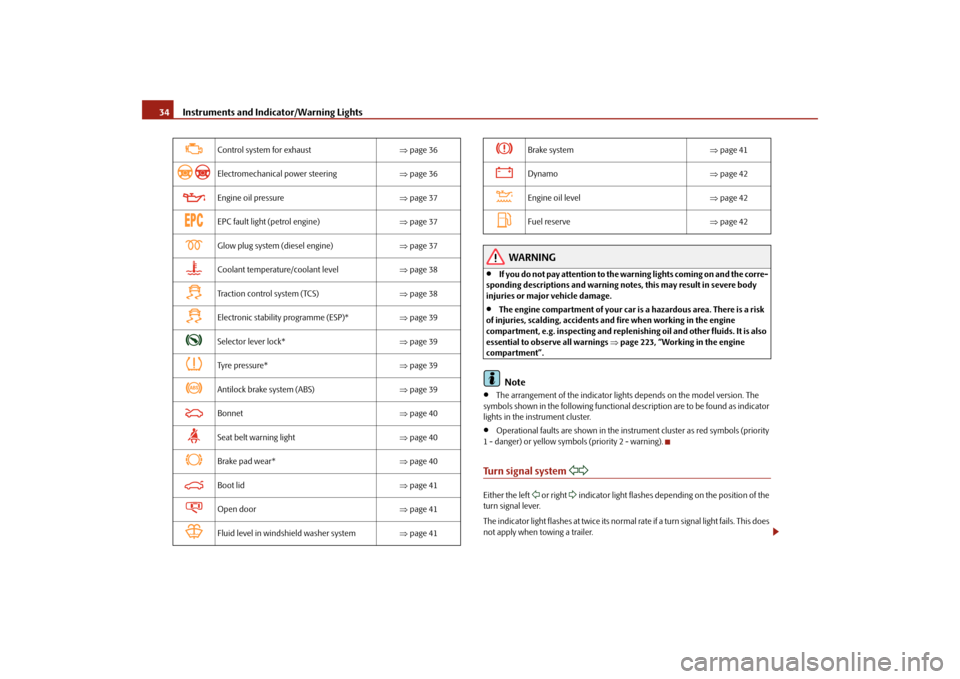
Control system for exhaust
⇒page 36
Electromechanical power steering
⇒page 36
Engine oil pressure
⇒page 37
EPC fault light (petrol engine)
⇒page 37
Glow plug system (diesel engine)
⇒page 37
Coolant temperature/coolant level
⇒page 38
Traction control system (TCS)
⇒page 38
Electronic stability programme (ESP)*
⇒page 39
Selector lever lock*
⇒page 39
Tyre pressure*
⇒page 39
Antilock brake system (ABS)
⇒page 39
Bonnet
⇒page 40
Seat belt warning light
⇒page 40
Brake pad wear*
⇒page 40
Boot lid
⇒page 41
Open door
⇒page 41
Fluid level in windshield washer system
⇒page 41
Brake system
⇒page 41
Dynamo
⇒page 42
Engine oil level
⇒page 42
Fuel reserve
⇒page 42
s2dk.1.book Page 34 Wednesday, April 8, 2009 12:23 PM
Page 75 of 294

Lights and Visibility
74
Top up with wash liquid
⇒page 234.
Winter position If the windscreen wipers are in rest posi
tion, they cannot be folded out from the
windscreen. For this reason we recommend
adjusting the windscreen wipers in
winter so that they can be folded out fr
om the windscreen easi
ly. You can set this
rest position as follows:•
Switch on the windscreen wipers.
•
Switch off the ignition. The windscreen wi
pers remain in the position in which
they were when switching off the ignition. You can also use the service po
sition as a winter position.
WARNING
•
Properly maintained windscreen wiper
blades are essential for clear visi-
bility and safe driving
⇒page 74.
•
Do not use the windscreen washer sy
stem at low temperatures, without
heating the windscreen beforehand. Otherwise the window cleaner could freeze on the windscreen and re
strict the view to the front.
•
The rain sensor only operates as a
support. The driver is not released
from the responsibility to set the function of the windscreen wipers manu- ally depending on the visibility conditions.
Caution
In frosty weather, please first of all chec
k whether the windscreen wiper blades are
not frozen to the windscreen before swit
ching them on. Switching on windscreen
wipers when the blades are frozen to the windscreen may result in damage both to the blades and the motor of the windscreen wipers!
Note
•
If the slower or the faster wiper setting is switched on
⇒page 73, fig. 73
and the vehicle speed decreases to below 4
km/h, the lower wiper step is switched
on automatically. At a speed increase of
more than 8 km/h the previous wiper
setting is established again.
•
If there is an obstacle on the windscreen, the wiper will try to push away the
obstacle. If the obstacle continues to bloc
k the wiper, the wiper stops after 5 cycles,
in order to avoid a damage to the wiper.
Remove the obstacle and and switch on
the wiper again.Headlight cleaning system*The headlights are being cleaned after the
windscreen has been sprayed for the first
time and fifth time, the low beam or ma
in beam are switched on and the wind-
screen wiper lever was held in the position
⇒page 73, fig. 73
for about 1
second. The headlight washer nozzles are moved fo
rward out of the bumper by the water
pressure for cleaning the headlights. You should remove stubborn dirt (such
as insect residues) from the headlight
lenses at regular intervals, for example when refuelling. Please refer to the following guidelines. You should remove any snow from the fixtures of the washer nozzles and clear ice in winter with a de-icing spray in order to ensure proper operation of the cleaning system.Replacing wiper blades for the windscreen wipers
A2
A3
A5
Fig. 74 Wiper blade for the windscreen wiper
s2dk.1.book Page 74 Wednesday, April 8, 2009 12:23 PM
Page 120 of 294

Starting-off and Driving
119
Using the system
Safety
Driving Tips
General Maintenance
Breakdown assistance
Technical Data
Starting the engineGeneral You can only start the engine only using an original ignition key.•
Place the gearshift lever into neutral (or place the selector lever to the position
P or N in the case of an automatic gearbox)
and put on the handbrake firmly before
starting the engine.•
The clutch pedal should be fully depressed when starting the engine which
means that the starter only
has to crank the engine.
•
Let go of the key as soon as the engine starts otherwise there may be damage
to the starter. The engine running noises may louder at
first be louder for
a short time after
starting the cold engine until oil pressure
can be built up in the hydraulic valve
clearance compensation. This is quite normal and is not an operating problem. If the engine does not start ... You can use the battery of anothe
r vehicle as a jump-start aid
⇒page 250.
It is only possible to tow-start vehicl
es fitted with a manual gearbox. The tow-
starting distance must not be more than 50 metres.
WARNING
•
Never run the engine in non ventilat
ed or enclosed areas. The exhaust
gases of the engine contain besides
the odorless and colourless carbon
monoxide a poisonous gas - hazard! Carbon monoxide can cause uncon- sciousness and death.•
Never leave your vehicle unattended with the engine running.Caution
•
The starter may only be operated (ignition key position ), if the engine is not
running. If the starter is immediately oper
ated after switching off the engine, the
starter or the engine can be damaged.
•
Avoid high engine revolutions, full throttl
e and high engine loads as long as the
engine has not yet reached it
s normal operating temperature - risk of damaging the
engine!•
Vehicles which are fitted wi
th an exhaust gas catalyti
c converter should not be
tow-started over a distance of more than 50 metres.
For the sake of the environment
Never warm up the engine when the vehi
cle is standing. Drive off right away.
Through this the engine reaches its operating temperature more rapidly and the pollutant emissions are lower.Petrol enginesThese engines are fitted with a starter system which selects the correct fuel/air mixture for every external air temperature.•
Do not operate accelerator before and when starting engine.
•
Interrupt the attempt at starting after
10 seconds if the engine does not start
right awayand wait for about 30 se
conds before repeating the attempt.
•
It is possible that the fuse on the electric
al fuel pump is defect if the engine still
does not start. Check the fuse and replace it if necessary
⇒page 256.
•
Contact the nearest specialist garage to obtain professional assistance.
It may be necessary, if the engine is
very hot
, to slightly depress the accelerator
after the engine has started.Diesel enginesGlow plug system Diesel engines are equipped with a glow
plug system, the preglow period being
controlled automatically in
line with the coolant temperature and outside temper-
ature. The preglow indicator light
comes on after the ignition has been switched on.
A3
s2dk.1.book Page 119 Wednesday, April 8, 2009 12:23 PM
Page 122 of 294

Starting-off and Driving
121
Using the system
Safety
Driving Tips
General Maintenance
Breakdown assistance
Technical Data
Shift into reverse only when the car is stationary. Depress the clutch pedal and hold it fully depressed. Wait a moment before
engaging reverse gear in order to avoid
any shift noises. The reversing lights will come on once reve
rse gear is engaged, provided the igni-
tion is on. Superb GreenLine - Shift recommendation for changing gears On the model Superb GreenLine, the currently engaged gear
⇒fig. 136
is
shown in the display of the instrument cluster. In order to minimise the fuel consumptio
n, a recommendation for shifting into
another gear is indicated in the display. An arrow points up or down depending on whether it is recommended to shift to
a higher gear or to a lower gear. At the
same time, the recommended gear is indicated instead of the currently engaged gear .
WARNING
Never engage the reverse gear when driving - risk of accident!
Note
•
One should not lay the hand on the shift lever while driving the vehicle. The
pressure of the hand will be transferred to the gearshift forks in the gearbox. This can, over a period of time, lead to early wear of the gearshift forks.
•
Depress the clutch pedal fully when changing gears, in order to avoid unneces-
sary wear and damage to the clutch and gearbox parts.HandbrakeApplying the handbrake – Pull the handbrake lever up fully. Releasing the handbrake – Pull the handbrake lever up slightly
and
at the same time
press in the
locking button
⇒
fig. 137
.
– Hold the button pressed and push the handbrake lever down fully
⇒
.
The handbrake warning light
lights up when the handbr
ake is applied, provided
the ignition is on. A warning signal sounds and the following text appears in the display* if you have inadvertently driven off with the handbrake applied:
Release parking brake!
The handbrake warning is activated if you dr
ive at a speed of more than 6 km/h for
more than 3 seconds.
Fig. 136 Shift recommenda- tion for changing gears
AA
AB
AA
Fig. 137 Centre console: Handbrake
s2dk.1.book Page 121 Wednesday, April 8, 2009 12:23 PM
Page 202 of 294

Driving and the Environment
201
Using the system
Safety
Driving Tips
General Maintenance
Breakdown assistance
Technical Data
Driving and the EnvironmentA new engineThe engine has to be run in during the first 1 500 kilometres.Up to 1 000 kilometres – Do not drive faster than 3/4 of the mamimum speed of the gear in use,
that is 3/4 of the maximum permissible engine speed.
– Do not use full throttle.– Avoid high engine revolutions. – Do not tow a trailer. From 1 000 up to 1 500 kilometres – Increase the power output of the engine
gradually
up to the full
speed of the gear engaged, that
is up to the maximum permissible
engine revolutions.
During the first operating hours the engine
has higher internal
friction than later
until all of the moving parts have harmonized. The driving style which you adopt during the first approx.1 500 kilometres
plays a decisive part in the success of
running in your car. You should not drive at unnecessarily
high engine revolutions
even after the
running-in period is
complete. The maximum permissib
le engine spee
d is marked
by the beginning of the red zone on the scale of the revolutions counter. Shift up into the next higher gear on a vehicle
fitted with manual gearbox before the red
zone is reached.
Extremely
high engine revolutions are automatically governed, by
the way. For a vehicle fitted with a manual gearbox
the converse situation also applies: Do
not drive at engine revolutions which are
too low
. Shift down as soon as the engine
is no longer running smoothly.
Caution
All the speed and engine revolution figure
s apply only when the engine is at its
normal operating temperature. Never rev up
an engine which is cold, neither when
the vehicle is stationary nor when driving in individual gears.
For the sake of the environment
Not driving at unnecessarily high engine revolutions and shifting to a higher gear as early as possible are ways to minimise fuel consumption and operating noise levels and protects the environment.New tyresNew tyres have to be “run in” since they do
not offer optimal grip at first. You should
take account of this fact for the first 500 kilometres and drive particularly carefully.New brake padsAllow for the fact that new brake pads do
not achieve their full braking efficiency
until approximately 200 kilometres. New brake pads must be first “run in” before they develop their optimal friction force.
You can, however, compensate for this
slightly reduced braking force by increasing the pressure on the brake pedal. This guideline also applies to any new
brake pads installed at a future date.
During the running-in period, you should
avoid excessive stresses on the brakes.
This includes, for example, violent braking,
particularly from very high speeds, and
also when crossing mountain passes.
s2dk.1.book Page 201 Wednesday, April 8, 2009 12:23 PM
Page 206 of 294

Driving and the Environment
205
Using the system
Safety
Driving Tips
General Maintenance
Breakdown assistance
Technical Data
Avoid driving short distances Short distances result in an above-average high fuel consumption.– Avoid driving a distance of no more than 4 km if the engine is cold.The engine and catalytic converter mu
st first have reached their optimal
operating
temperature
in order to effectively reduce fu
el consumption and pollutant emis-
sions. The cold engine vehicle consumes approx. 15 - 20 litres/100 km of fuel immediately after starting. Fuel co
nsumption drops to 10 litres/100 km after just 1 kilometre. The
engine reaches its operating temperat
ure (outside temperature and engine
dependent) only after about
4 to 10
kilometres and the fuel consumption then
stabilizes. You should therefore avoid driving short distances whenever possible. An important factor in this connection is also the
ambient temperature
. The
⇒ fig. 196
shows the different fuel consumptions for the same distance, on the one
hand at +20°C and on the other hand at
-10°C. Your vehicle has a higher fuel
consumption in winter than in summer.Checking tyre inflation pressures Tyres which are correctly inflated save fuel.Always ensure that your tyres are inflated
to the correct pressure at all times. The
rolling resistance will be increased if the tyre filling pressure is too low. This will not
only increase fuel consumption but also
tyre wear and the driving behaviour will
worsen. Always check the inflation pressure of the tyres when
cold
.
Do not drive with
winter tyres
all year round for this costs about 10 % more fuel.
Winter tyres are also louder.No unnecessary ballast Transporting ballast costs fuel.The fact that every kilogram of extra
weight
increases your fuel consumption
means that it is worth taking a look in the luggage compartment to avoid trans- porting any unnecessary ballast. It is particularly in town traffic, when one
is accelerating quite often, that the vehicle
weight will have a significant effect upon
the fuel consumption. A rule of thumb
here is that an increase in weight of 100
kilograms will cause an increase in fuel
consumption of about 1
litre/100 kilometres.
You may frequently also leave a
roof rack fitted
on just out of convenience,
although you no longer need it. The incr
eased aerodynamic drag of your vehicle
causes it to use about 10% more fuel th
an normal at a speed of 100 - 120 km/h,
even when you are not carr
ying a load on the roof.
Saving electricity Generating electricity costs fuel.– Switch off electrical components as
soon as you no longer need them.
When the engine is running, the alternator
generates and supplies
electrical power.
The greater the load on the alternator as a result of having a large number of elec-trical components switched on, the more
fuel will be consumed for operating the
alternator.
Fig. 196 Fuel consumption in litres/100 km at different temperatures
s2dk.1.book Page 205 Wednesday, April 8, 2009 12:23 PM
Page 236 of 294

Wheels and Tyres
235
Using the system
Safety
Driving Tips
General Maintenance
Breakdown assistance
Technical Data
Wheels and TyresWheelsGeneral information•
New tyres do not offer optimal grip at first and should therefore be run in for
about 500 km at a moderate speed and an
appropriately cautious style of driving.
You will also profit from longer tyre life.•
The tread depth of new tyres may differ
because of design features and the
configuration of the tread (depending on
the type of tyre and the manufacturer).
•
Drive over curbs on the side of the road
and other such obstacles slowly and,
where possible, at a right angle in order to avoid damage to tyres and wheel trims.•
Inspect your tyres from time to time
for damage (punctures, cuts, splits and
bulges). Remove foreign bodies from the tyre profile.•
Damage to tyres and wheels is frequent
ly not visible. Unus
ual vibrations or
pulling of the vehicle to one side
could be a sign of tyre damage.
Please reduce
your speed immediately and stop if
you suspect that a wheel is damaged.
Inspect the tyres for signs of damage (bulges,
splits, etc.). If no
visible damage is
present, please drive at an appropriatel
y slow speed and carefully to the nearest
specialist garage in order to have your vehicle inspected.•
Also protect your tyres from contact with oil, grease and fuel.
•
Immediately replace any dust caps of the valves which have got lost.
•
Mark wheels before removing them so th
at their previous direction of running
can be maintained when mounted them again.•
Always store wheels or tyres which been removed in a cool, dry and, where
possible, dark place. Tyres which are not fixed to a wheel trim should be stored upright. Unidirectional tyres* The direction of rotation of the tyres is marked by arrows on the wall of the tyre. This indicates the direction of rotation of the tyre, and it is essential that the tyres are fitted on to run in this direction. Only then
are the tyres able to provide the optimal
properties in terms of grip, low noise, wear-and-tear and aquaplaning.
Further information concerning
the use of unidi
rectional tyres
⇒page 239.
WARNING
•
New tyres during the first 500 km do not offer optimal grip and should
therefore be run appropriately - risk of accident!•
Never drive with damaged tyres - risk of accident!Note
Please observe the various differing legal requirements regarding tyres.Tyre lifeThe life of your tyres very much depends on the following points: Tyre pressure The working life of tyres will be shortened considerably if the tyres are insufficiently or over-inflated and this will have an advers
e effect on the handli
ng of your vehicle.
Correctly inflated tyres are of partic
ular importance when travelling at
high speeds
.
It is therefore good to check the pressure at least once a month and also before
Fig. 210 An opened fuel filler flap with a tyre size and tyre inflation pressure table
s2dk.1.book Page 235 Wednesday, April 8, 2009 12:23 PM