2009 Seat Ibiza ST light
[x] Cancel search: lightPage 134 of 250

Driving133
Safety First
Operating instructions
Practical tips
Technical Data
The immobiliser will be activated again automatically as soon as you pull the
key out of the ignition lock.
The engine can only be started using a genuine SEAT key with its correct code.
Note
A perfect operation of the vehicle is ensured if genuine SEAT keys are used.Starting and stopping the engineStarting petrol engines
The engine can only be started using a genuine SEAT key with
its correct code.– Move the gear lever to the neutral position and depress the
clutch pedal thoroughly and hold it in this position for the starter
to turn the engine on.
– Turn the ignition key to the starting ⇒page 132 position.
– Le t go o f the ig nit io n key as so on as the e ngin e star t s; t he sta r ter motor must not run on with the engine.After starting a very hot engine, you may need to slightly press down the
accelerator.
When starting a very cold engine, it may be a little noisy for the first few
seconds until oil pressure has built up in the hydraulic valve compensators.
This is quite normal, and no cause for concern. If the engine does not start immediately, switch the starter off after
10 seconds and try again after half a minute. If the engine still does not start,
the fuel pump fuse should be checked
⇒page 209, “Fuses”.
WARNING
•Never start or run the engine in unventilated or closed rooms. The
exhaust fumes contain carbon monoxide, an odourless and colourless
poisonous gas. Risk of fatal accidents. Carbon monoxide can cause loss of
consciousness. It can also cause death.•Never leave the vehicle unattended if the engine is running.•Never use “cold start sprays”, they could explode or cause the engine
to run at high revs. Risk of injury.Caution
•When the engine is cold, you should avoid high engine speeds, driving at
full throttle and over-loading the engine. Risk of engine damage.•The vehicle should not be pushed or towed more than 50 metres to start
the engine. Unburnt fuel could enter the catalytic converter and damage it.•Before attempting to push-start or tow a vehicle in order to start it, you
should first try to start it using the battery of another vehicle. Note and follow
the instructions in ⇒page 222, “Jump-starting”.For the sake of the environment
Do not warm-up the engine by running the engine with the vehicle stationary.
You should drive off as soon as you start the engine. This helps the engine
reach operating temperature faster and reduces emissions.
Ibiza ST_EN.book Seite 133 Dienstag, 12. Januar 2010 4:03 16
Page 135 of 250
Driving
134Starting diesel engines
The engine can only be started using a genuine SEAT key with
its correct code.– Move the gear lever to the neutral position and depress the
clutch pedal thoroughly and hold it in this position for the starter
to turn the engine on.
– Turn the ignition key to the starting position.
– Turn the ignition key to position ⇒page 132, fig. 101 . The
indicator lamp
will light for engine pre-heating.
– When the warning lamp turns off, turn the key to position to start the engine. Do not press the accelerator.
– Let go of the ignition key as soon as the engine starts, the starter motor must not be allowed to run on with the engine.
When starting a very cold engine, it may be a little noisy for the first few
seconds until oil pressure has built up in the hydraulic valve compensators.
This is quite normal, and no cause for concern.
If there are problems starting the engine, see the ⇒page 222.
Glow plug system for the diesel engine
To avoid unnecessary discharging of the battery, do not use any other major
electrical equipment while the glow plugs are pre-heating.
Start the engine as soon as the glow plug warning lamp goes out.
Starting the engine after the fuel tank has been completely run dry
If the fuel tank has been completely run dry, it may take longer than normal
(up to one minute) to start the engine after refuelling with diesel fuel. This is
because the system must eliminate air first.
WARNING
•Never start or run the engine in un ventilated or closed rooms. The
exhaust fumes contain carbon monoxide, an odourless and colourless
poisonous gas. Risk of fatal accidents. Carbon monoxide can cause loss of
consciousness. It can also cause death.•Never leave the vehicle unattended if the engine is running.•Never use “cold start sprays”, they could explode or cause the engine
to run at high revs. Risk of injury.Caution
•When the engine is cold, you should avoid high engine speeds, driving at
full throttle and over-loading the engine. Risk of engine damage.•The vehicle should not be pushed or towed more than 50 metres to start
the engine. Unburnt fuel could enter the catalytic converter and damage it.•Before attempting to push-start or tow a vehicle in order to start it, you
should first try to start it using the battery of another vehicle. Note and follow
the instructions in ⇒ page 222, “Jump-starting”.For the sake of the environment
Do not warm-up the engine by running the engine with the vehicle stationary.
You should drive off as soon as you start the engine. This helps the engine
reach operating temperature faster and reduces emissions.Switching the engine off– Stop the vehicle.
– Turn the ignition key to position ⇒page 132, fig. 101 .
A2A3
A1
Ibiza ST_EN.book Seite 134 Dienstag, 12. Januar 2010 4:03 16
Page 137 of 250
Driving
136The reverse lights light up when the reverse gear is selected and the ignition
is on.
WARNING
•When the engine is running, the vehicle will start to move as soon as a
gear is engaged and the clutch released.•Never select the reverse gear when the vehicle is in motion. Risk of acci-
dent.Note
•Do not rest your hand on the gear lever while driving. The pressure of your
hand could cause premature wear on the selector forks in the gearbox.•When changing gear, you should always depress the clutch fully to avoid
unnecessary wear and damage.•Do not hold the car “on the clutch” uphills. This causes premature wear
and damage to the clutch.
Automatic gearbox*Gearbox programmes
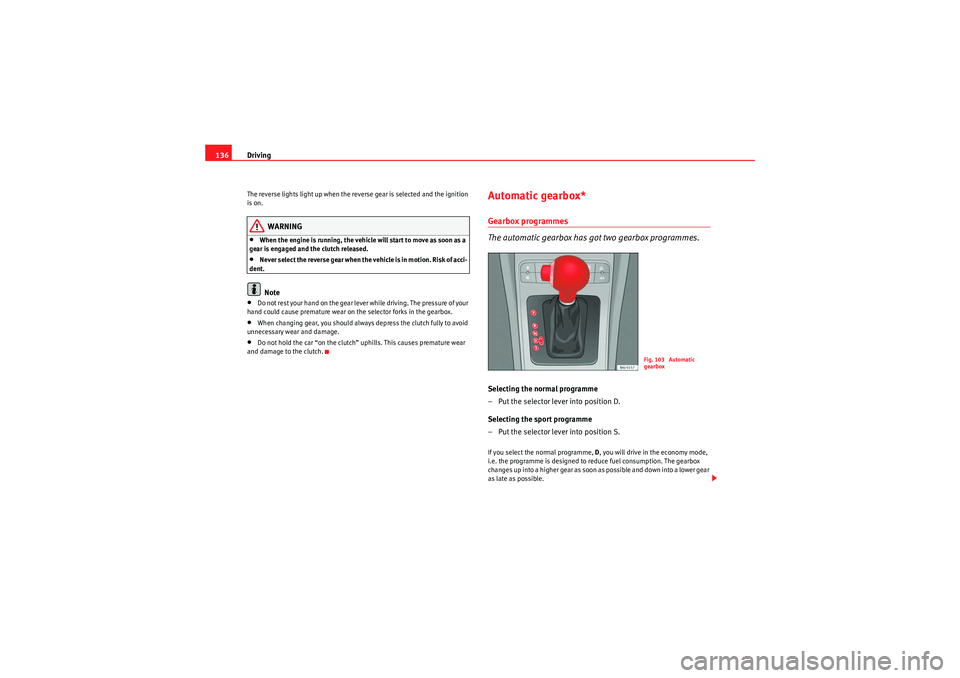
The automatic gearbox has got two gearbox programmes.Selecting the normal programme
– Put the selector lever into position D.
Selecting the sport programme
– Put the selector lever into position S.If you select the normal programme, D , you will drive in the economy mode,
i.e. the programme is designed to reduce fuel consumption. The gearbox
changes up into a higher gear as soon as possible and down into a lower gear
as late as possible.
Fig. 103 Automatic
gearbox
Ibiza ST_EN.book Seite 136 Dienstag, 12. Januar 2010 4:03 16
Page 139 of 250

Driving
138Driving a car with an automatic gearbox
The gearbox changes gear ratios automatically as the vehicle
moves.Starting
– Start the engine with the selector lever in position P or N.
Driving
– Hold the brake pedal pressed down.
– By holding the lock button (button on the left in the selector lever), select R, or D.
– Release the lever and wait a little for the gearbox to engage the gear (a slight movement can be felt).
– Release the brake and press the accelerator ⇒. Stopping briefly
– If stopping for a short time, keep the vehicle stationary by
pressing the foot brake hard to prevent the car moving back-
wards on a slope or “creeping” forwards, e.g. at traffic lights. The
selector lever does not need to be put into the positions P or N.
– Do not press the accelerator.
Parking the vehicle
– Press and hold the brake pedal until the vehicle comes to a standstill ⇒.
– Apply the handbrake.
– By pressing the lock button down, move the selector lever to P
and release the lock button.
Driving up and down hills
– Press the selector lever from position “D” to the right into the Tiptronic selector gate.
– Lightly press the selector lever back to change down.
Holding the car on a hill
– The footbrake must be always pressed down to prevent the vehicle from “rolling backwards” ⇒. Do not try to prevent the
vehicle from “rolling backwards” by increasing the engine speed
while a range of gears is selected.
Starting the vehicle up hills
– Apply the handbrake.
Fig. 106 Automatic
gearbox
Ibiza ST_EN.book Seite 138 Dienstag, 12. Januar 2010 4:03 16
Page 140 of 250

Driving139
Safety First
Operating instructions
Practical tips
Technical Data
– With a selected gear, accelerate slowly and at the same time,
release the handbrake.The steeper the slope, the lower the needed gear. This increases the braking
effect of the engine. For example, when driving down a very steep slope in 3rd
gear. If the engine brake effect is not enough, the vehicle will speed up. The
automatic gearbox automatically changes up to prevent the engine over-
revving. Use the foot brake to reduce speed and change into 3rd gear again
using Tiptronic* ⇒.
Your vehicle has an automatic interlock which prevents the selector lever
from being put into a position for driving forwards or in reverse from positions
P or N if the brake pedal is not depressed.
The ignition key cannot be removed unless the selector lever is in position P.
Warning lamp “Pressing brake pedal”
When the warning lamp next to the selector lever lights up, press the brake
pedal. This is necessary when the automatic gearbox gear lever is moved out
of positions P or N . At the same time, a text message or the instructions to
perform necessary operations may appear on the instrument panel.
WARNING
•As a driver, you should never leave your vehicle if the engine is running
and a gear is engaged. If you have to leave your vehicle while the engine is
running, you must apply the parking brake and engage parking lock P.•If the engine is running and D or R are engaged, you will need to hold
vehicle stopped by depressing the brake pedal. The car would keep on
creeping forward as the power transmission is not fully interrupted even
when the engine is idling.•Never accelerate when changing gear or you may cause an accident.•Never move the selector lever to R or P when driving. Risk of accident!•Before driving down a long, steep slop e, it is advisable to reduce speed
and change into a lower gear.
•If you stop the vehicle up hill, always hold the foot brake strongly
depressed down to stop it from rolling back.•Never allow the brake to rub and do not use the brake pedal too often
or for long periods. Constant braking will cause the brakes to overheat and
will considerably reduce the brake effect. This increases the braking
distance and could cause the brake system to fail.•Never allow the car to roll down a mountain or a slope with the lever in
the N or D position, regardless of the engine is running or not.Caution
•If you stop the vehicle up hills, do not attempt to stop it from rolling back
by depressing the accelerator when a gear has been selected. Otherwise, the
automatic gearbox may overheat causing damage. Pull the handbrake up or
fully depress the brake pedal to prevent the vehicle from rolling away.•If you allow the car to roll when the engine is not running, or with the gear
lever in position N, a lack of lubrication in the automatic gearbox will damage
it.WARNING (continued)
Ibiza ST_EN.book Seite 139 Dienstag, 12. Januar 2010 4:03 16
Page 141 of 250
Driving
140Changing gear in Tiptronic mode*
The Tiptronic system allows the driver to select gears manu-
ally
General information about driving in Tiptronic mode
Changing gear in Tiptronic mode
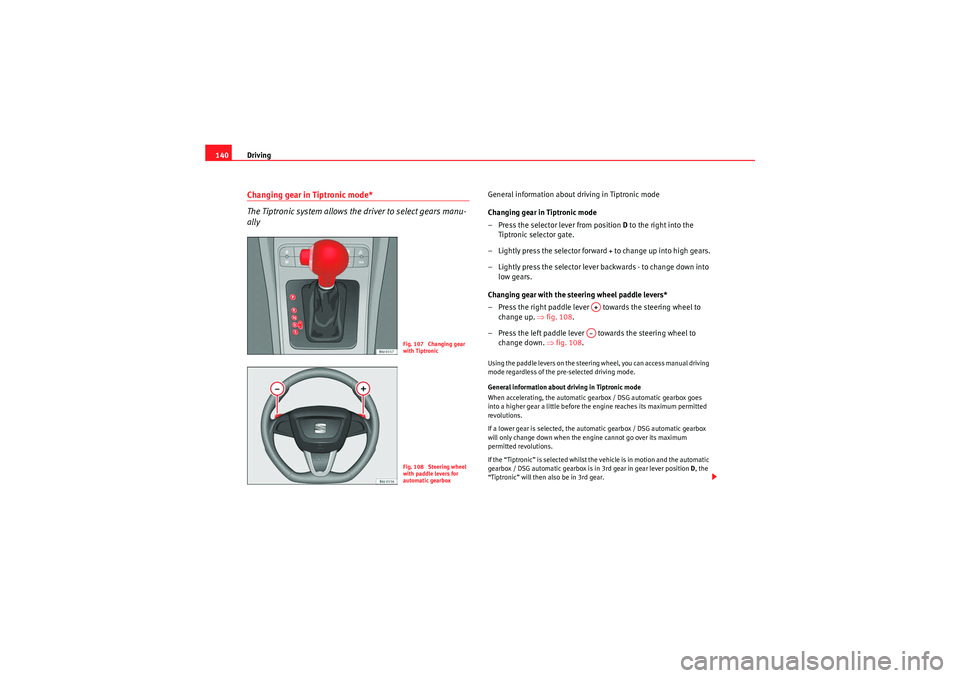
– Press the selector lever from position D to the right into the
Tiptronic selector gate.
– Lightly press the selector forward + to change up into high gears.
– Lightly press the selector lever backwards - to change down into
low gears.
Changing gear with the steering wheel paddle levers*
– Press the right paddle lever towards the steering wheel to change up. ⇒fig. 108 .
– Press the left paddle lever towards the steering wheel to change down. ⇒fig. 108 .Using the paddle levers on the steering wheel, you can access manual driving
mode regardless of the pre-selected driving mode.
General information about driving in Tiptronic mode
When accelerating, the automatic gearbox / DSG automatic gearbox goes
into a higher gear a little before the engine reaches its maximum permitted
revolutions.
If a lower gear is selected, the automatic gearbox / DSG automatic gearbox
will only change down when the engine cannot go over its maximum
permitted revolutions.
If the “Tiptronic” is selected whilst the vehicle is in motion and the automatic
gearbox / DSG automatic gearbox is in 3rd gear in gear lever position D, the
“Tiptronic” will then also be in 3rd gear.
Fig. 107 Changing gear
with TiptronicFig. 108 Steering wheel
with paddle levers for
automatic gearbox
A+A–
Ibiza ST_EN.book Seite 140 Dienstag, 12. Januar 2010 4:03 16
Page 142 of 250

Driving141
Safety First
Operating instructions
Practical tips
Technical Data
Changing gears in the normal or sport programme using the steering wheel
paddle levers
If the paddle levers ⇒
page 140, fig. 108 are used in the normal or sport
programme, the system switches temporarily to “Tiptronic” mode. To exit
“Tiptronic” mode again, press the right paddle lever towards the steering
wheel for approximately one second. You will also leave “Tiptronic” mode if
the paddle levers are not moved for a certain time.
Note
•The gear paddle levers on the steering wheel can be operated with the
gear lever in any position and with the vehicle in motion.Selector lever positions
The selector lever positions and gears are shown on the
instrument panel screen.
Selector lever positions
The selected gear is displayed on the side of the selector lever and on the
instrument panel screen. The currently selected gear for the automatic
gearbox will also be shown on the display.
Tiptronic gear indicator
If the automatic gearbox is shifted manually, the selected gears are shown on
the screen.
P - parking lock
When the selector lever is in this position, the drive wheels are locked
mechanically.
Position P on the lever must only be selected if the vehicle is stationary.
To move selector lever from position P, the locking button on the selector
lever handle must be pressed and the brake pedal depressed at the same
time while the ignition is switched on.
To put the selector lever in position P, simply press the lock button down and,
if necessary, depress the brake pedal down.
R - Reverse gear
The reverse gear is engaged in this position.
Reverse gear must be engaged only when the vehicle is stationary and the
engine is idling.
To move the selector lever to position R, press the lock button down and, at
the same time, press the brake pedal down, with the ignition switched on.
With the selector lever in position R and the ignition switched on the
following occurs:•Reverse lights light up.•The air conditioner automatically changes the air recirculation mode.•The wiper starts if the windscreen washer is on.•The parking distance warning system switches on.*
+Fig. 109 Automatic
gearbox: Instrument
panel display
Ibiza ST_EN.book Seite 141 Dienstag, 12. Januar 2010 4:03 16
Page 145 of 250
Driving
144
Applying the handbrake
– Pull the handbrake lever up firmly ⇒fig. 110 .
Releasing the handbrake
– Pull the lever up slightly and press the release knob in the direc- tion of the arrow ⇒fig. 110 and guide the handbrake lever down
fully ⇒ .Always apply the handbrake as far as it will go in order to prevent you from
driving with the handbrake applied by mistake ⇒.
The handbrake warning lamp
lights up when the handbrake is applied
and the ignition switched on. The warning turns off when the handbrake is
released.
WARNING
•Never use the handbrake to stop the vehicle when it is in motion. The
braking distance is considerably longer, because braking is only applied to
the rear wheels. Risk of accident!•If it is only partially released, this will cause rear brakes overheating,
which can impair the function of the brake system and could lead to an acci-
dent. This also causes premature wear on the rear brake pads.Caution
Always apply the handbrake before you leave the vehicle. The first gear
should also be selected.
Parking
The handbrake should always be firmly applied when the
vehicle is parked.Always note the following points when parking the vehicle:
– Use the brake pedal to stop the vehicle.
– Apply the handbrake.
– The first gear should also be selected.
– Switch the engine off and remove the key from the ignition lock. Turn the steering wheel slightly to engage the steering lock.
– Always take you car keys with you when you leave the vehicle ⇒ .Additional notes on parking the vehicle on gradients:
Turn the steering wheel so that the vehicle rolls against the kerb if it started
to roll.•If the vehicle is parked facing downhill , turn the front wheels so that they
point towards the kerb .•If the vehicle is parked facing uphill, turn the front wheels so that they
point away from the kerb .•Secure the vehicle as normal by applying the handbrake firmly and
engaging first gear.WARNING
•Take measures to reduce the risk of injury when you leave your vehicle
unattended.
Ibiza ST_EN.book Seite 144 Dienstag, 12. Januar 2010 4:03 16