2009 RENAULT CLIO section 4
[x] Cancel search: section 4Page 59 of 264
ENG_NU_853-3_BCSK85_Renaul")
Downloaded from www.Manualslib.com manuals search engine
JauneNoirNoir texte
1.53
ENG_UD10344_1Tableau de bord : témoins lumineux (X85 - B85 - C85 - S85 - K85 - Ren\
ault)ENG_NU_853-3_BCSK85_Renault_1
INSTRUMENT PANEL: warning lights (2/4)
®STOP lightThis lights up when the ignition is switched on and goes out as soon as the engine is started. It comes on with other warning lights and/or messages, and is accompanied by a beep.
It requires you to stop immediately, for your own safety, as soon as traffic con- ditions allow. Switch off the engine and do not restart it.
Contact an approved Dealer.
xAnti-lock braking warning lightThis lights up when the ignition is switched on and goes out after a few seconds.If it lights up when you are driving, it in- dicates a fault in the anti-lock braking system.Braking will then be as normal, without the ABS. Contact an approved Dealer as soon as possible.
©Warning lightThis lights up when the ignition is switched on and goes out as soon as the engine is started. It can light up in conjunction with other indicator lights and/or messages on the instrument panel.It means you should drive very care- fully to an approved Dealer as soon as possible. If you fail to follow this recom- mendation, you risk damaging your ve- hicle.
êEngine immobiliser system warning lightRefer to the information on the “Engine immobiliser” in Section 1.
ÔCoolant temperature warn-ing light
This lights up when the ignition is switched on and goes out after a few seconds.
– If this light flashes, it indicates a fault
in the injection system. Stop as soon as traffic conditions allow and con- tact an approved Dealer;
– If it shows a steady light, stop and let
the engine idle for a minute or two.
The temperature should lower and the warning light should go out. If not, stop the engine. Let the engine cool down before checking the coolant.
Contact an approved Dealer.
äæGear change warning light
This lights up to advise you to change to a higher gear (up arrow) or lower gear (down arrow).
The presence and operation of the warning lights DEPEND ON THE EQUIPMENT\
AND COUNTRY.
A
Page 60 of 264
ENG_NU_853-3_BCSK85_Renault_1
JauneNoirNoir te")
Downloaded from www.Manualslib.com manuals search engine
1.54
ENG_UD10344_1Tableau de bord : témoins lumineux (X85 - B85 - C85 - S85 - K85 - Ren\
ault)ENG_NU_853-3_BCSK85_Renault_1
JauneNoirNoir texte
INSTRUMENT PANEL: warning lights (3/4)
The presence and operation of the warning lights DEPEND ON THE EQUIPMENT\
AND COUNTRY.
ùWarning light for Electronic Stability Program (ESP) and traction control system (ASR).
This lights up when the ignition is switched on and goes out after a few seconds.
There are several reasons for the warn- ing light coming on: refer to the informa- tion on the “Electronic Stability Program: ESP” and “Traction control: ASR” in Section 2.
ÚBattery charge warning light
This lights up when the ignition is switched on and goes out after a few seconds.
If it comes on when the vehicle is being driven, and is accompanied by the
® warning light and a beep, it in- dicates that the electrical circuit is over- charged or undercharged.
Stop as soon as traffic conditions allow and contact an approved Dealer.
ÄToxic Fume Filter System Warning Light
For vehicles equipped with this option, the light comes on when the ignition is switched on then goes out.
– If it lights up continuously, consult
your approved dealer as soon as possible;
– if it flashes, reduce the engine speed until the light stops flashing. Contact your approved Dealer as soon as possible.Refer to the information on “Advice: antipollution, fuel economy and driving” in Section 2.
DHandbrake on and brake cir-cuit incident warning light
This comes on when the ignition is switched on and goes out as soon as the handbrake is released.If it comes on during braking and is ac-
companied by the ® warning light and a beep, it indicates that the fluid level in the circuit is low or that there is a braking system fault.
Stop as soon as traffic conditions allow and contact an approved Dealer.
èAutomatic gearbox opera- tional warning lights
R e f e r t o i n f o r m a t i o n o n “ A u t o m a t i c g e a r b o x ” a n d “ Q u i c k s h i f t g e a r b o x ” i n
Section 2.
c
A
ê
ÜParticle filter warning light
Refer to the information on “Special features of diesel versions with particle filter” in Section 2.
A
Page 63 of 264

Downloaded from www.Manualslib.com manuals search engine
warning buzzer ......................................................(current page)
JauneNoirNoir texte
1.57
ENG_UD10345_1Tableau de bord : afficheurs et indicateurs (X85 - B85 - C85 - S85 - K85 - Renault)ENG_NU_853-3_BCSK85_Renault_1
INSTRUMENT PANEL: displays and indicators (2/3)
Speedometer 5(km or miles per hour)
Overspeed buzzer
Depending on the vehicle, a buzzer sounds for approximately 10 seconds every 40 seconds, as long as the ve- hicle is travelling in excess of 72 mph (120 km/h).
Engine oil level low warning 6
The display informs the driver that the engine oil level is low when the engine is started. This warning lasts for 30 sec- onds. Refer to the information on the Engine oil level in Section 4.
Trip computer and warning
system
After 30 seconds, the display will switch to the trip computer and warn- ing system: refer to the information on the Trip computer and warning system in the following pages.
5
5
6
6
Page 71 of 264
Downloaded from www.Manualslib.com manuals search engine
JauneNoirNoir texte
1.65
ENG_UD13453_3Ordinateur de bord (X85 - B85 - C85 - S85 - K85 - Renault)ENG_NU_853-3_BCSK85_Renault_1
TRIP COMPUTER AND WARNING SYSTEM (7/10)
The display of information shown below DEPENDS ON THE VEHICLE EQUIPMENT \
AND COUNTRY.
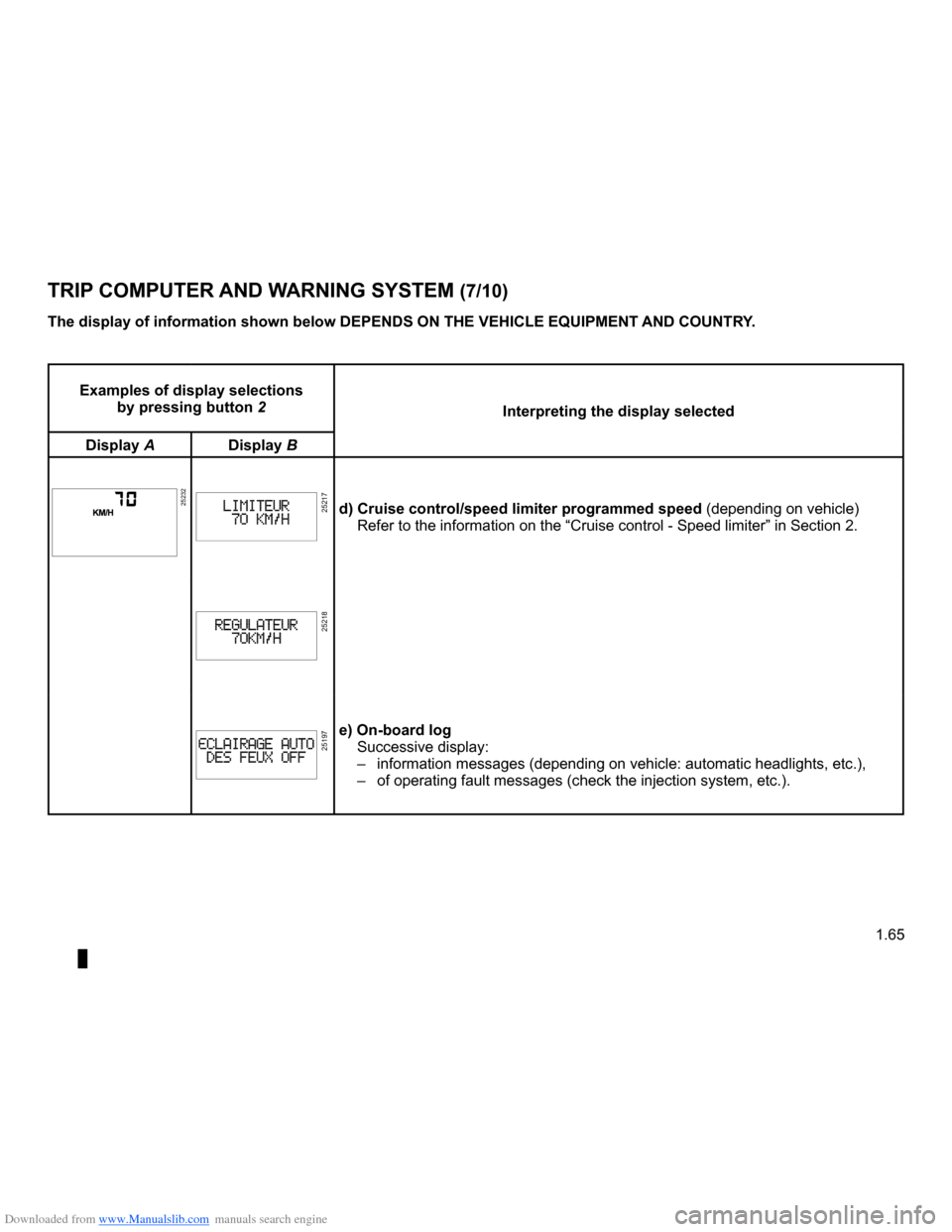
Examples of display selections by pressing button 2Interpreting the display selected
Display ADisplay B
252322523225217d) Cruise control/speed limiter programmed speed (depending on vehicle)Refer to the information on the “Cruise control - Speed limiter” i\
n Section 2.
25218
25197e) On-board logSuccessive display:
– information messages (depending on vehicle: automatic headlights, etc.)\
,
– of operating fault messages (check the injection system, etc.).
Page 73 of 264

Downloaded from www.Manualslib.com manuals search engine
JauneNoirNoir texte
1.67
ENG_UD13453_3Ordinateur de bord (X85 - B85 - C85 - S85 - K85 - Renault)ENG_NU_853-3_BCSK85_Renault_1
TRIP COMPUTER AND WARNING SYSTEM (9/10)
Operating fault messages
These appear with the © warning light and mean that you should drive very carefully to an approved Dealer as soon as possible. If you fail to follow this recommendation, you risk da\
maging your vehicle.They disappear when the display selection key is pressed or after several seconds and are stored in the computer log. The
© warning light stays on. Examples of operating fault messages are given \
on the following pages.
Examples of messagesInterpretation of messages
“Check ESP”Indicates a fault in the ESP system. Refer to the information on the “Electronic stability pro- gram: ESP” in Section 2.
“Clean diesel filter”Indicates that there is water present in the diesel fuel.Contact your approved Dealer as soon as possible.
“Electronic fault”Indicates a fault in the electronic management of your vehicle.Contact your approved Dealer as soon as possible.
“Check gearbox”Indicates that a fault has occurred in the gearbox; contact an approved Dealer as soon as possible.
“Check automatic lights”Indicates an automatic lighting operating fault; contact an approved Dea\
ler.
“Check steering”Indicates a power-assisted steering system operating fault.
Page 85 of 264
Downloaded from www.Manualslib.com manuals search engine
fog lights ................................................................(current page)lights:fog lights ..........................................................(current page)
JauneNoirNoir texte
1.79
ENG_UD10541_1Éclairages et signalisations extérieures (X85 - B85 - C85 - S85 -\
K85 - Renault)ENG_NU_853-3_BCSK85_Renault_1
EXTERIOR LIGHTING AND SIGNALS (5/5)
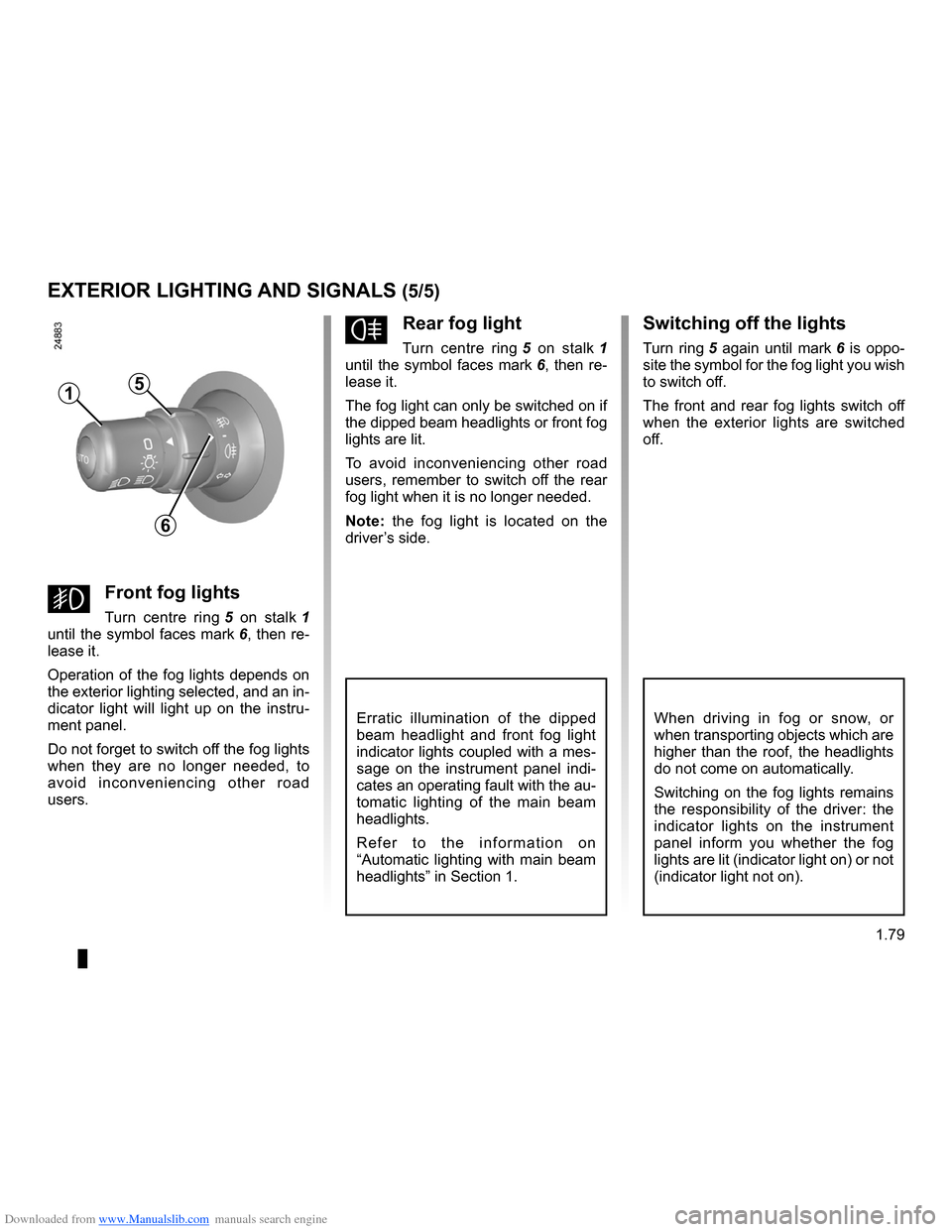
gFront fog lights
Turn centre ring 5 on stalk 1
until the symbol faces mark 6, then re- lease it.
Operation of the fog lights depends on the exterior lighting selected, and an in- dicator light will light up on the instru- ment panel.
Do not forget to switch off the fog lights when they are no longer needed, to avoid inconveniencing other road users.
fRear fog light
Turn centre ring 5 on stalk 1
until the symbol faces mark 6, then re- lease it.
The fog light can only be switched on if the dipped beam headlights or front fog lights are lit.
To avoid inconveniencing other road users, remember to switch off the rear fog light when it is no longer needed.
Note: the fog light is located on the driver’s side.
Erratic illumination of the dipped beam headlight and front fog light indicator lights coupled with a mes- sage on the instrument panel indi- cates an operating fault with the au- tomatic lighting of the main beam headlights.
R e f e r t o t h e i n f o r m a t i o n o n “Automatic lighting with main beam headlights” in Section 1.
Switching off the lights
Turn ring 5 again until mark 6 is oppo- site the symbol for the fog light you wish to switch off.
The front and rear fog lights switch off when the exterior lights are switched off.
15
6
When driving in fog or snow, or when transporting objects which are higher than the roof, the headlights do not come on automatically.
Switching on the fog lights remains the responsibility of the driver: the indicator lights on the instrument panel inform you whether the fog lights are lit (indicator light on) or not (indicator light not on).
Page 91 of 264

Downloaded from www.Manualslib.com manuals search engine
JauneNoirNoir texte
1.85
ENG_UD14663_2Réservoir carburant (X85 - B85 - C85 - S85 - K85 - Renault)ENG_NU_853-3_BCSK85_Renault_1
Filling up with fuel
Petrol versions
Using leaded petrol will damage the antipollution system and may lead to a loss of warranty.
To ensure that the fuel tank is not filled with leaded petrol, the fuel tank filler neck contains a restrictor fitted with a foolproof system which only allows the nozzle for unleaded petrol to be used (at the pump).
– Insert the nozzle so that the valve is
pushed back and then fully insert it before beginning to fill the tank (risk of splashback).
– Keep the nozzle in this position
throughout the entire filling opera- tion.
Petrol and diesel versions
When the pump cuts out automatically at the end of the filling procedure, a maximum of two further filling attempts may be made, as there must be suffi- cient space in the fuel tank to allow for expansion.
Petrol version
It is essential to use unleaded petrol. The octane rating (RON) must con- form with the specifications given on
the label inside fuel filler flap A. Refer to the information on “Engine specifica- tions” in Section 6.
Special features of vehicles running on ethanol-based fuel:
It is essential to use unleaded petrol or fuel containing a maximum of 85% eth- anol (E85).
To make it easier to start the engine in very cold conditions, it is recommended to use unleaded petrol or, on equipped vehicles, to use the heater integrated in the engine.
In this case, connect the special end of the extension piece supplied into the socket integrated into the radiator grille and the other end into a 220V socket for at least 6 hours before starting.
Note: when using ethanol-based fuel, you may notice over-consumption.
FUEL TANK (2/2)
No modifications what- soever are permitted on any part of the fuel supply system (electronic unit, wiring, fuel circuit, injector, protec- tive covers, etc.) as this may be
dangerous (unless undertaken by qualified Network personnel).
Persistent fuel odour
If you notice a persistent fuel odour you should:
– stop the vehicle as soon as traf
- fic conditions allow and switch off the ignition;
– switch on the hazard warning
lights and ask your passengers to leave the vehicle and stay clear of the traffic;
– contact an approved Dealer.
Page 93 of 264

Downloaded from www.Manualslib.com manuals search engine
2.1
ENG_UD14665_4Sommaire 2 (X85 - B85 - C85 - S85 - K85 - Renault)ENG_NU_853-3_BCSK85_Renault_2
Section 2: Driving
(Advice on use relating to fuel economy and the environment)
Running in . . . . . . . . . . . . . . . . . . . . . . . . . . . . . . . . . . . . \
. . . . . . . . . . . . . . . . . . . . . . . . . . . . . . . . . 2.2
Ignition switch . . . . . . . . . . . . . . . . . . . . . . . . . . . . . . . . . . . .\
. . . . . . . . . . . . . . . . . . . . . . . . . . . . . . 2.3
Starting/stopping the engine using the key . . . . . . . . . . . . . . . . . . . . . . . . . . . . . . . . . . . . \
. . . . . . . . 2.4
Starting/stopping the engine using the RENAULT card . . . . . . . . . . . . . . . . . . . . . . . . . . . . . . . . . . . 2.5
Special features of petrol versions . . . . . . . . . . . . . . . . . . . . . . . . . . . . . . . . . . . .\
. . . . . . . . . . . . . . 2.9
Special features of diesel versions . . . . . . . . . . . . . . . . . . . . . . . . . . . . . . . . . . . .\
. . . . . . . . . . . . . . 2.10
Special features of diesel versions with particle filter . . . . . . . . . . . . . . . . . . . . . . . . . . . . . . . . . . . .\
2.11
Gear lever/Handbrake . . . . . . . . . . . . . . . . . . . . . . . . . . . . . . . . . . . . \
. . . . . . . . . . . . . . . . . . . . . . . . 2.12
Advice on antipollution, fuel economy and driving . . . . . . . . . . . . . . . . . . . . . . . . . . . . . . . . . . . .\
. . 2.13
Environment . . . . . . . . . . . . . . . . . . . . . . . . . . . . . . . . . . . .\
. . . . . . . . . . . . . . . . . . . . . . . . . . . . . . . 2.16
Anti-lock braking system: ABS. . . . . . . . . . . . . . . . . . . . . . . . . . . . . . . . . . . . \
. . . . . . . . . . . . . . . . . . 2.17
Electronic Stability Program: ESP . . . . . . . . . . . . . . . . . . . . . . . . . . . . . . . . . . . . \
. . . . . . . . . . . . . . . 2.19
Traction control: ASR . . . . . . . . . . . . . . . . . . . . . . . . . . . . . . . . . . . . \
. . . . . . . . . . . . . . . . . . . . . . . . . 2.21
Emergency brake assist . . . . . . . . . . . . . . . . . . . . . . . . . . . . . . . . . . . .\
. . . . . . . . . . . . . . . . . . . . . . 2.23
Speed limiter . . . . . . . . . . . . . . . . . . . . . . . . . . . . . . . . . . . .\
. . . . . . . . . . . . . . . . . . . . . . . . . . . . . . . 2.24
Cruise control . . . . . . . . . . . . . . . . . . . . . . . . . . . . . . . . . . . .\
. . . . . . . . . . . . . . . . . . . . . . . . . . . . . . 2.27
Automatic gearbox. . . . . . . . . . . . . . . . . . . . . . . . . . . . . . . . . . . . \
. . . . . . . . . . . . . . . . . . . . . . . . . . . 2.31
Quickshift gearbox . . . . . . . . . . . . . . . . . . . . . . . . . . . . . . . . . . . . \
. . . . . . . . . . . . . . . . . . . . . . . . . . . 2.34
Parking distance control . . . . . . . . . . . . . . . . . . . . . . . . . . . . . . . . . . . .\
. . . . . . . . . . . . . . . . . . . . . . 2.39