2009 PORSCHE PANAMERA lock
[x] Cancel search: lockPage 167 of 343

Driving and Driving Safety
165
To remove the ignition key:
fStop the vehicle.
f Move PDK selector lever to position P.
f Switch ignition off.
f Remove the ignition key.Ignition lock position 1 – Ignition onfTurn ignition key to position 1.
All electrical equipment can be switched on. The
warning lights on the inst rument panel light up for
alamp check.
f Please see the chapter “INSTRUMENT PANEL
USA MODELS” on page 107.
If an electrical consumer is not switched on for
10 minutes after switching on the ignition, the
ignition must be switched off then on again.
Ignition lock position 2 – Start enginef Turn ignition key to ignition lock position 2.
The car key is reset automa tically from position 2
to position 1 when you start the engine.Ignition lock position 3 – Activate
steering column lock on vehicles with
Porsche Entry & Drivef Please see the chapter “Manually locking the
steering column on vehicles with Porsche
Entry & Drive” on page 165.Steering column lockVehicles without Porsche Entry & Drive
The steering column is locked automatically
when the ignition key is removed from the ignition
lock and unlocked automatically when the
ignition key is inserted into the ignition lock.
Vehicles with Porsche Entry & Drive
The steering column is locked automatically
when the driver’s door is opened when the ignition
is switched off. Manually locking the steering column on
vehicles with Porsche Entry & Drive
f
Once the ignition is switched off, turn the
control unit to ignition lock position 3 again
and hold it there for 2seconds.
The steering column is locked when you hear
a clicking noise.
The steering column can be unlocked
automatically by turning the control unit to
ignition lock position 1.
Emergency operation with Porsche
Entry & DriveInterference in radio tr ansmission between the
vehicle and ignition lock or a discharged ignition
lock battery can disable the Porsche Entry & Drive
comfort function.
If this happens, the control unit can be removed
from the ignition lock and the vehicle can be
started using the standard ignition key.
Removing the control unit from the
ignition lock
1. Turn the control unit to ignition lock position 3
and hold it there for about 10 seconds.
Once you hear the clicking sound, you can remove
the control unit in ignition lock position 0.
Page 168 of 343
166
Driving and Driving Safety
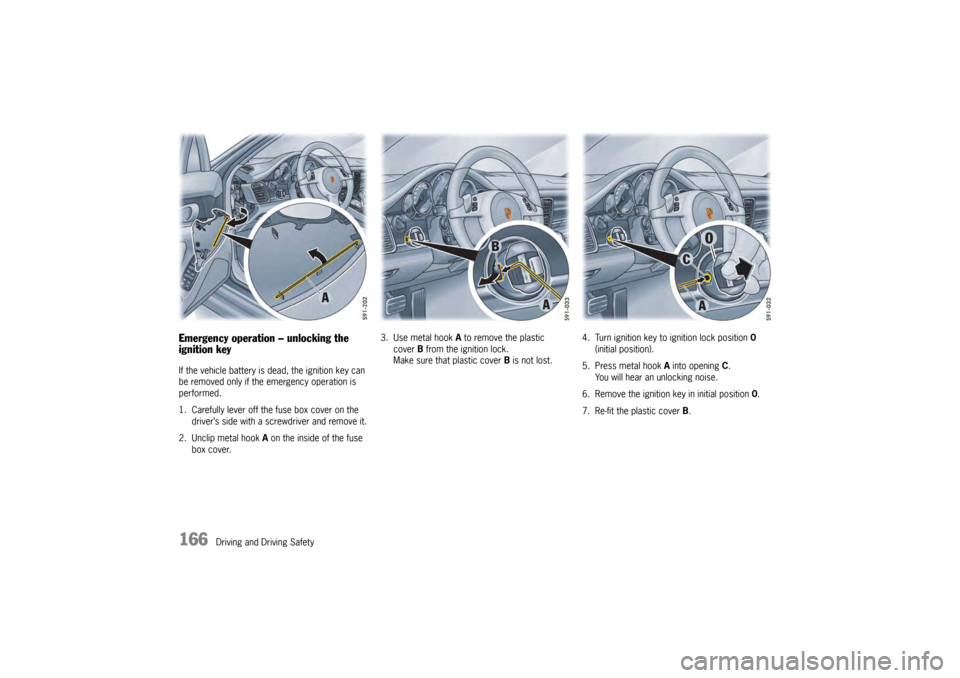
Emergency operation – unlocking the
ignition keyIf the vehicle battery is dead, the ignition key can
be removed only if the emergency operation is
performed.
1. Carefully lever off the fuse box cover on the driver’s side with a screwdriver and remove it.
2. Unclip metal hook A on the inside of the fuse
box cover. 3. Use metal hook A
to remove the plastic
cover B from the ignition lock.
Make sure that plastic cover B is not lost. 4. Turn ignition key to ignition lock position
0
(initial position).
5. Press metal hook A into opening C.
You will hear an unlocking noise.
6. Remove the ignition key in initial position 0.
7. Re-fit the plastic cover B .
Page 169 of 343

Driving and Driving Safety
167
Starting and Stopping the EngineThe immobilizer can be deactivated and the
engine started only using an authorised
ignition key.
fPlease see the chapter “IMMOBILIZER” on
page 250.
Warning!
Risk of poisoning. Exhaust gas contains
colorless and odorless carbon monoxide
(CO), which is toxic even in low
concentrations. Carbon monoxide can cause
unconsciousness and even death if inhaled.
f Never start or let the engine run in an
enclosed, unventilated area. It is not
recommended to sit in your car for prolonged
periods with the engine on and the car not
moving.
An unattended vehicle with a running engine
is potentially hazardous. If warning lights
should come on to indicate improper
operation, they would go unnoticed.
f Never leave the engine idling unattended.
Danger of fire close to the hot exhaust
system.
f Do not park or drive your vehicle where
combustible materials, such as dry grass or
leaves, can come into contact with the hot
exhaust system. For information on the emission control system:
f
Please see the chapter “EMISSION CONTROL
SYSTEM” on page 262.
f If your car catches on fire for any reason, call
the fire department. Do not endanger your life
by attempting to put out the fire.
Starting the vehicle f Operate the footbrake.
f Move PDK selector lever to position P or N.
f Do not press the accelerator pedal.
The engine control unit will provide the correct
starting mixture.
f Turn the ignition key or control unit (Porsche
Entry & Drive) to ignition lock position 2.
The starting process is carried out and
completed automatically as soon as ignition
lock position 2 (start engine) is reached.
The ignition key or control unit is reset
automatically to ignition lock position 1
(ignition on).
f Do not operate the starter for more than
approx. 10 seconds. If necessary, repeat the
starting procedure after a pause of approx.
10 seconds. Turn the ignition key back to
ignition lock position 0 (initial position) first.
The first operation of the starter is ended
automatically when the engine starts.
If the engine does not start, subsequent
starter operations will not be ended
automatically.
Page 170 of 343

168
Driving and Driving Safety
f
Do not warm up the engine when stationary.
Drive off immediately. Avoid high revs and full
throttle until the engine has reached operating
temperature.
f If the vehicle battery power is too weak, the
engine can be started with jump leads.
For information on jump-lead starting:
f Please see the chapter “EXTERNAL POWER
SUPPLY, JUMP-LEAD STARTING” on
page 306.
Note on operation
To ensure a good battery charge condition,
thereby ensuring that the battery will start the
engine, all electrical loads that are not required
should be switched off when the ignition is
switched on and when engine revs are low
(in traffic jams, in city traffic or in queues).
Stoppingf Only remove the ignition key when the vehicle
is stationary.
f Only switch the ignition off when the vehicle is
stationary, as there is no power steering and
brake booster assistance when the engine is
switched off.
f When leaving the vehicle, always remove the
ignition key, apply the electric parking brake
and engage selector-lever position P .
The control unit always remains in the ignition
lock on vehicles with Porsche Entry & Drive .
Warning!
Danger of injury. Hot engine compartment
components can burn skin on contact.
f Before working on any part in the engine
compartment, turn the engine off and let it cool
down sufficiently.
Risk of burn injury when standing near or
coming into contact with the exhaust pipe.
The exhaust pipe is hot wh en the vehicle is running
and remains hot for some time after the vehicle is
turned off. f
To prevent injury, make a point of noting where
your vehicle’s exhaust pipe is, avoid placing
your legs near the exhaust pipe when loading
and unloading cargo in the rear, and closely
supervise children around the vehicle during
time when the exhaust pipe could be hot.
A hot exhaust pipe can cause painful skin
burns.
Radiator fanFor information on radiator fans:
f Please see the chapter “RADIATOR FANS” on
page 258.
Warning!
Danger of injury. After the ignition is
switched off, the engine compartment and
coolant temperatures are monitored for
approx. 30 minutes. During this period, and
depending on temperature, the radiator fan
may continue to run or start to run.
f Carry out work in these areas only with the
engine off and exercise extreme caution,
always anticipating that the fan blade could suddenly start to run.
Page 191 of 343

Driving and Driving Safety
189
Car Audio Operation/TipsFor radio operation see your radio manual
which is included with your on-board
literature.FM receptionA vehicle is not an ideal place to listen to a radio.
Because the vehicle moves, reception conditions
are constantly changing.
Buildings, terrain, signal distance and noise from
other vehicles are all working against good
reception.
Some conditions affecting FM may appear to be
problems when they are not.
The following characteristics are completely
normal for a given reception area, and they do not
indicate any problem with the radio itself.
Note
Electronic accessories should only be installed by
your authorized Porsche dealer.
Equipment which has not been tested and
approved by Porsche may impair radio reception.Fading and drifting
FM range is limited to about 25 miles (40 km),
except for some high power stations.
If a vehicle is moving
away from the desired
station's transmitter, the signal will tend to fade
and/or drift. This condition is more prevalent with
FM than AM, and is often accompanied by
distortion.
Fading and drifting can be minimized to a certain
degree by careful attention to fine tuning or
selection of a stronger signal.
Static and fluttering
When the line-of-sight link between a transmitter
and vehicle is blocked by large buildings or
mountains, the radio sound may be accompanied
with static or fluttering because of the
characteristic of FM.
In a similar effect, a flutt ering noise is sometimes
heard when driving along a tree-lined road.
This static and flutteri ng can be reduced by
adjusting the tone control for greater bass
response until the disturbance has passed. Multipath
Because of the reflecting
characteristics of FM,
direct and reflected signals may reach the antenna
at the same time (multipath) and cancel each other
out.
As a vehicle moves through these electronic dead
spots, the listener may hear a momentary flutter
or loss of reception.
Station swapping
When two FM stations are close to each other, and
an electronic dead spot, such as static or
multipath area, interrupts the original signal,
some-times the stronger second signal will be
selected automatically until the original one
returns.
This swapping can also occur as you drive away
from the selected station and approach another
station of a stronger signal.
Page 195 of 343
Driving and Driving Safety
193
Porsche Doppelkupplung (PDK)Porsche Doppelkupplung (PDK) is a seven-speed
transmission with an “automatic” and a “manual”
selection mode.
In automatic selection mode (selector-lever
position D), gear changing is automatic.
You can change temporarily from automatic to
manual mode using the shift buttons on the
steering wheel.
In manual selection mode (selector-lever
position M ), you change gear using the shift
buttons on the steering wheel or with the PDK
selector lever.
You can change between selector-lever
positions D and M as you wish while driving.
Note
f Take care not to operate the shift buttons on
the steering wheel in advertently in either
automatic or manual mode, thereby triggering
undesired gear changes.
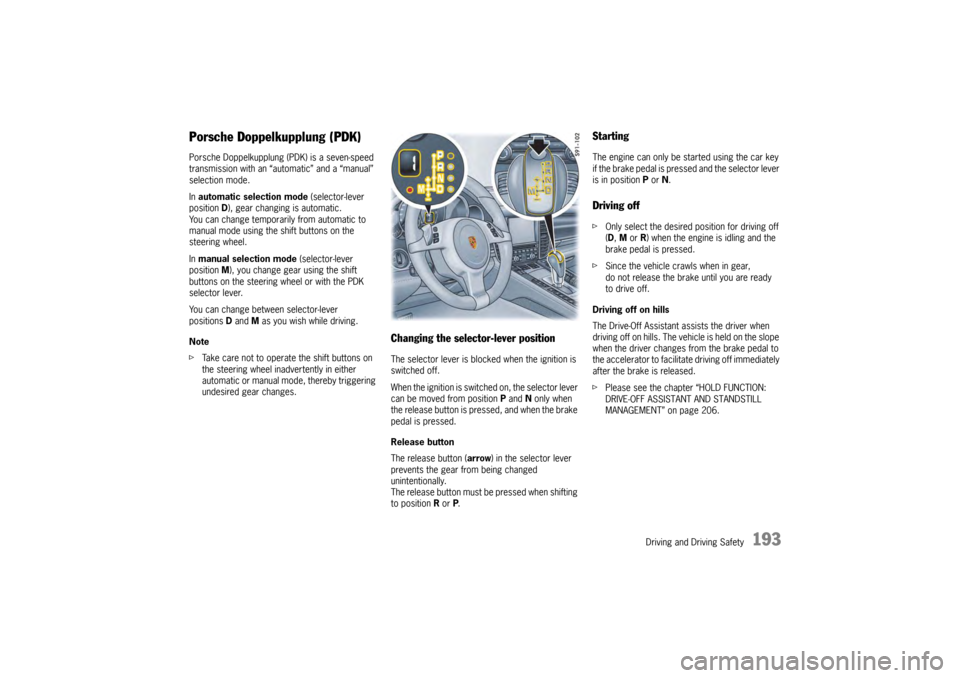
Changing the selector-lever positionThe selector lever is blocked when the ignition is
switched off.
When the ignition is switch ed on, the selector lever
can be moved from position P and N only when
the release button is pressed, and when the brake
pedal is pressed.
Release button
The release button ( arrow) in the selector lever
prevents the gear from being changed
unintentionally.
The release button must be pressed when shifting
to position R or P.
StartingThe engine can only be started using the car key
if the brake pedal is pressed and the selector lever
is in position P or N.Driving offf Only select the desired position for driving off
(D, M or R) when the engine is idling and the
brake pedal is pressed.
f Since the vehicle crawls when in gear,
do not release the brake until you are ready
to drive off.
Driving off on hills
The Drive-Off Assistant assists the driver when
driving off on hills. The vehicle is held on the slope
when the driver changes from the brake pedal to
the accelerator to facilitate driving off immediately
after the brake is released.
f Please see the chapter “HOLD FUNCTION:
DRIVE-OFF ASSISTANT AND STANDSTILL
MANAGEMENT” on page 206.
Page 197 of 343

Driving and Driving Safety
195
Selector-Lever PositionsP – Parking lockfEngage parking lock only when the vehicle is
stationary.
If selector-lever position P is flashing in the
instrument panel, the parking lock is not
engaged. The vehicle can roll away.
Shift again from selector-lever position R to P.
f Activate the electric parking brake and then
engage the parking lock.
If selector-lever position P is flashing in the
instrument panel, the parking lock is not
engaged. The vehicle can roll away.
Shift again from selector-lever position R to P.
The ignition key can be removed only in selector-
lever position P.R – Reverse gearf Select only if the vehicl e is stationary and the
brake is applied.N – Neutral (idling)Selector-lever position N must be selected for
towing or in car washes, for example.
f Only select the desired position for driving off
(D , M or R) when the engine is idling and the
brake pedal is pressed.
D – Automatic selection modeSelect position D for “normal” driving. The gears
are shifted automatically according to the
accelerator position and speed.
Depending on the way the vehicle is driven
(economical, comfortable or sporty driving style)
and on the resistance (e.g. uphill), the gear-
changing points are shifted towards higher or
lower engine-speed ranges.
The accelerator position, driving speed, engine
speed, longitudinal and lateral acceleration and
the road profile all have an influence on the gear-
changing characteristic.
Unwanted upshifts, e.g. when entering
bends, are prevented by swiftly releasing the
accelerator pedal.
Depending on lateral acceleration, upshifts on
bends are not made until the engine-speed limit
is reached.
When you brake, and depending on the amount of
deceleration, the PDK transmission changes down
earlier.
For subsequent cornering, the right gear is
engaged when pressure is applied to the brakes
before the bend. The bend is taken in the right
gear, and when you accelerate out of the bend you
do not have to change down.
With a sporty driving style, downshifts are already
initiated when the brake pedal is touched lightly.
This further enhances a dynamic driving style. The PDK transmission temporarily changes to the
sportiest gear-changing map, i.e. to the highest
possible gear-changing points, if the accelerator
pedal is pressed quickly. The transmission
accordingly shifts down
immediately by one or
two gears (temporary change-down).
The transmission no longer selects 7th gear
at high driving speeds.
“Sport” and “Sport Plus” Mode “Sport” mode activated:
The PDK transmission switches to a sporty gear-
changing map and shortens the shifting times.
A sporty driving style is recognized more quickly
and the gear-changing speeds are adapted to
driving performance.
Deceleration downshifts are initiated earlier.
Downshifts occur for small decelerations,
even at higher revs.
“Sport Plus” mode activated:
In “Sport Plus” mode, the PDK transmission
changes to a shift program designed for driving
on race circuits. 7th gear is not selected.
The gear-changing performance is enhanced
significantly again compared with “Sport” mode.
f Please see the chapter ““SPORT” AND “SPORT
PLUS” MODE” on page 212.
Page 202 of 343
200
Driving and Driving Safety
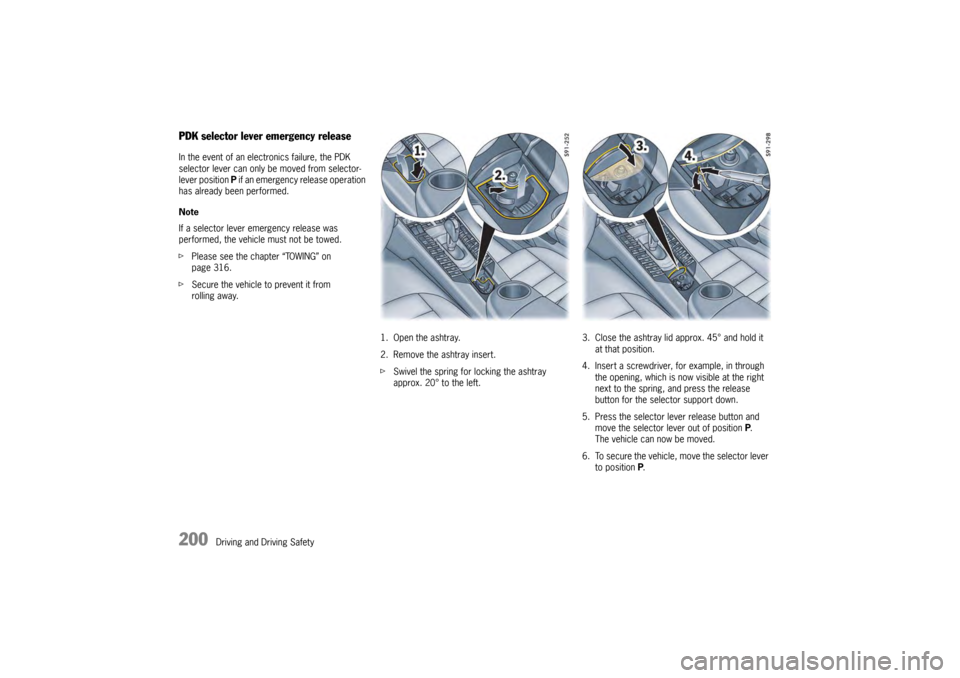
PDK selector lever emergency releaseIn the event of an electronics failure, the PDK
selector lever can only be moved from selector-
lever position P if an emergency release operation
has already been performed.
Note
If a selector lever emergency release was
performed, the vehicle must not be towed.
f Please see the chapter “TOWING” on
page 316.
f Secure the vehicle to prevent it from
rolling away.
1. Open the ashtray.
2. Remove the ashtray insert.
fSwivel the spring for locking the ashtray
approx. 20° to the left. 3. Close the ashtray lid a
pprox. 45° and hold it
at that position.
4. Insert a screwdriver, for example, in through the opening, which is now visible at the right
next to the spring, and press the release
button for the selector support down.
5. Press the selector lever release button and move the selector lever out of position P.
The vehicle can now be moved.
6. To secure the vehicle, move the selector lever
to position P.