2009 PORSCHE PANAMERA lock
[x] Cancel search: lockPage 259 of 343

Maintenance and Car Care
257
Checking Coolant Level and
Adding CoolantThe coolant provides year-round protection
from corrosion and freezing down to –31 °F
(–35 °C) (–40 °F (–40 °C) in Nordic countries).
Observe the following points:
fUse only antifreeze authorised by Porsche.
f Check the coolant level regularly.Coolant levelWhen the engine is cold and the vehicle is level,
the red display must be under the arrow between
the minus and plus markings.
f Add coolant if necessary.
The maximum fill level is reached when the red
display is under the plus marking.
f Please see the chapter “OVERVIEW OF
WARNING MESSAGES” on page 152.
f Please see the chapter “EXERCISE EXTREME
CAUTION WHEN WORKING ON YOUR VEHICLE”
on page 252. Checking when engine is cold
1. Open cap on the reservoir carefully and
allow any overpressure to escape.
Then unscrew cap completely.
2. Read off the engine coolant level.
3. Top up with coolant if necessary. Do not top up over the plus marking.
Only add a mixture of antifreeze and water
in equal parts.
Antifreeze in coolant:
50 % provides antifreeze protection
down to –31 °F (–35 °C).
4. Screw the cap on the reservoir closed until it locks securely. Checking the coolant level when a warning
message appears on the multi-function
display in the instrument panel
Warning!
Danger of serious personal injury or death
from scalding. Coolant is hazardous to your
health, and may be fatal if swallowed.
f Do not open the cap of the expansion tank
while the engine is hot.
f Allow the engine to cool down before opening
the cap and protect your hands, arms and face
from any possible escape of hot coolant.
f Keep coolant out of children's reach.
f Also, keep coolant away from your pets. They
can be attracted to it should there be a spill, or
to used coolant left in an open container. Coolant can be deadly to pets if consumed.
Page 260 of 343

258
Maintenance and Car Care
1. If the engine is hot, cover the reservoir cap
with a cloth.
Open cap carefully and allow any overpressure
to escape.
Then unscrew cap completely.
2. Read off the engine coolant level. Top up with coolant if necessary.
Only add a mixture of antifreeze and water
in equal parts.
Antifreeze in coolant:
50 % provides antifreeze protection
down to –31 °F (–35 °C).
Do not top up over the plus marking.
3. Screw the cap on the reservoir closed until it locks securely.
4. Have the cooling system checked. Please contact a qualif ied specialist workshop.
We recommend that you have an authorized
Porsche dealer to do this work as they have
trained workshop personnel and the necessary
parts and tools. Maintenance notes
If pure water is added in an emergency, the mixing
ratio will have to be corrected.
A significant loss of coolan
t indicates a leak in the
cooling system.
f The cause must be eliminated without delay.
Please contact a qualified specialist workshop.
We recommend that you have an authorized
Porsche dealer to do this work as they have
trained workshop personnel and the necessary
parts and tools.
Radiator fansThe radiators and radiator fans are in the front
of the vehicle.
Warning!
Risk of injury.
The fans can start running when a certain
temperature is reached, even with the
engine switched off.
f Exercise extreme care when working close to
the radiator fans and make sure the engine is switched off.
Brake FluidRegular checking of the brake fluid is part of
servicing.
The fluid level should always be between the
MIN and MAX markings.
A slight decrease in the fluid level due to wear
and automatic readjustment of the disc brakes
is normal.
However, if the fluid level falls significantly or
goes below the MIN marking, the brake system
may have developed a leak.
fHave the brake system checked immediately.
Please contact a qualified specialist workshop.
We recommend that you have an authorized
Page 262 of 343

260
Maintenance and Car Care
The warning light on the instrument panel and
the warning message on the multi-function display
alert you to the fact that the washer fluid level
is too low.
f
Add washer fluid at the next opportunity.
In this case, the remaining quantity is only approx.
1 litre. The maximum filling capacity is approx.
5.8USquarts (5.5liters).
Adding washer fluid
1. Open cap on washer fluid reservoir.
2. Add washer fluid.
3. Close cap carefully.
Power Steering
Warning!
Risk of accidents. When the engine is
stationary (e.g. when on tow) or the hydraulic
system fails, there is no power steering
assistance available.
Therefore, substantially more force will have
to be exerted to steer the vehicle.
f Exercise extreme care when your vehicle is
being towed.
f Have the fault corrected. Please contact a
qualified specialist workshop. We recommend
that you have an authorized Porsche dealer to
do this work as they have trained workshop personnel and the necessary parts and tools.
Regular checking of hydraulic fluid is part of
servicing.
The flow noise heard at full steering lock is design-
related and does not indicate a defect in the
steering system. Vehicles with Porsche Dynamic Chassis
Control (PDCC)
If the fluid level is too
low, the message “Check
steering oil level” will appe ar on the multi-function
display.
f Have the fluid level checked immediately.
f Please contact a qualified specialist workshop.
We recommend that you have an authorized
Porsche dealer to do this work as they have
trained workshop personnel and the necessary
parts and tools.
Warning light and warning
message
Page 268 of 343
266
Maintenance and Car Care
Refuelling
Danger!
The RF energy from a cellphone can cause a
sparking on bare metal, much like aluminum
foil in a microwave oven. The spark could
ignite gasoline fumes present while refuling.
Static discharge from your body can ignite
gasoline fumes present when you get back
out of the vehicle and touch the fuel nozzle.
In either case, resulting fire can cause
serious damage to the vehicle, serious injury
or death to persons in immediate vicinity.
f Do not use a cellphone while pumping gas.
fDo not re-enter the vehicle while pumping gas.
1. Stop the engine and switch off the ignition.
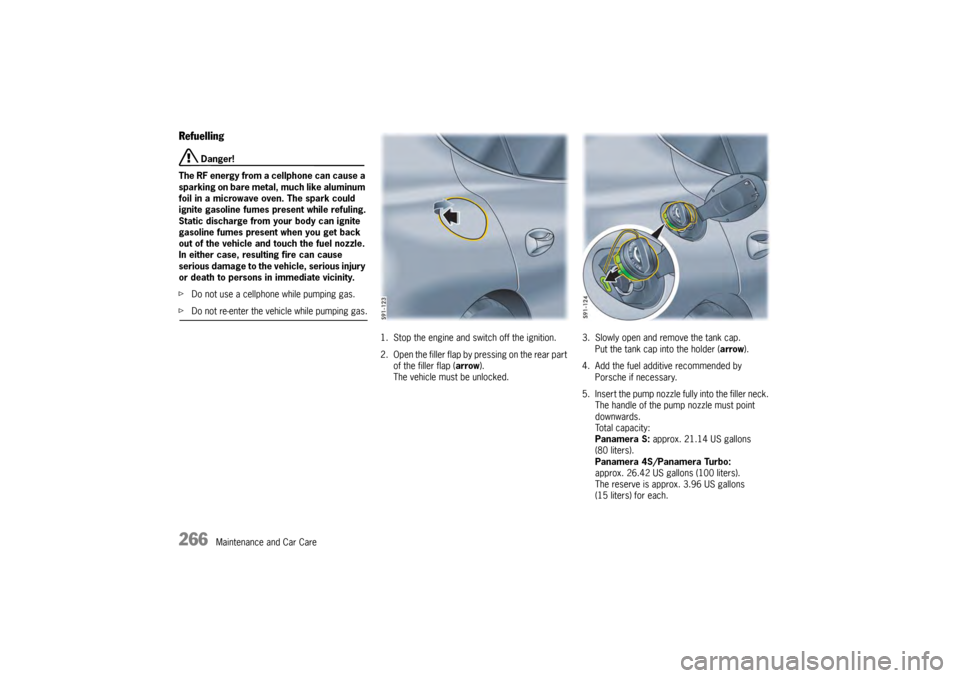
2 . O p e n t h e f i l l e r f l a p b y p re s s i n g o n t h e re a r p a r t of the filler flap ( arrow).
The vehicle must be unlocked. 3. Slowly open and remove the tank cap.
Put the tank cap into the holder ( arrow).
4. Add the fuel additive recommended by Porsche if necessary.
5. Insert the pump nozzle fully into the filler neck.
The handle of the pump nozzle must point
downwards.
Total capacity:
Panamera S: approx. 21.14 US gallons
(80 liters).
Panamera 4S/Panamera Turbo:
approx. 26.42 US gallons (100 liters).
The reserve is approx. 3.96 US gallons
(15 liters) for each.
Page 269 of 343
Maintenance and Car Care
267
6. Operate the pump nozzle and refuel the vehicle.
Do not add further fuel once the correctly
operated automatic pump nozzle has switched
off. Fuel could spray back or could flow over
when heated.
7. Replace the tank cap immediately after refuelling and close it until you hear and feel
it locking.
8. Close the filler flap and press on the rear of the filler flap until it engages securely.
If you lose the tank filler cap, you must
replace it only with an original part.
Caution!
Risk of damage. Decorative foils may fade
if they come into contact with fuel.
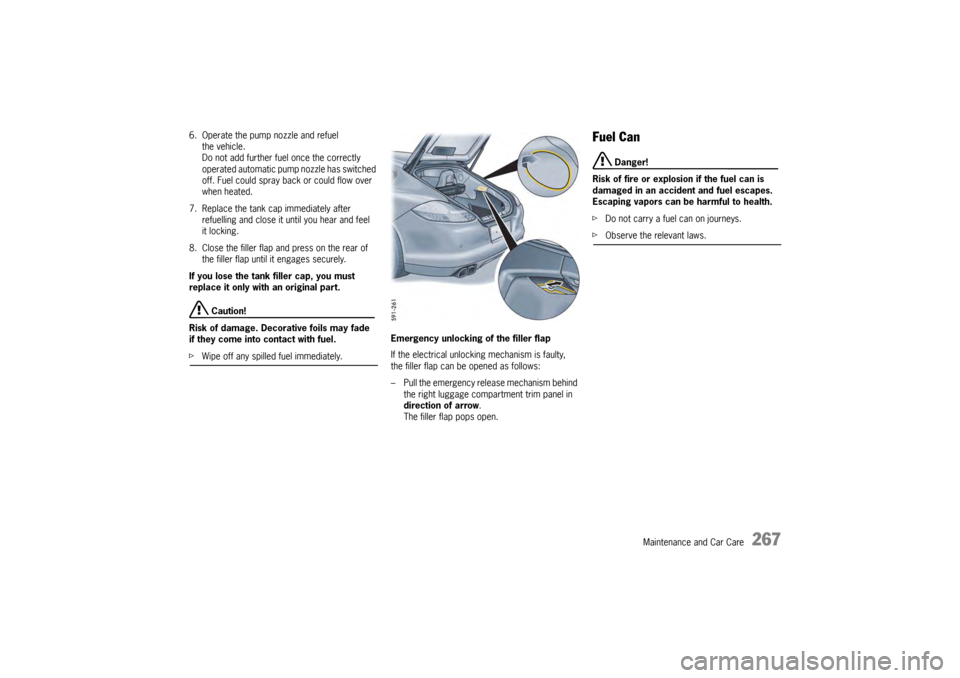
f Wipe off any spilled fuel immediately. Emergency unlocking of the filler flap
If the electrical unlocking mechanism is faulty,
the filler flap can be opened as follows:
– Pull the emergency release mechanism behind
the right luggage compartment trim panel in
direction of arrow .
The filler flap pops open.
Fuel Can
Danger!
Risk of fire or explosion if the fuel can is
damaged in an accident and fuel escapes.
Escaping vapors can be harmful to health.
f Do not carry a fuel can on journeys.
fObserve the relevant laws.
Page 270 of 343

268
Maintenance and Car Care
Fuel Recommendations Your Porsche is equipped with catalytic
converters and must use UNLEADED FUEL
ONLY .
Your engine is designed to provide optimum
performance and fuel economy using unleaded
premium fuel with an octane rating of 98 RON
(93 CLC or AKI) . Porsche therefore
recommends the use of these fuels in your
vehicle.
Porsche also recognizes that these fuels may not
always be available. Be assured that your vehicle
will operate properly on unleaded premium fuels
with octane numbers of at least 95 RON
(90 CLC or AKI) , since the engine’s “Electronic
Oktane™ knock control” will adapt the ignition
timing, if necessary.
It is important to observe the regular service
intervals, and particularly the oil change intervals,
specified in the “Maintenance” booklet.
T h e u s e o f U N L E A D E D F U E L O N LY i s c r i t i c a l l y
important to the life of the catalytic
converters. Deposits fr om leaded fuels will
ruin the converters and make them
ineffective as an emis sion control device.
Cars with catalytic converters have a smaller fuel
tank opening, and gas station pumps that
dispense unleaded fuel ha ve smaller nozzles. This
will prevent accidental pumping of leaded fuel into
cars with catalytic converters. Unleaded fuels may not be available outside the
continental U.S. and Canada. Therefore, we
recommend you do not take your car to areas or
countries where unleaded fuel may not be
available.
Octane ratings Octane rating indicates a fuel’s ability to resist
detonation. Therefore, buying the correct octane
gas is important to prevent engine “damage”.
The RON octane rating is based on the research
method. The CLC (U.S.
Cost of Living Council
octane rating) or AKI ( anti knock index) octane
rating usually displayed on U.S. fuel pumps is
calculated as research octane number plus motor
octane number, divided by 2, that is written as:
The CLC or AKI octane rating is usually lower than
the RON rating:
For example: 95 RON equals 90 CLC or AKI.
Fuels containing ethanolDo not use any fuels containing more than 10
percent ethanol by volume.
We recommend, however, to change to a different
fuel or station if any of the following problems
occur with your vehicle:
– Deterioration of driveability and performance.
– Substantially reduced fuel economy.
– Vapor lock and non-start problems, especially at high altitude or at high temperature.
– Engine malfunction or stalling.
RON+MON
2 R+M
2
or
Page 272 of 343

270
Maintenance and Car Care
High-pressure cleaning equipment
Warning!
High-pressure cleaning equipment can
damage the following components:
–Tires
– Logos, emblems, decorative foils
– Painted surfaces
– Alternator, valve covers
– ParkAssist sensors
– Radar sensor for adaptive cruise control
– Rearview camera
f Always read the operating instructions
provided by the equipment manufacturer.
f Always cover the lid of the brake fluid reservoir
prior to cleaning. Never point the cleaning jet
directly at the lid.
f When cleaning with a flat-jet nozzle or
a so-called “dirt blaster”. maintain a minimum
distance of 20 in. (50 cm).
f Never use high-pressure cleaning equipment
with a round-jet nozzle.
A high-pressure cleaning device fitted with
a round nozzle will damage your vehicle. The
tires are particularly susceptible to damage.
f Do not point the cleaning jet directly at any of the aforementioned components.
Decorative film
Caution!
Risk of damage due to separation of the
decorative film when using high-pressure
cleaning equipment.
f When cleaning components, the water must
not be hotter than 140 °F (60 °C) and the
pressure no greater than 580 psi (40 bar).
Always observe a minimum distance of 20 in. (50 cm).
Care of door lockfTo prevent the door lock from freezing
during the cold season, cover the lock barrel
with suitable adhesive tape while washing
the vehicle.
If the lock still freezes, use an ordinary de-icer.
In many cases, a well warmed key can help.
Never use excessive force.
Car washingThe best protection for the vehicle from the
damaging effects of the environment is frequent
washing and preservation.
The longer road salt, road dust, industrial dust,
insect remains, bird excrement, and tree sap,
resin, pollen, etc. are allowed to remain on the
bodywork, the more harmful their effect.
Observe the following poi nts in order to ensure
that the vehicle is washed thoroughly without
damaging the paintwork:
f The underside of the vehicle should also be
thoroughly washed at the end of the winter
season at the latest.
f Wash your vehicle only at sites provided for
this purpose to prevent soot, grease, oil and
heavy metals from entering the environment.
f Dark colors are slightly more susceptible
to scratching and require particularly careful
paint care.
Dark paints make even the smallest surface
blemishes (scratches) more conspicuous than
lighter colors.
f Do not wash your Porsche in direct sunlight
or when its body is hot.
f When washing by hand, use a car shampoo,
plenty of water, and a soft sponge or washing
brush.
We recommend Porsche car shampoo.
Page 278 of 343

276
Maintenance and Car Care
Cleaning air bag covers
Danger!
Risk of serious or fatal injury from impaired
operation of the air bag system caused by
incorrect cleaning.
f While it is appropriate to use normal surface
cleaning methods on the interior of your
vehicle, do not undertake deep cleaning of air
bag-related components, such as the
padded covers on the steering wheel,
the underside of the instrument panel,
front seats, roof pillars, roof liners and the
rear interior trim panels, and around the
seat backrest.
f Have your authorized Porsche dealer to clean these components.
Cleaning fabric liningsfFabric linings on pillars, roofliner and sun
blinds, etc. must be cleaned only using
suitable cleaning agents or a suitable dry
foam and a soft brush.
Alcantara careDo not use leather care products to
clean Alcantara.
For regular care, it is sufficient to clean the
cover with a soft brush.
Strong abrasion or rubbing when cleaning will
produce a lasting change to the surface.
Cleaning when lightly soiled
f Wet a soft cloth with water or a neutral
soap solution and wipe off the dirt.
Cleaning when heavily soiled
f Wet a soft cloth with lukewarm water or diluted
white spirit and dab the dirt from the outside
in.Cleaning the seat beltsfUse mild detergent to clean soiled belts.
f When drying, avoid direct sunlight.
f Only use suitable cleaning agents.
f Do not tint or bleach the belts.
The belt fabric could be weakened,
thus affecting safety.
Storing your PorscheIf you wish to keep your Porsche off the road for
a lengthy period, we recommend that you contact
your authorized Porsche dealer.
They will be glad to advise you about the
necessary measures, e.g. corrosion prevention,
care, maintenance and storage.
Further important information on laying up your
Porsche can be found in other sections.
fPlease see the chapter “BATTERY” on
page 303.
For information on locking the vehicle when
the battery is disconnected:
f Please see the chapter “NOT ALL VEHICLE
DOORS ARE LOCKED” on page 36.