2009 PORSCHE PANAMERA lock
[x] Cancel search: lockPage 306 of 343

304
Minor Repairs
Battery carefEnsure that battery is securely mounted.
f Keep terminals and connections clean and
properly tightened. Corrosion can be
prevented by coating the terminals and
connections with petroleum jelly or silicone
spray.
f Ensure that vent caps ar e securely tightened to
prevent spillage.
Checking the electrolyte fluid level
(only on low-maintenance batteries)
Generally, the electrolyte level must be checked
more often in summer than in the winter, and more
often when driving long distances.
f When adding water, use only clean containers.
In no case may alcohol (e.g. window cleaner
residues) be permitted to enter the battery.
f Unscrew and open the filler vent caps of each
cell.
With the car on a level surface, the fluid level
should meet the indicator mark in each cell.
f If necessary, top up with distilled water. Do not
use acid. Only fill up to the mark, otherwise the
electrolyte will overflow when the battery is
being charged and cause damage.
Winter operationDuring the winter months, battery capacity tends
to decrease as temperatures drop. Additionally,
more power is consumed while starting, and the
headlights, heater, rear window defogger, etc.,
are used more frequently.
f Let your Porsche dealer test the battery's
capacity before winter sets in.Vehicle storageIf the car stands for long periods in the garage or
workshop, the doors and lids should be closed.
f Remove the ignition key and, if necessary,
disconnect the battery.
Notes on operation
f When the battery is disconnected, the alarm
system ceases to function.
If the vehicle was locked before the battery
was disconnected, the alarm will be triggered
when the battery is reconnected.
To deactivate the alarm system:
f Lock the vehicle and unlock it again.
Alarm system, central locking
f The status of the central locking and alarm
system is not changed by disconnecting the
battery. Maintenance notes
Even if you put your vehicle out of operation, the
battery still discharges.
The battery will discharge more quickly if your
vehicle is not driven on a daily basis over a
distance of several miles. The more often you
drive your vehicle, and
the longer the distance
driven on each trip, the more opportunity the
vehicle‘s charging system w ill have to recharge the
batteries.
f To preserve its efficiency, charge the battery
about every 6 weeks.
f Check the battery acid level and top off with
distilled water if necessary.
f Store a battery that has been removed in a
dark, cool place, but not subject to freezing.
Page 307 of 343

Minor Repairs
305
Replacing the batteryThe service life of the battery is subject to normal
wear; it depends greatly on care, climatic
conditions, and driving conditions (distances,
loads).
f Only use an original Porsche battery, with the
correct part number, as a replacement. Only
this battery meets the spec ific requirements of
the vehicle.
f Please observe the disposal instructions for
batteries.
Putting vehicle into operationAfter the battery is connected or after a fully
discharged battery is charged, the PSM warning
light lights up on the instrument panel and
a message appears on the multi-function display
in the instrument panel to indicate a fault.
This fault can be corrected with a few
simple steps:
1. Start the engine. To do this, turn the igni tion key or the control
unit (on vehicles with Porsche Entry & Drive)
to ignition lock position 2, twice .
2. With the vehicle stationary, perform a few steering movements to the left and right and
then drive a short distance in a straight line
until the PSM warning light goes out and the
message is erased from the multi-function
display in the instrument panel.
3. If the warnings do not disappear, then:
Drive carefully to the nearest authorized
Porsche dealer to have the fault corrected.
4. After the warnings go out: Stop the vehicle in a suitable place.
5. Store the end position for the power windows. For information on storin
g the end positions for
the power windows:
f Please see the chapter “STORING END
POSITION OF THE DOOR WINDOWS AFTER
CONNECTING THE VEHICLE BATTERY” on
page 88.
6. Teach tires on vehicles with Tire Pressure Monitoring.
For information on teaching the Tire Pressure
Monitoring system:
f Please see the chapter “TIRE PRESSURE
MONITORING (TPM)” on page 127.
7. Store end position on vehicles with a slide/ tilt roof.
For information on storing the end position for the
slide/tilt roof:
f Please see the chapter “STORING END
POSITION OF THE SLIDE/TILT ROOF” on
page 90.
Page 311 of 343

Minor Repairs
309
Removing headlights1. Switch off the ignition and remove the ignition
key, or pull out the control unit on vehicles with
Porsche Entry & Drive.
2. Open the engine compartment lid.
3. Take a socket wrench out of the tool kit.
4. Place the socket wrench on the release and turn in direction of arrow until you feel and hear
the headlight being released. 5. Pull headlight approx. 4 in. (10 cm) forward
out of the fender.
6. Press back the releas e tab of the connector A
and pull connector off.
7. Press the release lever on the underside of the rapid-action coupling on the breather hose B
up and pull it off.
8. Pull headlight out completely.
Installing headlights1. Move the headlight release mechanism to unlock position. Insert the headlight into the
guide rails, attach the connector A and
breather hose B and then slide the headlight
fully into the fender.
2. Press the headlight to the rear and simultaneously turn the socket wrench in
direction of arrow. You should feel and hear the
headlight locking mechanism engage.
3. Check that the headlight is seated securely.
4. Remove the socket wrench and place it in the tool kit.
5. Close engine compartment lid.
Page 312 of 343
310
Minor Repairs
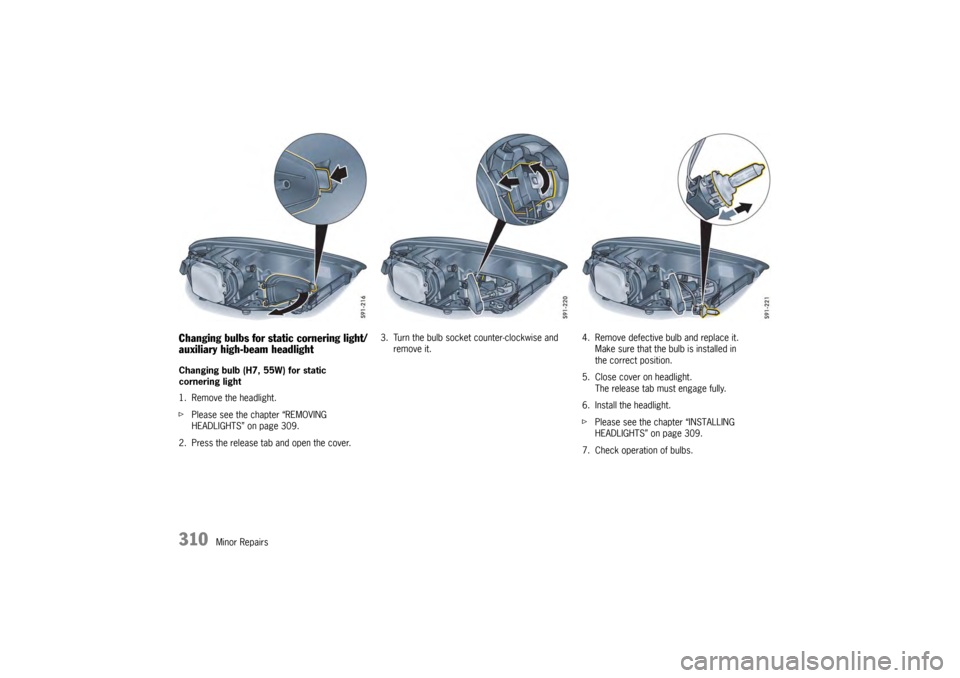
Changing bulbs for static cornering light/
auxiliary high-beam headlight Changing bulb (H7, 55W) for static
cornering light
1. Remove the headlight.
fPlease see the chapter “REMOVING
HEADLIGHTS” on page 309.
2. Press the release tab and open the cover. 3. Turn the bulb socket counter-clockwise and
remove it. 4. Remove defective bulb and replace it.
Make sure that the bulb is installed in
the correct position.
5. Close cover on headlight. The release tab must engage fully.
6. Install the headlight.
f Please see the chapter “INSTALLING
HEADLIGHTS” on page 309.
7. Check operation of bulbs.
Page 313 of 343
Minor Repairs
311
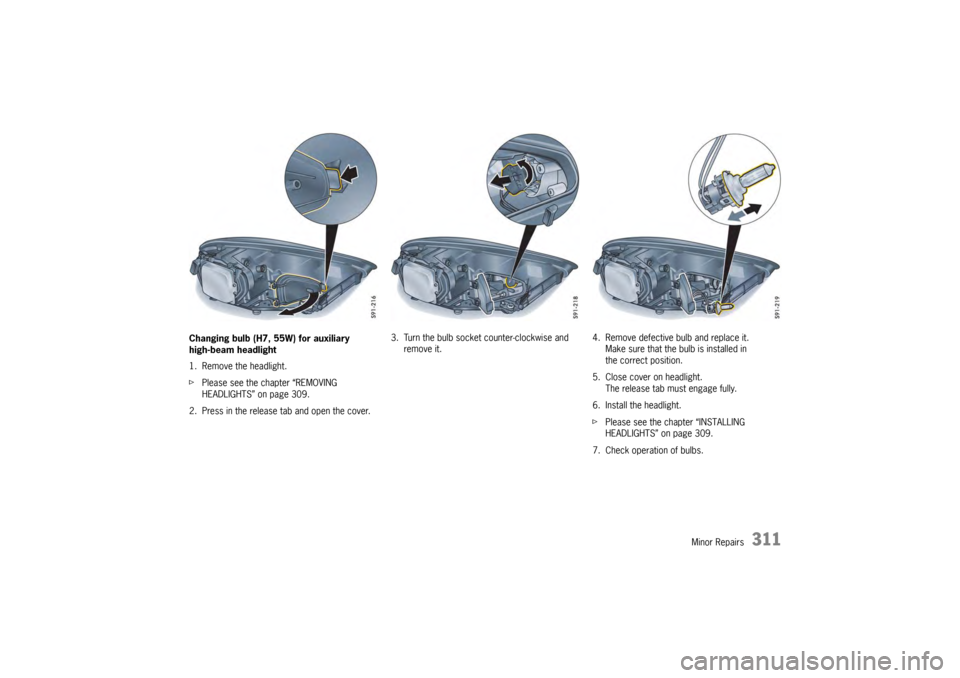
Changing bulb (H7, 55W) for auxiliary
high-beam headlight
1. Remove the headlight.
fPlease see the chapter “REMOVING
HEADLIGHTS” on page 309.
2. Press in the release tab and open the cover. 3. Turn the bulb socket counter-clockwise and
remove it. 4. Remove defective bulb and replace it.
Make sure that the bulb is installed in
the correct position.
5. Close cover on headlight. The release tab must engage fully.
6. Install the headlight.
f Please see the chapter “INSTALLING
HEADLIGHTS” on page 309.
7. Check operation of bulbs.
Page 314 of 343
312
Minor Repairs
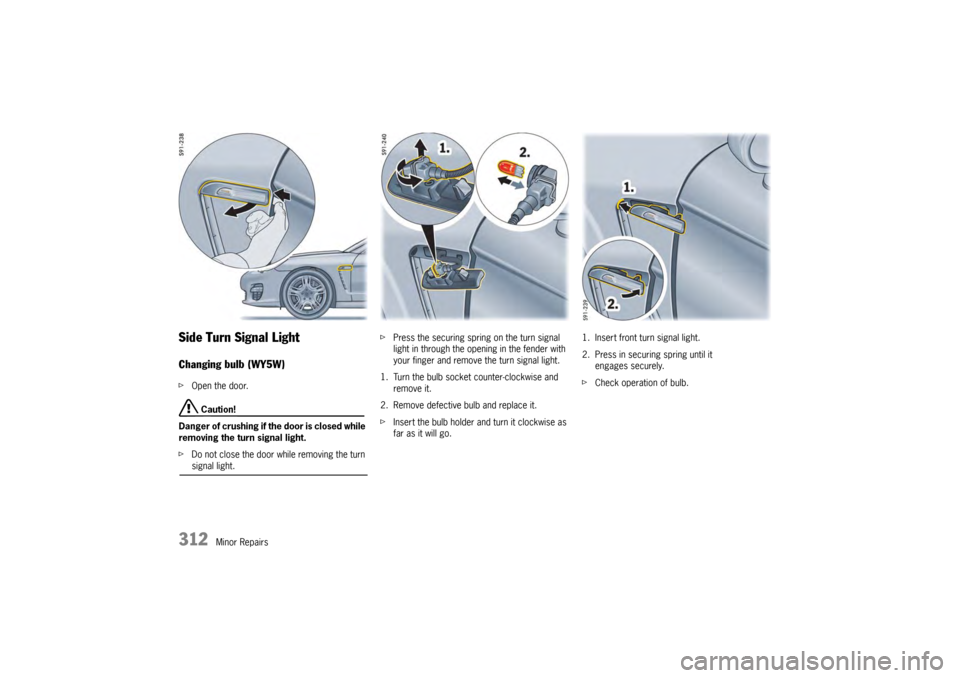
Side Turn Signal LightChanging bulb (WY5W)fOpen the door.
Caution!
Danger of crushing if th e door is closed while
removing the turn signal light.
f Do not close the door while removing the turn signal light. f
Press the securing spring on the turn signal
light in through the opening in the fender with
your finger and remove the turn signal light.
1. Turn the bulb socket counter-clockwise and remove it.
2. Remove defective bulb and replace it.
f Insert the bulb holder and turn it clockwise as
far as it will go. 1. Insert front turn signal light.
2. Press in securing spring until it
engages securely.
f Check operation of bulb.
Page 315 of 343
Minor Repairs
313
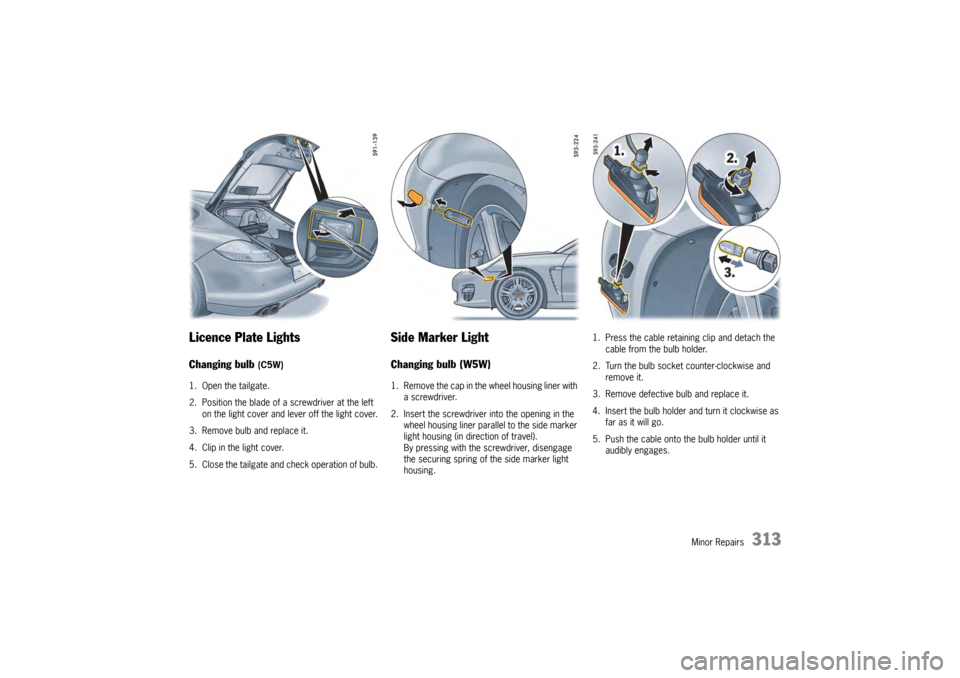
Licence Plate LightsChanging bulb
(C5W)
1. Open the tailgate.
2. Position the blade of a screwdriver at the left on the light cover and lever off the light cover.
3. Remove bulb and replace it.
4. Clip in the light cover.
5. Close the tailgate and check operation of bulb.
Side Marker LightChanging bulb (W5W)1. Remove the cap in the wheel housing liner with
a screwdriver.
2. Insert the screwdriver into the opening in the wheel housing liner parallel to the side marker
light housing (in direction of travel).
By pressing with the screwdriver, disengage
the securing spring of the side marker light
housing. 1. Press the cable retaining clip and detach the
cable from the bulb holder.
2. Turn the bulb socket counter-clockwise and remove it.
3. Remove defective bulb and replace it.
4. Insert the bulb holder and turn it clockwise as far as it will go.
5. Push the cable onto the bulb holder until it audibly engages.
Page 319 of 343

Minor Repairs
317
If the vehicle's transmission or shifter is already
damaged, serious damage will result if the vehicle
is not towed with all four wheels off the ground.
Porsche cannot be held responsible for damage
incurred in cases where a vehicle has been transported on one or both of its axles.
fThe vehicle must not be towed if the PDK
transmission is in em ergency operation mode
(yellow or red “Gearbox emergency operation”
warning message). The vehicle must be
transported with a car transporter or on
a trailer.
f If a selector lever emergency release was
performed, the vehicle must not be towed.
The vehicle must be transported with a car
transporter or on a trailer.
f Move PDK selector lever to position N.
To properly engage selector-lever position N
on the display and at the selector lever, the
engine must be started once before towing
the vehicle.
The vehicle can be towed as soon as the
selector lever is in position N and selector-
lever position N appears on the display.
f The vehicle must always roll on all four wheels
when towed.
The ignition must be switched on so that the
brake lights and turn signal lights operate and
the steering lock cannot engage.
f Do not exceed a maximum speed of 30 mph
(50 km/h). Maximum towing distance 30 miles (50 km).
If towing distances ar
e greater, the vehicle
must be transported with a car transporter
or on a trailer.
Panamera STowing a vehicle with PDK transmission on
one axle
f The vehicle must not be towed if the PDK
transmission is in emergency operation mode
(yellow or red “Gearbox emergency operation”
warning message). The vehicle must be
transported with a car transporter or on
a trailer.
f If a selector lever emergency release was
performed, the vehicle must not be towed.
The vehicle must be transported with a car
transporter or on a trailer.
f Move PDK selector lever to position N.
To properly engage selector-lever position N
on the display and at the selector lever, the
engine must be started once before towing
the vehicle.
The vehicle can be towed as soon as the
selector lever is in position N and selector-
lever position N appears on the display.
f Switch ignition off.
The ignition key must remain in the ignition
lock so that the steering wheel lock does
not engage.
The control unit must be removed from the ignition lock and the ke
y inserted in vehicles
with Porsche Entry & Drive.
f Please see the chapter “REMOVING THE
CONTROL UNIT FROM THE IGNITION LOCK” on
page 165.
f Make sure that the vehicle is
adequately illuminated.
f Do not exceed a maximum speed of 30 mph
(50 km/h).
Maximum towing distance 30 miles (50 km).
If towing distances are greater, the vehicle
must be transported with a car transporter or
on a trailer.
Panamera 4S, Panamera TurboTowing a vehicle with PDK and all-wheel drive
Caution!
We urge that wherever possible, a car
transporter or trailer be used to transport a
Panamera vehicle that cannot move under
its own power. This is the safest way to
transport a down vehicle.
For those instances where a car transporter or
trailer is not available, the vehicle may be towed
on all four axles only, provided the following
conditions are strictly met. Failure to meet these
conditions will result in serious and expensive
damage to the PDK transmission.