2009 PORSCHE PANAMERA warning
[x] Cancel search: warningPage 42 of 343

40
Seats, Mirrors and Steering Wheel
Driver's door memory buttons (driver memory or comfort
memory)Storing Vehicle SettingsDriver memoryThe current seat, exterior-mirror and steering
wheel settings are stored automatically on the car
key when the vehicle is locked.
Personal position settings for the driver’s seat,
exterior mirrors and the steering wheel can also
be stored in the person buttons and in the
driver’s door and retrieved at any time by pressing
the buttons.
Passenger's door memory buttons (comfort memory)Comfort memoryOn vehicles with the comfort memory package,
different vehicle settings, such as the multi-
function display, are stored on the car key and the
person buttons and in the driver’s door in
addition to the driver memory settings.
Personal position settings for the passenger seat
can be stored on the person buttons and in
the passenger’s door.
The passenger seat settings are not stored on the
car key.
Warning!
Risk of crushing due to uncontrolled
activation of settings.
f Do not activate the comfort memory button if
there is any risk of the seat crushing the
occupant.
f Cancel automatic adjustment by pressing any
of the seat adjustment buttons.
f Do not leave children in the vehicle unattended,
since they may depress the comfort setting
button and crush themselves or another occupant.
Page 44 of 343
42
Seats, Mirrors and Steering Wheel
Easy Entry FunctionThe Easy Entry function makes it easier for you to
get in and out of the vehicle.
Warning!
Risk of crushing if persons are behind the
driver’s seat when settings are retrieved.
Risk of damage if the rear seat bench is
folded forward when settings are retrieved.
f Switch off the Easy Entry function if there are
persons behind the driver’s seat or if the rear seat bench is folded forward.
Prerequisite
– Function must be activated on the multi- function display.
For information on swit ching the Easy Entry
function on and off:
f Please see the chapter “SWITCHING
COMFORT ENTRY ON AND OFF” on page 145. Entering the vehicle
When the driver’s door is opened, the steering
wheel and passenger seat
move upwards or to the
rear depending on the position of the seat and
steering wheel when the driver left the vehicle.
Once the driver’s door is closed and the ignition
key is inserted or, in the case of vehicles with
Porsche Entry & Drive, the ignition is switched on,
the seat and steering wheel move to the stored
position.
Exiting the vehicle
The steering wheel moves upwards:
– After the ignition key is removed or
– After the ignition is switched off and the
driver’s door is opened on vehicles with
Porsche Entry & Drive.
The driver’s seat moves to the rear:
– After the driver’s door is opened.
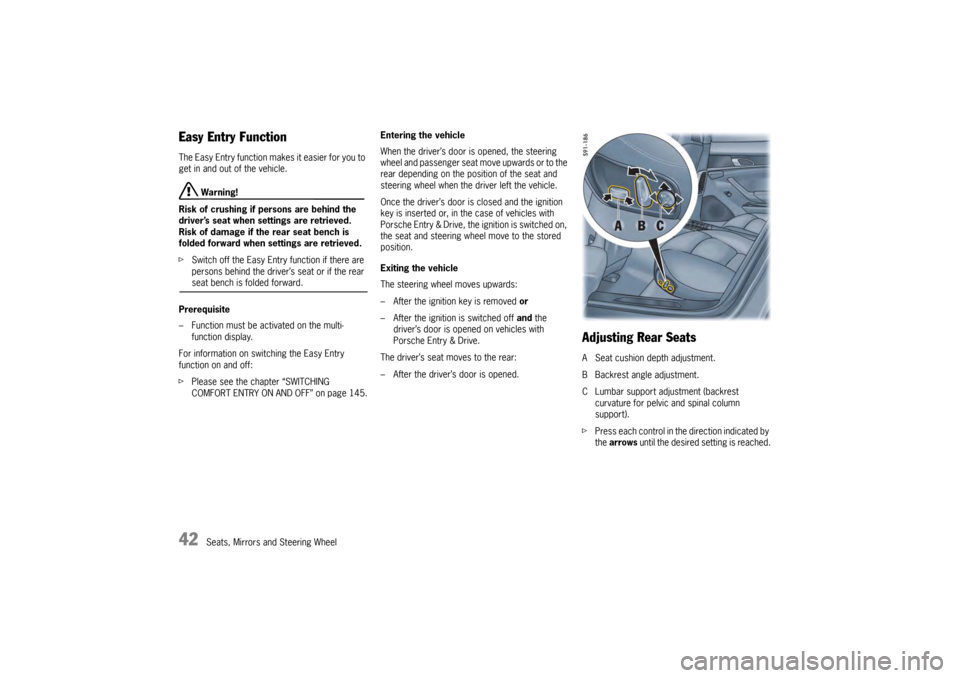
Adjusting Rear SeatsA Seat cushion depth adjustment.
B Backrest angle adjustment.
C Lumbar support adjustment (backrest curvature for pelvic and spinal column
support).
f Press each control in the direction indicated by
the arrows until the desired setting is reached.
Page 46 of 343
44
Seats, Mirrors and Steering Wheel
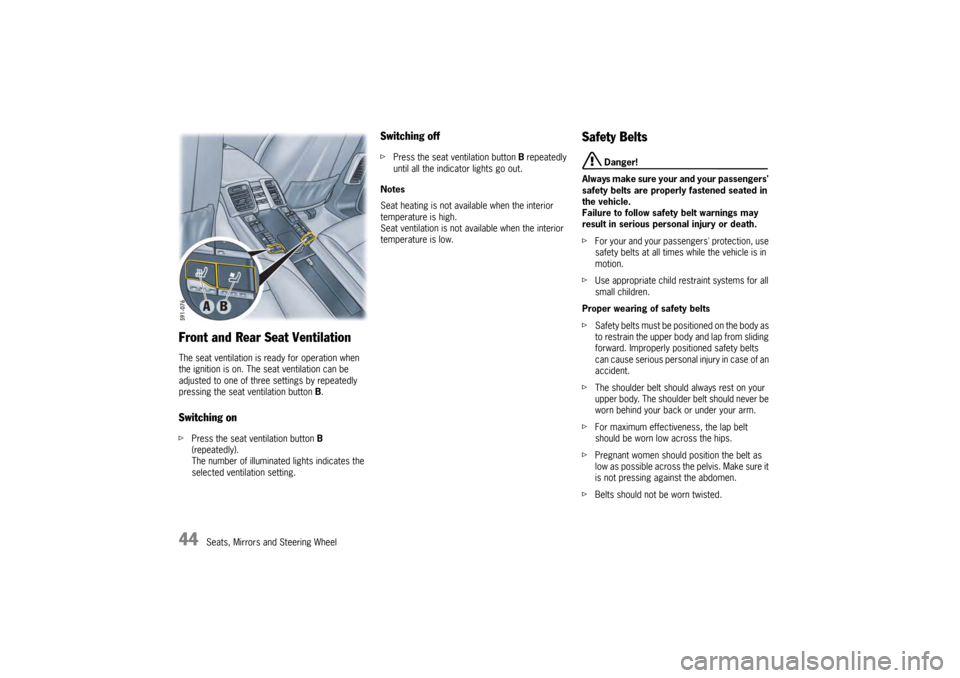
Front and Rear Seat VentilationThe seat ventilation is ready for operation when
the ignition is on. The seat ventilation can be
adjusted to one of three settings by repeatedly
pressing the seat ventilation button B.Switching onfPress the seat ventilation button B
(repeatedly).
The number of illuminated lights indicates the
selected ventilation setting.
Switching offf Press the seat ventilation button B repeatedly
until all the indicator lights go out.
Notes
Seat heating is not available when the interior
temperature is high.
Seat ventilation is not available when the interior
temperature is low.
Safety Belts
Danger!
Always make sure your and your passengers'
safety belts are properly fastened seated in
the vehicle.
Failure to follow safety belt warnings may
result in serious personal injury or death.
f For your and your passe ngers' protection, use
safety belts at all times while the vehicle is in
motion.
f Use appropriate child restraint systems for all
small children.
Proper wearing of safety belts
f S a f e t y b e l t s m u s t b e p o s i t i o n e d o n t h e b o d y a s
to restrain the upper bo dy and lap from sliding
forward. Improperly positioned safety belts
can cause serious personal injury in case of an
accident.
f The shoulder belt should always rest on your
upper body. The shoulder belt should never be
worn behind your back or under your arm.
f For maximum effectiveness, the lap belt
should be worn low across the hips.
f Pregnant women should position the belt as
low as possible across the pelvis. Make sure it
is not pressing against the abdomen.
f Belts should not be worn twisted.
Page 47 of 343
Seats, Mirrors and Steering Wheel
45
fDo not wear belts over rigid or breakable
objects in or on your clothing, such as eye
glasses, pens, keys, etc. as these may cause
injury.
f Several layers of heavy clothing may interfere
with proper positioning of belts.
f Belts must not rub against sharp objects or
damage may occur to the belt.
f Two occupants should never share the same
belt at the same time.
Care and maintenance
f Keep belt buckles free of any obstruction that
may prevent a secure locking.
f Belts that have been subjected to excessive
stretch forces in an accident must be
inspected or replaced to ensure their
continued effectiveness in restraining you.
The same applies to belt tensioner systems
which have been triggered. In addition, the
anchor points of the belts should be checked.
f If safety belts do not work properly, see your
authorized Porsche dealer immediately.
f If the belts show damage to webbing, bindings,
buckles or retractors, they should be replaced
to ensure safe operation.
f Do not modify or disassemble the safety belts
in your vehicle. f
The belts must be kept clean or the retractors
may not work properly.
Please see the chapter “CAR CARE
INSTRUCTIONS” on page 269.
f Never bleach or dye safety belts.
f Do not allow safety belts to retract until they
are completely dry after cleaning or this may
cause damage to the belt.
Belt tensionerDepending on the force of a collision, fastened
seat belts are automatically tightened in an
accident.
The belt tensioners are triggered in:
– Front and rear impacts of sufficient severity
– Side impacts
– In cases of vehicle rollover
Maintenance notes
The belt tensioner system can be triggered only
once; the system must be replaced afterwards.
If there is a fault in the belt tensioner system, the
air bag warning light lights up.
Work may be performed on the belt tensioner
system only by an authorized Porsche dealer.
Smoke is released when the belt tensioners are
triggered.
This does not indicate a fire in the vehicle. An audio-visual warning
system is
interconnected with the driver’s safety belt.
Every time the ignition is turned on, the gong will
sound for about 6 seconds to remind driver and
passenger to buckle up.
In addition, the gong will sound for approximately
90 seconds if vehicle speed exceeds 15 mph
(24 km/h).
The safety belt warning lights in the instrument
panel and multi-function display will go off as soon
as the driver has buckled up.
Safety Belt Warning System
Page 50 of 343

48
Seats, Mirrors and Steering Wheel Danger!
To provide optimal occupant protection, air
bags must inflate at very high speed. If you
are not wearing your safety belt or are too
close to the air bag when it is deployed,
inflating air bags can result in serious
personal injury or death.
f Make sure there are no people, animals or
objects between the driver or passenger and
the area into which the air bags inflate.
f Sit back as far from the dashboard or steering
wheel as is practical, while still maintaining full
vehicle control.
f Always hold the steering wheel by the outer
rim. Never rest your hands on the air bag
panel.
f Always fasten seat belts because triggering
of the air bag system depends on the force
and angle of impact.
f Do not transport heavy objects on or in front of
the passenger seat. These could impair the
function of the air bags, the seat belts, and
occupant sensing.
f Do not hang objects (e. g., jackets, coats,
coat hangers) over the backrest. f
Always keep the lid of the door storage
compartment closed. Objects must not
protrude out of the door storage
compartment.
f Do not add any additional coverings or stickers
to the steering wheel or in the area of the
passenger air bag, side air bags, knee air
bags, and head air bags. Doing so may
adversely affect the functioning of the air bag
system or cause harm to the occupants if the
air bag system should deploy.
f No objects should be placed over or near the
air bag on the instrument panel, because any
such objects could cause harm if the vehicle is
in a crash severe enough to cause the air bag
to inflate.
f Do not modify the seat coverings, since such
changes can block the seat-mounted side air
bag. Do not attach additional cushions,
protective coverings, or pillows to the
passenger's seat. Do not affix things to the
passenger's seat or cover it with other
materials. Do not cover the back of the
backrest. Do not make changes to the
passenger's seat, the cushion or foam, the
occupant sensor, and to the seat base frame.
f No changes must be made to the wiring or
components of the air bag system.
f Do not install any wiring for electrical
accessory equipment in the vicinity of the air
bag wiring harnesses. Doing so may disable the air bag system or cause inadvertent
inflation.
f If the warning light comes on, the air bag
system should be repaired immediately by
your authorized Porsche dealer.
f Always keep feet in the footwell while driving.
Do not put feet on the dashboard or the seat
area. Do not lean against the inside of the door
or outside the window while the vehicle is
moving.
f Using accessories not approved by Porsche
can cause the occupant sensing to be
impaired.
f Do not squeeze objects, such as the fire
extinguisher, or first aid kit under the seat.
f Only have seats removed and installed by an
authorized Porsche dealer so that occupant
sensing components will not be damaged.
f Give your passenger all of the information in
this chapter.
Note
Air bag components (e.g. steering wheel, seats)
may be disassembled only by an authorized
Porsche dealer.
f When disposing of a used air bag unit, our
safety instructions must be followed. These
instructions can be obtained at any authorized
Porsche dealer.
Page 53 of 343

Seats, Mirrors and Steering Wheel
51
Note
fAfter switching on the ignition, the
PASSENGER AIR BAG OFF warning light lights
up for a few seconds as a check.
PASSENGER AIR BAG OFF indicator lamp
lights up
The passenger’s air bags are switched off.
PASSENGER AIR BAG OFF indicator lamp
does not light up
The passenger’s air bags are active and ready for
operation.
Danger!
Risk of serious personal injury or death due
to the passenger air bag triggering
unintentionally.
When the ignition is on and the up to one-
year old child is seated in the child restraint
system on the passenger seat the indicator
lamp “PASSENGER AIR BAG OFF“ must be
on.
If the “PASSENGER AIR BAG OFF” indicator
lamp does not light up, it could indicate a
fault in the system, and the air bag could
inflate in a collision, placing the child at risk
of death or severe injury from the inflating air
bag.
In this case:
f Fasten the child restraint system on one of the
rear seats immediately.
f Have the fault remedied at your nearest authorized Porsche dealer. Faults are indicated by a warning light in the
instrument panel.
The air bag warning light illuminates when the
electronic monitoring of the air bag system
detects a malfunction of the
sensors, safety belt
system, occupant detection system, PASSENGER
AIR BAG OFF indicator lamp, related wiring, air bag
modules and control units.
f In the following cases you should
immediately consult an authorized
Porsche dealer in order to assure the air
bag system is functioning properly:
– If the warning light does not light up when the ignition is switched on or
– If the warning light does not go out once the engine is running or
– If the warning light appears while driving.
Warning light
Page 55 of 343
Seats, Mirrors and Steering Wheel
53
Danger!
Risk of serious personal injury or death to the
child.
f Follow all child restraint instructions and warnings in this manual.
– When using an infant or child restraint system, be sure to follow all manufacturer's
instructions on installation and use.
– Infants and small children should neither be held on the lap, nor should they share a safety
belt with another occupant while the vehicle is
in motion.
– Children too big for child restraint systems must use regular safety belts. A shoulder belt
can be used providing it does not cross the
face or the neck of the child.
– Choose a child restraint system according to the age and size of the child.
– Child restraint systems that are damaged or have been heavily stressed in an accident must
be replaced immediately.
– Children could be endangered in a crash if their child restraints are not properly secured in
vehicle.
– Do not affix objects to child restraint systems or cover them with other materials.
f For maximum safety and protection, do not
use a child restraint system in the front
passenger seat.
Direction of installation for child restraint
systemsAccording to accident statistics, children are safer
when properly restrained in the rear seating
positions than in the front seating positions.
Under all normal circumstances, the child seat
must be placed in the rear.
fDo not use a child restraint system in the front
passenger seat.
Group 0 and 0+: Children up to 29 lbs
(13 kg)
Children of this weight must be transported in a
restraint system which is fitted facing
backwards .
Group I: Children in between 20 lbs (9 kg)
and 40 lbs (18 kg)
Children of this weight are transported in child
restraint systems facing forward.
Group II: Children in between 33 lbs (15 kg)
and 55 lbs (25 kg)
Children of this weight are transported in child
restraint systems facing forward.
Group III: Children in between 49 lbs (22 kg)
and 80 lbs (36 kg)
Children of this weight are transported in child
restraint systems facing forward.
Using child restraint systems in the front
passenger seat
Danger!
The use of a child restraint system in the
front passenger seat can result in serious
personal injury or death to the child from an
air bag deployment.
To reduce risk of injury from an inflating air
bag in an accident, Porsche strongly
recommends:
f Under all normal circumstances, the child seat
must be placed in the rear.
Do not use a child restrai nt system in the front passenger seat.
However, there may be se rious situations where it
might be necessary to pl ace a child in the front
seat so that he/she can be kept under direct
observation to prevent an immediate risk to the
child (for example, while driving to the doctor or
hospital). The following in structions are provided
to you solely for that purpose.
f Seek appropriate advice from your authorized
Porsche dealer about the possible installation
of a Porsche child restraint system.
f If a child restraint system must be fastened to
the passenger's seat, adjust the passenger's
seat as far away from the air bag as possible.
Page 60 of 343
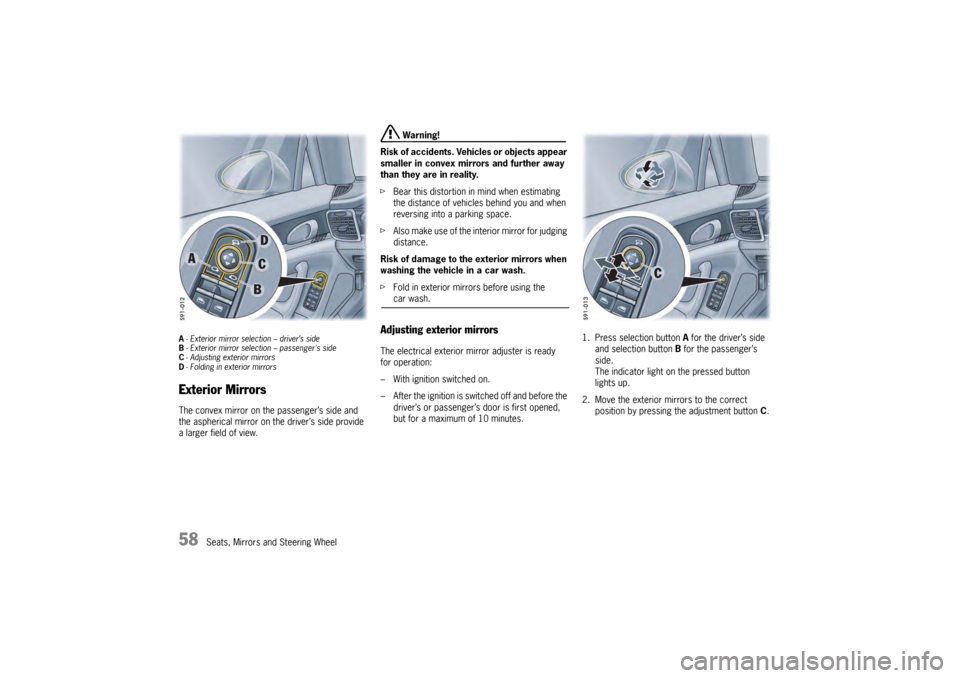
58
Seats, Mirrors and Steering Wheel
A- Exterior mirror selection – driver’s side
B - Exterior mirror selection – passenger's side
C - Adjusting exterior mirrors
D - Folding in exterior mirrorsExterior MirrorsThe convex mirror on the passenger’s side and
the aspherical mirror on the driver’s side provide
a larger field of view.
Warning!
Risk of accidents. Vehi cles or objects appear
smaller in convex mirrors and further away
than they are in reality.
f Bear this distortion in mind when estimating
the distance of vehicles behind you and when
reversing into a parking space.
f Also make use of the interior mirror for judging
distance.
Risk of damage to the exterior mirrors when
washing the vehicle in a car wash.
f Fold in exterior mirrors before using the car wash.
Adjusting exterior mirrors The electrical exterior mirror adjuster is ready
for operation:
– With ignition switched on.
– After the ignition is switched off and before the
driver’s or passenger’s door is first opened,
but for a maximum of 10 minutes. 1. Press selection button
A for the driver’s side
and selection button B for the passenger’s
side.
The indicator light on the pressed button
lights up.
2. Move the exterior mirrors to the correct position by pressing the adjustment button C.