2009 PORSCHE PANAMERA engine
[x] Cancel search: enginePage 29 of 343
Opening and Locking
27
Powerlift tailgateOpening and closing tailgate automatically
Warning!
Risk of poisoning! Exhaust gases can enter
the passenger compartment when the
tailgate is open.
f Always keep the tailgate closed when the
engine is running.
f Always keep the tailgate closed while driving.
Risk of injury and damage if the tailgate is
automatically opened or closed in an
uncontrolled way!
f Do not leave children in the car unattended.
f Open or close the tailgate only when the
vehicle is stationary.
f Never drive with the ta ilgate open. Exhaust
gases can enter the passenger compartment.
f Open or close the tailgate only when there are
no persons, animals or objects within its
movement range.
f Always keep a close eye on the opening and
closing operation so that movement can be
stopped at any time in the event of danger.
f Make sure there is sufficient clearance behind
and above the vehicle (e.g. roof transport systems, garage ceiling). Acoustic indication du
ring opening/closing
of the tailgate
Opening and closing of the tailgate are indicated
by warning tones.
You can have the warning tones activated/
deactivated at your authorized Porsche dealer.
Opening tailgate automatically
There are three ways of opening the tailgate:
Variant 1
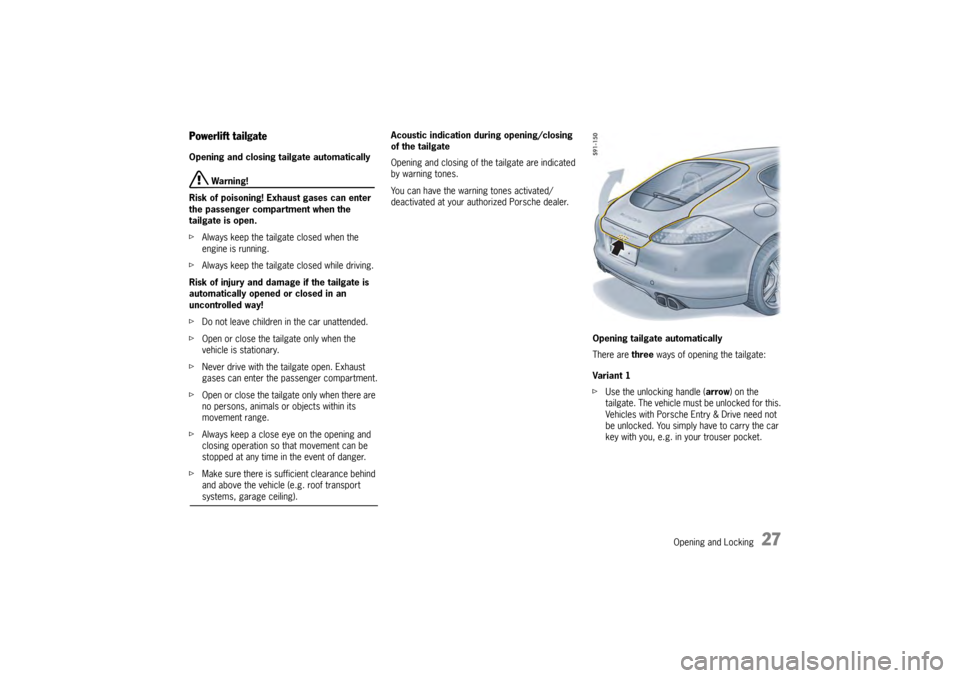
f Use the unlocking handle ( arrow) on the
tailgate. The vehicle must be unlocked for this.
Vehicles with Porsche Entry & Drive need not
be unlocked. You simply have to carry the car
key with you, e.g. in your trouser pocket.
Page 35 of 343

Opening and Locking
33
Activating and deactivating child lock
The child locks are fitted in the lock area of the
rear doors.
The doors cannot be opened from inside when the
child locks are on.
fTo engage: Turn the child lock in direction of
travel using the emergency key.
f To disengage: Turn the child lock away
from the direction of travel using the
emergency key.
For information on the emergency key:
f Please see the chapter “EMERGENCY KEY” on
page 20.
Opening and Closing the Engine
Compartment Lid
Danger!
Risk of loss of control or an accident,
resulting in serious personal injury or death.
f Should you notice at any time while driving that
one of the lids is not secured properly, please
stop immediately in a suitable place and
close it.
The engine compartment lid may fly up impairing vision.
Opening
Caution!
Risk of damage to engine compartment lid or
windshield wipers.
f Make sure that the windshield wipers are not
pulled out forwards when opening the engine
compartment lid.
f Always switch off windshield wipers
before opening the engine compartment lid
(wiper switch in position 0).
For information on the front wipers:
f Please see the chapter “FRONT WIPER AND HEADLIGHT WASHER SYSTEM” on page 102.
Page 36 of 343

34
Opening and Locking
1. Open the driver’s door.
2. Pull the release lever (
arrow).
The engine compartment lid is now unlocked. 3. Pull the unlocking handle (
arrow).
4. Open the engine compartment fully.
Closing1. Lower lid and let it fa ll into the lock. If
necessary, push the lid closed with the palm
of your hand in the area of the lock.
2. Check that the lid is en gaged correctly in the
lock and that the release lever is back in its
initial position.
When the vehicle is in motion, a message will
appear on the multi-function display in the
instrument panel if the lid is not closed properly.
Page 53 of 343

Seats, Mirrors and Steering Wheel
51
Note
fAfter switching on the ignition, the
PASSENGER AIR BAG OFF warning light lights
up for a few seconds as a check.
PASSENGER AIR BAG OFF indicator lamp
lights up
The passenger’s air bags are switched off.
PASSENGER AIR BAG OFF indicator lamp
does not light up
The passenger’s air bags are active and ready for
operation.
Danger!
Risk of serious personal injury or death due
to the passenger air bag triggering
unintentionally.
When the ignition is on and the up to one-
year old child is seated in the child restraint
system on the passenger seat the indicator
lamp “PASSENGER AIR BAG OFF“ must be
on.
If the “PASSENGER AIR BAG OFF” indicator
lamp does not light up, it could indicate a
fault in the system, and the air bag could
inflate in a collision, placing the child at risk
of death or severe injury from the inflating air
bag.
In this case:
f Fasten the child restraint system on one of the
rear seats immediately.
f Have the fault remedied at your nearest authorized Porsche dealer. Faults are indicated by a warning light in the
instrument panel.
The air bag warning light illuminates when the
electronic monitoring of the air bag system
detects a malfunction of the
sensors, safety belt
system, occupant detection system, PASSENGER
AIR BAG OFF indicator lamp, related wiring, air bag
modules and control units.
f In the following cases you should
immediately consult an authorized
Porsche dealer in order to assure the air
bag system is functioning properly:
– If the warning light does not light up when the ignition is switched on or
– If the warning light does not go out once the engine is running or
– If the warning light appears while driving.
Warning light
Page 61 of 343

Seats, Mirrors and Steering Wheel
59
If the electrical adjustment facility fails
f Adjust the mirror by pressing on the
mirror face.Folding in exterior mirrorsfPress button D.
Both exterior mirrors fold in automatically.
If the electrical adjustment facility fails
f Fold in mirrors manually.Folding out exterior mirrorsfPress button D.
Both exterior mirrors unfold automatically.
Folding exterior mirrors in and out
automaticallyThe exterior-mirrors can be folded in automatically
after the vehicle is locked.
Folding exterior mirrors in automatically
f Press and hold the button on the car key for
at least 1 second.
or
On vehicles with Porsche Entry & Drive, press
and hold the locking button in the handle on the
driver’s door for at least 1 second.
The exterior mirrors fold in.
Folding exterior mirr ors out automatically
f Switch on ignition.
The exterior mirrors fold out.
Note
The exterior mirrors do not fold out automatically
after the ignition is switch ed on if they were folded
in manually using the button D.
If the electrical adj ustment facility fails
f Unfold mirrors manually.
Storing exterior mirror settingsOn vehicles with driver or comfort memory,
individual exterior mirror settings can be stored on
the person buttons on the driver’s side and on the
car key.
For further information on retrieving and storing
vehicle settings:
f Please see the chapter “STORING VEHICLE
SETTINGS” on page 40.Exterior mirror heatingThe exterior mirror heating is activated
automatically when the heated rear window is
switched on while the engine is running.
For information on switch ing on the heated rear
window:
f Please see the chapter “HEATED REAR
WINDOW/EXTERIOR MIRROR HEATING” on
page 84.
Page 73 of 343
Air Conditioning
71
General FunctionsNote on operation
Additional settings relating to the climate type and
extended ventilation panel can be adjusted in the
multi-function display on the instrument panel:
f Please see the chapter “AIR-CONDITIONING
SETTINGS ON THE MULTI-FUNCTION
DISPLAY” on page 83.
f Please see the chapter “SETTING AIR
CONDITIONING” on page 146.
On vehicles with comfort memory, all air-
conditioning settings are stored on the relevant
ignition key when the vehicle is locked.REST modeUsing engine residual heat
The residual heat of the engine can be used to
heat the interior for up to 20 minutes after the
ignition has been switched off.
f When the ignition is switched off:
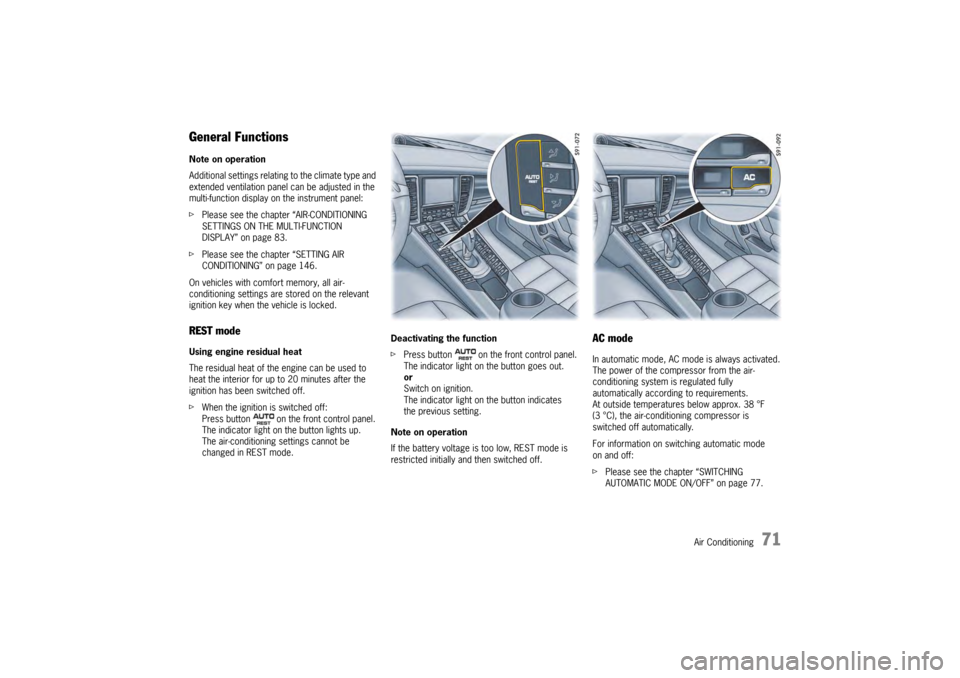
Press button on the front control panel.
The indicator light on the button lights up.
The air-conditioning settings cannot be
changed in REST mode. Deactivating the function
f
Press button on the front control panel.
The indicator light on the button goes out.
or
Switch on ignition.
The indicator light on the button indicates
the previous setting.
Note on operation
If the battery voltage is too low, REST mode is
restricted initially and then switched off.
AC modeIn automatic mode, AC mode is always activated.
The power of the compressor from the air-
conditioning system is regulated fully
automatically according to requirements.
At outside temperatures below approx. 38 °F
(3 °C), the air-conditioning compressor is
switched off automatically.
For information on switching automatic mode
on and off:
f Please see the chapter “SWITCHING
AUTOMATIC MODE ON/OFF” on page 77.
Page 77 of 343

Air Conditioning
75
Setting automatic air-recirculation modeIn automatic air-recirculation mode, the fresh air
supply is adjusted depending on the air quality.
Automatic air-recirculation mode can be switched
on and off on the multi-function display.
At outside temperatures below approx. 50 °F
(10 °C), air-recirculation mode is deactivated
automatically to prevent the windows from
misting.
For information on adjusting automatic air-
recirculation mode on the multi-function display:
fPlease see the chapter “SETTING AIR
CONDITIONING” on page 146.
Note
The recommended operating mode is automatic
air-recirculation mode (default setting).
Information on the air-conditioning
compressorThe air-conditioning compressor:
– Can switch off briefly to ensure sufficient engine cooling if the engine is operating under
extreme load.
– Automatically switches off at temperatures below 38 °F (3 °C) and cannot be switched on,
even manually.
– Operates most effectively with the windows closed.
If the vehicle has been in the sun for a long
time, it is a good idea to ventilate the interior
briefly with the windows open.
– Depending on the outside temperature and humidity, condensation can drip from the
evaporator and form a pool under the vehicle.
This is normal and not a sign of leaks.
Information on automatic load switch-offIf the charging condition of the battery is critical,
the following air-conditioning or heating functions
are restricted initially and then switched off.
– Heated seats
– Heated rear window/External mirror heating
–Fresh-air blower
– Air-conditioning compressor
Page 78 of 343
76
Air Conditioning
Front control panel
(2-zone and 4-zone air conditioning systems)Automatically Controlled
Air ConditioningDepending on various factors (e.g. sunlight, air
quality, ambient temperature, misted windows),
the air-conditioning system adjusts the preset
interior temperature, air distribution and air
quantity fully automatically.
Automatic mode is deactivated as soon as the
settings are adjusted manually. In this case,
automatic climate control still regulates the
air-conditioning functions that have not been
modified manually. Please read the information on:
–
REST mode , see page 71.
– AC mode , see page 71.
– AC MAX mode, see page 72.
– MONO mode , see page 74.
– Defrosting the windshield , see page 73.
– Air-recirculation mode , see page 74.
– Air-conditioning compressor , see page 75.
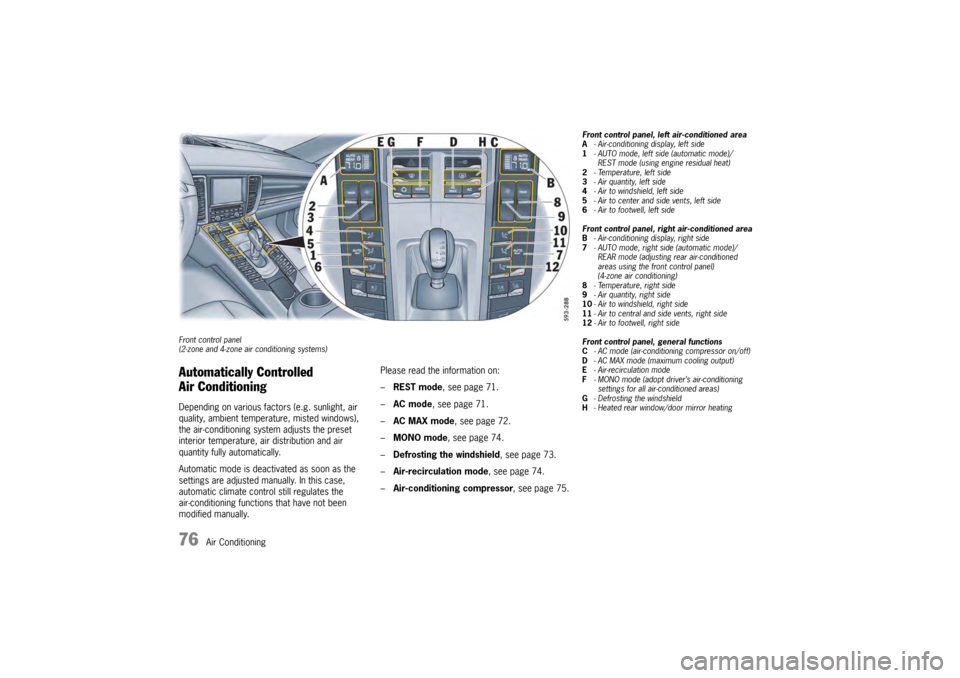
Front control panel, left air-conditioned area
A- Air-conditioning display, left side
1 - AUTO mode, left side (automatic mode)/
REST mode (using engine residual heat)
2 - Temperature, left side
3 - Air quantity, left side
4 - Air to windshield, left side
5 - Air to center and side vents, left side
6 - Air to footwell, left side
Front control panel, right air-conditioned area
B - Air-conditioning display, right side
7 - AUTO mode, right side (automatic mode)/
REAR mode (adjusting rear air-conditioned
areas using the front control panel)
(4-zone air conditioning)
8 - Temperature, right side
9 - Air quantity, right side
10 - Air to windshield, right side
11 - Air to central and side vents, right side
12 - Air to footwell, right side
Front control panel, general functions
C - AC mode (air-conditioning compressor on/off)
D - AC MAX mode (maximum cooling output)
E - Air-recirculation mode
F - MONO mode (adopt driver’s air-conditioning
settings for all air-conditioned areas)
G - Defrosting the windshield
H - Heated rear window/door mirror heating