Page 227 of 318

GM recommends replacing tires
in sets of four. This is because
uniform tread depth on all tires will
help keep the vehicle performing
most like it did when the tires were
new. Replacing less than a full set
of tires can affect the braking and
handling performance of the vehicle.
SeeTire Inspection and Rotation on
page 9-53.
{CAUTION
Mixing tires could cause you to
lose control while driving. If you
mix tires of different sizes,
brands, or types (radial and
bias-belted tires), the vehicle
may not handle properly, and
you could have a crash. Using
tires of different sizes, brands,
or types may also cause
(Continued)
CAUTION (Continued)
damage to the vehicle.
Be sure to use the correct
size, brand, and type of tires
on all wheels. It is all right
to drive with the compact
spare temporarily, as it was
developed for use on the
vehicle. SeeCompact
Spare Tire on page 9-70.
{CAUTION
If you use bias-ply tires on the
vehicle, the wheel rim anges
could develop cracks after
many miles of driving. A tire
and/or wheel could fail
suddenly, causing a crash.
Use only radial-ply tires with
the wheels on the vehicle.
Vehicles that have a tire pressure
monitoring system could give
an inaccurate low-pressure warning
if tires not recommended for the
vehicle are installed. Tires that do
not match the original equipment
tires could give a low-pressure
warning that is higher or lower
than the proper warning level you
would get with original equipment
tires. SeeTire Pressure Monitor
System on page 9-48.
The vehicle’s original equipment
tires are listed on the Tire and
Loading Information Label. See
Loading the Vehicle on page 8-32,
for more information about the
Tire and Loading Information label
and its location on the vehicle.
Vehicle Service and Care 9-55
2009 - Pontiac Vibe Owner Manual
Page 229 of 318

The grades are molded on
the sidewalls of most passenger
car tires. The Uniform Tire
Quality Grading (UTQG)
system does not apply to deep
tread, winter-type snow tires,
space-saver, or temporary use
spare tires, tires with nominal
rim diameters of 10 to 12 inches
(25 to 30 cm), or to some
limited-production tires.
While the tires available on
General Motors passenger
cars and light trucks may vary
with respect to these grades,
they must also conform to
federal safety requirements.Treadwear
The treadwear grade is a
comparative rating based on the
wear rate of the tire when tested
under controlled conditions on
a specied government test
course. For example, a tire
graded 150 would wear one and
a half (1
12) times as well on the
government course as a tire
graded 100. The relative
performance of tires depends
upon the actual conditions of
their use, however, and may
depart signicantly from the
norm due to variations in driving
habits, service practices,
and differences in road
characteristics and climate.Traction — AA, A, B, C
The traction grades, from
highest to lowest, are AA, A, B,
and C. Those grades represent
the tire’s ability to stop on wet
pavement as measured under
controlled conditions on specied
government test surfaces of
asphalt and concrete. A tire
marked C may have poor
traction performance.
{WARNING
The traction grade assigned
to this tire is based on
straight-ahead braking traction
tests, and does not include
acceleration, cornering,
hydroplaning, or peak traction
characteristics.
Vehicle Service and Care 9-57
2009 - Pontiac Vibe Owner Manual
Page 235 of 318
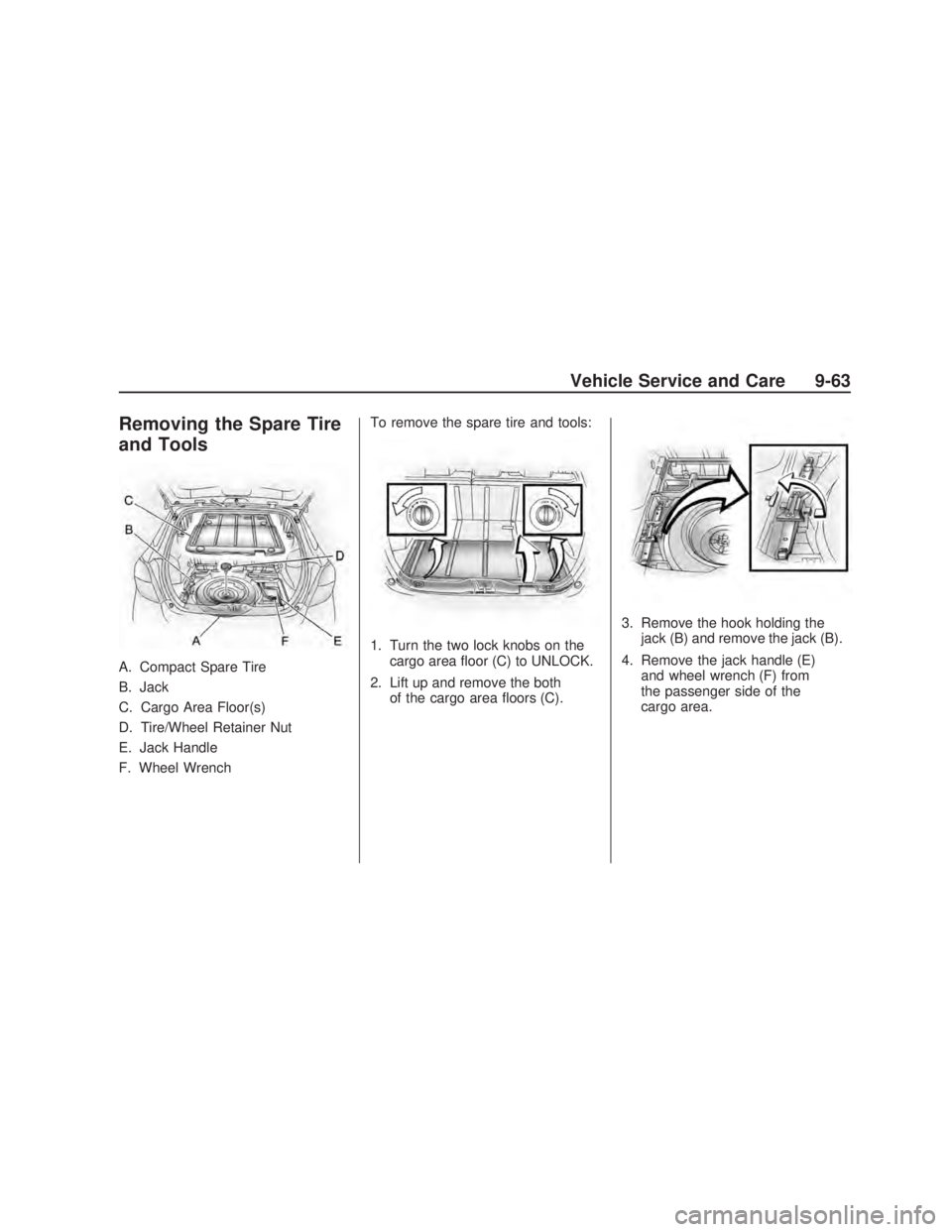
Removing the Spare Tire
and Tools
A. Compact Spare Tire
B. Jack
C. Cargo Area Floor(s)
D. Tire/Wheel Retainer Nut
E. Jack Handle
F. Wheel WrenchTo remove the spare tire and tools:
1. Turn the two lock knobs on the
cargo area oor (C) to UNLOCK.
2. Lift up and remove the both
of the cargo area oors (C).3. Remove the hook holding the
jack (B) and remove the jack (B).
4. Remove the jack handle (E)
and wheel wrench (F) from
the passenger side of the
cargo area.
Vehicle Service and Care 9-63
2009 - Pontiac Vibe Owner Manual
Page 236 of 318
5. Remove the tire/wheel
retainer (D) from the compact
spare tire (A) and remove
the compact spare tire (A).
SeeCompact Spare Tire on
page 9-70.
6. Place the compact spare tire (A)
next to the at tire.
Removing the Flat Tire
and Installing the
Spare Tire
1. Do a safety check before
proceeding. SeeChanging
a Flat Tire on page 9-62.
2. If the vehicle has steel wheels
with plastic wheel nut caps,
loosen the plastic wheel
nut caps. You may need the
wheel wrench to loosen them.
Do not pry off wheel covers that
have plastic wheel nut caps.
3. Remove the wheel cover and set
it off to the side.
4. Attach the jack handle to the jack
and turn clockwise to raise the
lift head a little.5. Loosen all the wheel nuts.
Do not remove them yet.
9-64 Vehicle Service and Care
2009 - Pontiac Vibe Owner Manual
Page 237 of 318
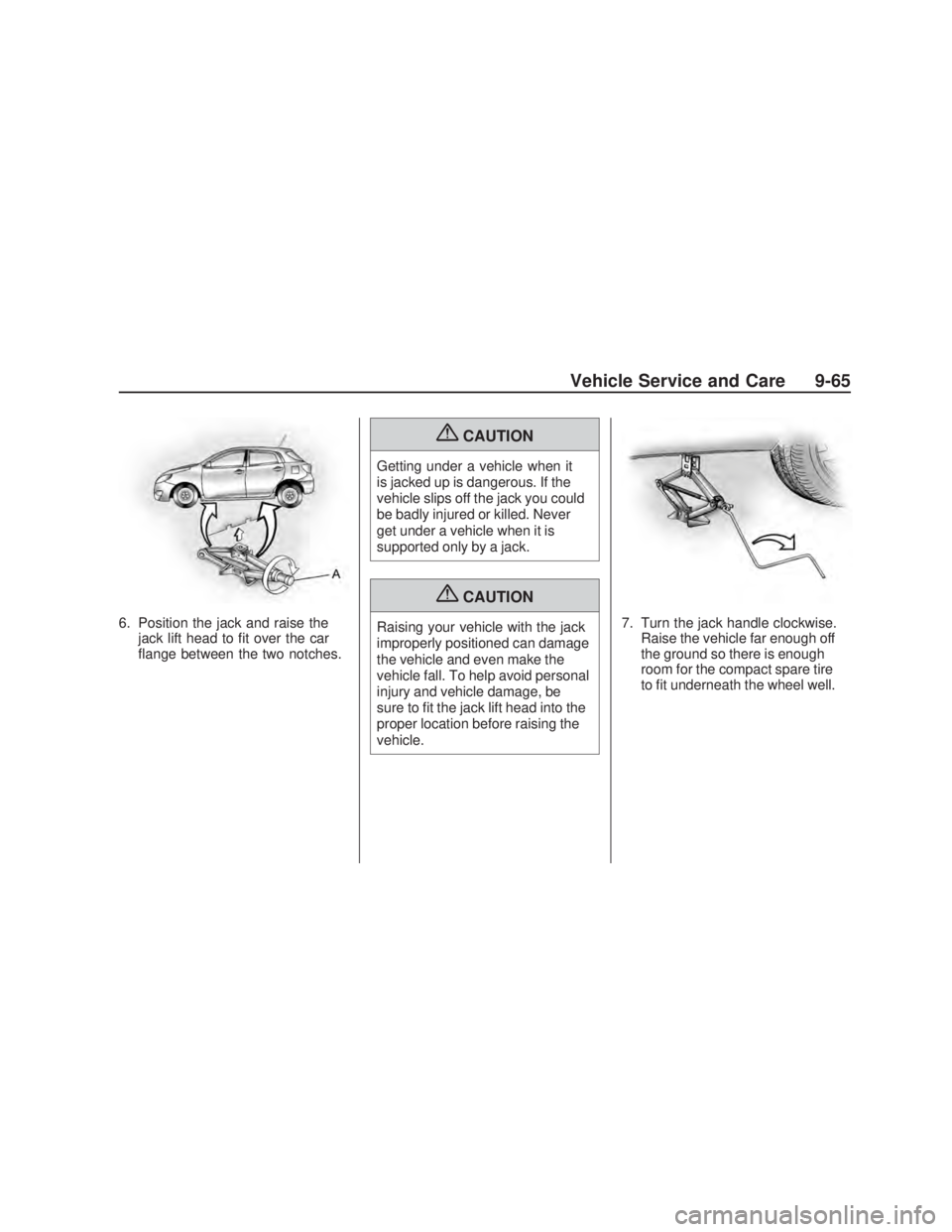
6. Position the jack and raise the
jack lift head to t over the car
ange between the two notches.
{CAUTION
Getting under a vehicle when it
is jacked up is dangerous. If the
vehicle slips off the jack you could
be badly injured or killed. Never
get under a vehicle when it is
supported only by a jack.
{CAUTION
Raising your vehicle with the jack
improperly positioned can damage
the vehicle and even make the
vehicle fall. To help avoid personal
injury and vehicle damage, be
sure to t the jack lift head into the
proper location before raising the
vehicle.7. Turn the jack handle clockwise.
Raise the vehicle far enough off
the ground so there is enough
room for the compact spare tire
to t underneath the wheel well.
Vehicle Service and Care 9-65
2009 - Pontiac Vibe Owner Manual
Page 238 of 318
8. Remove the wheel nuts and the
at tire.
9. Install the spare tire.
{CAUTION
Rust or dirt on a wheel, or on the
parts to which it is fastened, can
make wheel nuts become loose
after time. The wheel could come
off and cause an accident. When
you change a wheel, remove any
rust or dirt from places where the
wheel attaches to the vehicle.
In an emergency, you can use a
cloth or a paper towel to do this;
but be sure to use a scraper
or wire brush later, if needed,
to get all the rust or dirt off.
SeeChanging a Flat Tire on
page 9-62.10. Remove any rust or dirt from
the wheel bolts, mounting
surfaces and spare wheel.
11. Place the compact spare tire on
the wheel-mounting surface.
{CAUTION
Never use oil or grease on bolts
or nuts because the nuts might
come loose. The vehicle’s wheel
could fall off, causing a crash.
9-66 Vehicle Service and Care
2009 - Pontiac Vibe Owner Manual
Page 240 of 318

Storing a Flat or Spare
Tire and Tools
Storing the Compact
Spare Tire
{CAUTION
Storing a jack, a tire, or other
equipment in the passenger
compartment of the vehicle could
cause injury. In a sudden stop or
collision, loose equipment could
strike someone. Store all these
in the proper place.A. Compact Spare Tire
(Valve Stem Pointed Down)
B. Jack
C. Cargo Area Floor
D. Tire/Wheel Retainer Nut
E. Jack Handle
F. Wheel Wrench
1. Place the jack handle (E) and
wheel wrench (F) back in their
original location in the passenger
side of the cargo area.2. Place the jack (B) back in its
original location on the driver
side of the cargo area and close
the latch over the jack (B).
3. Place the compact spare tire (A),
valve stem pointed down, back
in its original location in the
center of the cargo area.
4. Turn the tire/wheel retainer
nut (D) clockwise to secure it
on the compact spare tire (A).
5. Close the cargo area oor (C).
Storing the Full-Size Flat Tire
{CAUTION
Storing a jack, a tire, or other
equipment in the passenger
compartment of the vehicle could
cause injury. In a sudden stop or
collision, loose equipment could
strike someone. Store all these in
the proper place.
9-68 Vehicle Service and Care
2009 - Pontiac Vibe Owner Manual
Page 241 of 318
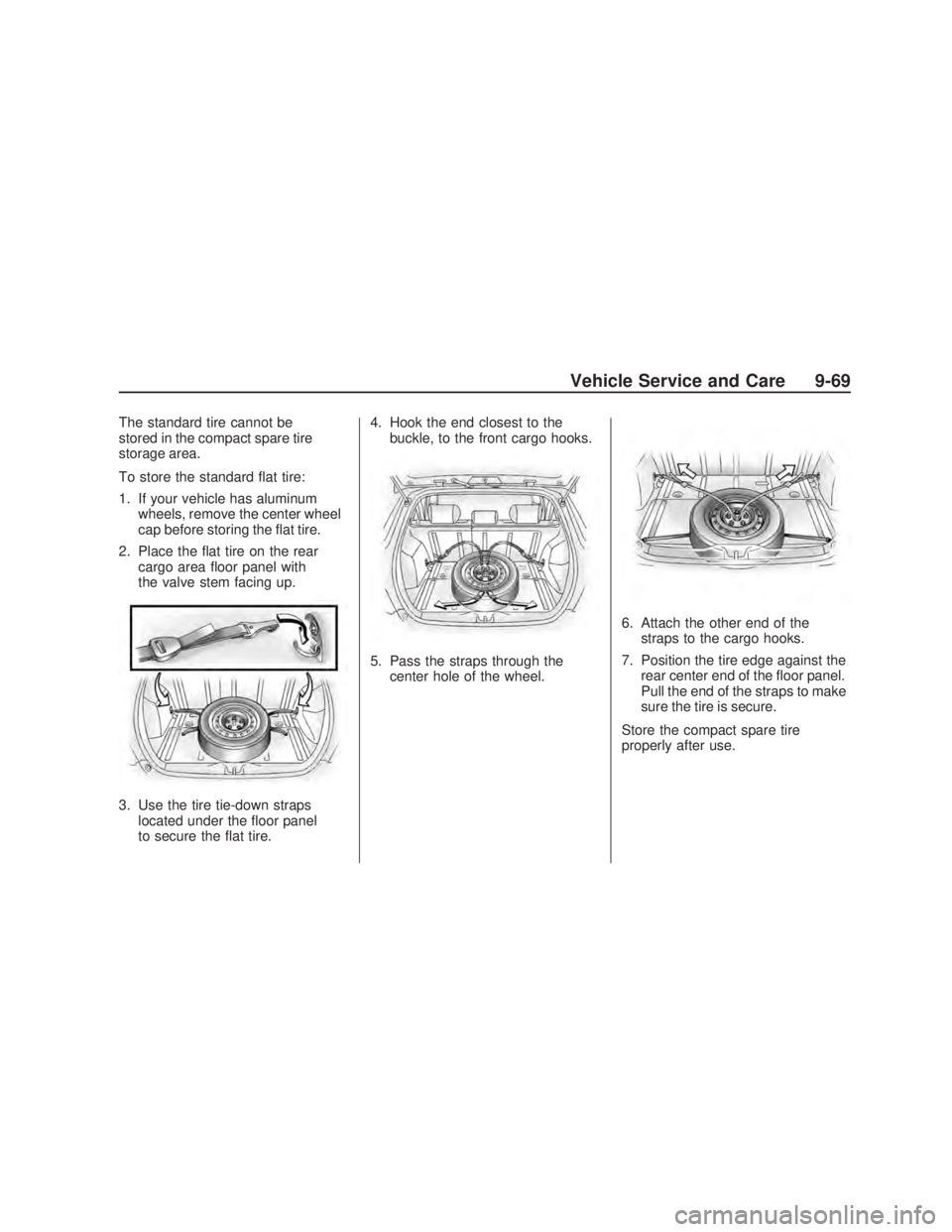
The standard tire cannot be
stored in the compact spare tire
storage area.
To store the standard at tire:
1. If your vehicle has aluminum
wheels, remove the center wheel
cap before storing the at tire.
2. Place the at tire on the rear
cargo area oor panel with
the valve stem facing up.
3. Use the tire tie-down straps
located under the oor panel
to secure the at tire.4. Hook the end closest to the
buckle, to the front cargo hooks.
5. Pass the straps through the
center hole of the wheel.6. Attach the other end of the
straps to the cargo hooks.
7. Position the tire edge against the
rear center end of the oor panel.
Pull the end of the straps to make
sure the tire is secure.
Store the compact spare tire
properly after use.
Vehicle Service and Care 9-69
2009 - Pontiac Vibe Owner Manual