2009 Peugeot 407 ESP
[x] Cancel search: ESPPage 101 of 250

7SAFETY
85
HORN
Press one of the spokes of the steering
wheel.
HAZARD WARNING LAMPS
Automatic lighting of hazard
warning lights *
When braking in an emergency, de-
pending on the deceleration, the hazard
warning lights come on automatically.
They switch off automatically the fi rst
time you accelerate.
It is also possible to switch them off by
pressing the button.
* According to country.
ELECTRONIC STABILITY CONTROL (ESP)
This system is linked and complemen-
tary to the ABS system.
In the event of a signifi cant variation
between the trajectory of the vehicle
and the path required by the driver,
the ESP monitors wheel by wheel and
acts automatically on the engine and
on the brake of one or more wheels, to
put the vehicle back on course, within
the limit of the laws of physics.
ESP operation The indicator light comes on. Disarming the ESP
In exceptional conditions (starting the
vehicle when it is stuck in the mud,
immobilised in snow, on unstable
ground...), it may be advisable to dis-
arm the ESP.
Press the "ESP OFF" switch, lo-
cated on the centre console.
The switch lights up and the warning
light comes on: the ESP no longer acts
on the operation of the engine.
Instrument panel indicator
light.
The system is triggered again:
automatically if the ignition is
switched off,
automatically above 30 mph (50 km/h),
manually by pressing the switch
again.
Press the button, the direction indicators
fl ash.
They can operate with the ignition off.
Page 102 of 250
7SAFETY
86
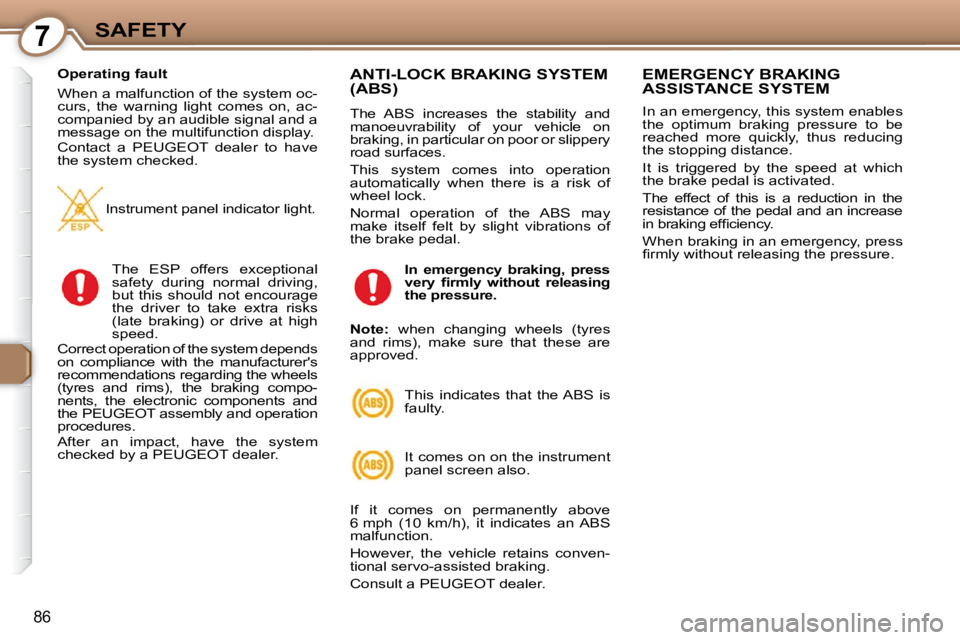
Operating fault
When a malfunction of the system oc-
curs, the warning light comes on, ac-
companied by an audible signal and a
message on the multifunction display.
Contact a PEUGEOT dealer to have
the system checked. Instrument panel indicator light.
The ESP offers exceptional
safety during normal driving,
but this should not encourage
the driver to take extra risks
(late braking) or drive at high
speed.
Correct operation of the system depends
on compliance with the manufacturer's
recommendations regarding the wheels
(tyres and rims), the braking compo-
nents, the electronic components and
the PEUGEOT assembly and operation
procedures.
After an impact, have the system
checked by a PEUGEOT dealer. ANTI-LOCK BRAKING SYSTEM (ABS)
The ABS increases the stability and
manoeuvrability of your vehicle on
braking, in particular on poor or slippery
road surfaces.
This system comes into operation
automatically when there is a risk of
wheel lock.
Normal operation of the ABS may
make itself felt by slight vibrations of
the brake pedal.
This indicates that the ABS is
faulty.
It comes on on the instrument
panel screen also.
If it comes on permanently above
6 mph (10 km/h), it indicates an ABS
malfunction.
However, the vehicle retains conven-
tional servo-assisted braking.
Consult a PEUGEOT dealer.
EMERGENCY BRAKING ASSISTANCE SYSTEM
In an emergency, this system enables
the optimum braking pressure to be
reached more quickly, thus reducing
the stopping distance.
It is triggered by the speed at which
the brake pedal is activated.
The effect of this is a reduction in the
resistance of the pedal and an increase
in braking effi ciency.
When braking in an emergency, press
fi rmly without releasing the pressure.
In emergency braking, press
very fi rmly without releasing
the pressure.
Note: when changing wheels (tyres
and rims), make sure that these are
approved.
Page 103 of 250

7SAFETY
86
Operating fault
When a malfunction of the system oc-
curs, the warning light comes on, ac-
companied by an audible signal and a
message on the multifunction display.
Contact a PEUGEOT dealer to have
the system checked. Instrument panel indicator light.
The ESP offers exceptional
safety during normal driving,
but this should not encourage
the driver to take extra risks
(late braking) or drive at high
speed.
Correct operation of the system depends
on compliance with the manufacturer's
recommendations regarding the wheels
(tyres and rims), the braking compo-
nents, the electronic components and
the PEUGEOT assembly and operation
procedures.
After an impact, have the system
checked by a PEUGEOT dealer. ANTI-LOCK BRAKING SYSTEM (ABS)
The ABS increases the stability and
manoeuvrability of your vehicle on
braking, in particular on poor or slippery
road surfaces.
This system comes into operation
automatically when there is a risk of
wheel lock.
Normal operation of the ABS may
make itself felt by slight vibrations of
the brake pedal.
This indicates that the ABS is
faulty.
It comes on on the instrument
panel screen also.
If it comes on permanently above
6 mph (10 km/h), it indicates an ABS
malfunction.
However, the vehicle retains conven-
tional servo-assisted braking.
Consult a PEUGEOT dealer.
EMERGENCY BRAKING ASSISTANCE SYSTEM
In an emergency, this system enables
the optimum braking pressure to be
reached more quickly, thus reducing
the stopping distance.
It is triggered by the speed at which
the brake pedal is activated.
The effect of this is a reduction in the
resistance of the pedal and an increase
in braking effi ciency.
When braking in an emergency, press
fi rmly without releasing the pressure.
In emergency braking, press
very fi rmly without releasing
the pressure.
Note: when changing wheels (tyres
and rims), make sure that these are
approved.
Page 108 of 250

7SAFETY
91
Front/rear * side air bags
The side air bags protect the driver and
passengers (with the exception of the
rear centre passenger) in the event of
a serious side impact in order to limit
the risks of injury to the chest.
Each side air bag is incorporated into
the front seat back and in the rear door
armrest * .
Activation
The side air bags are deployed inde-
pendently of each other in the event
of a serious side impact applied to all
or part of the side impact zone B , per-
pendicular to the longitudinal centre-
line of the vehicle on a horizontal plane
directed from the outside to the inside
of the vehicle.
The side air bag infl ates between the
front or rear occupant of the vehicle
and the corresponding door trim pad.
* According to country.
A. Front impact zone.
B. Side impact zone. Activation
It is deployed at the same time as the
corresponding side air bags in the event
of a serious side impact applied to all
or part of the side impact zone
B , per-
pendicular to the longitudinal centre-
line of the vehicle on a horizontal plane
directed from the outside to the inside
of the vehicle.
The curtain air bag infl ates between
the front or rear occupant of the vehicle
and the windows.
Impact detection zones
Curtain air bags
The curtain air bags protect the driver
and passengers (with the exception
of the rear centre passenger) in the
event of a serious side impact in order
to limit the risks of injury to the head.
Each curtain air bag is incorporated
into the door pillars and the upper part
of the passenger compartment.
In the event of a malfunction
Instrument panel warning light.
If this warning light comes on, accompa-
nied by an audible signal and a message
on the multifunction display, contact a
PEUGEOT dealer to have the system
checked. The air bags may no longer
be deployed in the event of a serious
impact. In the event of a minor impact
or bump to the side of the
vehicle or if the vehicle rolls
over, the air bag may not be
deployed.
In the event of a rear or front collision,
the air bag is not deployed.
Page 112 of 250

8DRIVING
94
Gear selection gate
Move the lever in the gate to select
a position.
The indicator light corresponding to the position selected appears on
the instrument panel screen.
P ark: to immobilise the vehicle and to
start the engine, with the handbrake on.
R everse: to reverse (select this position
with the vehicle stationary, engine at idle).
N eutral: to start the engine and to park,
with the handbrake on.
Note: if position N is inadvertently
engaged while driving, allow the engine to
return to idle before engaging position D
then accelerate.
D rive: to drive in automatic mode.
M anual: to drive selecting the gears.
S: sport programme.
: snow programme.
"PORSCHE TIPTRONIC SYSTEM" AUTOMATIC GEARBOX
The four or six speed automatic gearbox
offers, as required, the comfort of the
auto-adaptive programme enhanced
by a selection suited to dynamic driving
conditions: sport, or to driving on a
slippery road: snow.
However, manual selection is still possible
using the gear lever.
Moving Off
With the engine running, move off from
position P :
to exit position P, it is essential
to press the brake pedal,
select position R , D or M , then
gradually release the pressure on
the brake pedal; the vehicle moves
off immediately.
To move off from position N :
with your foot on the brake, release
the handbrake,
select position R , D or M , then
gradually release the pressure on
the brake pedal; the vehicle moves
off immediately.
Starting the engine
with the handbrake on, select position
P or N in the gate,
turn the ignition key. When the engine is at idle,
brakes not applied, if position
R , D or M is selected, the
vehicle moves even without the
accelerator being pressed.
Do not leave children unsupervised
inside the vehicle, with position
R, D or M selected, with the engine
running, as the vehicle moves
even without the accelerator being
pressed.
With the ignition off, if the
lever is not in position P , an
audible signal is heard when
the driver's door is opened, or
after approximately 45 seconds. Move
the lever to position P . The audible
signal ceases.
When maintenance operations need to
be carried out with the engine running,
apply the handbrake and select the
P ark position.
Page 115 of 250

8DRIVING
97
CRUISE CONTROL/SPEED LIMITER Selecting the function
Place switch 1 in the CRUISE
position. The cruise control is not
yet active and no speed has been
memorised. The display indicates:
Switching the function off
Place switch 1 in position 0 or
LIMIT to switch the system off.
Note: It is possible to acceler-
ate and drive momentarily at a
speed greater than the memo-
rised speed. The value memo-
rised fl ashes. When the accelerator
pedal is released, the vehicle will return
to the memorised speed.
Cancelling the memorised speed
If you wish to cancel the memorised
speed:
Press button 4 or the brake or
clutch pedal. The display indicates
(e.g. at 70 mph (110 km/h)):
Activation/memorising a speed
As soon as you reach the chosen speed,
press button 2 or 3 . This memorises the
speed, which will be maintained auto-
matically. The display indicates (e.g. at
70 mph (110 km/h)): On a steep descent, the cruise
control, which does not act on
the brakes, is not able to prevent
the vehicle from exceeding the
programmed speed.
In no circumstances does the cruise
control replace the requirement to
respect speed limits, nor does it replace
the need for vigilance and responsibility
on the part of the driver.
We recommend that your feet remain
near the pedals.
Cruise control function
This enables the vehicle to maintain
a steady speed programmed by the
driver.
In order for it to be memorised, the
vehicle speed must be greater than
25 mph (40 km/h) with at least fourth
gear engaged (second gear for the
automatic gearbox),
with the engine
running .
Page 116 of 250
8DRIVING
98
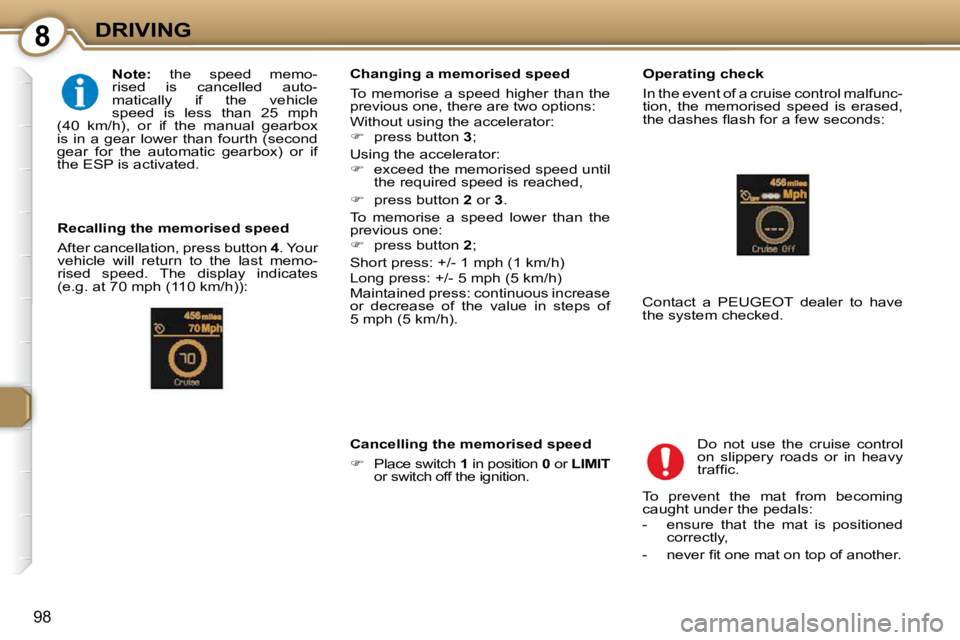
Note: the speed memo-
rised is cancelled auto-
matically if the vehicle
speed is less than 25 mph
(40 km/h), or if the manual gearbox
is in a gear lower than fourth (second
gear for the automatic gearbox) or if
the ESP is activated. Operating check
In the event of a cruise control malfunc-
tion, the memorised speed is erased,
the dashes fl ash for a few seconds:
Contact a PEUGEOT dealer to have
the system checked. Do not use the cruise control
on slippery roads or in heavy
traffi c.
To prevent the mat from becoming
caught under the pedals:
- ensure that the mat is positioned correctly,
- never fi t one mat on top of another.
Changing a memorised speed
To memorise a speed higher than the
previous one, there are two options:
Without using the accelerator:
press button 3 ;
Using the accelerator:
exceed the memorised speed until
the required speed is reached,
press button 2 or 3 .
To memorise a speed lower than the
previous one:
press button 2 ;
Short press: +/- 1 mph (1 km/h)
Long press: +/- 5 mph (5 km/h)
Maintained press: continuous increase
or decrease of the value in steps of
5 mph (5 km/h).
Recalling the memorised speed
After cancellation, press button
4 . Your
vehicle will return to the last memo-
rised speed. The display indicates
(e.g. at 70 mph (110 km/h)):
Cancelling the memorised speed
Place switch 1 in position 0 or LIMIT
or switch off the ignition.
Page 117 of 250

8DRIVING
99
Selecting the function
Place switch 1 in the LIMIT position.
The limiter is not yet active. By default
the display indicates:
Switching the function off
Place switch 1 in position 0 or
CRUISE or switch off the ignition
to switch the system off. The last
speed programmed remains in the
memory.
Memorising a speed
A speed can be memorised without
activation of the limiter.
Pressing buttons 2 and 3 decreases or
increases the speed.
Short press: +/- 1 mph (1 km/h)
Long press: +/- 5 mph (5 km/h)
Maintained press: continuous increase
or decrease of the value in steps of
5 mph (5 km/h). Activation/deactivation of the
limiter
Pressing button
4 activates the limiter,
pressing this button again deactivates it.
When the limiter is active, the display
indicates (e.g. at 70 mph (110 km/h)):
On a steep descent or if the
driver accelerates sharply, the
speed limiter, which does not
act on the brakes, is not able
to prevent the vehicle from exceeding
the programmed speed.
In no circumstances does the speed
limiter replace the requirement to respect
speed limits, nor does it replace the
need for vigilance and responsibility on
the part of the driver.
The driver must remain vigilant and
stay in complete control of his vehicle.
The operations must be car-
ried out with the engine run-
ning.
Limiter function
This prevents the vehicle speed
exceeding the speed programmed by
the driver (minimum speed of 18 mph
(30 km/h)).