Page 138 of 228
138
Driving and operating
high engine speed has been reached.
It shifts down in good time when
braking.
Manual mode
To utilise the engine braking effect,
select
a lower gear in good time when
driving downhill.
Rocking the vehicle
Rocking the vehicle is only
permissible if the vehicle is stuck in
sand, mud or snow. Move the selector
lever between R and A in a repeat
pattern. Do not race the engine and
avoid sudden acceleration.
Parking
Apply the hand brake. The most
recently engaged gear (see
transmission display) remains
engaged. With N, no gear is engaged.
When the ignition is switched off the
transmission no longer responds to
movement of the selector lever. Manual mode
If a higher gear is selected when the
engine speed is too low, or a lower
gear when the speed is too high, the
shift is not executed. This prevents
the engine from running at too low or
too high an engine speed.
If engine speed is too low, the
transmission automatically shifts to
a lower gear.
If engine speed is too high, the
transmission
only switches to a higher
gear via kickdown.
When + or - is selected in automatic
mode, the transmission switches to
manual mode and shifts accordingly.
Electronic driving
programmes
■ Following a cold start, the operating
temperature programme increases
engine speed to quickly bring the
catalytic converter to the required
temperature. ■ The adaptive programme tailors
gearshifting to the driving
conditions, e.g. greater load or
gradients.
■ When Sport
mode is engaged, shift
times are reduced and the
transmission shifts at higher engine
speeds (unless cruise control is
on). Sport mode 3 143.
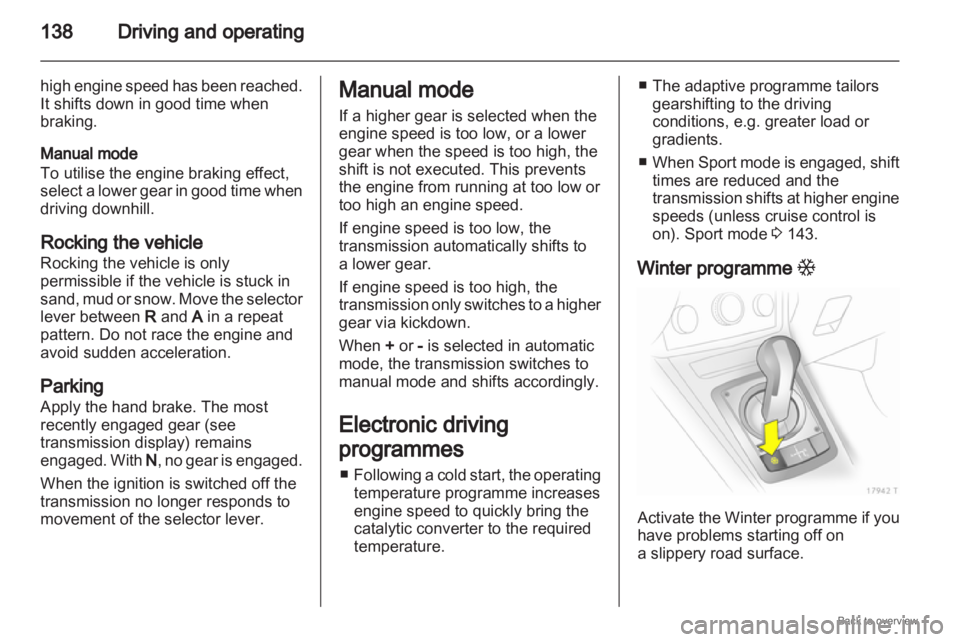
Winter programme T Activate the Winter programme if you
have problems starting off on
a slippery road surface.
Page 156 of 228
156
Vehicle care
Pull the release lever and return it to
its original position. Lift the safety catch upwards and
open the bonnet.
Air intake 3 125. Secure the bonnet support.
Closing
Before closing the bonnet, press the
support into the holder.
Lower
the bonnet and allow it to drop
into the catch. Check that the bonnet
is engaged.
Engine oil
Engine oil level is checked
automatically 3 91. It is advisable to
check the engine oil level manually
before embarking on a long journey. Check with the vehicle on a level
surface. The engine must be at
operating temperature and switched
off for at least 5 minutes.
Pull out the dipstick, wipe it clean,
insert
it to the stop on the handle, pull
out and read the engine oil level.
Insert dipstick to the stop on the
handle and make half a turn. Different dipsticks are used
depending on engine variant.
Page 161 of 228
Vehicle care
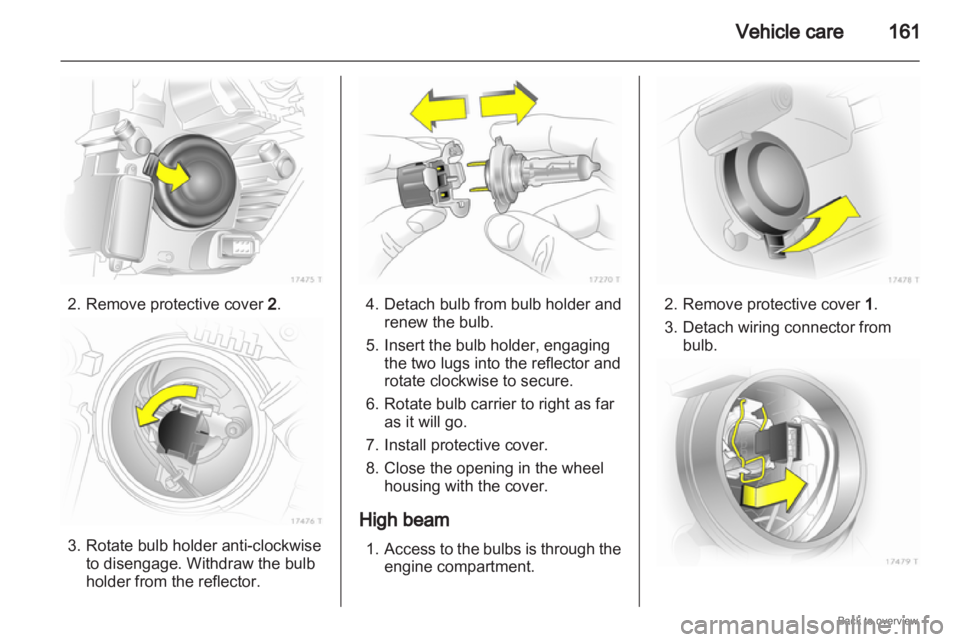
1612. Remove protective cover
2. 3. Rotate bulb holder anti-clockwise
to disengage. Withdraw the bulb
holder from the reflector. 4. Detach bulb from bulb holder and
renew the bulb.
5.
Insert the bulb holder, engagingthe two lugs into the reflector and
rotate clockwise to secure.
6. Rotate bulb carrier to right as far as it will go.
7. Install protective cover.
8. Close the opening in the wheel housing with the cover.
High beam 1. Access to the bulbs is through the engine compartment. 2. Remove protective cover
1.
3. Detach wiring connector frombulb.
Page 164 of 228
164
Vehicle care
3. Push bulb into socket slightly, rotate anti-clockwise, remove and
renew bulb.
4. Insert bulb holder in reflector, rotate clockwise to engage.
Fog lights
Have bulbs replaced by a workshop.
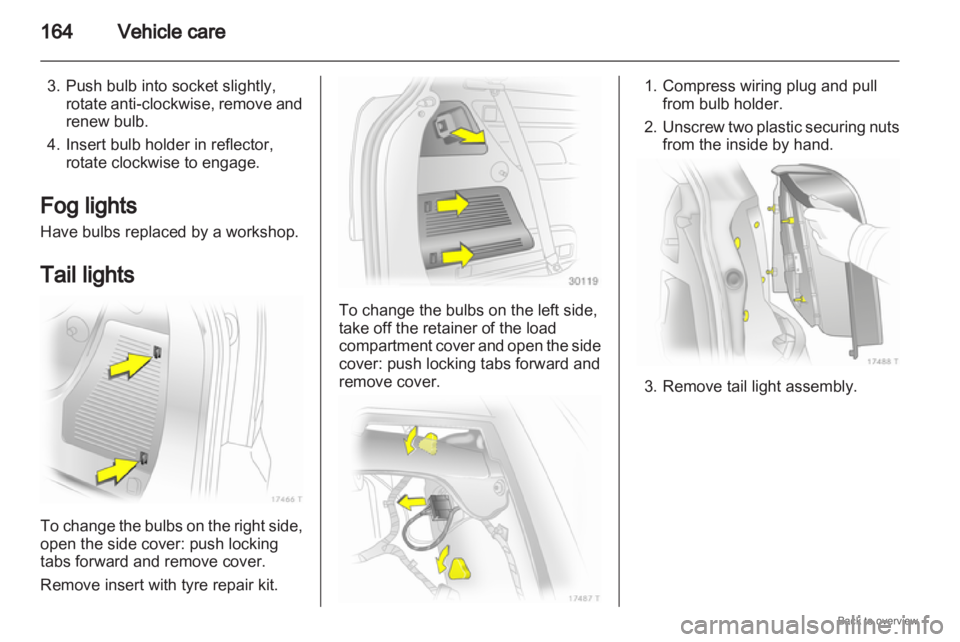
Tail lights To change the bulbs on the right side,
open the side cover: push locking
tabs forward and remove cover.
Remove insert with tyre repair kit. To change the bulbs on the left side,
take off the retainer of the load
compartment
cover and open the side
cover: push locking tabs forward and
remove cover. 1. Compress wiring plug and pull
from bulb holder.
2. Unscrew
two plastic securing nuts
from the inside by hand. 3. Remove tail light assembly.
Page 165 of 228
Vehicle care
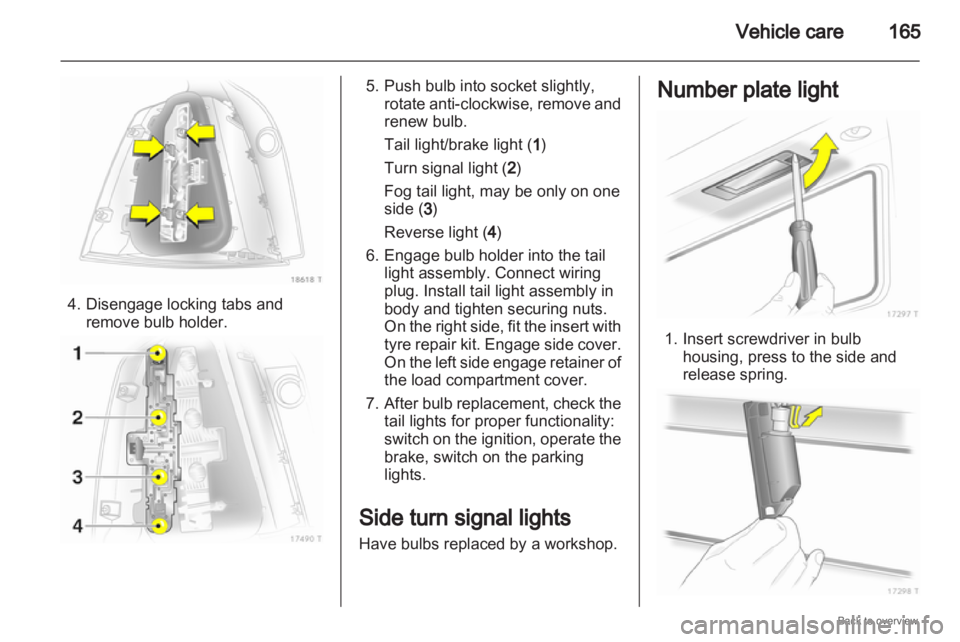
1654. Disengage locking tabs and
remove bulb holder. 5. Push bulb into socket slightly,
rotate anti-clockwise, remove and
renew bulb.
Tail light/brake light ( 1)
Turn signal light ( 2)
Fog tail light, may be only on one
side (3 )
Reverse light ( 4)
6. Engage bulb holder into the tail light assembly. Connect wiring
plug. Install tail light assembly in
body and tighten securing nuts.
On the right side, fit the insert with
tyre repair kit. Engage side cover.
On the left side engage retainer of
the load compartment cover.
7. After bulb replacement, check the tail lights for proper functionality:
switch on the ignition, operate the
brake, switch on the parking
lights.
Side turn signal lights
Have bulbs replaced by a workshop. Number plate light
1. Insert screwdriver in bulb
housing, press to the side and
release spring.
Page 174 of 228

174
Vehicle careThe jack and the vehicle tools are in
a pouch, secured to the stowage
compartment in the floor of the load
compartment with a rubber strap.
To close the lid, insert the lugs on its
front rim into the recesses and lock
into place. Wheels and tyres
Tyre condition, wheel condition
Drive over edges slowly and at right
angles if possible. Driving over sharp
edges can cause tyre and wheel
damage.
Do not trap tyres on the kerb
when parking.
Regularly check the wheels for
damage. Seek the assistance of
a workshop in the event of damage or
unusual wear.
Tyres
Tyres of size 225/45 R 17 are only
permitted if the vehicle is equipped
with electronic stability program.
Winter tyres
Winter tyres improve driving safety at
temperatures below 7 °C.
Tyres of size 225/40 R 18, 225/40 ZR
18 and 235/35 R 19 must not be used
as winter tyres. Winter tyres may only be used on the
Zafira OPC on special alloy wheels
approved by Opel.
Run-flat winter tyres may only be
used on factory approved alloy
wheels.
In accordance with country-specific
regulations, affix the speed sticker in
the driver's field of view.
Run-flat tyres
Run-flat tyres have reinforced, self-
supporting sidewalls, which ensure
that the tyres always have a certain
amount of driveability, even when
there is no pressure.
Run-flat tyres are only permitted on
vehicles with electronic stability
program
and tyre pressure monitoring
system or deflation detection system. Caution
Check tyre pressures regularly
even if run-flat tyres are fitted.
Page 182 of 228
182
Vehicle care
Wheel changing
Some vehicles are equipped with
a tyre repair kit instead of a spare
wheel 3 179.
Make the following preparations and
observe the following information: ■ Park
the vehicle on a level, firm and
non-skid surface. The front wheels
must be in the straight-ahead
position.
■ Apply the hand brake and engage first gear, reverse gear or P.
■ Remove the spare wheel 3 183.
■ Never change more than one wheel at once.
■ Use the jack only to change wheels.
■ If the ground on which the vehicle is standing is soft, a solid board
(max. 1 cm thick) should be placed
under the jack.
■ No people or animals may be in the vehicle when it is jacked up.
■ Never crawl under a jacked-up vehicle.
■ Do not start the vehicle when it is raised on the jack. ■ Before screwing in the wheel bolts,
clean them and lightly coat the
taper of each wheel bolt with
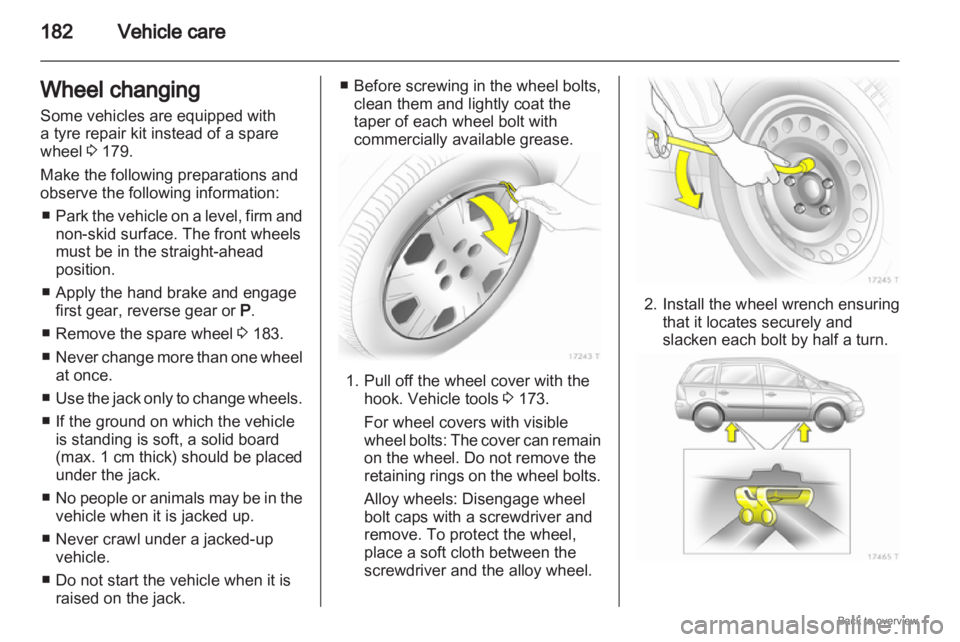
commercially available grease. 1. Pull off the wheel cover with the
hook. Vehicle tools 3 173.
For wheel covers with visible
wheel
bolts: The cover can remain
on the wheel. Do not remove the
retaining rings on the wheel bolts.
Alloy wheels: Disengage wheel
bolt caps with a screwdriver and
remove. To protect the wheel,
place a soft cloth between the
screwdriver and the alloy wheel. 2. Install the wheel wrench ensuring
that it locates securely and
slacken each bolt by half a turn.
Page 183 of 228

Vehicle care
183
3. Ensure the jack is positioned correctly with the vehicle jacking
points. 4. Set the jack to the necessary
height before positioning it directly
below the jacking point in
a manner that prevents it from
slipping. Attach jack handle and with the
jack correctly aligned rotate
handle until wheel is clear of the
ground.
5.
Unscrew the wheel bolts.
6. Change the wheel.
7. Screw in the wheel bolts.
8. Lower vehicle.
9. Install the wheel wrench ensuring that it locates securely and tighten
each bolt in a crosswise
sequence. Tightening torque is
110 Nm.
10. Align the valve hole in the wheel cover with the tyre valve before
installing. Install wheel bolt caps.
11.
Stow the replaced wheel 3 179
and the vehicle tools 3 173.
12. Check the tyre pressure of the installed tyre and also the wheel
bolt torque as soon as possible.
Have the defective tyre renewed or
repaired.
Spare wheel
The spare wheel can be classified as
a temporary spare wheel depending
on the size compared to the other
mounted wheels and country
regulations.
The spare wheel has a steel rim.
Use of a spare wheel that is smaller
than the other wheels or together with
winter tyres could affect driveability.
Have the defective tyre replaced as
soon as possible.