2009 NISSAN TIIDA width
[x] Cancel search: widthPage 1877 of 4331

EC
NP
O
This system is used when the engine is being started
and/or if the fail-safe system (CPU) is operating.
FUEL SHUT-OFF Fuel to each cylinder is cut off during deceleration, operation of the engine at excessively high speeds or oper-
ation of the vehicle at excessively high speeds.
Electronic Ignition (EI) System INFOID:0000000004537021
INPUT/OUTPUT SIGNAL CHART
*1: This signal is sent to the ECM through CAN communication line.
*2: ECM determines the start signal status by the signals of engine speed and battery voltage.
SYSTEM DESCRIPTION Firing order: 1 - 3 - 4 - 2
The ignition timing is controlled by the ECM to maintain the best air-fuel ratio for every running condition of the
engine. The ignition timing data is stored in the ECM.
The ECM receives information such as the injecti on pulse width and camshaft position sensor (PHASE) sig-
nal. Computing this information, ignition si gnals are transmitted to the power transistor.
During the following conditions, the ignition timing is revi sed by the ECM according to the other data stored in
the ECM.
• At starting
• During warm-up
• At idle
• At low battery voltage
• During acceleration
The knock sensor retard system is designed only for emergencies. The basic ignition timing is programmed
within the anti-knocking zone, if recommended fuel is used under dry conditions. The retard system does not
operate under normal driving conditions. If engine knocking occurs, the knock sensor monitors the condition.
The signal is transmitted to the ECM. The ECM retards the ignition timing to eliminate the knocking condition.
Fuel Cut Control (at No Load and High Engine Speed) INFOID:0000000004537022
INPUT/OUTPUT SIGNAL CHART Sensor Input Signal to ECM ECM function Actuator
Crankshaft position sensor (POS) Engine speed*2
Piston position
Ignition timing
control Power transistor
Camshaft position sensor (PHASE)
Mass air flow sensor Amount of intake air
Engine coolant temperature sensor Engine coolant temperature
Throttle position sensor Throttle position
Accelerator pedal position sensor Accelerator pedal position
Battery Battery voltage*2
Knock sensor Engine knocking
Park/neutral position (PNP) switch Gear position
ABS actuator and electric unit (control unit) Vehicle speed*1
Combination meter Sensor Input Signal to ECM ECM function Actuator
Park/neutral position (PNP) switch Neutral position
Fuel cut control Fuel injector
Accelerator pedal position sensor Accelerator pedal position
Engine coolant temperature sensor Engine coolant temperature
Crankshaft position sensor (POS)
Camshaft position sensor (PHASE) Engine speed
ABS actuator and electric unit (control unit) Vehicle speed*
Combination meter
Page 1964 of 4331
![NISSAN TIIDA 2009 Service Repair Manual Monitored item [Unit] Description Remarks
ENG SPEED
[rpm] • Indicates the engine speed computed from the signals of the
crankshaft position sensor (POS) and camshaft position sen-
sor (PHASE). •](/manual-img/5/57398/w960_57398-1963.png "NISSAN TIIDA 2009 Service Repair Manual Monitored item [Unit] Description Remarks
ENG SPEED
[rpm] • Indicates the engine speed computed from the signals of the
crankshaft position sensor (POS) and camshaft position sen-
sor (PHASE). •")
Monitored item [Unit] Description Remarks
ENG SPEED
[rpm] • Indicates the engine speed computed from the signals of the
crankshaft position sensor (POS) and camshaft position sen-
sor (PHASE). • Accuracy becomes poor if engine speed
drops below the idle rpm.
• If the signal is interrupted while the engine is running, an abnormal value may be indicat-
ed.
MAS A/F SE-B1
[V] • The signal voltage of the mass air flow sensor is displayed. • When the engine is stopped, a certain value
is indicated.
• When engine is running, specification range is indicated in "SPEC".
B/FUEL SCHDL
[msec] • “Base fuel schedule” indicates the fuel injection pulse width
programmed into ECM, prior to any learned on board correc-
tion. • When engine is running, specification range
is indicated in "SPEC".
A/F ALPHA-B1
[%] • The mean value of the air-fuel ratio feedback correction fac-
tor per cycle is indicated. • When the engine is stopped, a certain value
is indicated.
• This data also includes the data for the air/ fuel ratio learning control.
• When engine is running, specification range
is indicated in "SPEC".
COOLAN TEMP/S
[ ° C] or [ °F] • The engine coolant temperature (determined by the signal
voltage of the engine coolant temperature sensor) is dis-
played. • When the engine coolant temperature sen-
sor is open or short-circuited, ECM enters
fail-safe mode. The engine coolant temper-
ature determined by the ECM is displayed.
A/F SEN1 (B1)
[V] • The A/F signal computed from the input signal of the A/F sen-
sor 1 is displayed.
HO2S2 (B1)
[V] • The signal voltage of the heated oxygen sensor 2 is dis-
played.
HO2S2 MNTR (B1)
[RICH/LEAN] • Display of heated oxygen sensor 2 signal:
RICH: means the amount of oxygen after three way catalyst
is relatively small.
LEAN: means the amount of oxygen after three way catalyst
is relatively large. • When the engine is stopped, a certain value
is indicated.
VHCL SPEED SE
[km/h] or [mph] • The vehicle speed computed from the vehicle speed signal is
displayed.
BATTERY VOLT
[V] • The power supply voltage of ECM is displayed.
ACCEL SEN 1
[V] • The accelerator pedal position sensor signal voltage is dis-
played. • ACCEL SEN 2 signal is converted by ECM
internally. Thus, it differs from ECM terminal
voltage signal.
ACCEL SEN 2
[V]
TP SEN 1-B1
[V] • The throttle position sensor signal voltage is displayed. • TP SEN 2-B1 signal is converted by ECM in-
ternally. Thus, it differs from ECM terminal
voltage signal.
TP SEN 2-B1
[V]
Page 1965 of 4331
![NISSAN TIIDA 2009 Service Repair Manual EC
NP
O
FUEL T/TMP SE
[ ° C] or [ °F] • The fuel temperature (determined by the signal voltage of the
fuel tank temperature sensor) is displayed.
INT/A TEMP SE
[ ° C] or [ °F] • The intake ai](/manual-img/5/57398/w960_57398-1964.png "NISSAN TIIDA 2009 Service Repair Manual EC
NP
O
FUEL T/TMP SE
[ ° C] or [ °F] • The fuel temperature (determined by the signal voltage of the
fuel tank temperature sensor) is displayed.
INT/A TEMP SE
[ ° C] or [ °F] • The intake ai")
EC
NP
O
FUEL T/TMP SE
[ ° C] or [ °F] • The fuel temperature (determined by the signal voltage of the
fuel tank temperature sensor) is displayed.
INT/A TEMP SE
[ ° C] or [ °F] • The intake air temperature (determined by the signal voltage
of the intake air temperature sensor) is indicated.
EVAP SYS PRES
[V] • The signal voltage of EVAP control system pressure sensor
is displayed.
FUEL LEVEL SE
[V] • The signal voltage of the fuel level sensor is displayed.
START SIGNAL
[ON/OFF] • Indicates start signal status [ON/OFF] computed by the ECM
according to the signals of engine speed and battery voltage. • After starting the engine, [OFF] is displayed
regardless of the starter signal.
CLSD THL POS
[ON/OFF] • Indicates idle position [ON/OFF] computed by the ECM ac-
cording to the accelerator pedal position sensor signal.
AIR COND SIG
[ON/OFF] • Indicates [ON/OFF] condition of the air conditioner switch as
determined by the air conditioner signal.
P/N POSI SW
[ON/OFF] • Indicates [ON/OFF] condition from the park/neutral position
(PNP) switch signal.
PW/ST SIGNAL
[ON/OFF] • [ON/OFF] condition of the power steering system (deter-
mined by the signal sent from EPS control unit) is indicated.
LOAD SIGNAL
[ON/OFF] • Indicates [ON/OFF] condition from the electrical load signal.
ON: Rear window defogger switch is ON and/or lighting
switch is in 2nd position.
OFF: Both rear window defogger switch and lighting switch
are OFF.
IGNITION SW
[ON/OFF] • Indicates [ON/OFF] condition from ignition switch.
HEATER FAN SW
[ON/OFF] • Indicates [ON/OFF] condition from the heater fan switch sig-
nal.
BRAKE SW
[ON/OFF] • Indicates [ON/OFF] condition from the stop lamp switch sig-
nal.
INJ PULSE-B1
[msec] • Indicates the actual fuel injection pulse width compensated
by ECM according to the input signals. • When the engine is stopped, a certain com-
puted value is indicated.
IGN TIMING
[BTDC] • Indicates the ignition timing computed by ECM according to
the input signals. • When the engine is stopped, a certain value
is indicated.
CAL/LD VALUE
[%] • “Calculated load value” indicates the value of the current air-
flow divided by peak airflow.
MASS AIRFLOW
[g·m/s] • Indicates the mass airflow computed by ECM according to
the signal voltage of the mass air flow sensor.
PURG VOL C/V
[%] • Indicates the EVAP canister purge volume control solenoid
valve control value computed by the ECM according to the in-
put signals.
• The opening becomes larger as the value increases.
INT/V TIM (B1)
[ ° CA] • Indicates [
°CA] of intake camshaft advanced angle.
INT/V SOL (B1)
[%] • The control value of the intake valve timing control solenoid
valve (determined by ECM according to the input signal) is in-
dicated.
• The advance angle becomes larger as the value increases
AIR COND RLY
[ON/OFF] • The air conditioner relay control condition (determined by
ECM according to the input signals) is indicated.
FUEL PUMP RLY
[ON/OFF] • Indicates the fuel pump relay control condition determined by
ECM according to the input signals.
Monitored item [Unit] Description Remarks
Page 2385 of 4331
![NISSAN TIIDA 2009 Service Repair Manual ENGINE CONTROL SYSTEM
EC-1029
< SERVICE INFOMATION >
[MR TYPE 2] C
D E
F
G H
I
J
K L
M A EC
NP
O
The mixture ratio feedback system provides the best air/
fuel mixture ratio for drivability and emissio](/manual-img/5/57398/w960_57398-2384.png "NISSAN TIIDA 2009 Service Repair Manual ENGINE CONTROL SYSTEM
EC-1029
< SERVICE INFOMATION >
[MR TYPE 2] C
D E
F
G H
I
J
K L
M A EC
NP
O
The mixture ratio feedback system provides the best air/
fuel mixture ratio for drivability and emissio")
ENGINE CONTROL SYSTEM
EC-1029
< SERVICE INFOMATION >
[MR TYPE 2] C
D E
F
G H
I
J
K L
M A EC
NP
O
The mixture ratio feedback system provides the best air/
fuel mixture ratio for drivability and emission control.
The three way catalyst (manifold) can then better r educe CO, HC and NOx emissions. This system uses air
fuel ratio (A/F) sensor 1 in the exhaust manifold to monitor whether the engine operation is rich or lean. The
ECM adjusts the injection pulse width according to the sensor voltage signal. For more information about air
fuel ratio (A/F) sensor 1, refer to EC-1210 . This maintains the mixture ratio within the range of stoichiometric
(ideal air/fuel mixture).
This stage is referred to as the closed loop control condition.
Heated oxygen sensor 2 is located downstream of the th ree way catalyst (manifold). Even if the switching
characteristics of air fuel ratio (A/F) sensor 1 shift, the air/fuel ratio is controlled to stoichiometric by the signal
from heated oxygen sensor 2.
Open Loop Control The open loop system condition refers to when the ECM detects any of the following conditions. Feedback
control stops in order to maintain stabilized fuel combustion.
• Deceleration and acceleration
• High-load, high-speed operation
• Malfunction of air fuel ratio (A/F) sensor 1 or its circuit
• Insufficient activation of air fuel ratio (A /F) sensor 1 at low engine coolant temperature
• High engine coolant temperature
• During warm-up
• After shifting from N to D (A/T and CVT models)
• When starting the engine
MIXTURE RATIO SELF-LEARNING CONTROL The mixture ratio feedback control system monitors the mixture ratio signal transmitted from air fuel ratio (A/F)
sensor 1. This feedback signal is then sent to the ECM. The ECM controls the basic mixture ratio as close to
the theoretical mixture ratio as possible. However, the bas ic mixture ratio is not necessarily controlled as orig-
inally designed. Both manufacturing differences (i.e., mass air flow sensor hot wire) and characteristic
changes during operation (i.e., fuel injector clogging) directly affect mixture ratio.
Accordingly, the difference between the basic and theoretical mixture ratios is monitored in this system. This is
then computed in terms of “injection pulse duration” to automatically compensate for the difference between
the two ratios.
“Fuel trim” refers to the feedback compensation value co mpared against the basic injection duration. Fuel trim
includes short term fuel trim and long term fuel trim.
“Short term fuel trim” is the short-term fuel compensati on used to maintain the mixture ratio at its theoretical
value. The signal from air fuel ratio (A/F) sensor 1 i ndicates whether the mixture ratio is RICH or LEAN com-
pared to the theoretical value. The signal then triggers a r eduction in fuel volume if the mixture ratio is rich, and
an increase in fuel volume if it is lean.
“Long term fuel trim” is overall fuel compensation ca rried out long-term to compensate for continual deviation
of the short term fuel trim from the central value. Such deviation will occur due to individual engine differences,
wear over time and changes in the usage environment.
FUEL INJECTION TIMING
Two types of systems are used.
Sequential Multiport Fuel Injection System
Fuel is injected into each cylinder during each engine cycl e according to the firing order. This system is used
when the engine is running.
Simultaneous Multiport Fuel Injection System Fuel is injected simultaneously into all four cylinders twice each engine cycle. In other words, pulse signals of
the same width are simultaneously transmitted from the ECM.
The four fuel injectors will then receive the signals two times for each engine cycle. SEF337W
Page 2476 of 4331
![NISSAN TIIDA 2009 Service Repair Manual Monitored item [Unit] Description Remarks
ENG SPEED
[rpm] • Indicates the engine speed computed from the signals of the
crankshaft position sensor (POS) and camshaft position sen-
sor (PHASE). •](/manual-img/5/57398/w960_57398-2475.png "NISSAN TIIDA 2009 Service Repair Manual Monitored item [Unit] Description Remarks
ENG SPEED
[rpm] • Indicates the engine speed computed from the signals of the
crankshaft position sensor (POS) and camshaft position sen-
sor (PHASE). •")
Monitored item [Unit] Description Remarks
ENG SPEED
[rpm] • Indicates the engine speed computed from the signals of the
crankshaft position sensor (POS) and camshaft position sen-
sor (PHASE). • Accuracy becomes poor if engine speed
drops below the idle rpm.
• If the signal is interrupted while the engine is running, an abnormal value may be indicat-
ed.
MAS A/F SE-B1
[V] • The signal voltage of the mass air flow sensor is displayed. • When the engine is stopped, a certain value
is indicated.
• When engine is running, specification range is indicated in "SPEC".
B/FUEL SCHDL
[msec] • “Base fuel schedule” indicates the fuel injection pulse width
programmed into ECM, prior to any learned on board correc-
tion. • When engine is running, specification range
is indicated in "SPEC".
A/F ALPHA-B1
[%] • The mean value of the air-fuel ratio feedback correction fac-
tor per cycle is indicated. • When the engine is stopped, a certain value
is indicated.
• This data also includes the data for the air/ fuel ratio learning control.
• When engine is running, specification range
is indicated in "SPEC".
COOLAN TEMP/S
[ ° C] or [ °F] • The engine coolant temperature (determined by the signal
voltage of the engine coolant temperature sensor) is dis-
played. • When the engine coolant temperature sen-
sor is open or short-circuited, ECM enters
fail-safe mode. The engine coolant temper-
ature determined by the ECM is displayed.
A/F SEN1 (B1)
[V] • The A/F signal computed from the input signal of the A/F sen-
sor 1 is displayed.
HO2S2 (B1)
[V] • The signal voltage of the heated oxygen sensor 2 is dis-
played.
HO2S2 MNTR (B1)
[RICH/LEAN] • Display of heated oxygen sensor 2 signal:
RICH: means the amount of oxygen after three way catalyst
is relatively small.
LEAN: means the amount of oxygen after three way catalyst
is relatively large. • When the engine is stopped, a certain value
is indicated.
VHCL SPEED SE
[km/h] or [mph] • The vehicle speed computed from the vehicle speed signal is
displayed.
BATTERY VOLT
[V] • The power supply voltage of ECM is displayed.
ACCEL SEN 1
[V] • The accelerator pedal position sensor signal voltage is dis-
played. • ACCEL SEN 2 signal is converted by ECM
internally. Thus, it differs from ECM terminal
voltage signal.
ACCEL SEN 2
[V]
TP SEN 1-B1
[V] • The throttle position sensor signal voltage is displayed. • TP SEN 2-B1 signal is converted by ECM in-
ternally. Thus, it differs from ECM terminal
voltage signal.
TP SEN 2-B1
[V]
Page 2477 of 4331
![NISSAN TIIDA 2009 Service Repair Manual EC
NP
O
FUEL T/TMP SE
[ ° C] or [ °F] • The fuel temperature (determined by the signal voltage of the
fuel tank temperature sensor) is displayed.
INT/A TEMP SE
[ ° C] or [ °F] • The intake ai](/manual-img/5/57398/w960_57398-2476.png "NISSAN TIIDA 2009 Service Repair Manual EC
NP
O
FUEL T/TMP SE
[ ° C] or [ °F] • The fuel temperature (determined by the signal voltage of the
fuel tank temperature sensor) is displayed.
INT/A TEMP SE
[ ° C] or [ °F] • The intake ai")
EC
NP
O
FUEL T/TMP SE
[ ° C] or [ °F] • The fuel temperature (determined by the signal voltage of the
fuel tank temperature sensor) is displayed.
INT/A TEMP SE
[ ° C] or [ °F] • The intake air temperature (determined by the signal voltage
of the intake air temperature sensor) is indicated.
EVAP SYS PRES
[V] • The signal voltage of EVAP control system pressure sensor
is displayed.
FUEL LEVEL SE
[V] • The signal voltage of the fuel level sensor is displayed.
START SIGNAL
[ON/OFF] • Indicates start signal status [ON/OFF] computed by the ECM
according to the signals of engine speed and battery voltage. • After starting the engine, [OFF] is displayed
regardless of the starter signal.
CLSD THL POS
[ON/OFF] • Indicates idle position [ON/OFF] computed by the ECM ac-
cording to the accelerator pedal position sensor signal.
AIR COND SIG
[ON/OFF] • Indicates [ON/OFF] condition of the air conditioner switch as
determined by the air conditioner signal.
P/N POSI SW
[ON/OFF] • Indicates [ON/OFF] condition from the park/neutral position
(PNP) switch signal.
PW/ST SIGNAL
[ON/OFF] • [ON/OFF] condition of the power steering system (deter-
mined by the signal sent from EPS control unit) is indicated.
LOAD SIGNAL
[ON/OFF] • Indicates [ON/OFF] condition from the electrical load signal.
ON: Rear window defogger switch is ON and/or lighting
switch is in 2nd position.
OFF: Both rear window defogger switch and lighting switch
are OFF.
IGNITION SW
[ON/OFF] • Indicates [ON/OFF] condition from ignition switch.
HEATER FAN SW
[ON/OFF] • Indicates [ON/OFF] condition from the heater fan switch sig-
nal.
BRAKE SW
[ON/OFF] • Indicates [ON/OFF] condition from the stop lamp switch sig-
nal.
INJ PULSE-B1
[msec] • Indicates the actual fuel injection pulse width compensated
by ECM according to the input signals. • When the engine is stopped, a certain com-
puted value is indicated.
IGN TIMING
[BTDC] • Indicates the ignition timing computed by ECM according to
the input signals. • When the engine is stopped, a certain value
is indicated.
CAL/LD VALUE
[%] • “Calculated load value” indicates the value of the current air-
flow divided by peak airflow.
MASS AIRFLOW
[g·m/s] • Indicates the mass airflow computed by ECM according to
the signal voltage of the mass air flow sensor.
PURG VOL C/V
[%] • Indicates the EVAP canister purge volume control solenoid
valve control value computed by the ECM according to the in-
put signals.
• The opening becomes larger as the value increases.
INT/V TIM (B1)
[ ° CA] • Indicates [
°CA] of intake camshaft advanced angle.
INT/V SOL (B1)
[%] • The control value of the intake valve timing control solenoid
valve (determined by ECM according to the input signal) is in-
dicated.
• The advance angle becomes larger as the value increases
AIR COND RLY
[ON/OFF] • The air conditioner relay control condition (determined by
ECM according to the input signals) is indicated.
FUEL PUMP RLY
[ON/OFF] • Indicates the fuel pump relay control condition determined by
ECM according to the input signals.
Monitored item [Unit] Description Remarks
Page 2521 of 4331
![NISSAN TIIDA 2009 Service Repair Manual DTC P0075 IVT CONTROL SOLENOID VALVE
EC-1165
< SERVICE INFOMATION >
[MR TYPE 2] C
D E
F
G H
I
J
K L
M A EC
NP
O
DTC P0075 IVT CONTROL SOLENOID VALVE
Component Description INFOID:0000000004499990
Intak](/manual-img/5/57398/w960_57398-2520.png "NISSAN TIIDA 2009 Service Repair Manual DTC P0075 IVT CONTROL SOLENOID VALVE
EC-1165
< SERVICE INFOMATION >
[MR TYPE 2] C
D E
F
G H
I
J
K L
M A EC
NP
O
DTC P0075 IVT CONTROL SOLENOID VALVE
Component Description INFOID:0000000004499990
Intak")
DTC P0075 IVT CONTROL SOLENOID VALVE
EC-1165
< SERVICE INFOMATION >
[MR TYPE 2] C
D E
F
G H
I
J
K L
M A EC
NP
O
DTC P0075 IVT CONTROL SOLENOID VALVE
Component Description INFOID:0000000004499990
Intake valve timing control solenoid valve is activated by ON/OFF
pulse duty (ratio) signals from the ECM.
The intake valve timing control solenoid valve changes the oil
amount and direction of flow through intake valve timing control unit
or stops oil flow.
The longer pulse width advances valve angle.
The shorter pulse width retards valve angle.
When ON and OFF pulse widths become equal, the solenoid valve
stops oil pressure flow to fix the intake valve angle at the control
position.
CONSULT-III Reference Val ue in Data Monitor Mode INFOID:0000000004499991
Specification data are reference values.
On Board Diagnosis Logic INFOID:0000000004499992
DTC Confirmation Procedure INFOID:0000000004499993
NOTE:
If DTC Confirmation Procedure h as been previously conducted, alw ays turn ignition switch OFF and
wait at least 10 seconds before conducting the next test.
1. Start engine and let it idle for 5 seconds.
2. Check 1st trip DTC.
3. If 1st trip DTC is detected, go to EC-1167, " Diagnosis Procedure " . PBIB1842E
MONITOR ITEM CONDITION SPECIFICATION
INT/V SOL (B1) • Engine: After warming up
• Air conditioner switch: OFF
• Shift lever: P or N (A/T, CVT), Neu-
tral (M/T)
• No load Idle 0% - 2%
When revving engine up to 2,000 rpm
quickly Approx. 0% - 90%DTC No. Trouble diagnosis name DTC detecting condition Possible cause
P0075
0075 Intake valve timing control
solenoid valve circuit An improper voltage is sent to the ECM
through intake valve timing control solenoid
valve. • Harness or connectors
(Intake valve timing control solenoid valve
circuit is open or shorted.)
• Intake valve timing control solenoid valve
Page 3055 of 4331
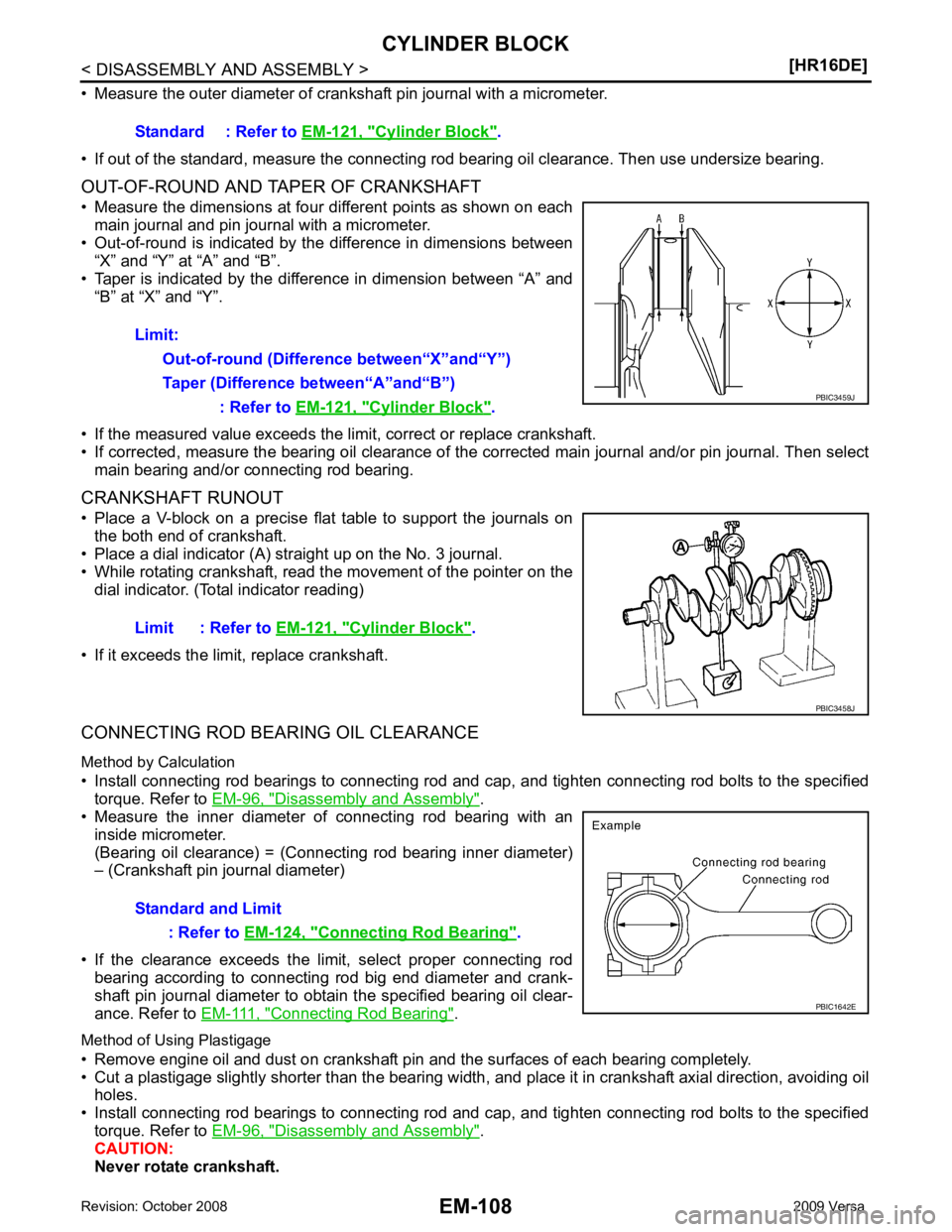
Disassembly and Assembly " .
• Measure the inner diameter of connecting rod bearing with an
inside micrometer.
(Bearing oil clearance) = (Connecting rod bearing inner diameter)
– (Crankshaft pin journal diameter)
• If the clearance exceeds the limit, select proper connecting rod bearing according to connecting rod big end diameter and crank-
shaft pin journal diameter to obtain the specified bearing oil clear-
ance. Refer to EM-111, " Connecting Rod Bearing " .
Method of Using Plastigage
• Remove engine oil and dust on crankshaft pin and the surfaces of each bearing completely.
• Cut a plastigage slightly shorter than the bearing width, and place it in crankshaft axial direction, avoiding oil
holes.
• Install connecting rod bearings to connecting rod and c ap, and tighten connecting rod bolts to the specified
torque. Refer to EM-96, " Disassembly and Assembly " .
CAUTION:
Never rotate crankshaft. Standard : Refer to
EM-121, " Cylinder Block " .
Limit: Out-of-round (Difference between“X”and“Y”)
Taper (Difference between“A”and“B”) : Refer to EM-121, " Cylinder Block " .
Cylinder Block " .
Connecting Rod Bearing " .