2009 NISSAN TIIDA O2 SENSOR
[x] Cancel search: O2 SENSORPage 864 of 4331
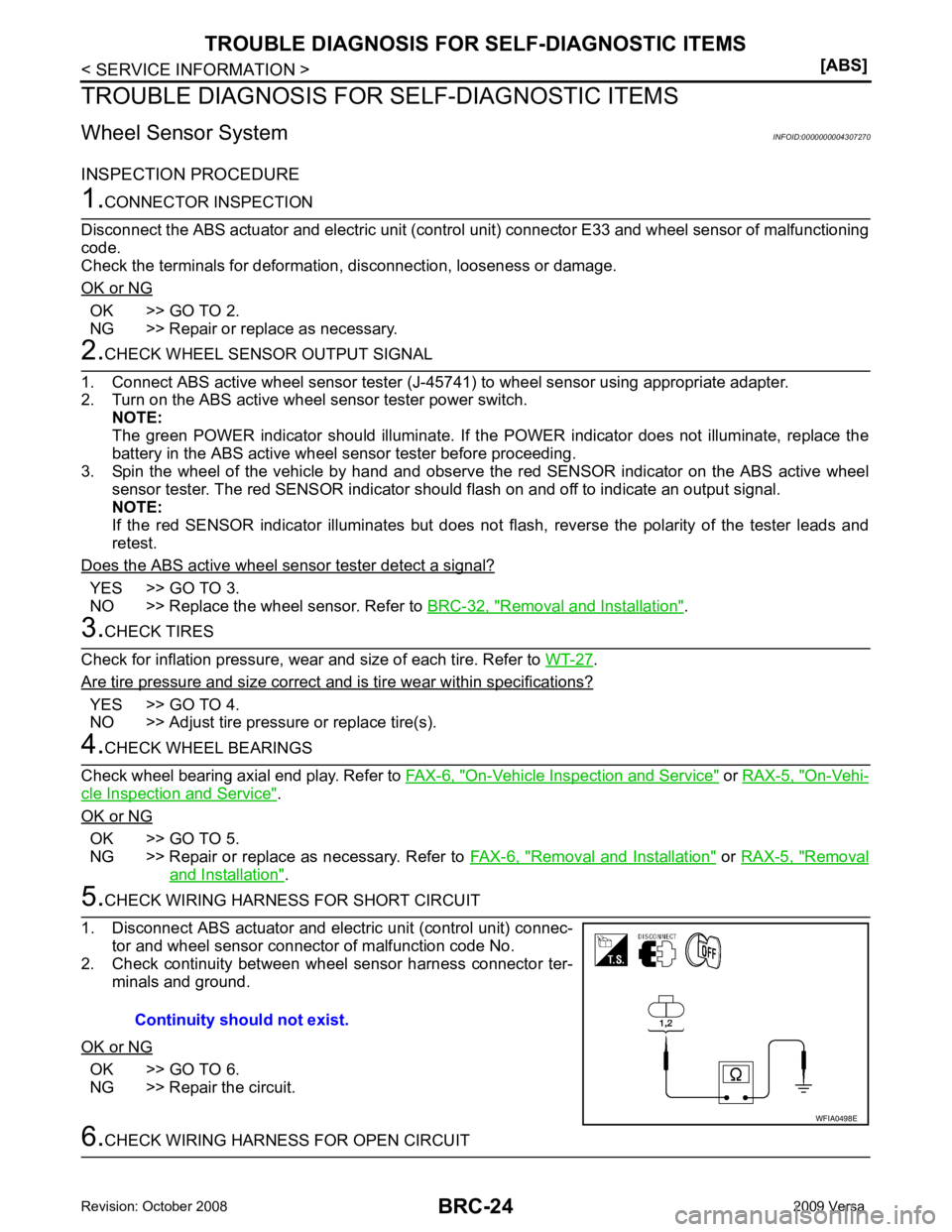
OK >> GO TO 2.
NG >> Repair or replace as necessary. YES >> GO TO 3.
NO >> Replace the wheel sensor. Refer to BRC-32, " Removal and Installation " .
.
Are tire pressure and size correct and is tire wear within specifications? YES >> GO TO 4.
NO >> Adjust tire pressure or replace tire(s). On-Vehicle Inspection and Service " or
RAX-5, " On-Vehi-
cle Inspection and Service " .
OK or NG OK >> GO TO 5.
NG >> Repair or replace as necessary. Refer to FAX-6, " Removal and Installation " or
RAX-5, " Removal
and Installation " .
OK >> GO TO 6.
NG >> Repair the circuit.
Page 865 of 4331

BRC
N
O P
Check continuity between ABS actuator and electric
unit (control unit) harness connector and wheel sensor
harness connector.
OK or NG OK >> Replace the ABS actuator and electric unit (control unit). Refer to
BRC-35, " Removal and Installa-
tion " .
NG >> Repair the circuit.
ABS Control Unit Inspection INFOID:0000000004307271
INSPECTION PROCEDURE YES >> Replace ABS actuator and electr
ic unit (control unit). Refer to BRC-35, " Removal and Installa-
tion " .
NO >> Inspection End.
Solenoid Valve System Inspection INFOID:0000000004307272
INSPECTION PROCEDURE YES >> GO TO 2.
NO >> Inspection End. Wheel sensor
ABS actuator and
electric unit (control unit) Wheel sensor
Continuity
Connector Terminals Connector Terminals
Front LH
E335
E51 1
Yes
16 2
Front RH 10
E52 1
9 2
Rear LH 17
B123 1
6 2
Rear RH 19
B124 1
8 2 Self-diagnosis results
CONTROLLER FAILURE Self-diagnosis results
FR LH IN ABS SOL
FR LH OUT ABS SOL FR RH IN ABS SOL
FR RH OUT ABS SOL RR LH IN ABS SOL
RR LH OUT ABS SOL RR RH IN ABS SOL
RR RH OUT ABS SOL
Page 872 of 4331
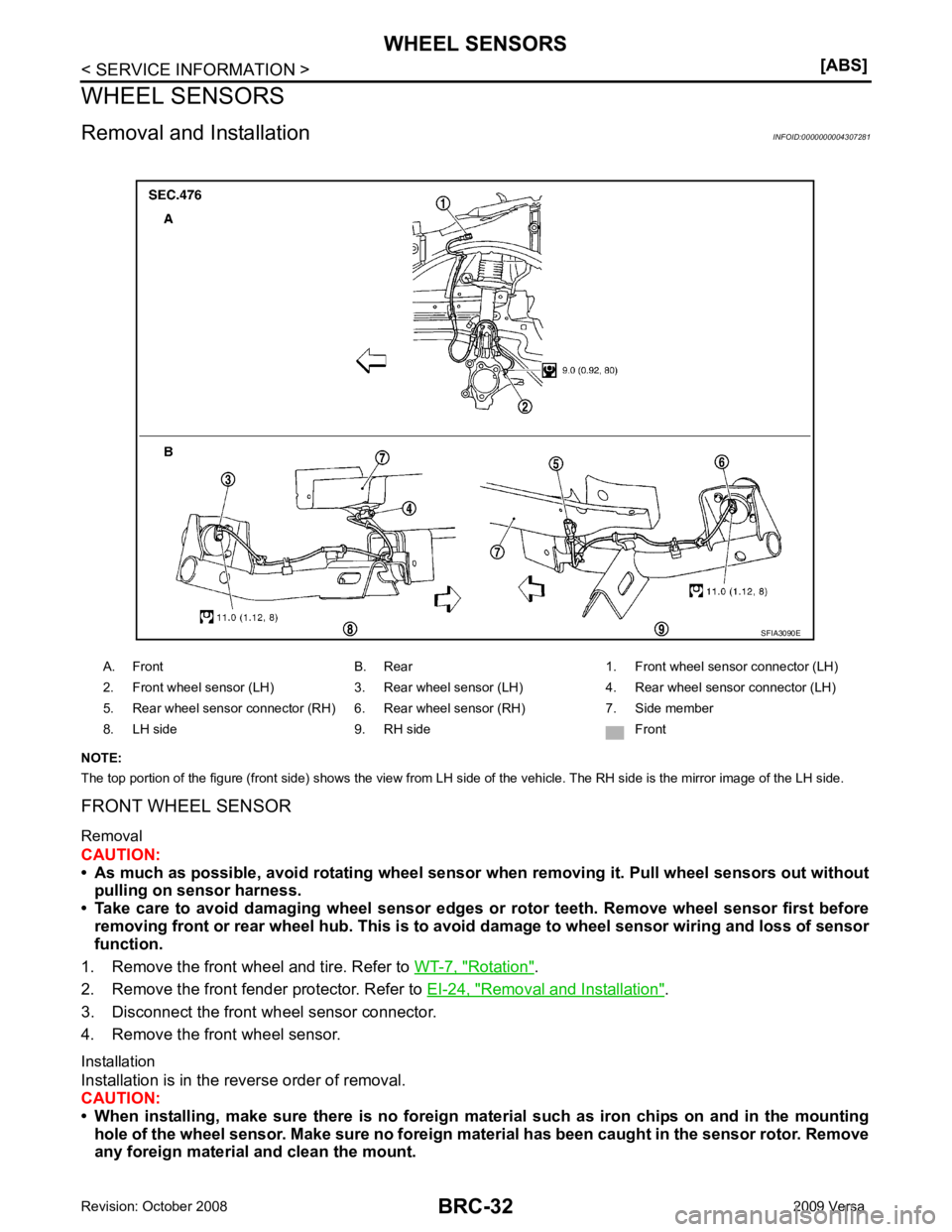
Rotation " .
2. Remove the front fender protector. Refer to EI-24, " Removal and Installation " .
3. Disconnect the front wheel sensor connector.
4. Remove the front wheel sensor.
Installation
Installation is in the reverse order of removal.
CAUTION:
• When installing, make sure there is no foreign material such as iron chips on and in the mounting
hole of the wheel sensor. Make sure no foreign material has been caught in the sensor rotor. Remove
any foreign material and clean the mount. A. Front B. Rear 1. Front wheel sensor connector (LH)
2. Front wheel sensor (LH) 3. Rear wheel sensor (LH) 4. Rear wheel sensor connector (LH)
5. Rear wheel sensor connector (RH) 6. Rear wheel sensor (RH) 7. Side member
8. LH side 9. RH side Front
Page 873 of 4331

BRC
N
O P
• When installing front wheel sensor, press rubber gr
ommets of strut bracket and body all the way in
until they get locked, and be careful not to apply a twist to harness. Harness should not be twisted
after installation. (Install it with harness paint ma rk on body side grommet facing front of vehicle,
and the strut side grommet facing outside of vehicle.)
REAR WHEEL SENSOR
Removal CAUTION:
• As much as possible, avoid rotati ng wheel sensor when removing it. Pull wheel sensors out without
pulling on sensor harness.
• Take care to avoid damaging wheel sensor edges or rotor teeth. Remove wheel sensor first before
removing front or rear wheel hub. This is to avo id damage to wheel sensor wiring and loss of sensor
function.
1. Disconnect the rear wheel sensor connector.
2. Remove the rear wheel sensor.
Installation Installation is in the reverse order of removal.
CAUTION:
• When installing, make sure there is no foreign mate rial such as iron chips on and in the mounting
hole of the wheel sensor. Make sure no foreign material has been caught in the sensor rotor. Remove
any foreign material and clean the mount.
• When installing rear wheel sensor, press rubber grommets of suspension arm bracket and harness
of side member all the way in until they get locked , and be careful not to apply a twist to harness.
Harness should not be twisted after installati on. (Aim the paint mark upward of vehicle.)
Page 878 of 4331
CL-2< SERVICE INFORMATION >
PRECAUTIONS
SERVICE INFORMATION
PRECAUTIONS
Precaution for Supplemental Restraint Syst em (SRS) "AIR BAG" and "SEAT BELT
PRE-TENSIONER" INFOID:0000000004802358
The Supplemental Restraint System such as “A IR BAG” and “SEAT BELT PRE-TENSIONER”, used along
with a front seat belt, helps to reduce the risk or severi ty of injury to the driver and front passenger for certain
types of collision. This system includes seat belt switch inputs and dual stage front air bag modules. The SRS
system uses the seat belt switches to determine the front air bag deployment, and may only deploy one front
air bag, depending on the severity of a collision and w hether the front occupants are belted or unbelted.
Information necessary to service the system safely is included in the SRS and SB section of this Service Man-
ual.
WARNING:
• To avoid rendering the SRS inopera tive, which could increase the risk of personal injury or death in
the event of a collision which would result in air bag inflation, all maintenance must be performed by
an authorized NISS AN/INFINITI dealer.
• Improper maintenance, including incorrect removal and installation of the SRS can lead to personal
injury caused by unintent ional activation of the system. For re moval of Spiral Cable and Air Bag
Module, see the SRS section.
• Do not use electrical test equipmen t on any circuit related to the SRS unless instructed to in this
Service Manual. SRS wiring harn esses can be identified by yellow and/or orange harnesses or har-
ness connectors.
• When working near the Airbag Diagnosis Sensor Unit or other Airbag System sensors with the Igni-
tion ON or engine running, DO NOT use air or electri c power tools or strike near the sensor(s) with a
hammer. Heavy vibration could activate the sensor( s) and deploy the air bag(s), possibly causing
serious injury.
• When using air or electric power tools or hammers , always switch the Ignition OFF, disconnect the
battery, and wait at least 3 minu tes before performing any service.
Precaution for Procedure without Cowl Top Cover INFOID:0000000004305163
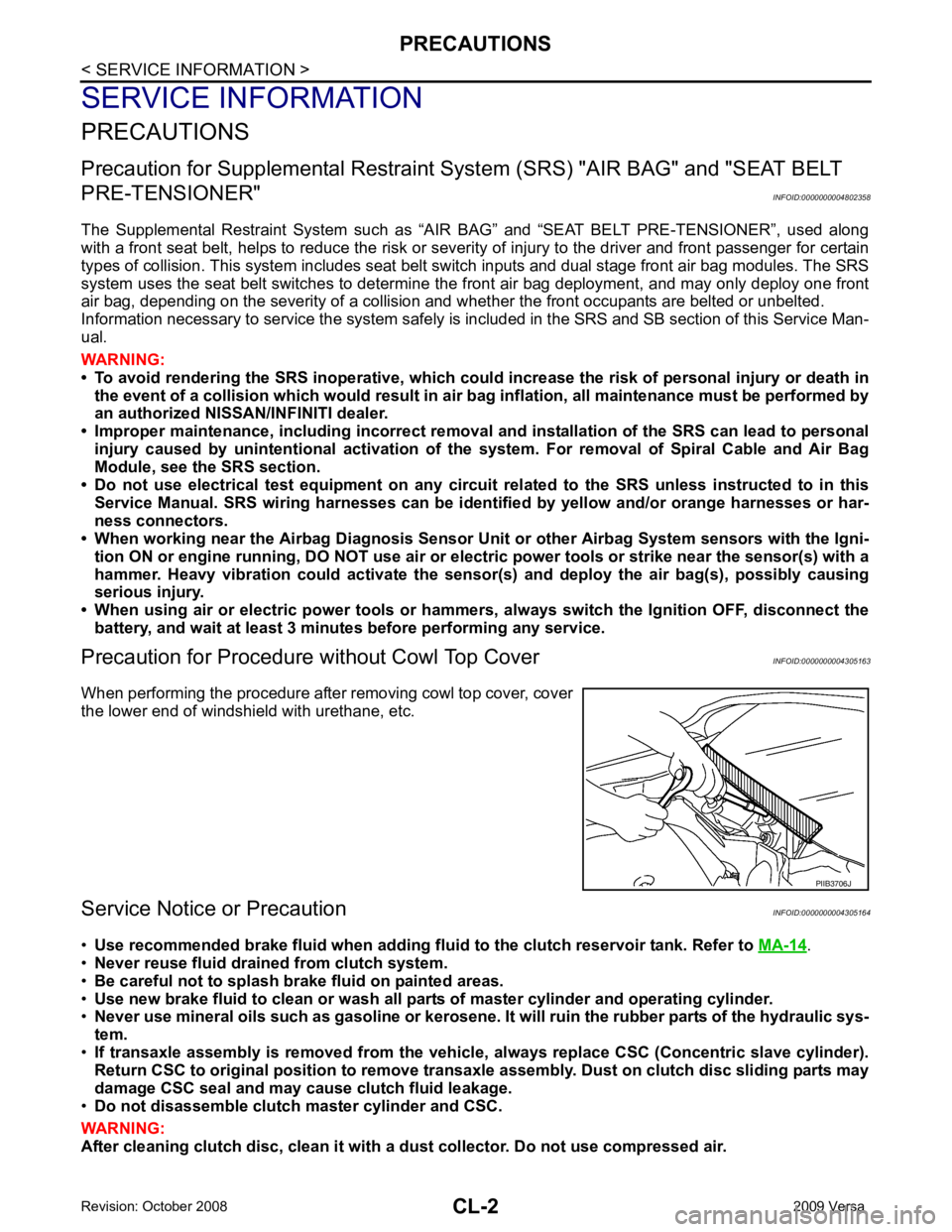
When performing the procedure after removing cowl top cover, cover
the lower end of windshield with urethane, etc.
Service Notice or Precaution INFOID:0000000004305164
• Use recommended brake fluid when adding flui d to the clutch reservoir tank. Refer to MA-14 .
• Never reuse fluid drained from clutch system.
• Be careful not to splash brake fluid on painted areas.
• Use new brake fluid to clean or wash all part s of master cylinder and operating cylinder.
• Never use mineral oils such as gasoline or kerosene. It will ruin the rubber parts of the hydraulic sys-
tem.
• If transaxle assembly is removed from the vehicle , always replace CSC (Concentric slave cylinder).
Return CSC to original position to remove transaxle assembly. Dust on clutch disc sliding parts may
damage CSC seal and may cause clutch fluid leakage.
• Do not disassemble clutch master cylinder and CSC.
WARNING:
After cleaning clutch disc, clean it with a dust collector. Do not use compressed air. PIIB3706J
Page 897 of 4331

CO
NP
O
PRECAUTION
PRECAUTIONS
Precaution for Supplemental Restraint System (SRS) "AIR BAG" and "SEAT BELT
PRE-TENSIONER" INFOID:0000000004784387
The Supplemental Restraint System such as “A IR BAG” and “SEAT BELT PRE-TENSIONER”, used along
with a front seat belt, helps to reduce the risk or severi ty of injury to the driver and front passenger for certain
types of collision. This system includes seat belt switch inputs and dual stage front air bag modules. The SRS
system uses the seat belt switches to determine the front air bag deployment, and may only deploy one front
air bag, depending on the severity of a collision and w hether the front occupants are belted or unbelted.
Information necessary to service the system safely is included in the SRS and SB section of this Service Man-
ual.
WARNING:
• To avoid rendering the SRS inoper ative, which could increase the risk of personal injury or death in
the event of a collision which would result in air bag inflation, all maintenance must be performed by
an authorized NISSAN/INFINITI dealer.
• Improper maintenance, including in correct removal and installation of the SRS can lead to personal
injury caused by unintentional act ivation of the system. For removal of Spiral Cable and Air Bag
Module, see the SRS section.
• Do not use electrical test equipm ent on any circuit related to the SRS unless instructed to in this
Service Manual. SRS wiring harnesses can be identi fied by yellow and/or orange harnesses or har-
ness connectors.
• When working near the Airbag Diagnosis Sensor Un it or other Airbag System sensors with the Igni-
tion ON or engine running, DO NOT use air or el ectric power tools or strike near the sensor(s) with a
hammer. Heavy vibration could activate the sensor( s) and deploy the air bag(s), possibly causing
serious injury.
• When using air or electric power tools or hammers , always switch the Ignition OFF, disconnect the
battery, and wait at least 3 minutes before performing any service.
Precaution Necessary for Steering Wh eel Rotation After Battery Disconnect
INFOID:0000000004784348
NOTE:
• This Procedure is applied only to models with Inte lligent Key system and NATS (NISSAN ANTI-THEFT SYS-
TEM).
• Remove and install all control units after disconnecti ng both battery cables with the ignition knob in the
″ LOCK ″ position.
• Always use CONSULT-III to perform self-diagnosis as a part of each function inspection after finishing work.
If DTC is detected, perform trouble diagnosis according to self-diagnostic results.
For models equipped with the Intelligent Key system and NATS , an electrically controlled steering lock mech-
anism is adopted on the key cylinder.
For this reason, if the battery is disconnected or if the battery is discharged, the steering wheel will lock and
steering wheel rotation will become impossible.
If steering wheel rotation is required when battery pow er is interrupted, follow the procedure below before
starting the repair operation.
OPERATION PROCEDURE 1. Connect both battery cables. NOTE:
Supply power using jumper cables if battery is discharged.
2. Use the Intelligent Key or mechanical key to turn the ignition switch to the ″ACC ″ position. At this time, the
steering lock will be released.
3. Disconnect both battery cables. The steering lock will remain released and the steering wheel can be
rotated.
4. Perform the necessary repair operation.
5. When the repair work is completed, return the ignition switch to the ″LOCK ″ position before connecting
the battery cables. (At this time, the steering lock mechanism will engage.)
6. Perform a self-diagnosis check of al l control units using CONSULT-III.
Page 918 of 4331
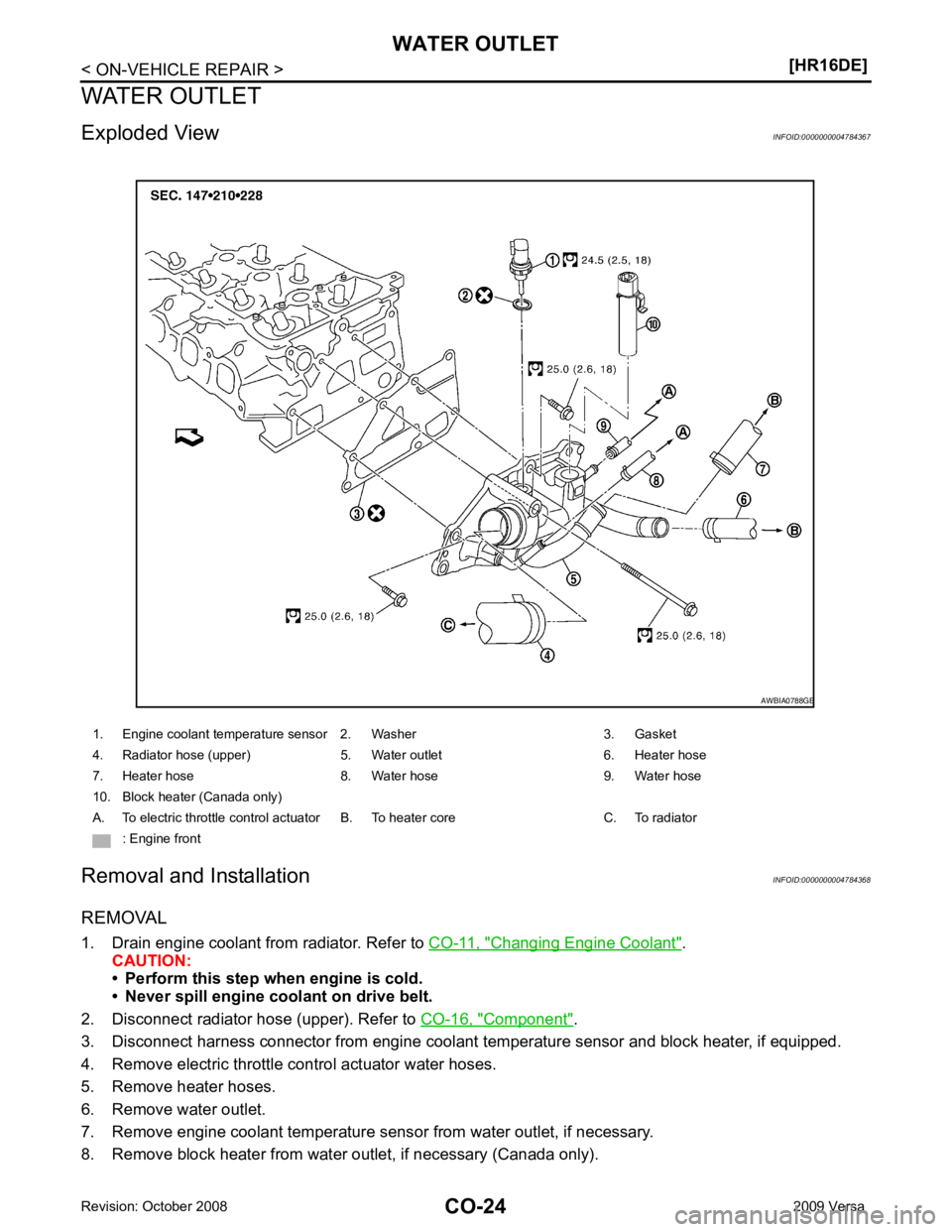
Changing Engine Coolant " .
CAUTION:
• Perform this step when engine is cold.
• Never spill engine coolant on drive belt.
2. Disconnect radiator hose (upper). Refer to CO-16, " Component " .
3. Disconnect harness connector from engine coolant temperature sensor and block heater, if equipped.
4. Remove electric throttle control actuator water hoses.
5. Remove heater hoses.
6. Remove water outlet.
7. Remove engine coolant temperature sens or from water outlet, if necessary.
8. Remove block heater from water outlet, if necessary (Canada only). 1. Engine coolant temperature sensor 2. Washer 3. Gasket
4. Radiator hose (upper) 5. Water outlet 6. Heater hose
7. Heater hose 8. Water hose 9. Water hose
10. Block heater (Canada only)
A. To electric throttle control actuator B. To heater core C. To radiator : Engine front
Page 941 of 4331
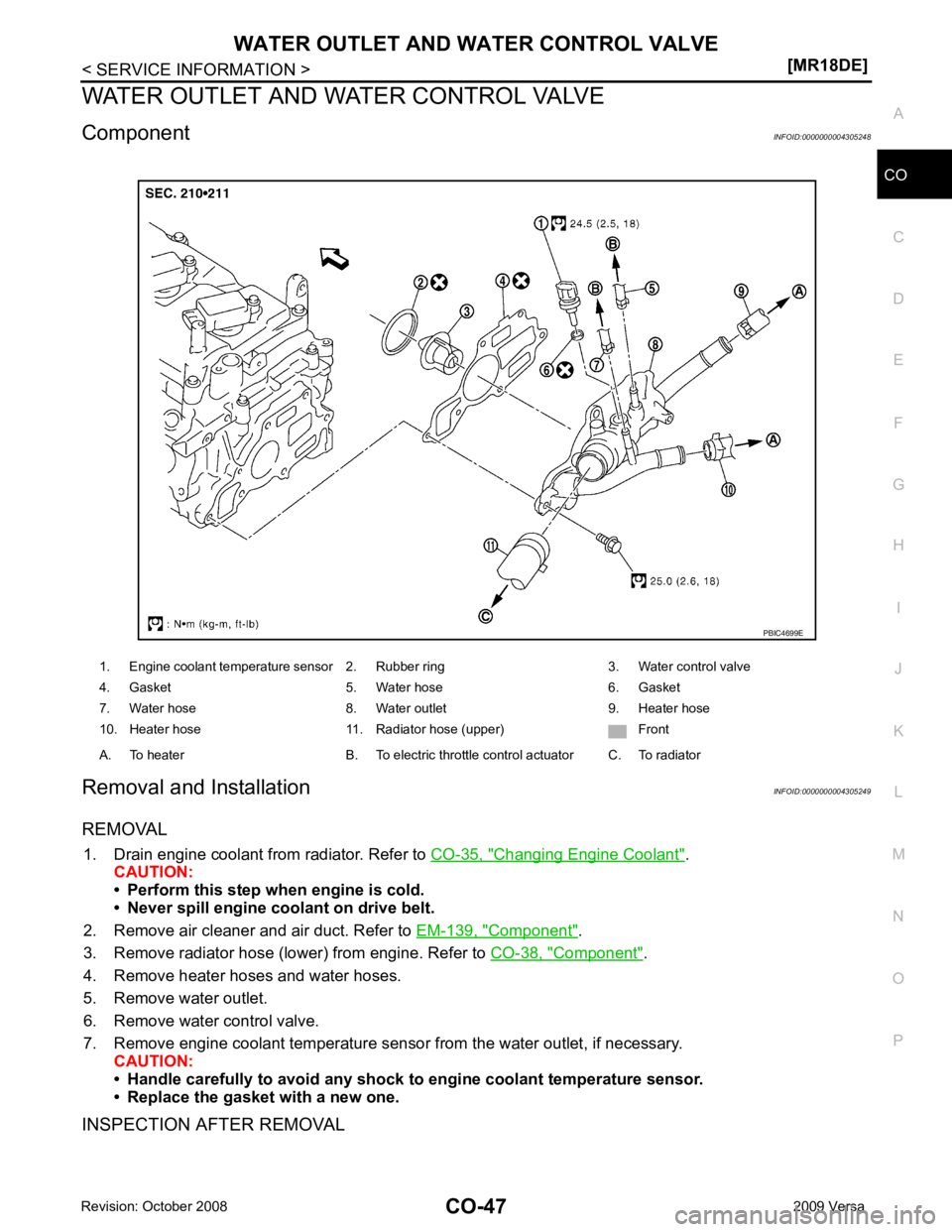
CO
NP
O
WATER OUTLET AND WATER CONTROL VALVE
Component INFOID:0000000004305248
Removal and Installation INFOID:0000000004305249
REMOVAL 1. Drain engine coolant from radiator. Refer to CO-35, " Changing Engine Coolant " .
CAUTION:
• Perform this step when engine is cold.
• Never spill engine coolant on drive belt.
2. Remove air cleaner and air duct. Refer to EM-139, " Component " .
3. Remove radiator hose (lower) from engine. Refer to CO-38, " Component " .
4. Remove heater hoses and water hoses.
5. Remove water outlet.
6. Remove water control valve.
7. Remove engine coolant temperature sensor from the water outlet, if necessary. CAUTION:
• Handle carefully to avoid any shock to engine coolant temperature sensor.
• Replace the gasket with a new one.
INSPECTION AFTER REMOVAL 1. Engine coolant temperature sensor 2. Rubber ring 3. Water control valve
4. Gasket 5. Water hose 6. Gasket
7. Water hose 8. Water outlet 9. Heater hose
10. Heater hose 11. Radiator hose (upper) Front
A. To heater B. To electric throttle control actuator C. To radiator