2009 NISSAN TIIDA O2 SENSOR
[x] Cancel search: O2 SENSORPage 947 of 4331

CVT
N
O
P
N
Description ..........................................................
..
104
CONSULT-III Refe rence Value in Data Monitor
Mode ................................................................... ..
104
On Board Diagnosis Logic .................................. ..104
Possible Cause ................................................... ..104
DTC Confirmation Procedure .............................. ..104
Diagnosis Procedure ........................................... ..104
DTC P0776 PRESSURE CONTROL SOLE-
NOID B PERFORMANCE (SEC PRESSURE
SOLENOID VALVE) ....................................... ..106
Description .......................................................... ..106
CONSULT-III Refe rence Value in Data Monitor
Mode ................................................................... ..
106
On Board Diagnosis Logic .................................. ..106
Possible Cause ................................................... ..106
DTC Confirmation Procedure .............................. ..106
Diagnosis Procedure ........................................... ..106
DTC P0778 PRESSURE CONTROL SOLE-
NOID B ELECTRICAL (SEC PRESSURE SO-
LENOID VALVE) ............................................ ..
108
Description .......................................................... ..108
CONSULT-III Refe rence Value in Data Monitor
Mode ................................................................... ..
108
On Board Diagnosis Logic .................................. ..108
Possible Cause ................................................... ..108
DTC Confirmation Procedure .............................. ..108
Wiring Diagram - CVT - SECPSV .........................109
Diagnosis Procedure ........................................... ..110
Component Inspection ........................................ ..111
DTC P0840 TRANSMISSION FLUID PRES-
SURE SENSOR A CIRCUIT (SEC PRES-
SURE SENSOR) ............................................. ..
113
Description .......................................................... ..113
CONSULT-III Refe rence Value in Data Monitor
Mode ................................................................... ..
113
On Board Diagnosis Logic .................................. ..113
Possible Cause ................................................... ..113
DTC Confirmation Procedure .............................. ..113
Wiring Diagram - CVT - SECPS .......................... ..114
Diagnosis Procedure ........................................... ..115
DTC P0841 PRESSURE SENSOR FUNC-
TION ............................................................... ..
117
Description .......................................................... ..117
CONSULT-III Refe rence Value in Data Monitor
Mode ................................................................... ..
117
On Board Diagnosis Logic .................................. ..117
Possible Cause ................................................... ..117
DTC Confirmation Procedure .............................. ..117
Diagnosis Procedure ........................................... ..117
DTC P0845 TRANSMISSION FLUID PRES-
SURE SENSOR B CIRCUIT (PRI PRESSURE
SENSOR) ........................................................ ..119
Description .......................................................... ..119 CONSULT-III Reference Va
lue in Data Monitor
Mode .................................................................... ..
119
On Board Diagnosis Logic ................................... ..119
Possible Cause .................................................... ..119
DTC Confirmation Procedure .............................. ..119
Wiring Diagram - CVT - PRIPS ........................... ..120
Diagnosis Procedure ........................................... ..121
DTC P0868 SECONDARY PRESSURE
DOWN ............................................................. 123
Description ........................................................... ..123
CONSULT-III Reference Va lue in Data Monitor
Mode .................................................................... ..
123
On Board Diagnosis Logic ................................... ..123
Possible Cause .................................................... ..123
DTC Confirmation Procedure .............................. ..123
Diagnosis Procedure ........................................... ..123
DTC P1701 TRANSMISSION CONTROL
MODULE (POWER SUPPLY) ......................... 125
Description ........................................................... ..125
On Board Diagnosis Logic ................................... ..125
Possible Cause .................................................... ..125
DTC Confirmation Procedure .............................. ..125
Wiring Diagram - CVT - POWER ......................... ..126
Diagnosis Procedure ........................................... ..127
DTC P1705 THROTTLE POSITION SENSOR .129
Description ........................................................... ..129
CONSULT-III Reference Va lue in Data Monitor
Mode .................................................................... ..
129
On Board Diagnosis Logic ................................... ..129
Possible Cause .................................................... ..129
DTC Confirmation Procedure .............................. ..129
Diagnosis Procedure ........................................... ..129
DTC P1722 ESTM VEHICLE SPEED SIGNAL .131
Description ........................................................... ..131
CONSULT-III Reference Va lue in Data Monitor
Mode .................................................................... ..
131
On Board Diagnosis Logic ................................... ..131
Possible Cause .................................................... ..131
DTC Confirmation Procedure .............................. ..131
Diagnosis Procedure ........................................... ..131
DTC P1723 CVT SPEED SENSOR FUNC-
TION ................................................................ 133
Description ........................................................... ..133
On Board Diagnosis Logic ................................... ..133
Possible Cause .................................................... ..133
DTC Confirmation Procedure .............................. ..133
Diagnosis Procedure ........................................... ..133
DTC P1726 ELECTRIC THROTTLE CON-
TROL SYSTEM ............................................... 135
Description ........................................................... ..135
On Board Diagnosis Logic ................................... ..135
Possible Cause .................................................... ..135
DTC Confirmation Procedure .............................. ..135
Diagnosis Procedure ........................................... ..135
Page 949 of 4331

CVT
N
O
P
N
Precaution Necessary fo
r Steering Wheel Rota-
tion After Battery Disconnect ............................... ..
189
Precaution for On Board Diagnosis (OBD) System
of CVT and Engine .............................................. ..
190
Service After Replacing TCM and Transaxle As-
sembly ................................................................. ..
190
Removal and Installation Procedure for CVT Unit
Connector ............................................................ ..
191
Precaution ........................................................... ..192
Service Notice or Precaution ............................... ..193
PREPARATION .............................................. ..195
Special Service Tool ........................................... ..195
Commercial Service Tool .................................... ..195
CVT FLUID ..................................................... ..196
Checking CVT Fluid ............................................ ..196
Changing CVT Fluid ............................................ ..197
CVT Fluid Cooler Cleanin g ...................................197
CVT SYSTEM ... .............................................. ..201
Cross-Sectional View - RE0F08B ....................... ..201
Control System .................................................... ..202
Hydraulic Control System ......................................203
TCM Function ...................................................... ..203
CAN Communication ........................................... ..204
Input/Output Signal of TCM ................................. ..204
Line Pressure and Secondary Pressure Control . ..205
Shift Control ........................................................ ..205
Lock-up and Select Control ................................. ..207
Control Valve ....................................................... ..207
ON BOARD DIAGNOSTIC (OBD) SYSTEM .. ..209
Introduction ......................................................... ..209
OBD-II Function for CVT System ........................ ..209
One or Two Trip Detection Logic of OBD-II ........ ..209
OBD-II Diagnostic Trouble Code (DTC) .............. ..209
Malfunction Indicator Lamp (MIL) ........................ ..210
TROUBLE DIAGNOSIS ................................. ..212
DTC Inspection Priority Chart ............................. ..212
Fail-Safe .............................................................. ..212
How to Perform Trouble Diagnosis for Quick and
Accurate Repair ........... .........................................
213
CVT Electrical Parts Location ............................. ..218
Circuit Diagram ................................................... ..219
Inspections before Trouble Diagnosis ................. ..219
Road Test ............................................................ ..223
Check before Engine Is Started ............................224
Check at Idle ....................................................... ..224
Cruise Test .......................................................... ..226
Vehicle Speed When Shifting Gears ................... ..228
TCM Terminal and Reference Value ................... ..228
CONSULT-III Function (TRANSMISSION) ......... ..230
Diagnosis Procedu re without CONSULT-III ........ ..237
DTC U1000 CAN COMMUNICATION LINE ... ..238
Description .......................................................... ..238
On Board Diagnosis Logic .................................. ..238
Possible Cause ................................................... ..238 DTC Confirmation Procedure ..............................
..238
Wiring Diagram - CVT - CAN ............................... ..239
Diagnosis Procedure ........................................... ..240
DTC U1010 TRANSMISSION CONTROL
MODULE (CAN) .............................................. 241
Description ........................................................... ..241
On Board Diagnosis Logic ................................... ..241
Possible Cause .................................................... ..241
DTC Confirmation Procedure .............................. ..241
Diagnosis Procedure ........................................... ..241
DTC P0703 STOP LAMP SWITCH CIRCUIT . 242
Description ........................................................... ..242
CONSULT-III Reference Va lue in Data Monitor
Mode .................................................................... ..
242
On Board Diagnosis Logic ................................... ..242
Possible Cause .................................................... ..242
DTC Confirmation Procedure .............................. ..242
Diagnosis Procedure ........................................... ..242
DTC P0705 PARK/NEUTRAL POSITION
SWITCH ........................................................... 244
Description ........................................................... ..244
CONSULT-III Reference Va lue in Data Monitor
Mode .................................................................... ..
244
On Board Diagnosis Logic ................................... ..244
Possible Cause .................................................... ..244
DTC Confirmation Procedure .............................. ..244
Wiring Diagram - CVT - PNP/SW ........................ ..245
Diagnosis Procedure ........................................... ..246
Component Inspection ......................................... ..247
DTC P0710 CVT FLUID TEMPERATURE
SENSOR CIRCUIT .......................................... 249
Description ........................................................... ..249
CONSULT-III Reference Va lue in Data Monitor
Mode .................................................................... ..
249
On Board Diagnosis Logic ................................... ..249
Possible Cause .................................................... ..249
DTC Confirmation Procedure .............................. ..249
Wiring Diagram - CVT - FTS ............................... ..250
Diagnosis Procedure ........................................... ..251
Component Inspection ......................................... ..252
DTC P0715 INPUT SPEED SENSOR CIR-
CUIT (PRI SPEED SENSOR) .......................... 254
Description ........................................................... ..254
CONSULT-III Reference Va lue in Data Monitor
Mode .................................................................... ..
254
On Board Diagnosis Logic ................................... ..254
Possible Cause .................................................... ..254
DTC Confirmation Procedure .............................. ..254
Wiring Diagram - CVT - PRSCVT ........................ ..255
Diagnosis Procedure ........................................... ..256
DTC P0720 VEHICLE SPEED SENSOR CVT
(SECONDARY SPEED SENSOR) .................. 258
Description ........................................................... ..258
Page 951 of 4331

CVT
N
O
P
N
Description ..........................................................
..
293
CONSULT-III Refe rence Value in Data Monitor
Mode ................................................................... ..
293
On Board Diagnosis Logic .................................. ..293
Possible Cause ................................................... ..293
DTC Confirmation Procedure .............................. ..293
Diagnosis Procedure ........................................... ..293
DTC P1701 TRANSMISSION CONTROL
MODULE (POWER SUPPLY) ........................ ..295
Description .......................................................... ..295
On Board Diagnosis Logic .................................. ..295
Possible Cause ................................................... ..295
DTC Confirmation Procedure .............................. ..295
Wiring Diagram - CVT - POWER ........................ ..296
Diagnosis Procedure ........................................... ..297
DTC P1705 THROTTLE POSITION SENSOR ..299
Description .......................................................... ..299
CONSULT-III Refe rence Value in Data Monitor
Mode ................................................................... ..
299
On Board Diagnosis Logic .................................. ..299
Possible Cause ................................................... ..299
DTC Confirmation Procedure .............................. ..299
Diagnosis Procedure ........................................... ..299
DTC P1722 ESTM VEHICLE SPEED SIGNAL ..301
Description .......................................................... ..301
CONSULT-III Refe rence Value in Data Monitor
Mode ................................................................... ..
301
On Board Diagnosis Logic .................................. ..301
Possible Cause ................................................... ..301
DTC Confirmation Procedure .............................. ..301
Diagnosis Procedure ........................................... ..301
DTC P1723 CVT SPEED SENSOR FUNC-
TION ............................................................... ..303
Description .......................................................... ..303
On Board Diagnosis Logic .................................. ..303
Possible Cause ................................................... ..303
DTC Confirmation Procedure .............................. ..303
Diagnosis Procedure ........................................... ..303
DTC P1726 ELECTRIC THROTTLE CON-
TROL SYSTEM .............................................. ..
305
Description .......................................................... ..305
On Board Diagnosis Logic .................................. ..305
Possible Cause ................................................... ..305
DTC Confirmation Procedure .............................. ..305
Diagnosis Procedure ........................................... ..305
DTC P1740 LOCK-UP SELECT SOLENOID
VALVE CIRCUIT ............................................ ..
306
Description .......................................................... ..306
CONSULT-III Refe rence Value in Data Monitor
Mode ................................................................... ..
306
On Board Diagnosis Logic .................................. ..306
Possible Cause ................................................... ..306
DTC Confirmation Procedure .............................. ..306
Wiring Diagram - CVT - L/USSV ......................... ..307 Diagnosis Procedure ...........................................
..308
Component Inspection ......................................... ..309
DTC P1745 LINE PRESSURE CONTROL ..... 310
Description ........................................................... ..310
On Board Diagnosis Logic ................................... ..310
Possible Cause .................................................... ..310
DTC Confirmation Procedure .............................. ..310
Diagnosis Procedure ........................................... ..310
DTC P1777 STEP MOTOR - CIRCUIT ........... 311
Description ........................................................... ..311
CONSULT-III Reference Va lue in Data Monitor
Mode .................................................................... ..
311
On Board Diagnosis Logic ................................... ..311
Possible Cause .................................................... ..311
DTC Confirmation Procedure .............................. ..311
Wiring Diagram - CVT - STM ............................... ..312
Diagnosis Procedure ........................................... ..313
Component Inspection ......................................... ..314
DTC P1778 STEP MOTOR - FUNCTION ....... 315
Description ........................................................... ..315
CONSULT-III Reference Va lue in Data Monitor
Mode .................................................................... ..
315
On Board Diagnosis Logic ................................... ..315
Possible Cause .................................................... ..315
DTC Confirmation Procedure .............................. ..315
Diagnosis Procedure ........................................... ..316
OVERDRIVE CONTROL SWITCH .................. 317
Description ........................................................... ..317
CONSULT-III Reference Va lue in Data Monitor
Mode .................................................................... ..
317
Wiring Diagram - CVT - ODSW ........................... ..318
Diagnosis Procedure ........................................... ..318
Component Inspection ......................................... ..320
SHIFT POSITION INDICATOR CIRCUIT ........ 322
Description ........................................................... ..322
CONSULT-III Reference Va lue in Data Monitor
Mode .................................................................... ..
322
Diagnosis Procedure ........................................... ..322
TROUBLE DIAGNOSIS FOR SYMPTOMS .... 323
Wiring Diagram - CVT - NONDTC ....................... ..323
O/D OFF Indicator Lamp Does Not Come On ..... ..325
Engine Cannot Be Started in "P" and "N" Position ..327
In "P" Position, Vehicle Moves Forward or Back-
ward When Pushed ............................................. ..
327
In "N" Position, Vehicle Moves ............................ ..328
Large Shock "N" → "R" Position .......................... ..328
Vehicle Does Not Creep Backward in "R" Position ..329
Vehicle Does Not Creep Forward in "D" or "L" Po-
sition .................................................................... ..
330
Vehicle Speed Does Not Change in "L" Position . ..331
Vehicle Speed Does Not Change in overdrive-off
mode .................................................................... ..
332
Vehicle Speed Does Not Change in "D" Position .. 333
Vehicle Does Not Decelerate by Engine Brake ... ..333
Page 955 of 4331

CVT
N
O P
PRECAUTIONS
Precaution for Supplemental Restraint System (SRS) "AIR BAG" and "SEAT BELT
PRE-TENSIONER" INFOID:0000000004800719
The Supplemental Restraint System such as “A IR BAG” and “SEAT BELT PRE-TENSIONER”, used along
with a front seat belt, helps to reduce the risk or severi ty of injury to the driver and front passenger for certain
types of collision. This system includes seat belt switch inputs and dual stage front air bag modules. The SRS
system uses the seat belt switches to determine the front air bag deployment, and may only deploy one front
air bag, depending on the severity of a collision and w hether the front occupants are belted or unbelted.
Information necessary to service the system safely is included in the SRS and SB section of this Service Man-
ual.
WARNING:
• To avoid rendering the SRS inoper ative, which could increase the risk of personal injury or death in
the event of a collision which would result in air bag inflation, all maintenance must be performed by
an authorized NISSAN/INFINITI dealer.
• Improper maintenance, including in correct removal and installation of the SRS can lead to personal
injury caused by unintentional act ivation of the system. For removal of Spiral Cable and Air Bag
Module, see the SRS section.
• Do not use electrical test equipm ent on any circuit related to the SRS unless instructed to in this
Service Manual. SRS wiring harnesses can be identi fied by yellow and/or orange harnesses or har-
ness connectors.
• When working near the Airbag Diagnosis Sensor Un it or other Airbag System sensors with the Igni-
tion ON or engine running, DO NOT use air or el ectric power tools or strike near the sensor(s) with a
hammer. Heavy vibration could activate the sensor( s) and deploy the air bag(s), possibly causing
serious injury.
• When using air or electric power tools or hammers , always switch the Ignition OFF, disconnect the
battery, and wait at least 3 minutes before performing any service.
Precaution Necessary for Steering Wh eel Rotation After Battery Disconnect
INFOID:0000000004666854
NOTE:
• This Procedure is applied only to models with Intell igent Key system and NVIS/IVIS (NISSAN/INFINITI
VEHICLE IMMOBILIZER SYSTEM - NATS).
• Remove and install all control units after disconnecti ng both battery cables with the ignition knob in the
″ LOCK ″ position.
• Always use CONSULT-III to perform self-diagnosis as a part of each function inspection after finishing work.
If DTC is detected, perform trouble diagnosis according to self-diagnostic results.
For models equipped with the Intelligent Key system and NVIS/IVIS, an electrically controlled steering lock
mechanism is adopted on the key cylinder.
For this reason, if the battery is disconnected or if the battery is discharged, the steering wheel will lock and
steering wheel rotation will become impossible.
If steering wheel rotation is required when battery pow er is interrupted, follow the procedure below before
starting the repair operation.
OPERATION PROCEDURE 1. Connect both battery cables. NOTE:
Supply power using jumper cables if battery is discharged.
2. Use the Intelligent Key or mechanical key to turn the ignition switch to the ″ACC ″ position. At this time, the
steering lock will be released.
3. Disconnect both battery cables. The steering lock will remain released and the steering wheel can be
rotated.
4. Perform the necessary repair operation.
5. When the repair work is completed, return the ignition switch to the ″LOCK ″ position before connecting
the battery cables. (At this time, the steering lock mechanism will engage.)
6. Perform a self-diagnosis check of al l control units using CONSULT-III.
Page 971 of 4331
CVT
N
O P
Optimize the line pressure and secondary pressure, dependi
ng on driving conditions, on the basis of the throt-
tle position, the engine speed, the primary pulley (input ) revolution speed, the secondary pulley (output) revo-
lution speed, the brake signal, the PNP switch signal, the lock-up signal, the voltage, the target gear ratio, the
fluid temperature, and the fluid pressure.
FEEDBACK CONTROL When controlling the normal fluid pressure or the sele cted fluid pressure, the secondary pressure can be set
more accurately by using the fluid pressure sensor to detect the secondary pressure and controlling the feed-
back.
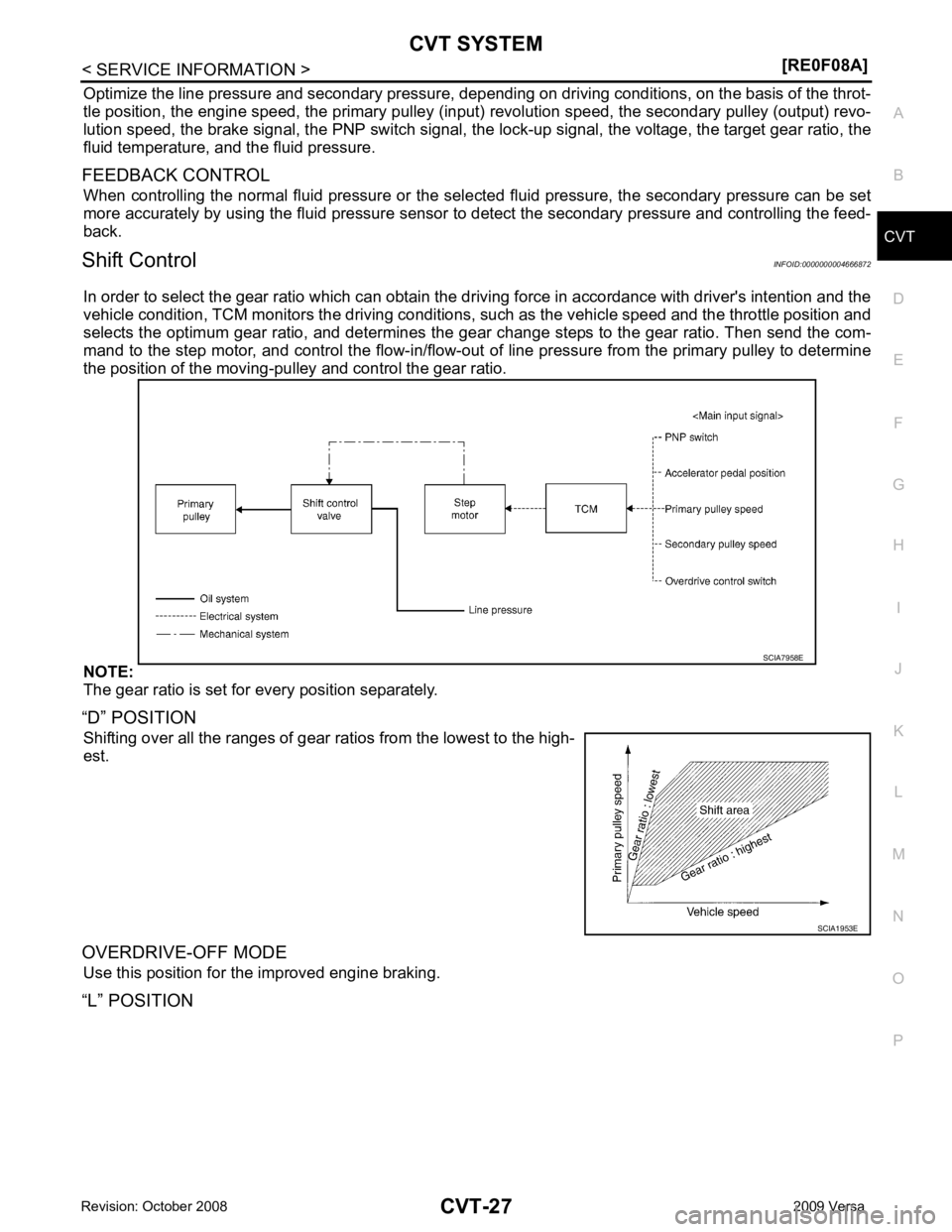
Shift Control INFOID:0000000004666872
In order to select the gear ratio which can obtain the dr iving force in accordance with driver's intention and the
vehicle condition, TCM monitors the driving conditions, such as the vehicle speed and the throttle position and
selects the optimum gear ratio, and determines the gear change steps to the gear ratio. Then send the com-
mand to the step motor, and control the flow-in/flow-out of line pressure from the primary pulley to determine
the position of the moving-pul ley and control the gear ratio.
NOTE:
The gear ratio is set for every position separately.
“D” POSITION Shifting over all the ranges of gear ra tios from the lowest to the high-
est.
OVERDRIVE-OFF MODE Use this position for the improved engine braking.
“L” POSITION
Page 974 of 4331
" CONSULT-III Function (TRANSMISSION) " .
OBD-II Function for CVT System INFOID:0000000004666876
The ECM provides emission-related on board diagnostic (O BD-II) functions for the CVT system. One function
is to receive a signal from the TCM used with OBD-relat ed parts of the CVT system. The signal is sent to the
ECM when a malfunction occurs in the corresponding OBD-re lated part. The other function is to indicate a
diagnostic result by means of the MIL (malfunction indi cator lamp) on the instrument panel. Sensors, switches
and solenoid valves are used as sensing elements.
The MIL automatically illuminates in One or Two Trip Detection Logic when a malfunction is sensed in relation
to CVT system parts.
One or Two Trip Detection Logic of OBD-II INFOID:0000000004666877
ONE TRIP DETECTION LOGIC
If a malfunction is sensed during the first test drive, the MIL will illuminate and the malfunction will be stored in
the ECM memory as a DTC. The TCM is not provided with such a memory function.
TWO TRIP DETECTION LOGIC
When a malfunction is sensed during the first test drive, it is stored in the ECM memory as a 1st trip DTC
(diagnostic trouble code) or 1st trip freeze frame data. At this point, the MIL will not illuminate. — 1st trip
If the same malfunction as that experienced during the fi rst test drive is sensed during the second test drive,
the MIL will illuminate. — 2nd trip
The “trip” in the “One or Two Trip Detection Logic” means a driving mode in which self-diagnosis is performed
during vehicle operation.
OBD-II Diagnostic Trouble Code (DTC) INFOID:0000000004666878
HOW TO READ DTC AND 1ST TRIP DTC
DTC and 1st trip DTC can be read by the following methods.
( with CONSULT-III or GST) CONSULT-III or GST (Generic Scan Tool) Examples: P0705, P0720 etc.
These DTC are prescribed by SAE J2012.
(CONSULT-III also displays the malfunctioning component or system.)
• 1st trip DTC No. is the same as DTC No.
• Output of the diagnostic troubl e code indicates that the indicated circuit has a malfunction. How-
ever, in case of the Mode II and GST, they do not indicate whether the malfunction is still occurring or
occurred in the past and returned to normal.
CONSULT-III can identify them as shown below, therefore, CONSULT-III (if available) is recom-
mended.
DTC or 1st trip DTC of a malfunction is displayed in SELF-DIAGNOSTIC RESULTS mode for “ENGINE” with
CONSULT-III. Time data indicates how many times the vehicle was driven after the last detection of a DTC.
If the DTC is being detected currently, the time data will be “0”.
If a 1st trip DTC is stored in the ECM, the time data will be “1t”. Freeze Frame Data and 1st Trip Freeze Frame Data
Page 977 of 4331

CVT
N
O P
TROUBLE DIAGNOSIS
DTC Inspection Priority Chart INFOID:0000000004666880
If some DTCs are displayed at the same time, perform inspections one by one based on the following priority
chart.
NOTE:
If DTC “U1000 CAN COMM CIRCUIT” is displayed with other DTCs, first perform the trouble diagnosis
for “DTC U1000 CAN COMMUNICATION LINE”. Refer to CVT-60 .
Fail-Safe INFOID:0000000004666881
The TCM has an electrical fail-safe mode. This mode make s it possible to operate even if there is an error in a
main electronic control input/output signal circuit.
FAIL-SAFE FUNCTION If any malfunction occurs in a sensor or solenoid, th is function controls the CVT to make driving possible.
Output Speed Sensor (Secondary Speed Sensor) The shift pattern is changed in accordance with throttle position when an unexpected signal is sent from the
output speed sensor (secondary speed sensor) to the TCM. The overdrive-off mode is inhibited, and the tran-
saxle is put in “D”.
Input Speed Sensor (Primary Speed Sensor) The shift pattern is changed in accordance with throttle position and secondary speed (vehicle speed) when
an unexpected signal is sent from the input speed sensor (primary speed sensor) to the TCM. The sport mode
is inhibited, and the transaxle is put in “D”.
PNP Switch If an unexpected signal is sent from the PNP switch to the TCM, the transaxle is put in “D”.
CVT Fluid Temperature Sensor If an unexpected signal is sent from the CVT fluid temper ature sensor to the TCM, the gear ratio in use before
receiving the unexpected signal is maintained or the gear ratio is controlled to keep engine speed under 3500
rpm.
Transmission Fluid Pressure Sens or A (Secondary Pressure Sensor)
• If an unexpected signal is sent from the transmission fl uid pressure sensor A (secondary pressure sensor) to
the TCM, the secondary pressure feedback control is stopped and the offset value obtained before the non-
standard condition occurs is used to control line pressure.
• If transmission fluid pressure sensor A (secondary pre ssure sensor) error signal is input to TCM, secondary
pressure feedback control stops, but line pressure is controlled normally.
Pressure Control Solenoid A (Line Pressure Solenoid) If an unexpected signal is sent from the solenoid to t he TCM, the pressure control solenoid A (line pressure
solenoid) is turned OFF to achieve the maximum fluid pressure.
Pressure Control Solenoid B (Secondary Pressure Solenoid) If an unexpected signal is sent from the solenoid to t he TCM, the pressure control solenoid B (secondary pres-
sure solenoid) is turned OFF to achieve the maximum fluid pressure.
Torque Converter Clutch Solenoid If an unexpected signal is sent from the solenoid to t he TCM, the torque converter clutch solenoid is turned
OFF to cancel the lock-up.
Step Motor If an unexpected signal is sent from the step motor to the TCM, the step motor coil phases “A” through “D” are
all turned OFF to hold the gear ratio used right before the non-standard condition occurred.
CVT Lock-up Select Solenoid Priority Detected items (DTC)
1 U1000 CAN communication line
2 Except above
Page 978 of 4331
![NISSAN TIIDA 2009 Service Repair Manual CVT-34< SERVICE INFORMATION >
[RE0F08A]
TROUBLE DIAGNOSIS
If an unexpected signal is sent from the solenoid to t he TCM, the CVT lock-up select solenoid is turned OFF to
cancel the lock-up.
TCM Power](/manual-img/5/57398/w960_57398-977.png "NISSAN TIIDA 2009 Service Repair Manual CVT-34< SERVICE INFORMATION >
[RE0F08A]
TROUBLE DIAGNOSIS
If an unexpected signal is sent from the solenoid to t he TCM, the CVT lock-up select solenoid is turned OFF to
cancel the lock-up.
TCM Power")
CVT-34< SERVICE INFORMATION >
[RE0F08A]
TROUBLE DIAGNOSIS
If an unexpected signal is sent from the solenoid to t he TCM, the CVT lock-up select solenoid is turned OFF to
cancel the lock-up.
TCM Power Supply (Memory Back-up)
Transaxle assembly is protected by limiting the engine torque when the memory back-up power supply (for
controlling) from the battery is not supplied to TCM. Normal statues is restored when turning the ignition switch
OFF to ON after the normal power supply.
How to Perform Trouble Diagnosis for Quick and Accurate Repair INFOID:0000000004666882
INTRODUCTION
The TCM receives a signal from the vehicle speed sensor, PNP switch and provides shift control or lock-up
control via CVT solenoid valves.
The TCM also communicates with the ECM by means of a signal
sent from sensing elements used wit h the OBD-related parts of the
CVT system for malfunction-diagnostic purposes. The TCM is capa-
ble of diagnosing malfunctioning parts while the ECM can store mal-
functions in its memory.
Input and output signals must always be correct and stable in the
operation of the CVT system. The CVT system must be in good
operating condition and be free of valve seizure, solenoid valve mal-
function, etc.
It is much more difficult to diagnose an error that occurs intermit-
tently rather than continuously. Mo st intermittent errors are caused
by poor electric connections or improper wiring. In this case, careful
checking of suspected circuits ma y help prevent the replacement of
good parts.
A visual check only may not find the cause of the errors. A road test
with CONSULT-III (or GST) or a circuit tester connected should be
performed. Follow the "WORK FLOW" .
Before undertaking actual checks, take a few minutes to talk with a
customer who approaches with a driveability complaint. The cus-
tomer can supply good information about such errors, especially
intermittent ones. Find out what symptoms are present and under
what conditions they occur. A “DIAGNOSTIC WORKSHEET” as
shown on the example (Refer to "Diagnostic Worksheet Chart" )
should be used.
Start your diagnosis by looking for “conventional” errors first. This will
help troubleshoot driveability errors on an electronically controlled
engine vehicle.
Also check related Service bulletins.
WORK FLOW
A good understanding of the malfunction conditions can make troubleshooting faster and more accurate.
In general, each customer feels differently about a malf unction. It is important to fully understand the symp-
toms or conditions for a customer complaint.
Make good use of the two sheets provided, "Informati on From Customer" and "Diagnostic Worksheet Chart" ,
to perform the best troubleshooting possible.
Work Flow Chart SAT631IB
SAT632I
SEF234G