2009 MERCEDES-BENZ E-CLASS COUPE stop start
[x] Cancel search: stop startPage 237 of 313
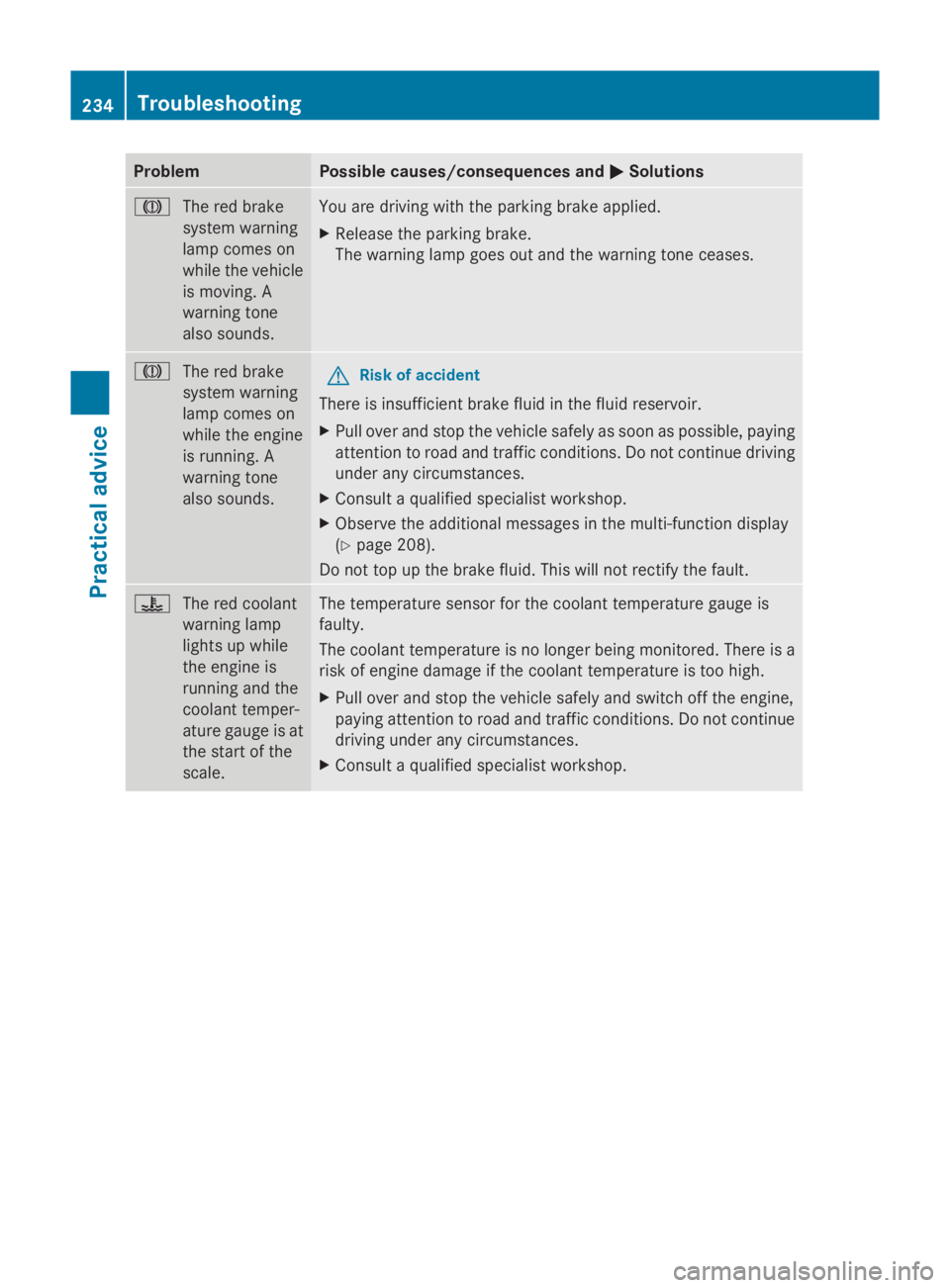
Problem Possible causes/consequences and
0050
0050Solutions 004D
The red brake
system warning
lamp comes on
while the vehicle
is moving. A
warning tone
also sounds. You are driving with the parking brake applied.
X
Release the parking brake.
The warning lamp goes out and the warning tone ceases. 004D
The red brake
system warning
lamp comes on
while the engine
is running. A
warning tone
also sounds. G
Risk of accident
There is insufficient brake fluid in the fluid reservoir.
X Pull over and stop the vehicle safely as soon as possible, paying
attention to road and traffic conditions. Do not continue driving
under any circumstances.
X Consult aqualified specialist workshop.
X Observe the additional messages in the multi-function display
(Y page 208).
Do not top up the brake fluid. This will not rectify the fault. 00AE
The red coolant
warning lamp
lights up while
the engine is
running and the
coolant temper-
ature gauge is at
the start of the
scale. The temperature sensor for the coolant temperature gauge is
faulty.
The coolant temperature is no longer being monitored. There is a
risk of engine damage if the coolant temperature is too high.
X
Pull over and stop the vehicle safely and switch off the engine,
paying attention to road and traffic conditions. Do not continue
driving under any circumstances.
X Consult aqualified specialist workshop. 234
TroubleshootingPractical advice
207_AKB; 2; 3, en-GB
mkalafa,
Version: 2.11.8.1 2009-07-23T10:23:49+02:00-Seite 234
Page 238 of 313

Problem Possible causes/consequences and
0050
0050Solutions 00AE
The red coolant
warning lamp
comes on while
the engine is
running. Awarn-
ing tone also
sounds. The coolant temperature has exceeded 130 †. The airflow to the
radiator may be blocked or the coolant level may be too low.
The engine is not being cooled sufficiently and may be damaged.
X
Pull over and stop the vehicle safely and switch off the engine,
paying attention to road and traffic conditions.
X Allow the engine and coolant to cool.
X Make sure that the air supply to the radiator is not blocked, e.g.
by slush.
X Check the coolant level (Y page 183). Observe the warning
notes.
X If necessary, top up the coolant.
X Have the engine cooling system checked at aqualified specialist
workshop if the coolant needs topping up more often than usual.
If the coolant level is correct,t he electric radiator fan may be
faulty.
X Do not continue driving under any circumstances.
X Consult aqualified specialist workshop. 00BB
The yellow
engine diagnos-
tics warning
lamp lights up
while the engine
is running. Vehicles with
adiesel engine: the fuel tank has been run dry.
X Start the engine three to four times after refuelling.
Emergency running mode is cancelled. The vehicle need not be
checked. 00BB
The yellow
engine diagnos-
tics warning
lamp lights up
while the engine
is running. There may be
afault, for example:
R in the engine management
R in the ignition system
R in the exhaust system
R in the ignition system (for vehicles with petrol engines)
The emission limit values may be exceeded and the engine can
run in emergency mode.
X Have the vehicle checked as soon as possible at aqualified
specialist workshop. Troubleshooting
235Practical advice
207_AKB; 2; 3, en-GB
mkalafa, Version: 2.11.8.1 2009-07-23T10:23:49+02:00-Seite 235 Z
Page 245 of 313

Problem Possible causes/consequences and
0050
0050Solutions Vehicles with
apetrol
engine:
The engine is not run-
ning smoothly and is
misfiring. There is
amalfunction in the engine electronics or amechanical
componentoft he engine control unit.
X Only depress the accelerator pedal slightly.
X Have the cause rectified immediately at aqualified specialist
workshop.
Otherwise, non-combusted fuel may get into the catalytic con-
verter and damage it. The coolant tempera-
ture gauge shows a
value above 120 †.
The coolant warning
lamp may also light up
and awarning tone may
sound (Y page 107). The coolant level is too low. The coolant is too hot and the engine
is no longer being cooled sufficiently.
X
Stop as soon as possible and allow the engine and the coolant
to cool down.
X Check the coolant level (Y page 183). Observe the warning
notes as you do so and top up the coolant if necessary. If the coolant level is correct,t
he radiator fan may be faulty. The
coolant is too hot and the engine is no longer being cooled suffi-
ciently.
X If the coolant temperature is less than 120 †, you can continue
driving to the nearest qualified specialist workshop.
X Avoid heavy loads on the engine as you do so, e.g. driving on
mountain roads and stop/start driving. 242
TroubleshootingPractical advice
207_AKB; 2; 3, en-GB
mkalafa,
Version: 2.11.8.1 2009-07-23T10:23:49+02:00-Seite 242
Page 246 of 313

Automati
ctransmission* Problem Possible causes/consequences and
0050
0050Solutions The transmission has
problem
sshifting gear. The transmission is losing oil.
X
Hav ethe transmission checke dataqualified specialist work-
sho pimmediately. The acceleration ability
is deteriorating.
The transmission no
longer changes gear. The transmission is in emergenc
ymode.
It is only possible to shif tinto second gear and revers egear.
X Stop th evehicle.
X Mov ethe transmission to position P.
X Turn th ekeyin th eignition to position 0(Y page 65 )orpress
th eS tart/Sto pbutton* repeatedly until all indicator lamp sin
th ei nstrumen tcluste rgoo ut.
X Wait at least 10 seconds before restarting th eengine.
X Mov ethe transmission to position Dor R.
If D is selected, th etransmission shifts into secondgear;ifRis
selected, th etransmission shifts int orevers egear.
X Hav ethe transmission checke dataqualified specialist work-
sho pimmediately. PARKTRONIC*
Problem Possible causes/consequences and
0050 0050Solutions Only th
ered segments
in th ePARKTRONIC
warning display are lit.
You also hear awarning
tone for approximately
two seconds.
PARKTRONI Cisdeacti-
vated after approx-
imately 20 seconds and
th ei ndicator lamp in
th eP ARKTRONI Cbut-
to nl ights up. PARKTRONI
Chas malfunctioned and has switched itself off.
X If problem spersist, hav ePARKTRONI Cchecked ataq ualified
specialist workshop. Only th
ered segments
in th ePARKTRONIC
warning display are lit.
PARKTRONI Cisdeacti-
vated after approx-
imately 20 seconds. The PARKTRONI
Csensor sare dirt yorthere is interference.
X Clean th ePARKTRONI Csensor s(Ypage 202).
X Switc hthe ignition bac kon. Troubleshooting
243Practical advice
*optional
207_AKB; 2; 3, en-GB
mkalafa,
Version: 2.11.8.1 2009-07-23T10:23:49+02:00-Seite 243 Z
Page 252 of 313
Parking up the vehicle
Problem Possible causes/consequences and
0050
0050Solutions The vehicle is to be left
parked up for longer
than four weeks. The battery can be damaged through exhaustive discharge.
X
Disconnect the battery (Y page 275) or connect toatrickle
charger.
i Have the battery checked at aqualified specialist workshop,
e.g. aMercedes-Benz Service Centre. The vehicle is to be left
parked up for longer
than six weeks. Damage resulting from non-use may occur if the vehicle is parked
up for long periods.
X
Visit aqualified specialist workshop and seek advice. Locking/unlocking in an emergency
Emergency key element
If the vehicle can no longer be locked or
unlocked with the key, use the emergency
key element.
If you use the emergency key element to
unlock and open the driver's door or the boot
lid, the anti-theft alarm system* will be trig-
gered (Y page 58).
There are several waystot urn off the alarm:
X Press the 0036or0037 button on the key.
or
X Insert the key into the ignition lock.
or
X Press the Start/Stop button* in the ignition
lock. The key must be in the vehicle.
or
X Lock or unlock the vehicle using KEYLESS
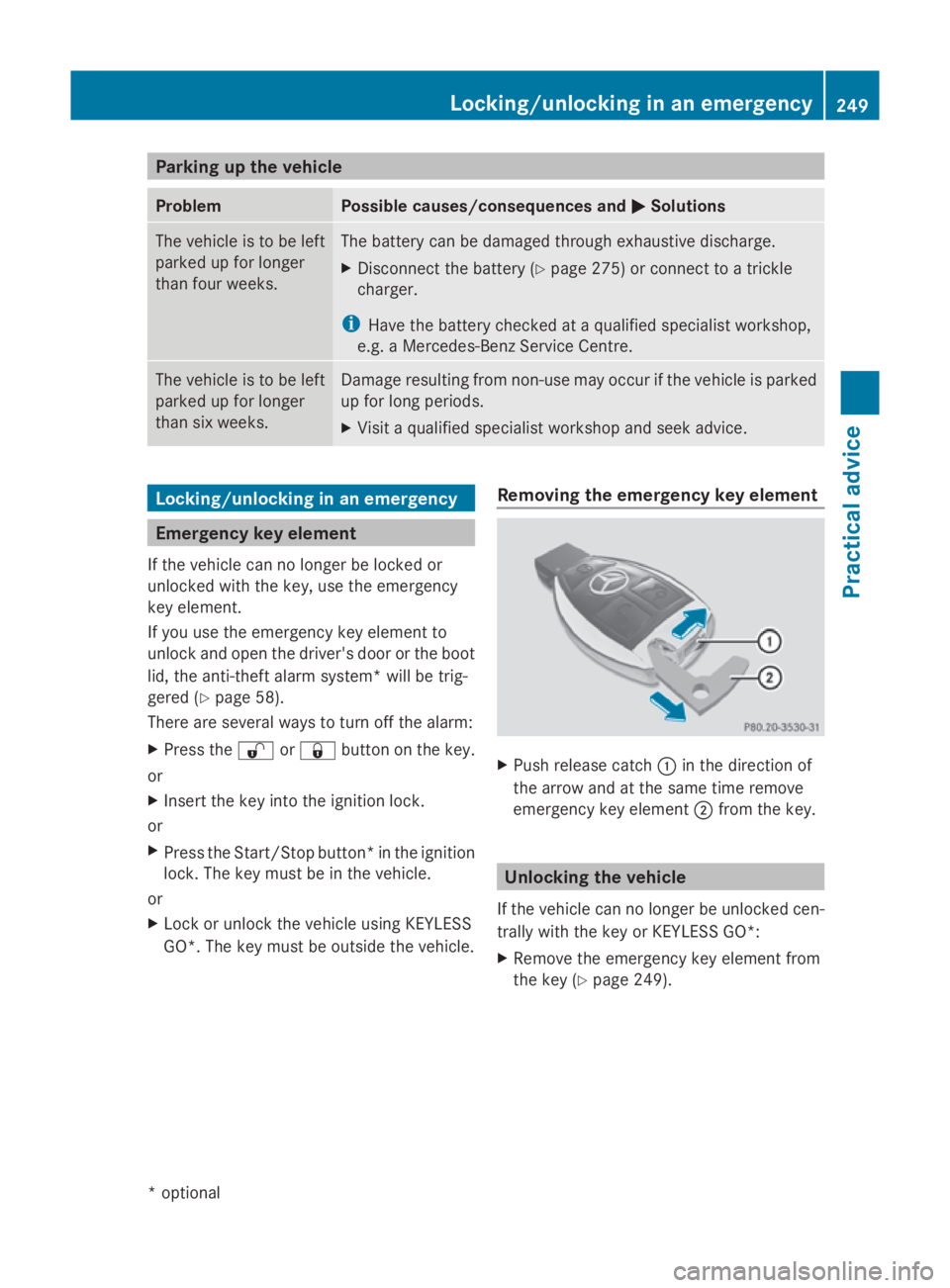
GO*. The key must be outside the vehicle. Removing the emergency key element X
Push release catch 0046in the direction of
the arrow and at the same time remove
emergency key element 0047from the key. Unlocking the vehicle
If the vehicle can no longer be unlocked cen-
trally with the key or KEYLESS GO*:
X Remove the emergency key element from
the key (Y page 249). Locking/unlocking in an emergency
249Practical advice
*optional
207_AKB; 2; 3, en-GB
mkalafa,
Version: 2.11.8.1 2009-07-23T10:23:49+02:00-Seite 249 Z
Page 268 of 313

G
Risk of injury
Compl ywitht he manufacturer' ssafety
instructions shown on the sticke ronthe elec-
tric ai rpum p.
You rvehicle may be equipped with one of two
different ai rpum ps. Version 1can be identi-
fie dbyt he flap, behind which the hos ewith
the pressure gaug eand cable are located;
version 2hasap ressure gaug eintegrate din
the electri cairpump.
Version 1 X
Ope nflap 0047on the electri cairpump.
X Pull connector 0086with cable and ai rpump
hose 0087outoft he housing.
X Screw ai rpum phose 0087onto flange 006Eof
TIREFIT sealant fille rbottle 0046.
X Place TIREFIT sealant fille rbottle 0046head
downwards into recess 008Aof the electric
ai rp um p. X
Remove the cap from valve 0070on the faulty
tyre. X
Make sure pressure release screw 0071on
pressure gauge 0072is fully closed.
X Screw fille rhose 006Fonto valve 0070.
X Inser tconnector 0086into the socke tofthe
cigarette lighter* (Y page 173) or into a
12 Vp ower socke t(Ypage 174) in your
vehicle.
X Vehicles without KEYLES SGO*: turn the
key to position 2(Y page 65) in the ignition
lock.
X Vehicles with KEYLES SGO*: press the
Start/Stop button twice (position
2 (Y page 66)).
X Press on/off switch 0088on the electri cair
pump to I.
The electri cairpump is switched on. The
tyre is inflated.
i First, TIREFIT is pumpe dinto the tyre .The
pressure can briefl yrisetoa round 5bar.
Do no tswitcho ff the electric pump dur-
ing this phase.
X Let the electri cpum prun for five minutes.
The tyre shoul dthen have apressure of at
leas t1.8 bar.
! Do not operate the electri cairpump for
longer than eight minutes at atime without
ab reak. It may otherwise overheat.
The ai rpum pcan be operate dagain once
it ha scooled down. Flat tyre
265Practical advice
*optional
207_AKB
;2;3,en-GB
mkalafa ,V ersion: 2.11.8.1
2009-07-23T10:23:49+02:00
-Seite 265 Z
Page 281 of 313

Towin
gand tow-starting Points to remember
G
Ris
kofa ccident
If yo uhavet he vehicl etowed ,you must us ea
rigid towing ba rif:
R the engine is not running.
R there is abrake system malfunction.
R there is amalfunctio ninthe powe rsupply
or the vehicle's electrical system.
The powe rsteerin gand the brake force boos-
ter do not work when the engine is not run-
ning .Greate rbraking force will the nbe
required and brake peda ltravel will be longer.
If necessary ,dep ress the brake peda lwithf ull
force.
Before towing away ,makes uret ha tthe steer-
ing can be moved and is not locked.
If yo utow or tow-start anothe rvehicle, its
weight must not exceed the maximum per-
missibl egross vehicl eweigh tofy ourvehicle. G
Ris
kofa ccident
The vehicl eisbraked when the HOLD function
or DISTRONI CPLUS* is activated .Therefore,
deactivate HOLD and DISTRONI CPLUSift he
vehicl eistobet owed.
It is better to have the vehicl etransported
tha ntoh aveitt owed.
When towing ,obs erve the lega lrequirements
in al lcountrie sconcerned.
! When towing ,pulla wa yslowly and
smoothly. If the tractiv epower is too high,
the vehicles could be damaged.
! Do not us ethe towing ey efor recovery,
as thi scould damage the vehicle. If in
doubt, recover the vehicl ewithac rane.
! Youm aytow the vehicl efor am aximum
of 50 km. Atowing spee dof50k m/h must
not be exceeded.
For towing distances ove r50km, the entire
vehicl emustbel ifted up and transported. !
On vehicles with KEYLESS-GO *, usethe
key instea dofthe Start/Stop button. Turn
the key to position 2in the ignition lock and
shift the automatic transmission to N.Then
tur nthe key back to 0and leav eitinthe
ignition lock.
! Onlysecur ethe tow cable or towing bar
to the towing eyes .You could otherwise
damage the vehicle.
R Vehicle swithana utomatic transmission*
must not be tow-started.
R If yo uaretowing the vehicl eoveral onger
distance, thi smustbed onew itht he rear
axl eraised.
R Th eign ition must be switched off if yo uare
towing the vehicl ewitht he rea raxler aised.
Otherwise, interventio nbyESP®
could
damage the brake system.
R If the vehicl ehassuffered transmission
damage ,onlyt ow it with the propeller shaft
disconnected.
R If the engine does not start, try jump-start-
ing it (Y page 276).
R If it is not possibl etojump-star tthe vehicle,
have it towed to the neares tqualified spe-
cialist workshop ,e.g.aM ercedes-Benz
Service Centre.
R Th ea utomatic transmission* must be in
position Nwhen the vehicl eisbeing towed.
R Before towing the vehicle, make sure that
the battery is connected and charged. Oth-
erwise:
-yo uc annot switch on the ignition.
- yo uc annot shift the transmission to posi-
tion Non vehicles with automatic trans-
mission*.
- yo uh avenos upport when braking.
i Switch off the automatic locking feature
befor ethe vehicl eistowed (Y page 120).
Otherwise, yo ucould be locked ou twhen
pushing or towing the vehicle. 278
Towin
gand tow-startingPractical advice
*optional
207_AKB; 2; 3, en-GB
mkalafa
,V ersion: 2.11.8.1
2009-07-23T10:23:49+02:00
-Seite 278
Page 282 of 313

Fitting th
etowing eye
Vehicles with atraile rtow hitch*: if you
inten dtou se thevehicl efor towing, fol dout
th eb all couplin gand connec tthe towbar
(Y page 193) to this.
Opening th ecovers The mounting
sfor th eremovable towin geyes
are locate dinthebumpers .They are located
at th efront and rear behind covers. Coupé (example)
X
Press cover 0046inwards on th emarkin gin
th ed irection of th earrow.
X Tak ecover 0046 off th eopening but do not
remove it.
Securing th etowing eye X
Tak ethe towin geye and th ewheel wrench
from th evehicl etoolkit (Y page 207).
X Screw in th etow inge ye clockwise to the
stop.
X Inser tthe wheel wrench handle int othe
towin geye and tighten it. Towing th
evehicle
! You may to wthe vehicl efor am aximum
of 50 km .Atowings pee dof50k m/hm ust
no tbee xceeded.
Fo rtow ingd istances ove r50km,thee ntire
vehicl emust be lifted up and transported.
! The engin emust be switched off (key in
ignition loc kinposition 0or position 1)if
th ev ehicl eisb eingtow ed wit hthe front
axle raised or if th eparking brak eisbeing
tested on adynamometer. Otherwise,
intervention by ESP ®
could damag ethe
brak esystem.
Vehicles with manua ltra nsmission X
Turn th ekeyto position 2(Y page 65 )in
th ei gnition lock.
X Fully depress th eclutch pedal.
X Shift to neutral.
Vehicles with automatic transmission* X
Turn th ekeyto position 2(Y page 65 )in
th ei gnition lock.
X Shift th etransmission to position N. Tow-starting (emergency engine
starting)
Pleas enote:
R Vehicles wit hanautomatic transmission*
must no tbetow-started.
R The battery must be connected.
R The engin eand catalyti cconverter must be
cold.
R Avoid repeated and lengthy starting
attempts.
Vehicles with manua ltra nsmission X
Turn th ekeyto position 2(Y page 65 )in
th ei gnition lock.
X Fully depress th eclutch pedal. Towin
gand tow-starting
279Practical advice
*optional
207_AKB
;2;3,en-GB
mkalafa, Version:2.11.8.1
2009-07-23T10:23:49+02:00
-Seite 279 Z