Page 283 of 506
The operator can override the AUTO mode setting to
change airflow distribution by rotating the Mode Control
knob (on the right) to one of the following positions.
•PanelAir is directed through the outlets in the instrument
panel. These outlets can be adjusted to direct airflow.
NOTE: The center instrument panel outlets can be
aimed so that they are directed toward the rear seat
passengers for maximum airflow to the rear.
•Bi-Level Air is directed through the panel and floor outlets.
NOTE: For all settings except full cold or full hot, there
is a difference in temperature between the upper and
lower outlets. The warmer air flows to the floor outlets.
This feature gives improved comfort during sunny but
cool conditions.
•Floor Air is directed through the floor outlets with a
small amount flowing through the defrost and side
window demist outlets.
•Mix Air is directed through the floor, defrost, and side
window demist outlets. This setting works best in
cold or snowy conditions that require extra heat to
the windshield. This setting is good for maintaining
comfort while reducing moisture on the windshield.
•Defrost Air is directed through the windshield and side
window demist outlets. Use this mode with maxi-
mum blower and temperature settings for best wind-
shield and side window defrosting.
UNDERSTANDING YOUR INSTRUMENT PANEL 281
4
Page 286 of 506
Window Fogging
Interior fogging on the windshield can be quickly re-
moved by turning the mode selector to Defrost. The
Defrost/Floor mode can be used to maintain a clear
windshield and provide sufficient heating. If side win-
dow fogging becomes a problem, increase blower speed.
Vehicle windows tend to fog on the inside in mild but
rainy or humid weather.
NOTE:Recirculate without A/C should not be used for
long periods as fogging may occur.
Side Window Demisters
A side window demister outlet is located at each end of
the instrument panel. These non-adjustable outlets direct
air toward the side windows when the system is in the
Floor, Mix, or Defrost mode. The air is directed at the area
of the windows through which you view the outside
mirrors.
Outside Air Intake
Make sure the air intake, located directly in front of the
windshield, is free of obstructions such as leaves. Leaves
collected in the air intake may reduce airflow, and if they
enter the plenum, they could plug the water drains. In
winter months, make sure the air intake is clear of ice,
slush, and snow.
A/C Air Filter — If Equipped
The A/C Air Filter will reduce, but not eliminate, diesel
and agricultural smells. The filter acts on air coming from
outside the vehicle and recirculated air within the pas-
senger compartment. Refer to “Maintenance Procedures”
in Section 7 of this manual for A/C Air Filter service
information or see your authorized dealer for service.
Refer to the “Maintenance Schedules” in Section 8 of this
manual for filter service intervals.
284 UNDERSTANDING YOUR INSTRUMENT PANEL
Page 292 of 506
�Adding Fuel ......................... 370
▫ Fuel Filler Cap (Gas Cap) .............. 370
▫ Loose Fuel Filler Cap Message ........... 371
� Vehicle Loading ...................... 371
▫ Certification Label ................... 371
� Trailer Towing ........................ 374
▫ Common Towing Definitions ............ 374
▫ Trailer Hitch Classification .............. 379
▫ Trailer Towing Weights (Maximum Trailer
Weight Ratings) ..................... 380 ▫
Trailer And Tongue Weight ............. 382
▫ Towing Requirements ................. 383
▫ Towing Tips ........................ 388
� Recreational Towing
(Behind Motorhome, Etc.) ................ 389
▫ Towing – Two-Wheel Drive Models ....... 389
▫ Towing — Four-Wheel Drive Models ...... 389
290 STARTING AND OPERATING
Page 294 of 506
If Engine Fails to Start
WARNING!
•Never pour fuel or other flammable liquids into
the throttle body air inlet opening in an attempt to
start the vehicle. This could result in a flash fire
causing serious personal injury.(Continued)
WARNING! (Continued)
•Do not attempt to push or tow your vehicle to get
it started. Vehicles equipped with an automatic
transmission cannot be started this way. Unburned
fuel could enter the catalytic converter and once
the engine has started, ignite and damage the
converter and vehicle. If the vehicle has a dis-
charged battery, booster cables may be used to
obtain a start from a booster battery or the battery
in another vehicle. This type of start can be dan-
gerous if done improperly. Refer to Section 6 of
this manual for proper jump starting procedures
and follow them carefully.
292 STARTING AND OPERATING
Page 300 of 506
WARNING! (Continued)
•It is dangerous to move the shift lever out of PARK
or NEUTRAL if the engine speed is higher than
idle speed. If your foot is not firmly on the brake
pedal, the vehicle could accelerate quickly forward
or in reverse. You could lose control of the vehicle
and hit someone or something. Only shift into
gear when the engine is idling normally and when
your right foot is firmly on the brake pedal.
REVERSE
This range is for moving the vehicle rearward. Use this
range only after the vehicle has come to a complete stop.
NEUTRAL
This range is used when the vehicle is standing for
prolonged periods with the engine running. The engine
may be started in this range. Set the parking brake if you
must leave the vehicle. NOTE:
Towing the vehicle, coasting, or driving for any
other reason with shift lever in NEUTRAL can result in
severe transmission damage. Refer to “Recreational Tow-
ing” in Section 5 and “Towing a Disabled Vehicle” in
Section 6 of this manual.
DRIVE
This range is used for most city and highway driving.
2 (Second)
This range is used for moderate grades and to assist
braking on dry pavement or in mud and snow. Begins at
a stop in low gear with automatic upshift to 2nd gear.
Will not shift to 3rd gear.
1 (First)
This range is used for hard pulling at low speeds in mud,
sand, snow, or on steep grades. Begins and stays in low
gear with no upshift. Provides engine compression brak-
ing at low speeds.
298 STARTING AND OPERATING
Page 301 of 506
Overdrive Operation
The overdrive automatic transmission contains an elec-
tronically controlled 4th speed (OVERDRIVE). The trans-
mission will automatically shift from 3rd gear to OVER-
DRIVE if the following conditions are present:
•the shift lever is in DRIVE
•the engine coolant has reached normal operating tem-
perature
•vehicle speed is above approximately 30 mph
(48 km/h)
•the TOW/HAUL button has not been activated
•the transmission has reached normal operating
temperature
NOTE:
•If the vehicle is started in extremely cold temperatures,
the transmission may not shift into OVERDRIVE and will automatically select the most desirable gear for
operation at this temperature. Normal operation will
resume when the transmission fluid temperature has
risen to a suitable level. Refer to the “Note” under
“Torque Converter Clutch” in this section.
•If the transmission temperature gets extremely hot, the
transmission will automatically select the most desir-
able gear for operation at this temperature. If the
transmission temperature becomes hot enough, the
“Transmission Temperature Warning Light” may illu-
minate and the transmission may downshift out of
OVERDRIVE until the transmission cools down. After
the transmission cools down, the transmission will
resume normal operation.
The transmission will downshift from OVERDRIVE to
DRIVE if the accelerator pedal is fully pressed at vehicle
speeds above approximately 35 mph (56 km/h).
STARTING AND OPERATING 299
5
Page 302 of 506
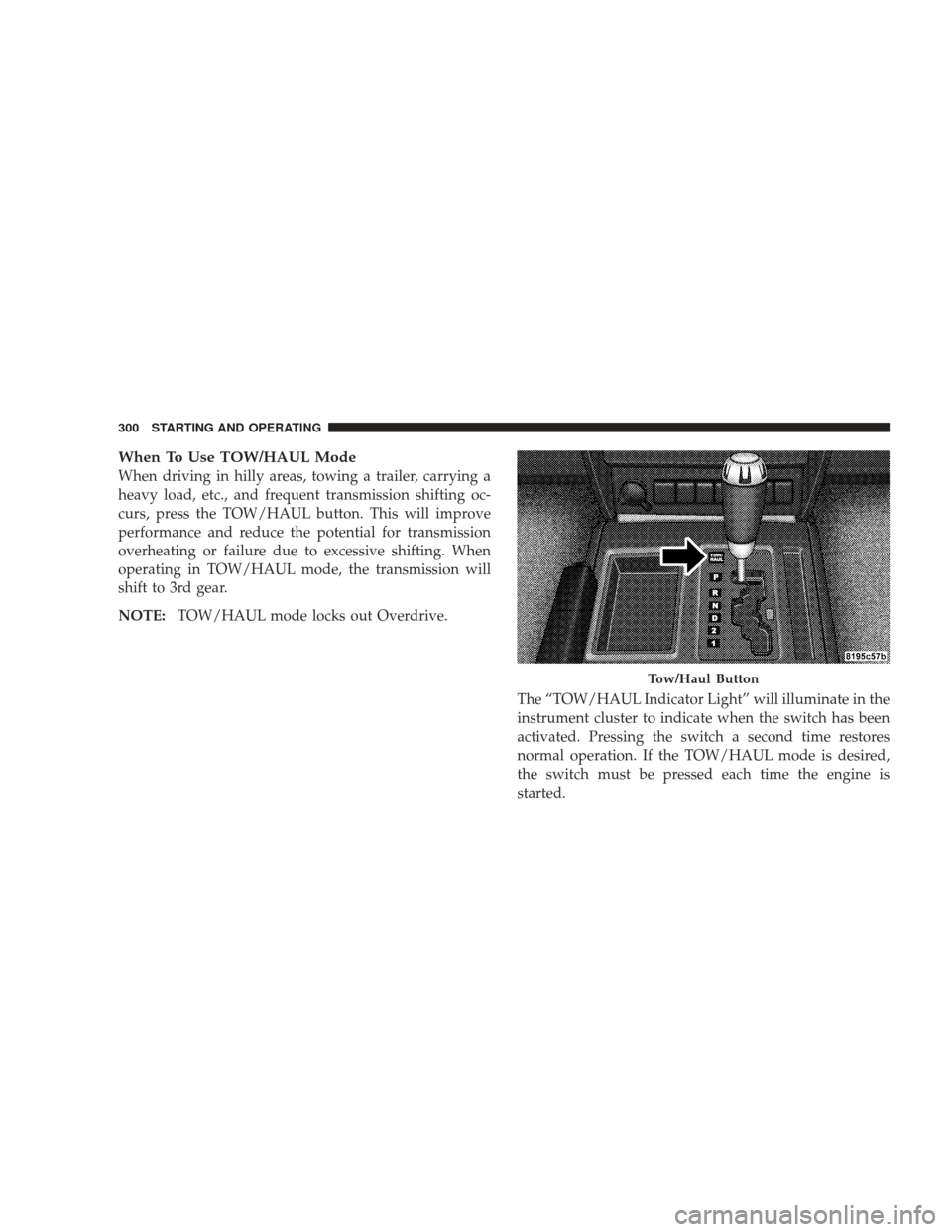
When To Use TOW/HAUL Mode
When driving in hilly areas, towing a trailer, carrying a
heavy load, etc., and frequent transmission shifting oc-
curs, press the TOW/HAUL button. This will improve
performance and reduce the potential for transmission
overheating or failure due to excessive shifting. When
operating in TOW/HAUL mode, the transmission will
shift to 3rd gear.
NOTE:TOW/HAUL mode locks out Overdrive.
The “TOW/HAUL Indicator Light” will illuminate in the
instrument cluster to indicate when the switch has been
activated. Pressing the switch a second time restores
normal operation. If the TOW/HAUL mode is desired,
the switch must be pressed each time the engine is
started.
Tow/Haul Button
300 STARTING AND OPERATING
Page 304 of 506
FOUR-WHEEL DRIVE OPERATION
MP1522 Command-Trac�Transfer Case — If
Equipped
Operating Information and Precautions
The Command-Trac� transfer case provides four posi-
tions:
•Two–wheel drive (2WD) high range
•Four-wheel drive (4WD LOCK) high range
•Four-wheel drive (4WD LOW) low range
•Neutral (N)
This transfer case is intended to be driven in the two-
wheel drive position (2WD) for normal street and high-
way conditions such as dry hard-surfaced roads.
When additional traction is required, select the transfer
case 4WD LOCK position or 4WD LOW position. This position locks the front driveshaft and rear driveshaft
together and forces the front and rear wheels to rotate at
the same speed.
Use the transfer case NEUTRAL position for recreational
towing only. Refer to “Recreational Towing” in this
section for specific procedures on shifting into and out of
NEUTRAL.
CAUTION!
•Do not attempt to make a shift while only the front
wheels or rear wheels are spinning. The MP1522
Command-Trac�
transfer case is not equipped
with a synchronizer and therefore the speed of the
front driveshaft and rear driveshaft must be equal
for the shift to take place. Shifting while only the
front wheels or rear wheels are spinning can cause
damage to the transfer case.
(Continued)
302 STARTING AND OPERATING