Page 353 of 521
spare tire can be used in place of any of the four road
tires. A low spare tire will set the “SPARE LOW PRES-
SURE” message, but it will not cause the Tire Pressure
Monitoring Telltale Light to illuminate or the chime to
sound.
Tire Pressure Monitoring Low Pressure Warnings
The Tire Pressure Monitoring Telltale Light will
illuminate in the instrument cluster, and an au-
dible chime will be activated, when one or more of
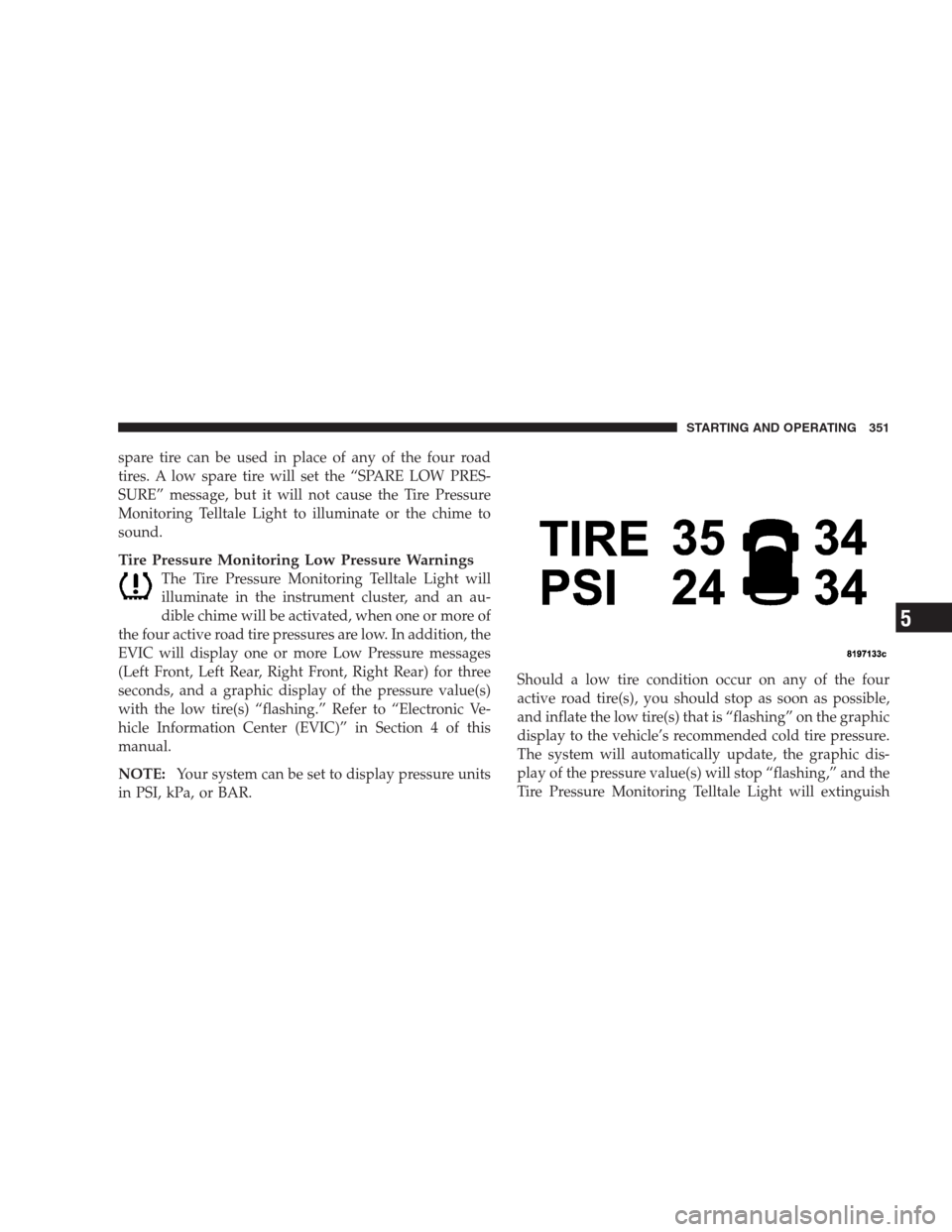
the four active road tire pressures are low. In addition, the
EVIC will display one or more Low Pressure messages
(Left Front, Left Rear, Right Front, Right Rear) for three
seconds, and a graphic display of the pressure value(s)
with the low tire(s) “flashing.” Refer to “Electronic Ve-
hicle Information Center (EVIC)” in Section 4 of this
manual.
NOTE:Your system can be set to display pressure units
in PSI, kPa, or BAR.Should a low tire condition occur on any of the four
active road tire(s), you should stop as soon as possible,
and inflate the low tire(s) that is “flashing” on the graphic
display to the vehicle’s recommended cold tire pressure.
The system will automatically update, the graphic dis-
play of the pressure value(s) will stop “flashing,” and the
Tire Pressure Monitoring Telltale Light will extinguish
STARTING AND OPERATING 351
5
Page 354 of 521
once the updated tire pressure(s) have been received. The
vehicle may need to be driven for up to 20 minutes above
15 mph (24 km/h) to receive this information.
CHECK TPM SYSTEM Warning
The Tire Pressure Monitoring Telltale Light will flash on
and off for 75 seconds, and remain on solid when a
system fault is detected. The system fault will also sound
a chime. The EVIC will display a “CHECK TPM SYS-
TEM” message for three seconds. This message is then
followed by a graphic display, with “- -“ in place of the
pressure value(s), indicating which Tire Pressure Moni-
toring Sensor(s) is not being received.
NOTE:Your system can be set to display pressure units
in PSI, kPa, or BAR.
352 STARTING AND OPERATING
Page 355 of 521

If the ignition key is cycled, this sequence will repeat,
providing the system fault still exists. If the system fault
no longer exists, the Tire Pressure Monitoring Telltale
Light will no longer flash, the�CHECK TPM SYSTEM�
message will not be present, and a pressure value will be
displayed instead of dashes. A system fault can occur by
any of the following:
1. Jamming due to electronic devices or driving next to
facilities emitting the same Radio Frequencies as the TPM
sensors.
2. Installing some form of aftermarket window tinting
that affects radio wave signals.
3. Lots of snow or ice around the wheels or wheel
housings.
4. Using tire chains on the vehicle.
5. Using wheels/tires not equipped with TPM sensors.The EVIC will also display a�CHECK TPM SYSTEM�
message for three seconds when a system fault is de-
tected possibly related to the trigger component. In this
case, the�CHECK TPM SYSTEM�message is then fol-
lowed by a graphic display, with pressure values still
shown. This indicates the pressure values are still being
received from the TPM Sensors. However, the system still
needs to be serviced as long as the�CHECK TPM
SYSTEM�message exists.
NOTE:
•If your vehicle is equipped with a matching full-size
spare wheel and tire assembly, it has a tire pressure
monitoring sensor, and can be monitored by the Tire
Pressure Monitoring System (TPMS). In the event that
the matching full-size spare tire is swapped with a low
pressure road tire, the next ignition key cycle will still
show the Tire Pressure Monitoring Telltale Light to be
ON, a chime to sound, a Low Pressure message to
appear in the EVIC, and the graphic display will still
STARTING AND OPERATING 353
5
Page 356 of 521

show the low tire pressure value “flashing.” Driving
the vehicle for up to 20 minutes above 15 mph
(24 km/h) will turn OFF the Tire Pressure Monitoring
Telltale Light as long as none of road tires are below
the low pressure warning threshold. The EVIC will
also display a “SPARE LOW PRESSURE” message,
and the graphic display will show a tire pressure value
in place of the “flashing” low tire pressure value.
•If your vehicle is not equipped with a matching
full-size spare wheel and tire assembly, it does not
have a tire pressure monitoring sensor in the spare tire.
The TPMS will not be able to monitor the tire pressure.
If you install the spare tire in place of a road tire that
has a pressure below the low-pressure warning limit,
upon the next ignition key cycle, the Tire Pressure
Monitoring Telltale Light will remain ON, a chime will
sound, and the EVIC will still display a “flashing”
pressure value in the graphic display. After driving the
vehicle for up to 20 minutes above 15 mph (24 km/h),the Tire Pressure Monitoring Telltale Light will flash
on and off for 75 seconds and then remain on solid. In
addition, the EVIC will display a “CHECK TPM
SYSTEM�message for three seconds and then display
dashes (- -) in place of the pressure value. For each
subsequent ignition key cycle, a chime will sound, the
Tire Pressure Monitoring Telltale Light will flash on
and off for 75 seconds and then remain on solid, and
the EVIC will display a�CHECK TPM SYSTEM�
message for three seconds and then display dashes (- -)
in place of the pressure value. Once you repair or
replace the original road tire, and reinstall it on the
vehicle in place of the spare tire, the TPMS will update
automatically.
In addition, the Tire Pressure Monitoring Telltale Light
will turn OFF and the graphic in the EVIC will display a
new pressure value instead of dashes (- -), as long as no
tire pressure is below the low-pressure warning limit in
any of the four active road tires. The vehicle may need to
354 STARTING AND OPERATING
Page 368 of 521

WARNING!
•Never have any smoking materials lit in or near
the vehicle when the gas cap is removed or the
tank filled.
•Never add fuel when the engine is running. This is
in violation of most state and federal fire regula-
tions and will cause the malfunction indicator
light to turn on.
NOTE:Tighten the gas cap about one-quarter turn until
you hear one click. This is an indication that the cap is
properly tightened.
If the gas cap is not tighten properly, the Malfunction
Indicator Light will come on. Be sure the gas cap is
tightened every time the vehicle is refueled.
WARNING!
A fire may result if gasoline is pumped into a
portable container that is inside of a vehicle. You
could be burned. Always place gas containers on the
ground while filling.
Loose Fuel Filler Cap Message
If the vehicle diagnostic system determines that the fuel
filler cap is loose, improperly installed, or damaged, a
“CHECK GASCAP” message will be displayed in the
EVIC (Electronic Vehicle Information Center). Refer to
“Electronic Vehicle Information Center” in Section 4 of
this manual. Tighten the fuel filler cap until a “clicking”
sound is heard. This is an indication that the fuel filler
cap is properly tightened. Refer to “Onboard Diagnostic
System — OBDII” in Section 7 of this manual for more
information.
366 STARTING AND OPERATING
Page 386 of 521
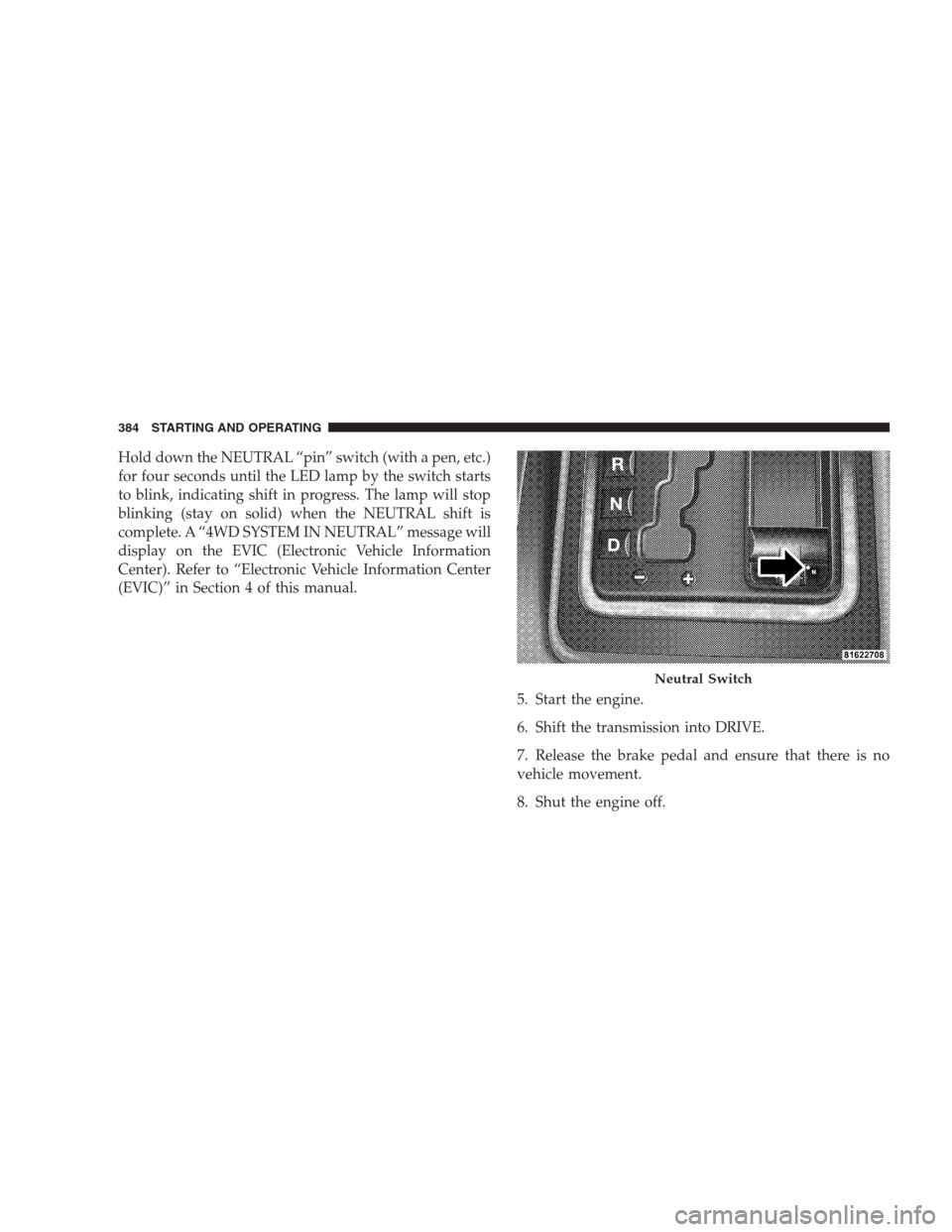
Hold down the NEUTRAL “pin” switch (with a pen, etc.)
for four seconds until the LED lamp by the switch starts
to blink, indicating shift in progress. The lamp will stop
blinking (stay on solid) when the NEUTRAL shift is
complete. A “4WD SYSTEM IN NEUTRAL” message will
display on the EVIC (Electronic Vehicle Information
Center). Refer to “Electronic Vehicle Information Center
(EVIC)” in Section 4 of this manual.
5. Start the engine.
6. Shift the transmission into DRIVE.
7. Release the brake pedal and ensure that there is no
vehicle movement.
8. Shut the engine off.
Neutral Switch
384 STARTING AND OPERATING
Page 388 of 521
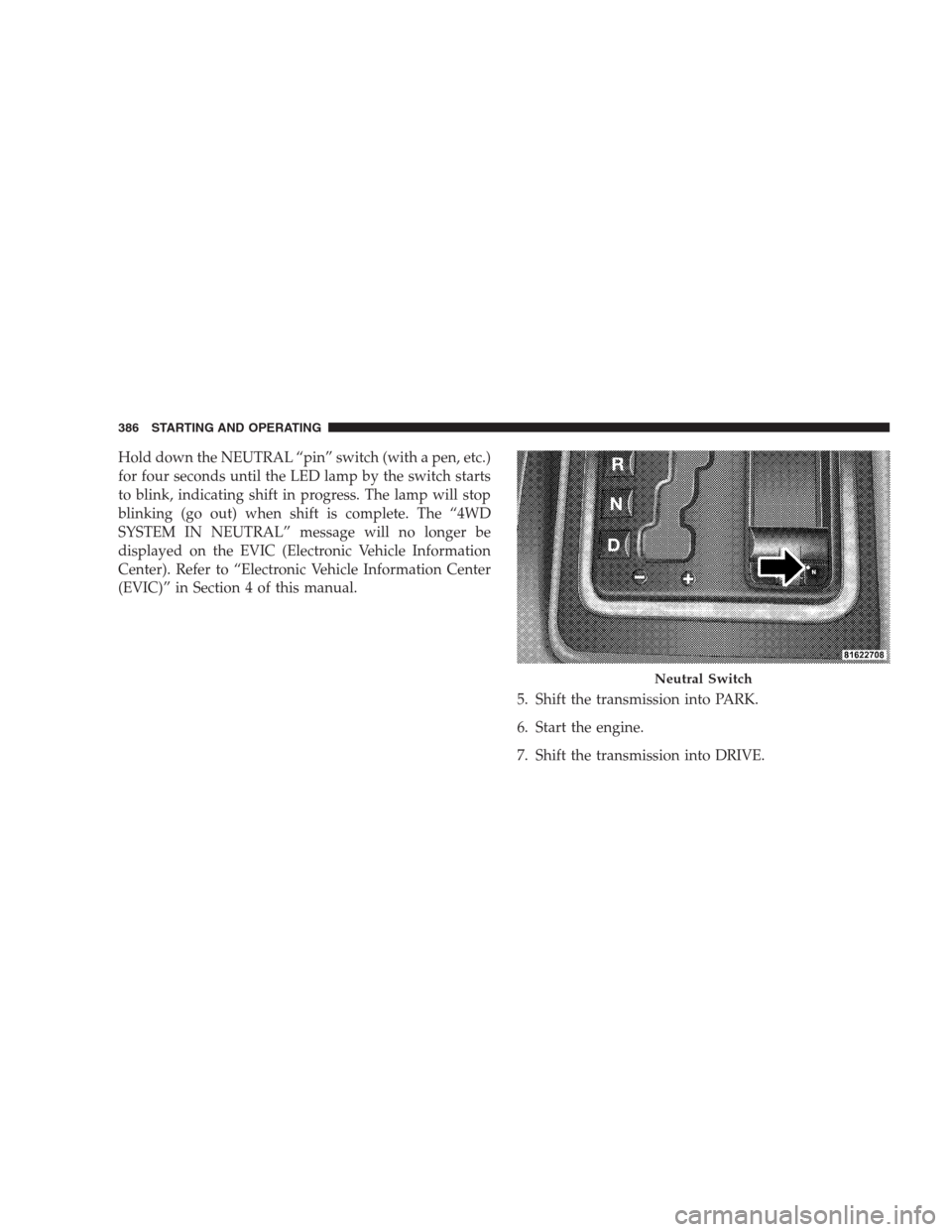
Hold down the NEUTRAL “pin” switch (with a pen, etc.)
for four seconds until the LED lamp by the switch starts
to blink, indicating shift in progress. The lamp will stop
blinking (go out) when shift is complete. The “4WD
SYSTEM IN NEUTRAL” message will no longer be
displayed on the EVIC (Electronic Vehicle Information
Center). Refer to “Electronic Vehicle Information Center
(EVIC)” in Section 4 of this manual.
5. Shift the transmission into PARK.
6. Start the engine.
7. Shift the transmission into DRIVE.
Neutral Switch
386 STARTING AND OPERATING
Page 412 of 521
ONBOARD DIAGNOSTIC SYSTEM — OBD II
Your vehicle is equipped with a sophisticated onboard
diagnostic system called OBD II. This system monitors
the performance of the emissions, engine, and automatic
transmission control systems. When these systems are
operating properly, your vehicle will provide excellent
performance and fuel economy, as well as engine emis-
sions well within current government regulations.
If any of these systems require service, the OBD II system
will turn on the “Malfunction Indicator Light.” It will
also store diagnostic codes and other information to
assist your service technician in making repairs. Al-
though your vehicle will usually be drivable and not
need towing, see your authorized dealer for service as
soon as possible.CAUTION!
•Prolonged driving with the “Malfunction Indica-
tor Light” on could cause further damage to the
emission control system. It could also affect fuel
economy and drivability. The vehicle must be
serviced before any emissions tests can be per-
formed.
•If the “Malfunction Indicator Light” is flashing
while the engine is running, severe catalytic con-
verter damage and power loss will soon occur.
Immediate service is required.
Loose Fuel Filler Cap Message
After fuel is added, the vehicle diagnostic system can
determine if the fuel filler cap is loose, improperly
installed, or damaged. A “CHECK GASCAP” message
will be displayed in the EVIC (Refer to Section 4 of this
410 MAINTAINING YOUR VEHICLE