2009 JEEP GRAND CHEROKEE display
[x] Cancel search: displayPage 295 of 521
OVER TEMP” message may display, and the transmis-
sion may downshift out of Overdrive until the transmis-
sion cools down. After cool down, the transmission will
resume normal operation.
In high ambient temperatures with sustained high engine
speed and load, an upshift, followed shortly thereafter by
a downshift, may occur. The TOW/HAUL light will turn
off. This is a normal part of the overheat protection
strategy when operating in the TOW/HAUL mode.
The transmission will downshift from Overdrive, to the
most desirable gear, if the accelerator pedal is fully
depressed at vehicle speeds above approximately 35 mph
(56 km/h).
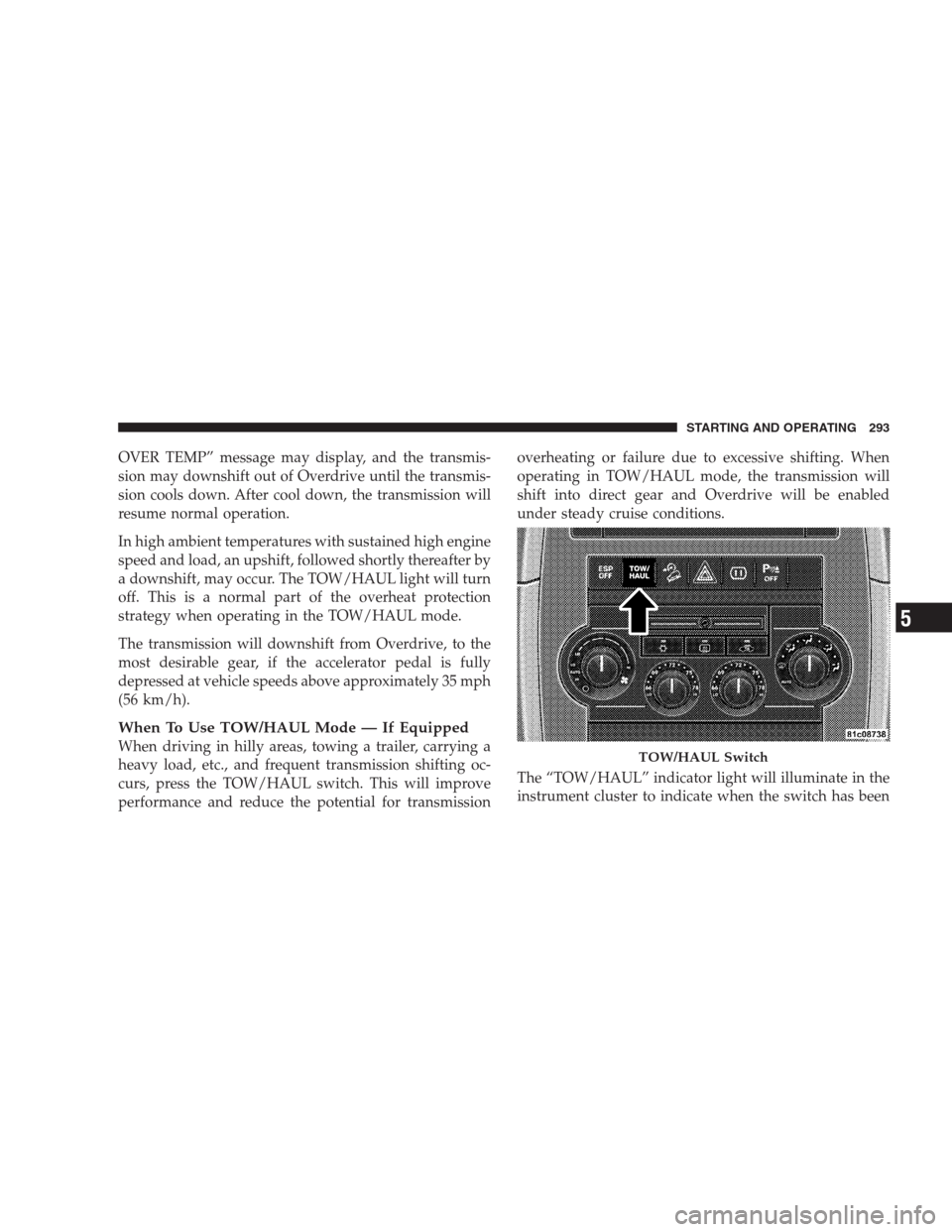
When To Use TOW/HAUL Mode — If Equipped
When driving in hilly areas, towing a trailer, carrying a
heavy load, etc., and frequent transmission shifting oc-
curs, press the TOW/HAUL switch. This will improve
performance and reduce the potential for transmissionoverheating or failure due to excessive shifting. When
operating in TOW/HAUL mode, the transmission will
shift into direct gear and Overdrive will be enabled
under steady cruise conditions.
The “TOW/HAUL” indicator light will illuminate in the
instrument cluster to indicate when the switch has beenTOW/HAUL Switch
STARTING AND OPERATING 293
5
Page 302 of 521
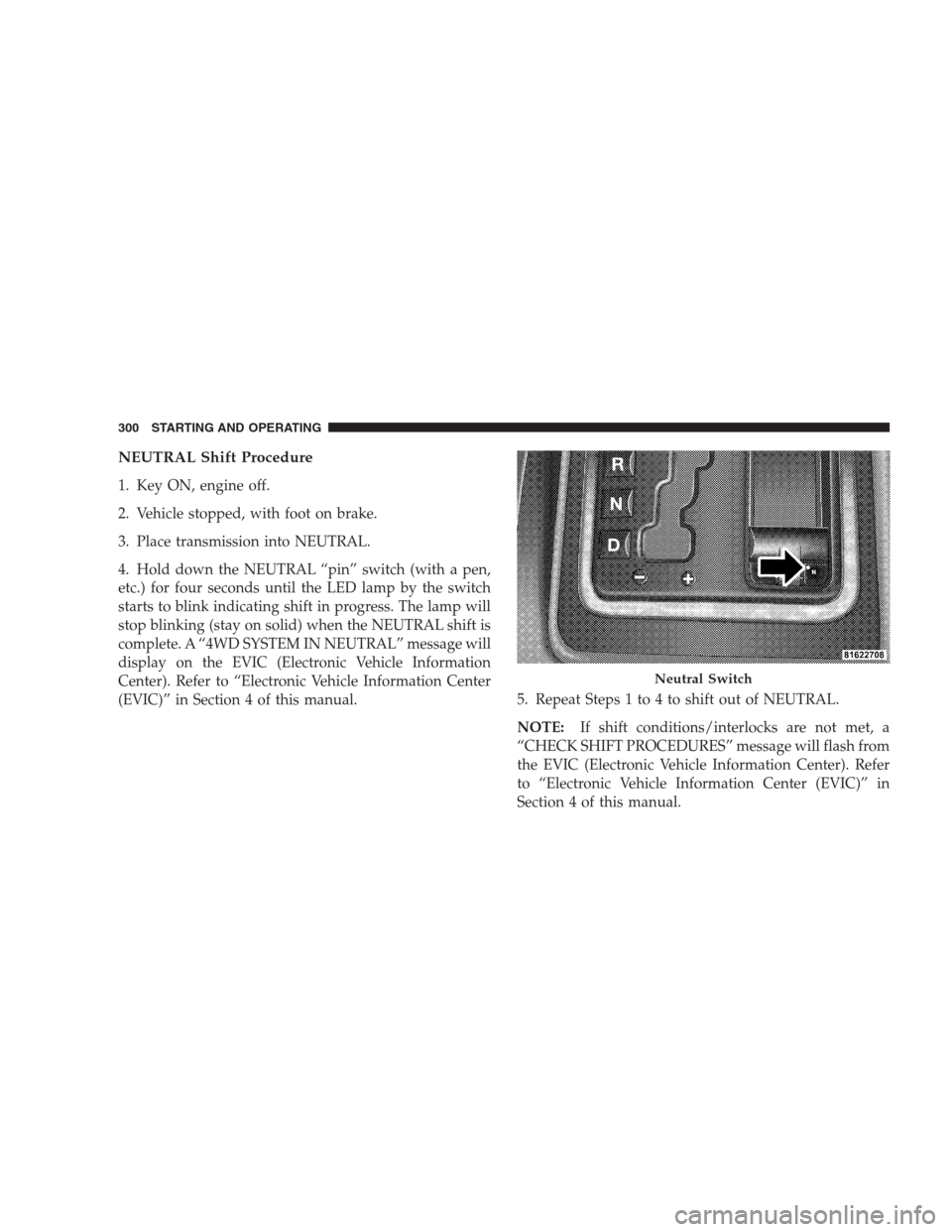
NEUTRAL Shift Procedure
1. Key ON, engine off.
2. Vehicle stopped, with foot on brake.
3. Place transmission into NEUTRAL.
4. Hold down the NEUTRAL “pin” switch (with a pen,
etc.) for four seconds until the LED lamp by the switch
starts to blink indicating shift in progress. The lamp will
stop blinking (stay on solid) when the NEUTRAL shift is
complete. A “4WD SYSTEM IN NEUTRAL” message will
display on the EVIC (Electronic Vehicle Information
Center). Refer to “Electronic Vehicle Information Center
(EVIC)” in Section 4 of this manual.5. Repeat Steps 1 to 4 to shift out of NEUTRAL.
NOTE:If shift conditions/interlocks are not met, a
“CHECK SHIFT PROCEDURES” message will flash from
the EVIC (Electronic Vehicle Information Center). Refer
to “Electronic Vehicle Information Center (EVIC)” in
Section 4 of this manual.
Neutral Switch
300 STARTING AND OPERATING
Page 320 of 521
NOTE:To improve the vehicle’s traction when driving
with snow chains, or starting off in deep snow, sand, or
gravel, it may be desirable to switch to the “Partial Off”
mode by pressing the ESP OFF switch. Once the situation
requiring ESP to be switched to the “Partial Off” mode is
overcome, turn ESP back on by momentarily depressing
the ESP OFF switch. This may be done while the vehicle
is in motion.
Full Off (4WD Models Only)
This mode is intended for off-highway or off-road use
when ESP stability features could inhibit vehicle maneu-
verability due to trail conditions. This mode is entered by
depressing and holding the ESP OFF switch for five
seconds when the vehicle is stopped and the engine is
running. After five seconds, the ESP/TCS Indicator Light
will illuminate, and the “ESP OFF” message will appear
in the Electronic Vehicle Information Center (EVIC).
Refer to “Electronic Vehicle Information Center (EVIC)”
in Section 4 of this manual for more information.In this mode, ESP and TCS, except for the “limited slip”
feature described in the TCS section, are turned off until
the vehicle reaches a speed of 40 mph (64 km/h). At
40 mph (64 km/h), the system returns to “Partial Off”
mode, described above. When the vehicle speed drops
below 35 mph (56 km/h), the ESP system shuts off. ESP
is deactivated at low vehicle speeds so that it will not
interfere with off-road driving, but ESP function returns
to provide the stability feature at speeds above 40 mph
(64 km/h). The ESP/TCS Indicator Light will always be
illuminated when ESP is off. To turn ESP on again,
momentarily depress the ESP OFF switch. This will
restore the normal “ESP On” mode of operation.
NOTE:The “ESP OFF” message will display, and the
audible chime will sound, when the shift lever is placed
in the PARK position from any other position, and then
moved out of the PARK position. This will occur even if
the message was previously cleared.
318 STARTING AND OPERATING
Page 321 of 521
WARNING!
With the ESP switched off, the enhanced vehicle
stability offered by ESP and ERM are unavailable. In
an emergency evasive maneuver, the ESP and ERM
systems will not engage to assist in maintaining
stability. The “Full Off” ESP mode is intended for
off-road use only.
4WD Low Range
Full Off
This is the normal operating mode for ESP in 4WD LOW
range. Whenever the vehicle is started in 4WD LOW
range, or the transfer case (if equipped) is shifted from
4WD HIGH range or NEUTRAL to 4WD LOW range, the
ESP system will be in this “Full Off” mode. In 4WD LOW
range, ESP and TCS, except for the “limited slip” feature
described in the TCS section, are turned off until the
vehicle reaches a speed of 40 mph (64 km/h). At 40 mph(64 km/h), the normal ESP stability function returns but
TCS remains off. When the vehicle speed drops below
35 mph (56 km/h), the ESP system shuts off. ESP is
deactivated at low vehicle speeds in 4WD LOW range so
that it will not interfere with off-road driving but ESP
function returns to provide the stability feature at speeds
above 40 mph (64 km/h). The ESP/TCS Indicator Light
will always be illuminated in 4WD LOW range when ESP
is off.
NOTE:The “ESP OFF” message will display, and the
audible chime will sound, when the shift lever is placed
in the PARK position from any other position, and then
moved out of the PARK position. This will occur even if
the message was previously cleared
STARTING AND OPERATING 319
5
Page 346 of 521
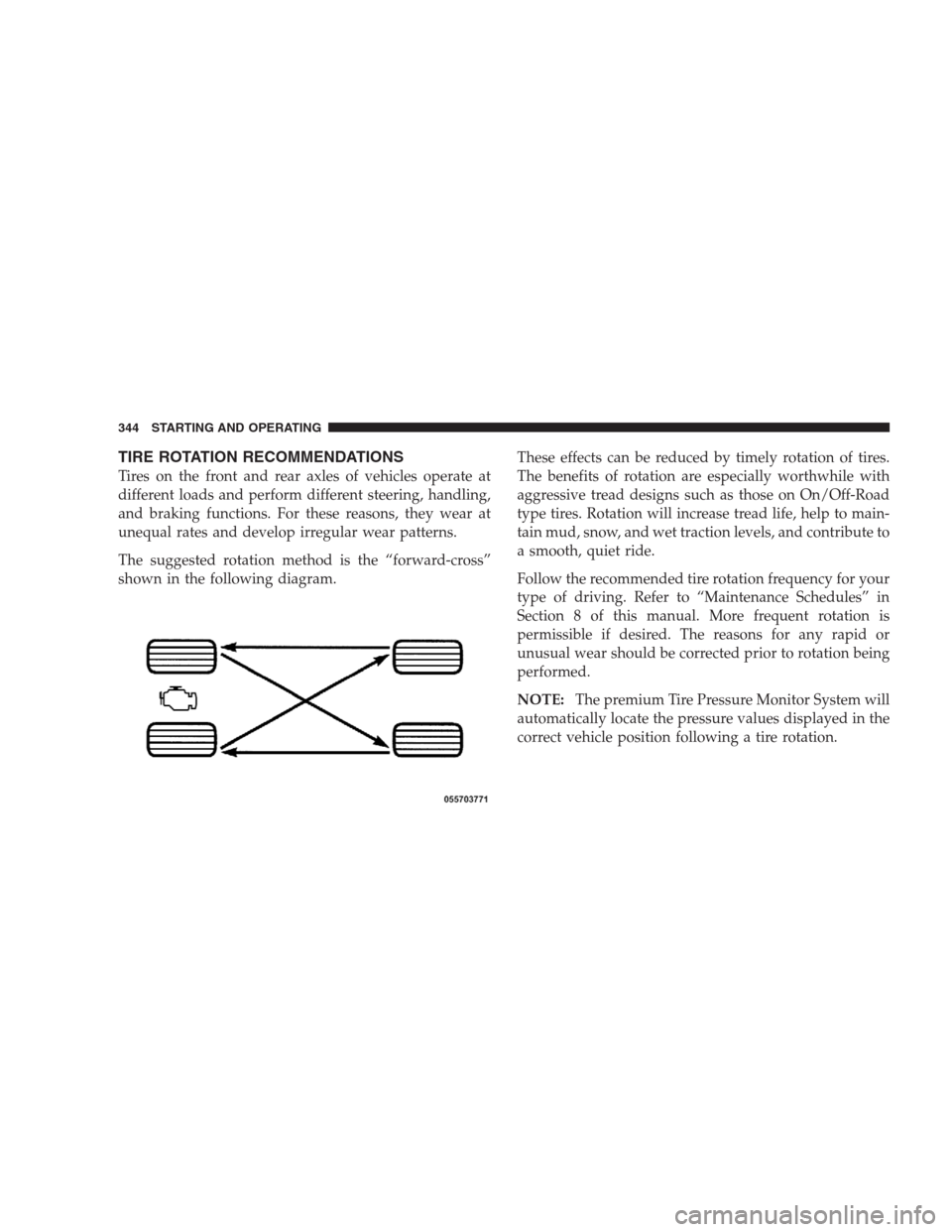
TIRE ROTATION RECOMMENDATIONS
Tires on the front and rear axles of vehicles operate at
different loads and perform different steering, handling,
and braking functions. For these reasons, they wear at
unequal rates and develop irregular wear patterns.
The suggested rotation method is the “forward-cross”
shown in the following diagram.These effects can be reduced by timely rotation of tires.
The benefits of rotation are especially worthwhile with
aggressive tread designs such as those on On/Off-Road
type tires. Rotation will increase tread life, help to main-
tain mud, snow, and wet traction levels, and contribute to
a smooth, quiet ride.
Follow the recommended tire rotation frequency for your
type of driving. Refer to “Maintenance Schedules” in
Section 8 of this manual. More frequent rotation is
permissible if desired. The reasons for any rapid or
unusual wear should be corrected prior to rotation being
performed.
NOTE:The premium Tire Pressure Monitor System will
automatically locate the pressure values displayed in the
correct vehicle position following a tire rotation.
344 STARTING AND OPERATING
Page 350 of 521
A tire pressure monitoring sensor is located in the spare
wheel, if the vehicle is equipped with a matching full-size
spare wheel and tire assembly. The matching full-size
spare tire can be used in place of any of the four road
tires. A low spare tire will not cause the Tire Pressure
Monitoring Telltale Light to illuminate, a warning mes-
sage to appear, or the chime to sound.
The Tire Pressure Monitoring Telltale Light will
illuminate in the instrument cluster, a “TIRE LOW
PRESSURE” message will display in the instru-
ment cluster for 60 seconds, and an audible chime will be
activated, when one or more of the four active road tire
pressures are low. Should this occur, you should stop as
soon as possible, check the inflation pressure of each tire
on your vehicle, and inflate each tire to the vehicle’s
recommended cold placard pressure value. The system
will automatically update and the Tire Pressure Monitor-
ing Telltale Light will extinguish, once the updated tirepressures have been received. The vehicle may need to be
driven for up to 20 minutes above 15 mph (24 km/h) to
receive this information.
The Tire Pressure Monitoring Telltale Light will flash on
and off for 75 seconds, and remain on solid when a
system fault is detected. In addition, a “CHECK TPM
SYSTEM” message will be displayed for 75 seconds when
a system fault is detected, and a chime will sound. If the
ignition key is cycled, this sequence will repeat, provid-
ing the system fault still exists. The Tire Pressure Moni-
toring Telltale Light will turn off when the fault condition
no longer exists. A system fault can occur by any of the
following:
1. Jamming due to electronic devices or driving next to
facilities emitting the same Radio Frequencies as the TPM
sensors.
2. Installing some form of aftermarket window tinting
that affects radio wave signals.
348 STARTING AND OPERATING
Page 351 of 521
3. Lots of snow or ice around the wheels or wheel
housings.
4. Using tire chains on the vehicle.
5. Using wheels/tires not equipped with TPM sensors.
NOTE:
•If your vehicle is equipped with a matching full-size
spare wheel and tire assembly, it has a tire pressure
monitoring sensor, and can be monitored by the Tire
Pressure Monitoring System (TPMS). In the event that
the matching full-size spare tire is swapped with a low
pressure road tire, the next ignition key cycle will still
show the Tire Pressure Monitoring Telltale Light to be
ON, a “TIRE LOW PRESSURE” message will be
displayed in the instrument cluster for 60 seconds, and
a chime to sound. Driving the vehicle for up to
20 minutes above 15 mph (24 km/h) will turn OFF theTire Pressure Monitoring Telltale Light as long as none
of the road tires are below the low pressure warning
threshold.
•If your vehicle is not equipped with a matching
full-size spare wheel and tire assembly, it does not
have a tire pressure monitoring sensor in the spare tire.
The TPMS will not be able to monitor the tire pressure.
If you install the spare tire, in place of a road tire, that
has a pressure below the low-pressure warning limit,
upon the next ignition key cycle, a chime will sound, a
“TIRE LOW PRESSURE” message will be displayed in
the instrument cluster for 60 seconds, and the Tire
Pressure Monitoring Telltale Light will turn ON. After
driving the vehicle for up to 20 minutes above 15 mph
(25 km/h), the Tire Pressure Monitoring Telltale Light
will flash on and off for 75 seconds and then remain on
solid. In addition, a “CHECK TPM SYSTEM” message
will be displayed for 75 seconds. For each subsequent
ignition key cycle, a chime will sound, a “CHECK
STARTING AND OPERATING 349
5
Page 352 of 521

TPM SYSTEM” message will be displayed for 75 sec-
onds, and the Tire Pressure Monitoring Telltale Light
will flash on and off for 75 seconds and then remain on
solid. Once you repair or replace the original road tire,
and reinstall it on the vehicle in place of the spare tire,
the TPMS will update automatically and the Tire
Pressure Monitoring Telltale Light will turn OFF, as
long as no tire pressure is below the low-pressure
warning limit in any of the four active road tires. The
vehicle may need to be driven for up to 20 minutes
above 15 mph (24 km/h) in order for the TPMS to
receive this information.
Premium System — If Equipped
The Tire Pressure Monitor System (TPMS) uses wireless
technology with wheel rim-mounted electronic sensors to
monitor tire pressure levels. Sensors, mounted to each
wheel as part of the valve stem, transmit tire pressure
readings to the Receiver Module.NOTE:It is particularly important, for you to regularly
check the tire pressure in all of your tires and to maintain
the proper pressure.
The Tire Pressure Monitor System (TPMS) consists of the
following components:
•Receiver Module
•Four Tire Pressure Monitoring Sensors
•Three Trigger Modules (mounted in three of the four
wheel wells)
•Various Tire Pressure Monitoring System Messages,
which display in the Electronic Vehicle Information
Center (EVIC), and a graphic displaying tire pressures
•Tire Pressure Monitoring Telltale Light
A tire pressure monitoring sensor is located in the spare
wheel, if the vehicle is equipped with a matching full-size
spare wheel and tire assembly. The matching full-size
350 STARTING AND OPERATING