2009 Hyundai Santa Fe charging
[x] Cancel search: chargingPage 10 of 269
YOUR VEHICLE AT A GLANCE
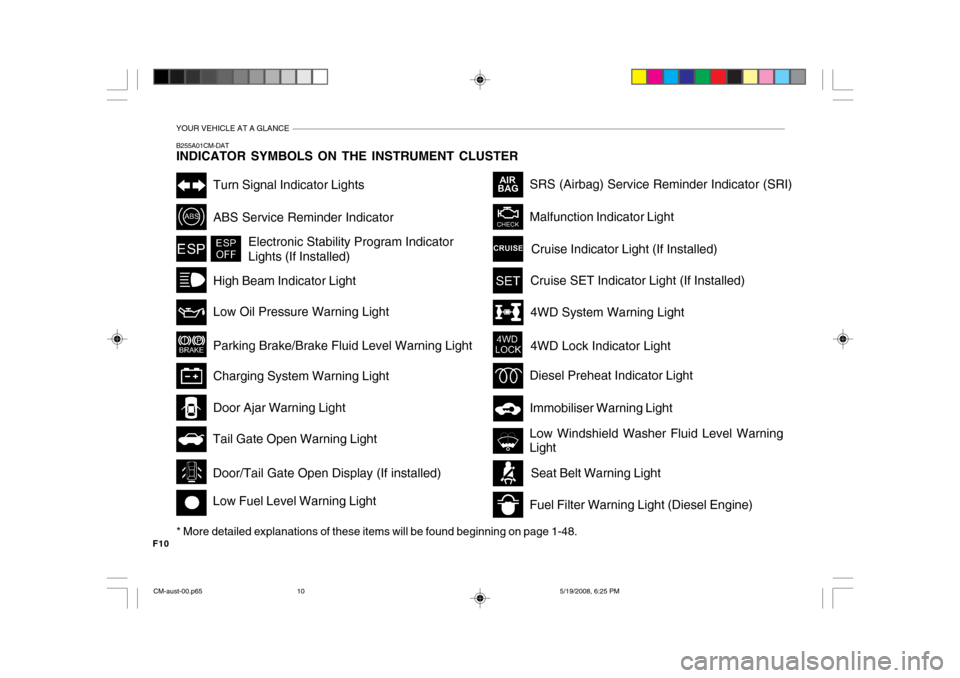
F10B255A01CM-DAT INDICATOR SYMBOLS ON THE INSTRUMENT CLUSTER
* More detailed explanations of these items will be found beginning on page 1-48.
4WD System Warning Light
Malfunction Indicator Light
SRS (Airbag) Service Reminder Indicator (SRI)
Tail Gate Open Warning Light
Low Fuel Level Warning Light Door Ajar Warning Light
ABS Service Reminder Indicator
Turn Signal Indicator Lights
High Beam Indicator Light Low Oil Pressure Warning Light Parking Brake/Brake Fluid Level Warning Light Charging System Warning Light
Immobiliser Warning Light
4WD Lock Indicator Light
Electronic Stability Program Indicator Lights (If Installed)
Cruise SET Indicator Light (If Installed)
Door/Tail Gate Open Display (If installed)
Cruise Indicator Light (If Installed)
Low Windshield Washer Fluid Level Warning LightSeat Belt Warning Light
Diesel Preheat Indicator Light
Fuel Filter Warning Light (Diesel Engine)
CM-aust-00.p65 5/19/2008, 6:25 PM
10
Page 56 of 269
1
FEATURES OF YOUR HYUNDAI
45
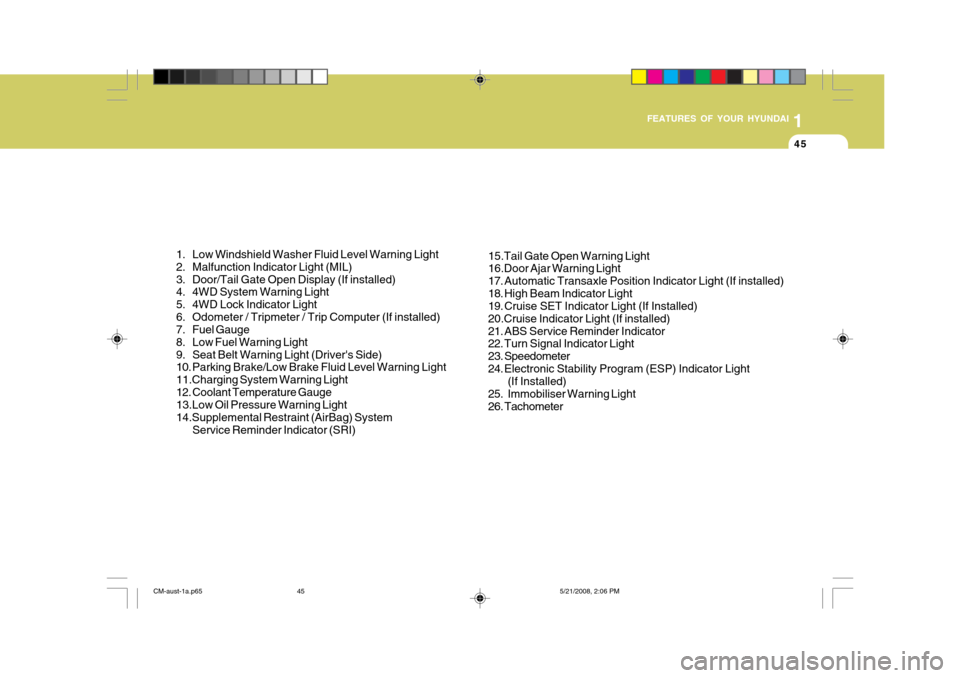
1. Low Windshield Washer Fluid Level Warning Light
2. Malfunction Indicator Light (MIL)
3. Door/Tail Gate Open Display (If installed)
4. 4WD System Warning Light
5. 4WD Lock Indicator Light
6. Odometer / Tripmeter / Trip Computer (If installed)
7. Fuel Gauge
8. Low Fuel Warning Light
9. Seat Belt Warning Light (Driver's Side)
10. Parking Brake/Low Brake Fluid Level Warning Light 11.Charging System Warning Light
12. Coolant Temperature Gauge 13.Low Oil Pressure Warning Light 14.Supplemental Restraint (AirBag) System Service Reminder Indicator (SRI) 15.Tail Gate Open Warning Light 16.Door Ajar Warning Light
17. Automatic Transaxle Position Indicator Light (If installed)
18. High Beam Indicator Light
19. Cruise SET Indicator Light (If Installed) 20.Cruise Indicator Light (If installed)
21. ABS Service Reminder Indicator
22. Turn Signal Indicator Light
23. Speedometer
24. Electronic Stability Program (ESP) Indicator Light
(If Installed)
25. Immobiliser Warning Light
26. Tachometer
CM-aust-1a.p65 5/21/2008, 2:06 PM
45
Page 58 of 269
1
FEATURES OF YOUR HYUNDAI
47
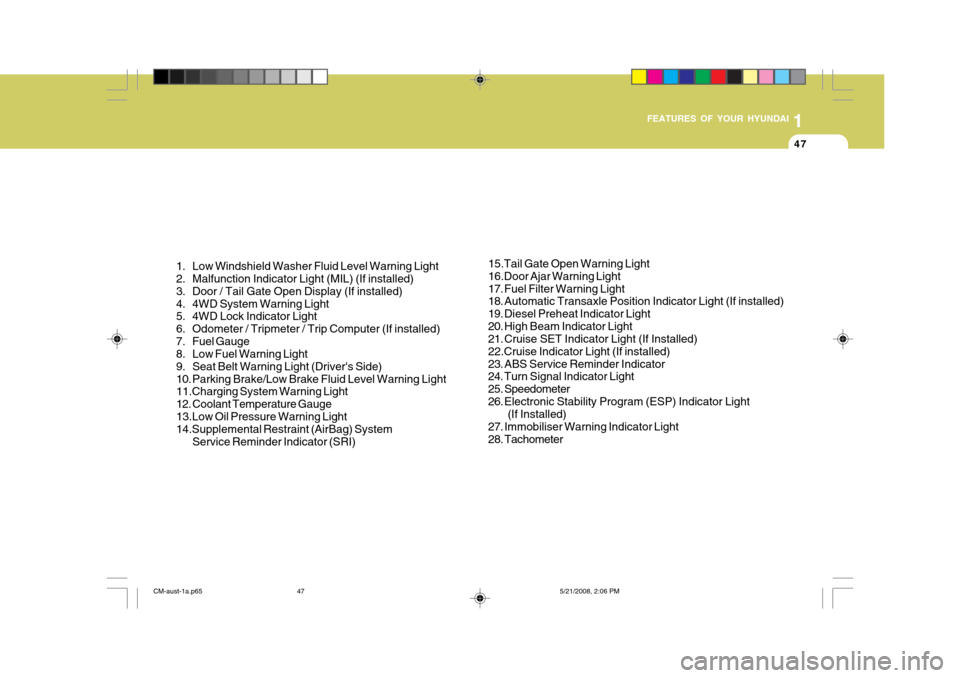
1. Low Windshield Washer Fluid Level Warning Light
2. Malfunction Indicator Light (MIL) (If installed)
3. Door / Tail Gate Open Display (If installed)
4. 4WD System Warning Light
5. 4WD Lock Indicator Light
6. Odometer / Tripmeter / Trip Computer (If installed)
7. Fuel Gauge
8. Low Fuel Warning Light
9. Seat Belt Warning Light (Driver's Side)
10. Parking Brake/Low Brake Fluid Level Warning Light 11.Charging System Warning Light
12. Coolant Temperature Gauge13.Low Oil Pressure Warning Light 14.Supplemental Restraint (AirBag) System Service Reminder Indicator (SRI) 15.Tail Gate Open Warning Light 16.Door Ajar Warning Light
17. Fuel Filter Warning Light
18. Automatic Transaxle Position Indicator Light (If installed)
19. Diesel Preheat Indicator Light
20. High Beam Indicator Light
21. Cruise SET Indicator Light (If Installed) 22.Cruise Indicator Light (If installed)
23. ABS Service Reminder Indicator
24. Turn Signal Indicator Light
25. Speedometer
26. Electronic Stability Program (ESP) Indicator Light
(If Installed)
27. Immobiliser Warning Indicator Light
28. Tachometer
CM-aust-1a.p65 5/21/2008, 2:06 PM
47
Page 61 of 269
1FEATURES OF YOUR HYUNDAI
50
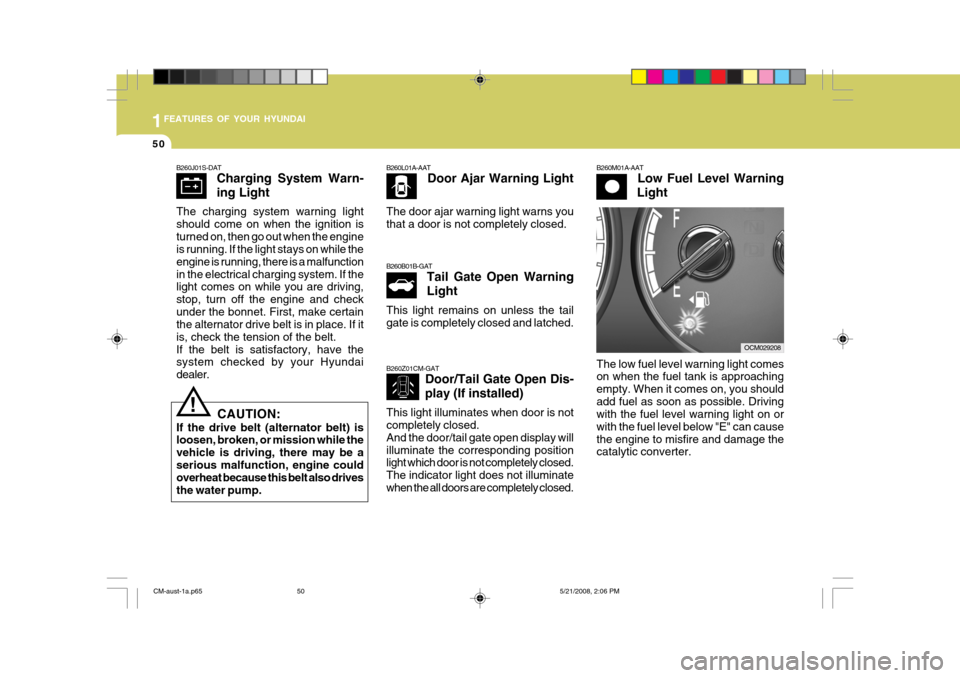
B260J01S-DAT
Charging System Warn- ing Light
The charging system warning light should come on when the ignition isturned on, then go out when the engine is running. If the light stays on while the engine is running, there is a malfunctionin the electrical charging system. If the light comes on while you are driving, stop, turn off the engine and checkunder the bonnet. First, make certain the alternator drive belt is in place. If it is, check the tension of the belt.If the belt is satisfactory, have the system checked by your Hyundai dealer. B260L01A-AAT
Door Ajar Warning Light
The door ajar warning light warns youthat a door is not completely closed. B260M01A-AAT
Low Fuel Level Warning
Light
B260B01B-GAT Tail Gate Open Warning Light
This light remains on unless the tail gate is completely closed and latched.
! CAUTION:
If the drive belt (alternator belt) is loosen, broken, or mission while the vehicle is driving, there may be aserious malfunction, engine could overheat because this belt also drives the water pump. B260Z01CM-GAT
Door/Tail Gate Open Dis- play (If installed)
This light illuminates when door is not completely closed. And the door/tail gate open display willilluminate the corresponding position light which door is not completely closed. The indicator light does not illuminatewhen the all doors are completely closed.
The low fuel level warning light comes on when the fuel tank is approaching empty. When it comes on, you shouldadd fuel as soon as possible. Driving with the fuel level warning light on or with the fuel level below "E" can causethe engine to misfire and damage the catalytic converter.
OCM029208
CM-aust-1a.p65 5/21/2008, 2:06 PM
50
Page 168 of 269
2
DRIVING YOUR HYUNDAI
23WINTER DRIVING
C160A01A-DAT The more severe weather conditions of winter result in greater wear and other problems. To minimise the problems of winter driving, you should follow thesesuggestions: C160C01A-AAT Use High Quality Ethylene Glycol Coolant Your Hyundai is delivered with high quality ethylene glycol coolant in thecooling system. It is the only type of coolant that should be used because it helps prevent corrosion in the coolingsystem, lubricates the water pump and prevents freezing. Be sure to replace or replenish your coolant in accordancewith the maintenance schedule in Sec- tion 5. Before winter, have your coolant tested to assure that its freezing pointis sufficient for the temperatures antici- pated during the winter.
C160B01A-DAT Snowy or Icy Conditions To drive your vehicle in deep snow, it may be necessary to use snow tyres or to install tyre chains on your tyres. If snow tyres are needed, it is necessary to select tyres equivalent in size and type to the original equipment tyres.Failure to do so may adversely affect the safety and handling of your car. Furthermore, speeding, rapid accelera-tion, sudden brake applications, and sharp turns are potentially very hazard- ous practices. During deceleration, use engine brak-ing to the fullest extent. Sudden brakeapplications on snowy or icy roads may cause skids to occur. You need to keep sufficient distance between the vehiclein operation in front and your vehicle. Also, apply the brake gently. It should be noted that installing tyre chains onthe tyre will provide a greater driving force, but will not prevent side skids. NOTE: Tyre chains are not legal in all states. Check state laws before fitting tyre chains.
C160D01A-DAT Check Battery and Cables Winter puts additional burdens on the battery and charging system. Visually inspect the battery and cables as de-scribed in Section 6. The level of charge in your battery can be checked by your Hyundai dealer or a service station.
CM-aust-2.p65 5/19/2008, 6:35 PM
23
Page 174 of 269
2
DRIVING YOUR HYUNDAI
29
!
C190F01A-DAT Trailer and Vehicle Towing Tips
1. Before towing, check towbar and
safety chain connections as well as proper operation of the trailer running lights, brake lights and turn signals.
2. Always drive your vehicle at a mod- erate speed (Less than 100 km/h).
3. Trailer towing requires more fuel than
normal conditions.
4. To maintain engine braking efficiency and electrical charging performance, do not use fifth gear (manualtransaxle) or overdrive (automatic transaxle).
5. Always secure items in the trailer to prevent load shift while driving.
6. Check the condition and air pressure
of all tyres on the trailer and your car. Low tyre pressure can seriously af- fect the handling. Also check the spare tyre.
7. The vehicle/trailer combination is more affected by crosswind and buf-feting. When being passed by alarge vehicle, keep a constant speed and steer straight ahead. If there is too much wind buffeting, slow downto get out of the other vehicle's air turbulence. 8. When parking your car and trailer,
especially on a hill, be sure to follow all the normal precautions. Turn your front wheel into the curb, set the parking brake firmly, and put thetransaxle in 1st or Reverse (manual) or Park (automatic). In addition, place wheel chocks at each of the trailer'styres.
9. If the trailer has electric brakes, drive
your vehicle with the trailer attached,and then apply the trailer brakes by hand. This test confirms the opera- tion of the trailer brakes and alsochecks your electrical connection at the same time.
10. During your trip, check occasionally to be sure that the load is secure,and that the lights and any trailer brakes are still working.
11. Avoid jerky starts, sudden accel- eration or sudden stops.
12. Avoid sharp turns and rapid lane changes.
13. Avoid holding the brake pedal down
too long or too frequently. This couldcause the brakes to overheat, re- sulting in reduced braking efficiency.
CAUTION:
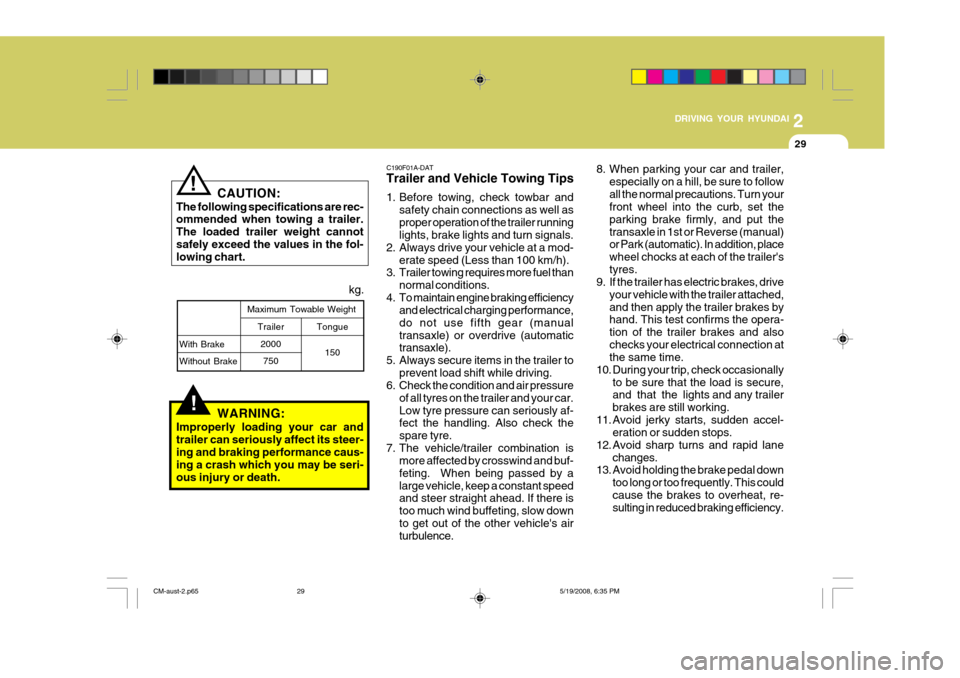
The following specifications are rec-ommended when towing a trailer. The loaded trailer weight cannotsafely exceed the values in the fol- lowing chart.
!
Maximum Towable Weight kg.
With Brake Without Brake
WARNING:
Improperly loading your car and trailer can seriously affect its steer-ing and braking performance caus- ing a crash which you may be seri- ous injury or death.
Tongue
150
Trailer
2000750
CM-aust-2.p65 5/19/2008, 6:35 PM
29
Page 179 of 269
3WHAT TO DO IN AN EMERGENCY
4
!
IF THE ENGINE OVERHEATS
4. Check to see if the water pump drivebelt is missing. If it is not missing, check to see that it is tight. If the drive belt seems to be satisfactory, check for coolant leaking from theradiator, hoses or under the car. (If the air conditioning had been in use, it is normal for cold water to bedraining from it when you stop).
D030A02TB-DAT If your temperature gauge indicates overheating, you experience a loss of power, or hear loud pinging or knocking, the engine is probably too hot. If thishappens to you, you should:
1. Pull off the road and stop as soon as
it is safe to do so.
2. Place the gear selector lever in "P"
(automatic), or neutral (manual transaxle) and set the parking brake. If the air conditioning is on, turn it off.
3. If coolant is running out under the car or steam is coming out from underthe bonnet, stop the engine. Do not open the bonnet until the coolant hasstopped running or the steaming has stopped. If there is no visible loss of coolant and no steam, leave theengine running and check to be sure the engine cooling fan is operating. If the fan is not running, turn the engineoff. WARNING:
While the engine is running, keephands and clothing away from mov-ing parts such as the fan and drive belts to prevent injury.
5. Start the engine in the car with the
discharged battery using the normal starting procedure. After the enginestarts, leave the jumper cables con- nected and let the engine run at fast idle or about 2000 rpm for severalminutes.
6. Carefully remove the jumper cables
in the reverse order of attachment.
If you do not know why your batterybecame discharged (because the lightswere left on, etc.), have the charging system checked by your Hyundai dealer.
CM-aust-3.p65 5/19/2008, 6:35 PM
4
Page 232 of 269
6
DO-IT-YOURSELF MAINTENANCE
25
!
G210B01Y-GAT
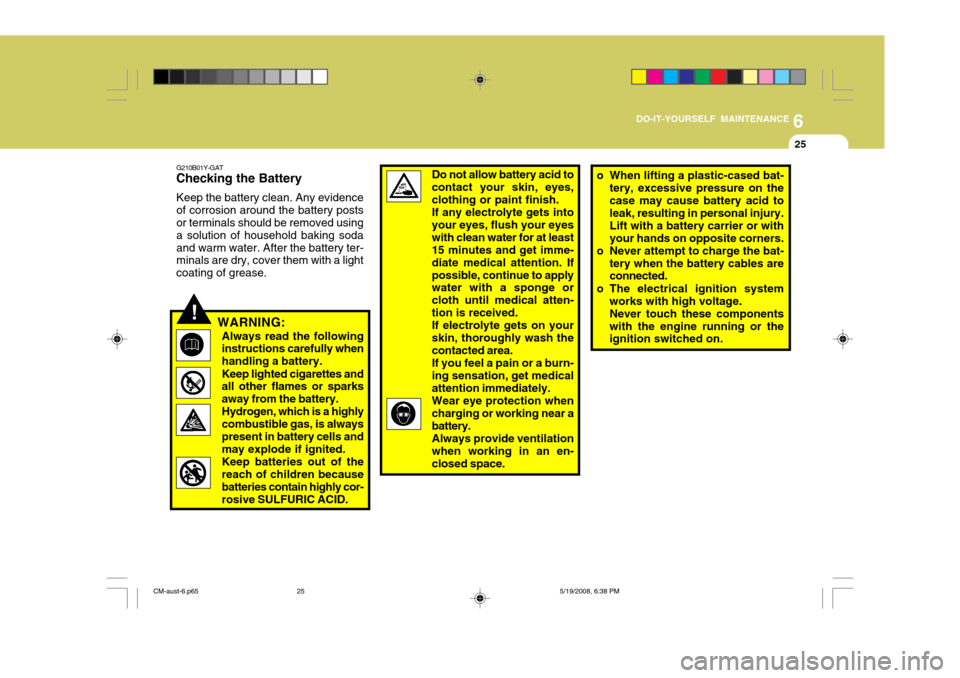
Checking the Battery
Keep the battery clean. Any evidence of corrosion around the battery posts or terminals should be removed using a solution of household baking sodaand warm water. After the battery ter- minals are dry, cover them with a light coating of grease.
WARNING: Always read the following instructions carefully when handling a battery. Keep lighted cigarettes and all other flames or sparks away from the battery.Hydrogen, which is a highlycombustible gas, is alwayspresent in battery cells and may explode if ignited. Keep batteries out of the reach of children because batteries contain highly cor- rosive SULFURIC ACID. Do not allow battery acid tocontact your skin, eyes,clothing or paint finish.If any electrolyte gets intoyour eyes, flush your eyeswith clean water for at least 15 minutes and get imme- diate medical attention. Ifpossible, continue to apply water with a sponge or cloth until medical atten-tion is received.If electrolyte gets on yourskin, thoroughly wash the contacted area. If you feel a pain or a burn- ing sensation, get medical attention immediately. Wear eye protection when charging or working near a battery. Always provide ventilation when working in an en- closed space.
o When lifting a plastic-cased bat-
tery, excessive pressure on the case may cause battery acid to leak, resulting in personal injury. Lift with a battery carrier or withyour hands on opposite corners.
o Never attempt to charge the bat-
tery when the battery cables are connected.
o The electrical ignition system works with high voltage. Never touch these componentswith the engine running or the ignition switched on.
CM-aust-6.p65 5/19/2008, 6:38 PM
25