2009 Hyundai Santa Fe brake light
[x] Cancel search: brake lightPage 95 of 269
1FEATURES OF YOUR HYUNDAI
84
!
TAIL GATE
B540A01CM-AAT
WARNING:
The tail gate should always be kept completely closed while the vehicleis in motion. If it is left open or ajar, poisonous exhaust gases may enter the car resulting in serious illness ordeath to the occupants. See addi- tional warnings concerning exhaust gases on page 2-2.
o The tail gate is opened by pulling the outside handle up, raising the tail gate manually.
o To close, lower the tail gate, then
press down on it until it is closed. Tobe sure the tail gate is fully closed, always try to pull it up again without using the outside handle.
Releasing the parking brakeTo release the parking brake, first applythe foot brake and pull the praking brake lever slightly. Secondly, depress the release button and lower the parkingbrake lever while holding the button. Type B: Applying the parking brake To engage the parking brake, first applythe foot brake and then depress the parking brake pedal down as far as possible. In addition it is recommendedthat when parking the vehicle on a gradient, the shift lever should be in a low gear on manual transaxle vehiclesor in the P (Park) position on automatic transaxle vehicles.
B535A01CM-GAT Parking brake warning chime (if installed) The parking brake warning chime re- minds you that the parking brake isapplied when you are driving above 10km/h. Always release the parking brake before you drive.
Releasing the parking brakeTo release the parking brake, depressthe parking brake pedal a second time. If the parking brake pedal does not release or dose not release all the way,have the system checked by an authorised HYUNDAI dealer. NOTE: The parking brake pedal should be checked periodically for proper stroke.
!
CAUTION:
Driving with the parking brake ap- plied will cause excessive brake pad and brake rotor wear.
CM-aust-1a.p65 5/21/2008, 2:09 PM
84
Page 98 of 269
1
FEATURES OF YOUR HYUNDAI
87HIGH-MOUNTED REAR STOP LIGHT
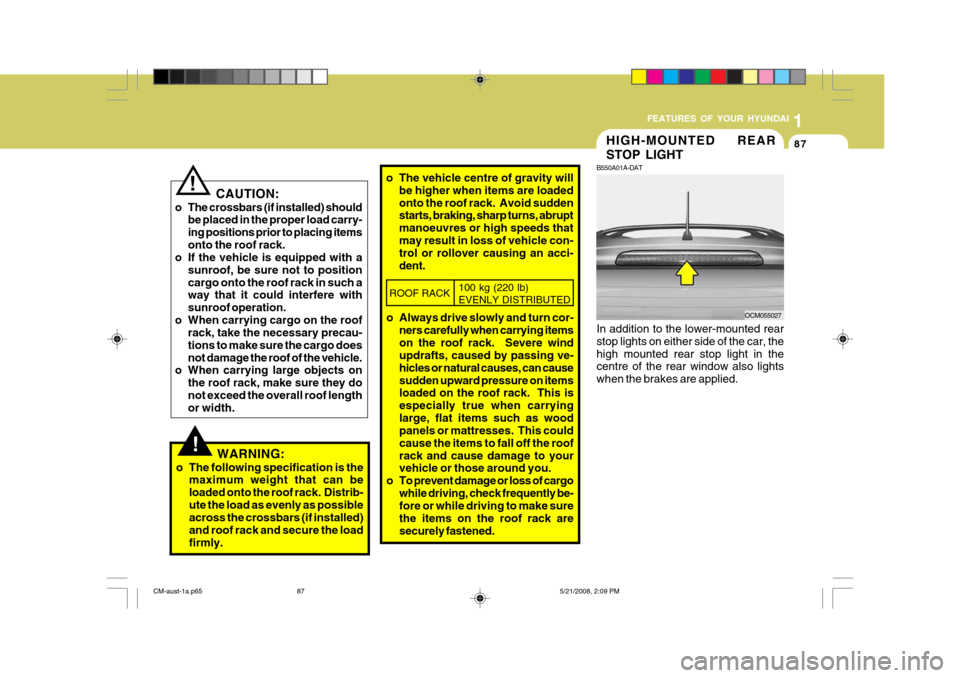
B550A01A-DAT In addition to the lower-mounted rear stop lights on either side of the car, the high mounted rear stop light in the centre of the rear window also lights when the brakes are applied. OCM055027
!WARNING:
o The following specification is the maximum weight that can be loaded onto the roof rack. Distrib-ute the load as evenly as possible across the crossbars (if installed) and roof rack and secure the loadfirmly. o The vehicle centre of gravity will
be higher when items are loadedonto the roof rack. Avoid sudden starts, braking, sharp turns, abrupt manoeuvres or high speeds thatmay result in loss of vehicle con- trol or rollover causing an acci- dent.
CAUTION:
o The crossbars (if installed) should be placed in the proper load carry-ing positions prior to placing itemsonto the roof rack.
o If the vehicle is equipped with a
sunroof, be sure not to positioncargo onto the roof rack in such a way that it could interfere with sunroof operation.
o When carrying cargo on the roof rack, take the necessary precau-tions to make sure the cargo doesnot damage the roof of the vehicle.
o When carrying large objects on
the roof rack, make sure they donot exceed the overall roof length or width.
!
ROOF RACK 100 kg (220 lb) EVENLY DISTRIBUTED
o Always drive slowly and turn cor-
ners carefully when carrying items on the roof rack. Severe wind updrafts, caused by passing ve- hicles or natural causes, can causesudden upward pressure on items loaded on the roof rack. This is especially true when carryinglarge, flat items such as wood panels or mattresses. This could cause the items to fall off the roofrack and cause damage to your vehicle or those around you.
o To prevent damage or loss of cargo while driving, check frequently be-fore or while driving to make sure the items on the roof rack aresecurely fastened.
CM-aust-1a.p65 5/21/2008, 2:09 PM
87
Page 108 of 269
1
FEATURES OF YOUR HYUNDAI
97
o Use the cruise control system only
when traveling on open highways in good weather.
o Do not use the cruise control when
it may not be safe to keep the carat a constant speed, for instance, driving in heavy or varying traffic, or on slippery (rainy, icy or snow-covered) or winding roads or over 6% up-hill or down-hill roads.
o Pay particular attention to the driv-
ing conditions whenever using thecruise control system.
o During cruise-control driving with a manual transaxle vehicle, do not shift into neutral without depress-ing the clutch pedal, since the engine will be overrevved. If this happens, depress the clutch pedalor release the cruise control ON/ OFF switch.
o During normal cruise control op-
eration, when the "SET" switch isactivated or reactivated after ap- plying the brakes, the cruise con-trol will energize after approxi- mately 3 seconds. This delay is normal.
!WARNING:
o Keep the cruise control ON/OFF switch off when not using the cruise control.
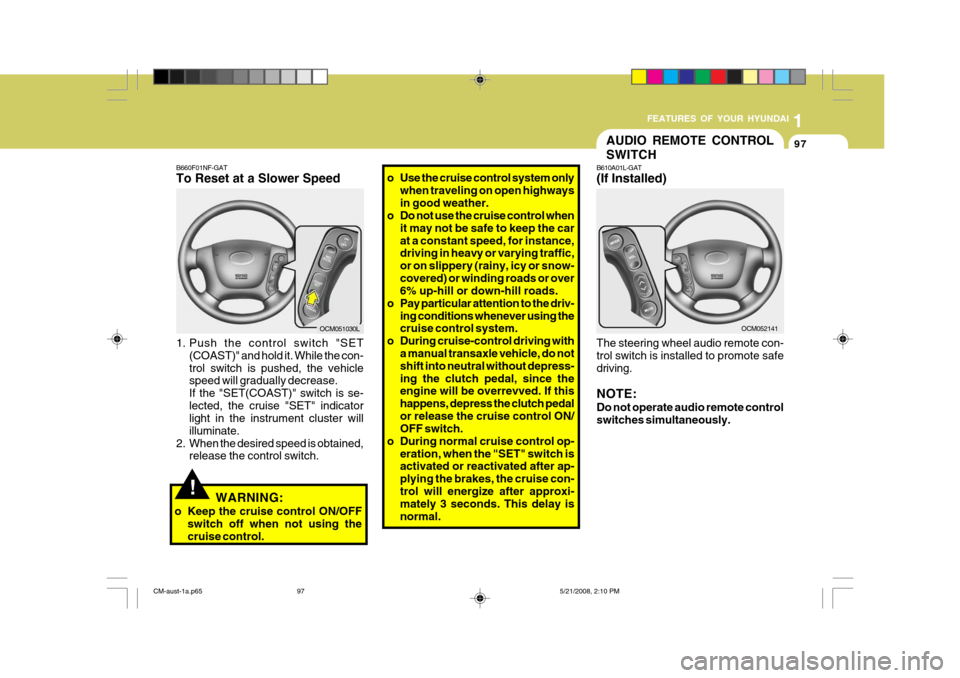
B660F01NF-GAT To Reset at a Slower Speed
1. Push the control switch "SET (COAST)" and hold it. While the con- trol switch is pushed, the vehicle speed will gradually decrease. If the "SET(COAST)" switch is se-lected, the cruise "SET" indicator light in the instrument cluster will illuminate.
2. When the desired speed is obtained, release the control switch.
OCM051030L
AUDIO REMOTE CONTROL SWITCH
B610A01L-GAT (If Installed) The steering wheel audio remote con- trol switch is installed to promote safedriving. NOTE: Do not operate audio remote control switches simultaneously. OCM052141
CM-aust-1a.p65
5/21/2008, 2:10 PM
97
Page 148 of 269
2
DRIVING YOUR HYUNDAI
3
!
BEFORE STARTING THE ENGINE
C020A01CM-DAT Before you start the engine, you should always:
1. Look around the vehicle to be sure
there are no flat tyres, puddles of oil, water or other indications of possible trouble.
2. After entering the car, check to be sure the hand brake is engaged.
3. Check that all windows, and lights are clean.
4. Check that the interior and exterior
mirrors are clean and in position.
5. Check your seat, seatback and head- rest to be sure they are in their properpositions.
6. Lock all the doors.
7. Fasten your seat belt and be sure
that all other occupants have fas- tened theirs.
8. Turn off all lights and accessories
that are not needed.
9. When you turn the ignition switch to "ON", check that all appropriate warn-ing lights are operating and that youhave sufficient fuel.
10. Check the operation of warning lights
and all bulbs when key is in the "ON"position.
C020A01HP-DAT
o In a collision crash, an unbelted
person is significantly more likelyto die than a person wearing aseatbelt.
RISK OF ROLLOVER
WARNING:
o Utility vehicle has a significantly higher collision rate than othertype of vehicles.
o Utility vehicle have higher ground clearance and a narrower trackto make them capable of perform-ing in a wide variety of off-road applications. Specific design characteristics give them a highercentre of gravity than ordinary cars. An advantage of the higher ground clearance is a better viewof the road allowing you to antici- pate problem. They are not de- signed for cornering at the samespeeds as conventional 2-wheel drive vehicles any more than low- slung sports cars are designed toperform satisfactorily under off- road conditions. If at all possible, avoid sharp turns or abrupt ma-neuvers. As with other vehicles of this type, failure to operate this vehicle correctly may result inloss of control or vehicle rollover.
CM-aust-2.p65 5/19/2008, 6:34 PM
3
Page 155 of 269
2DRIVING YOUR HYUNDAI
10
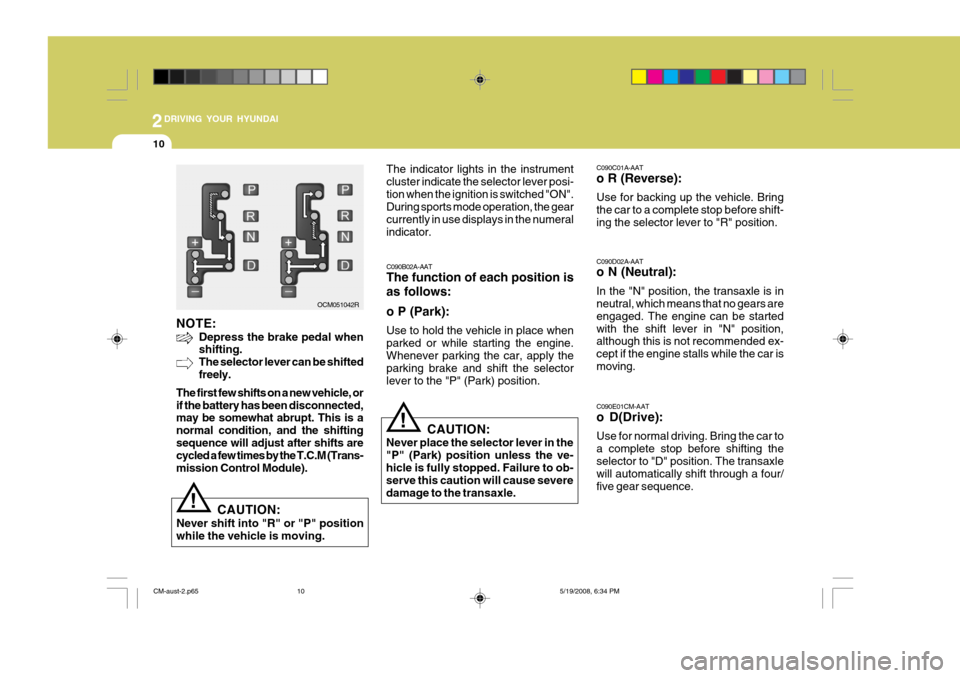
C090C01A-AAT o R (Reverse): Use for backing up the vehicle. Bring the car to a complete stop before shift-ing the selector lever to "R" position. C090D02A-AAT o N (Neutral): In the "N" position, the transaxle is in neutral, which means that no gears are engaged. The engine can be startedwith the shift lever in "N" position, although this is not recommended ex- cept if the engine stalls while the car ismoving. C090E01CM-AAT
o D(Drive): Use for normal driving. Bring the car to a complete stop before shifting the selector to "D" position. The transaxle will automatically shift through a four/five gear sequence.
CAUTION:
Never shift into "R" or "P" position while the vehicle is moving.
! The indicator lights in the instrument cluster indicate the selector lever posi-tion when the ignition is switched "ON". During sports mode operation, the gear currently in use displays in the numeralindicator. C090B02A-AAT The function of each position is as follows: o P (Park): Use to hold the vehicle in place when parked or while starting the engine. Whenever parking the car, apply the parking brake and shift the selectorlever to the "P" (Park) position.
CAUTION:
Never place the selector lever in the"P" (Park) position unless the ve-hicle is fully stopped. Failure to ob- serve this caution will cause severe damage to the transaxle.
!
NOTE:
Depress the brake pedal when shifting. The selector lever can be shiftedfreely.
The first few shifts on a new vehicle, orif the battery has been disconnected, may be somewhat abrupt. This is a normal condition, and the shiftingsequence will adjust after shifts are cycled a few times by the T.C.M (Trans- mission Control Module). OCM051042R
CM-aust-2.p65
5/19/2008, 6:34 PM
10
Page 159 of 269
2DRIVING YOUR HYUNDAI
14
o The risk of rollover is greatly in-
creased if you lose control of your vehicle at highway speeds.
o Loss of control often occurs if two or more wheels drop off theroadway and the driver oversteers to reenter the roadway.
o In the event your vehicle leaves the roadway, do not steer sharply.Instead, slow down before pull- ing back into the travel lanes.
o Never exceed posted speed lim- its.
o If your vehicle becomes stuck in
snow, mud, sand, etc., then youmay attempt to rock the vehicle free by moving it forward andbackward. Do not attempt this procedure if people or objects are anywhere near the vehicle.During the rocking operation the vehicle may suddenly move for- ward of backward as it becomesunstuck, causing injury or dam- age to nearby people or objects.!WARNING:
Your ABS (ESP) will not prevent accidents due to improper or dan-gerous driving manoeuvres. Even though vehicle control is improved during emergency braking, alwaysmaintain a safe distance between you and objects ahead. Vehicle speeds should always be reducedduring extreme road conditions. The braking distance for cars equipped with an anti-lock brakingsystem (the electronic stability pro- gram) may be longer than for those without it in the following road con-ditions. These roads should be driven at reduced speeds.
o Rough, gravel or snow-covered roads.
o With tyre chains installed.
o On roads where the road surface is pitted or has different surface height.
ANTI-LOCK BRAKE SYSTEM
C120A01FC-DAT The Anti-Lock Brake System (ABS) is designed to prevent wheel lock-up dur- ing sudden braking or on hazardous road surfaces. The ABS control modulemonitors the wheel speed and controls the pressure applied to each brake. Thus, in emergency situations or onslick roads, ABS will increase vehicle control during braking. NOTE:
o A click sound may be heard in the engine compartment when the vehicle begins to move after the engine is started. These condi- tions are normal and indicate thatthe anti-lock brake system (Elec- tronic Stability Program) is func- tioning properly.
o During ABS (ESP) operation, a
slight pulsation may be felt in thebrake pedal when the brakes are applied. Also, a noise may be heard in the engine compartmentwhile braking. These conditions are normal and indicate that the anti-lock brake system (ElectronicStability Program) is functioning properly.
CM-aust-2.p65 5/19/2008, 6:35 PM
14
Page 165 of 269
2DRIVING YOUR HYUNDAI
20
!
GOOD BRAKING PRACTICES
C130A01A-DAT o Don't coast down hills with the car
out of gear. This is extremely haz- ardous. Keep the car in gear at all times, use the brakes to slow down,then shift to a lower gear so thatengine braking will help you maintaina safe speed.
o Don't "ride" the brake pedal. Resting
your foot on the brake pedal whiledriving can be dangerous because itcan result in the brakes overheatingand losing their effectiveness. It alsoincreases the wear of the brake com-ponents.
o If a tyre goes flat while you are driving, apply the brakes gently andkeep the car pointed straight aheadwhile you slow down. When you aremoving slowly enough for it to besafe to do so, pull off the road and stop in a safe place.
o If your car is equipped with an auto-
matic transaxle, don't let your car creep forward. To avoid creepingforward, keep your foot on the brakepedal when the car is stopped.
o Use caution when parking on a hill. Engage the parking brake and placethe gear selector lever in "P" (auto-matic transaxle) or in first or re-
verse gear (manual transaxle).
WARNING:
Nothing should be carried on top ofthe shelf panel behind the rear seat. If there were an accident or a suddenstop, such objects could move for- ward and cause damage to the ve- hicle or injure the occupants.
o After being parked, check to be sure the parking brake is not engaged and that the parking brake indicator light is out before driving away.
o Driving through water may get the brakes wet. They can also get wet when the car is washed. Wet brakescan be dangerous! Your car will not stop as quickly if the brakes are wet. Wet brakes cause the car to pull toone side. To dry the brakes, apply the brakes lightly until the braking action returns to normal, taking careto keep the car under control at all times. If the braking action does not return to normal, stop as soon as it issafe to do so and call your Hyundai dealer for assistance.
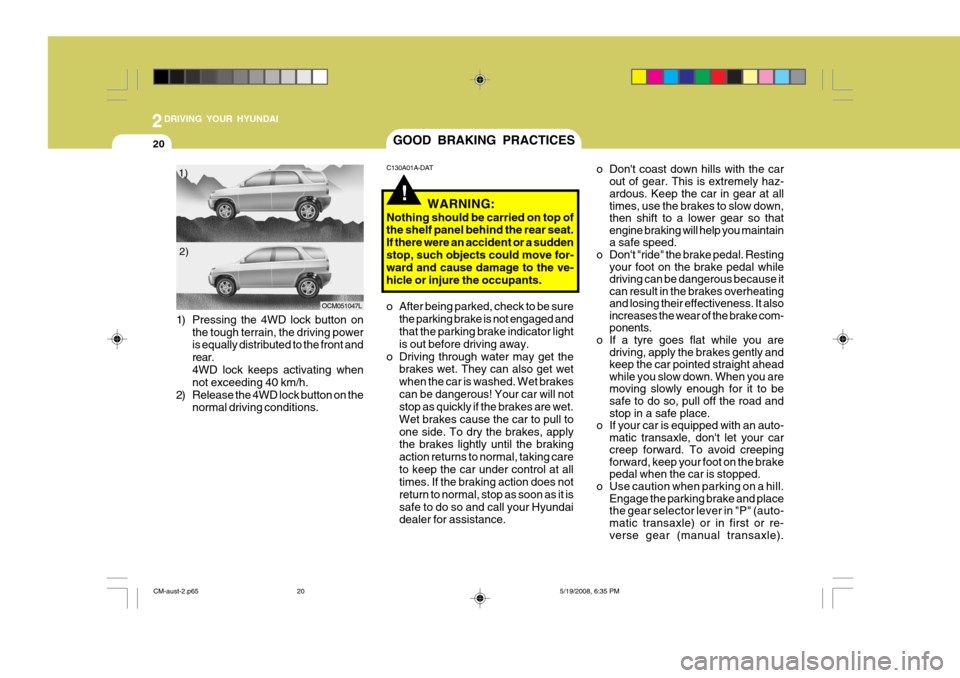
1) Pressing the 4WD lock button on
the tough terrain, the driving power is equally distributed to the front and rear. 4WD lock keeps activating when not exceeding 40 km/h.
2) Release the 4WD lock button on the normal driving conditions.
1)
2)
OCM051047L
CM-aust-2.p65 5/19/2008, 6:35 PM
20
Page 166 of 269
2
DRIVING YOUR HYUNDAI
21
If your car is facing downhill, turn the front wheels into the kerb to helpkeep the car from rolling. If your car is facing uphill, turn the front wheels away from the kerb to help keep thecar from rolling. If there is no kerb or if it is required by other conditions to keep the car from rolling, block thewheels.
o Under some conditions your parking
brake can freeze in the engagedposition. This is most likely to hap- pen when there is an accumulation of snow or ice around or near the rearbrakes or if the brakes are wet. If there is a risk that the parking brake may freeze, apply it only temporarilywhile you put the gear selector lever in "P" (automatic) or in first or re- verse gear (manual transaxle) andblock the rear wheels so the car cannot roll. Then release the parking brake.
o Do not hold the vehicle on the up- grade with the accelerator pedal. Thiscan cause the transaxle to overheat.Always use the brake pedal or park- ing brake.DRIVING FOR ECONOMY
C140A01A-DAT You can save fuel and get more kilometres from your car if you follow these suggestions:
o Drive smoothly. Accelerate at a moderate rate. Don't make "kanga- roo" starts or full-throttle shifts.Maintain a steady cruising speed. Don't race between stoplights. Try to adjust your speed to that of the othertraffic so you don't have to change speeds unnecessarily. Avoid heavy traffic whenever possible. Alwaysmaintain a safe distance from other vehicles so you can avoid unneces- sary braking. This also reduces brakewear.
o Drive at a moderate speed. The faster
you drive, the more fuel your caruses. Driving at a moderate speed, especially on the highway, is one of the most effective ways to reducefuel consumption.
o Don't "ride" the brake. This can in-
crease fuel consumption and alsoincrease wear on these components. o In addition, driving with your foot
resting on the brake pedal may causethe brakes to overheat, which re- duces their effectiveness and may lead to more serious consequences.
o Take care of your tyres. Keep them inflated to the recommended pres-sure. Incorrect inflation, either toomuch or too little, results in unneces- sary tyre wear. Check the tyre pres- sures at least once a month.
o Be sure that the wheels are aligned correctly. Improper alignment canresult from hitting kerb or driving toofast over irregular surfaces. Poor alignment causes faster tyre wear and may also result in other prob-lems as well as greater fuel con- sumption.
o Keep your car in good condition. For better fuel economy and reducedmaintenance costs, maintain your car in accordance with the mainte-nance schedule in Section 5. If you drive your car in severe conditions, more frequent maintenance is re-quired (see Section 5 for details).
CM-aust-2.p65 5/19/2008, 6:35 PM
21