2009 Hyundai Santa Fe fuel type
[x] Cancel search: fuel typePage 13 of 269
1FEATURES OF YOUR HYUNDAI
2
OCM051001R
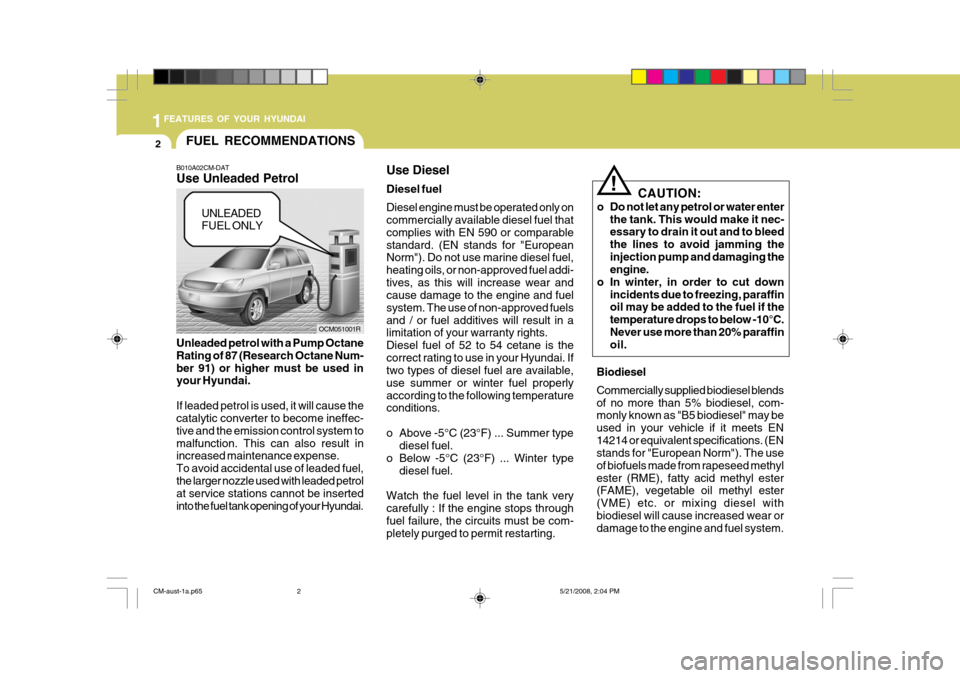
Unleaded petrol with a Pump Octane Rating of 87 (Research Octane Num-ber 91) or higher must be used in your Hyundai. If leaded petrol is used, it will cause the catalytic converter to become ineffec- tive and the emission control system tomalfunction. This can also result in increased maintenance expense. To avoid accidental use of leaded fuel,the larger nozzle used with leaded petrol at service stations cannot be inserted into the fuel tank opening of your Hyundai.
B010A02CM-DAT Use Unleaded Petrol
FUEL RECOMMENDATIONS
UNLEADED FUEL ONLY
!
Use Diesel Diesel fuel Diesel engine must be operated only on commercially available diesel fuel that complies with EN 590 or comparablestandard. (EN stands for "European Norm"). Do not use marine diesel fuel, heating oils, or non-approved fuel addi-tives, as this will increase wear and cause damage to the engine and fuel system. The use of non-approved fuelsand / or fuel additives will result in a limitation of your warranty rights. Diesel fuel of 52 to 54 cetane is thecorrect rating to use in your Hyundai. If two types of diesel fuel are available, use summer or winter fuel properlyaccording to the following temperature conditions.
o Above -5°C (23°F) ... Summer type
diesel fuel.
o Below -5°C (23°F) ... Winter type diesel fuel.
Watch the fuel level in the tank very carefully : If the engine stops through fuel failure, the circuits must be com- pletely purged to permit restarting. CAUTION:
o Do not let any petrol or water enter the tank. This would make it nec- essary to drain it out and to bleed the lines to avoid jamming theinjection pump and damaging the engine.
o In winter, in order to cut down
incidents due to freezing, paraffinoil may be added to the fuel if the temperature drops to below -10°C.Never use more than 20% paraffin oil.
Biodiesel Commercially supplied biodiesel blends of no more than 5% biodiesel, com- monly known as "B5 biodiesel" may be used in your vehicle if it meets EN14214 or equivalent specifications. (EN stands for "European Norm"). The use of biofuels made from rapeseed methylester (RME), fatty acid methyl ester (FAME), vegetable oil methyl ester (VME) etc. or mixing diesel withbiodiesel will cause increased wear or damage to the engine and fuel system.
CM-aust-1a.p65 5/21/2008, 2:04 PM
2
Page 14 of 269

1
FEATURES OF YOUR HYUNDAI
3
B010E01A-DAT Petrol for Cleaner Air To help contribute to cleaner air, Hyundai recommends that you use petrol treatedwith detergent additives, which help prevent deposit formation in the engine. This petrol will help the engine runcleaner and enhance performance of the Emission Control System.
B010D01A-DAT Do not Use Methanol Fuels containing methanol (wood alco- hol) should not be used in your Hyundai.This type of fuel can reduce vehicle performance and damage components of the fuel system.
! B010F01A-AAT Operation in Foreign Countries If you are going to drive your Hyundai in another country, be sure to:
o Observe all regulations regarding
registration and insurance.
o Determine that acceptable fuel is
available.
CAUTION:
Hyundai Warranty Policy will not cover the damage of the fuel system and performance problems that are caused by the use of methanol orfuels containing methanol. B010B01A-DAT What About Gasohol [E-10]? Gasohol (a mixture of 90% unleaded gasoline and 10% ethanol or grain alco-hol) may be used in your Hyundai. However, if your engine develops drive ability problems, the use of 100% un-leaded petrol is recommended. Fuels with unspecified quantities of alcohol, or alcohols other than ethanol, shouldnot be used.
Repair or replacement of worn or dam-aged components due to the use of nonapproved fuels will not be covered by the manufactures warranty.
CAUTION:
o Never use any fuel, whether diesel or B5 biodiesel that fails to meet the latest petroleum industry speci-fication.
o Never use any fuel additives or
treatments that are not recom- mended or approved by the ve- hicle manufacturer.
!
CM-aust-1a.p65 5/21/2008, 2:04 PM
3
Page 148 of 269
2
DRIVING YOUR HYUNDAI
3
!
BEFORE STARTING THE ENGINE
C020A01CM-DAT Before you start the engine, you should always:
1. Look around the vehicle to be sure
there are no flat tyres, puddles of oil, water or other indications of possible trouble.
2. After entering the car, check to be sure the hand brake is engaged.
3. Check that all windows, and lights are clean.
4. Check that the interior and exterior
mirrors are clean and in position.
5. Check your seat, seatback and head- rest to be sure they are in their properpositions.
6. Lock all the doors.
7. Fasten your seat belt and be sure
that all other occupants have fas- tened theirs.
8. Turn off all lights and accessories
that are not needed.
9. When you turn the ignition switch to "ON", check that all appropriate warn-ing lights are operating and that youhave sufficient fuel.
10. Check the operation of warning lights
and all bulbs when key is in the "ON"position.
C020A01HP-DAT
o In a collision crash, an unbelted
person is significantly more likelyto die than a person wearing aseatbelt.
RISK OF ROLLOVER
WARNING:
o Utility vehicle has a significantly higher collision rate than othertype of vehicles.
o Utility vehicle have higher ground clearance and a narrower trackto make them capable of perform-ing in a wide variety of off-road applications. Specific design characteristics give them a highercentre of gravity than ordinary cars. An advantage of the higher ground clearance is a better viewof the road allowing you to antici- pate problem. They are not de- signed for cornering at the samespeeds as conventional 2-wheel drive vehicles any more than low- slung sports cars are designed toperform satisfactorily under off- road conditions. If at all possible, avoid sharp turns or abrupt ma-neuvers. As with other vehicles of this type, failure to operate this vehicle correctly may result inloss of control or vehicle rollover.
CM-aust-2.p65 5/19/2008, 6:34 PM
3
Page 200 of 269

5VEHICLE MAINTENANCE REQUIREMENTS
4REGULAR SERVICING
F030A03A-DAT An odometer reading or time interval determines when service is necessary. For most people, the odometer reading will indicate when service is needed. If, however, you drive very little, your vehicle should be serviced at least every 12 months. Under severe driving conditions, more frequent maintenance is required.
See Note (3) See Note (5)
NO.
12 3 4 5 6 7 8 9
1011
F030B04CM-DAT R :Replace I : Inspect and, after Inspection, clean, adjust, repair or replace of necessary.
105
84
R I I I I 120
96
R I
R I II I
9072
R I I I I
RR
75 60
R I I I I
60 48
R I
R I II I
45 36
R I I I
R R
30 24
R I I II I
15 12
R I I I I
KILOMETERS X 1000 MONTHS DESCRIPTION ENGINE CONTROL SYSTEM MAINTENANCE (PETROL) ENGINE OIL & FILTER
DRIVE BELT
2.7 V6
(AUTO-TENSIONER, ALTERNATOR, P/STR'G, A/CON) 3.3 V6FUEL FILTER (MPI TYPE) FUEL LINES, FUEL HOSES & CONNECTIONS TIMING BELT (2.7 V6 only) VAPOR HOSE & FUEL FILLER CAP CRANKCASE VENTILATION HOSES AIR CLEANER FILTER FUEL TANK AIR FILTER (if installed)
VALVE CLEARANCE See Note (4)SPARK PLUG (IRIDIUM COATED)
NOTE: (1) EVERY 48,000 KM OR 24 MONTHS : "I" (2) INSPECT EVERY 60,000 KM AND REPLACE EVERY
120,000 KM OR 60 MONTHS.
(3) EVERY 96,000 KM OR 48 MONTHS : "I"
See Note (2)
See Note (1)
(4) INSPECT FOR EXCESSIVE TAPPET NOISE AND/OR ENGINE VIBRATION AND ADJUST IF NECESSARY.
(5) EVERY 160,000 KM : "R"
CM-aust-5.p65 5/19/2008, 6:37 PM
4
Page 252 of 269

7EMISSION CONTROL SYSTEMS
4
o Avoid idling the engine for periodslonger than 3 minutes.
o Your Hyundai should not be either pushed or pulled to get it started. This can cause the catalytic con-verter to overload.
o Take care not to park, idle or drive your Hyundai over or near flam- mable objects, such as grass, pa- per, leaves or rags. These materialscould come in contact with the cata- lytic converter and could cause a fire.
o Do not touch the catalytic converter or any other part of the exhaustsystem while the engine is runningas it is very hot and could result in burns.
o Remember that your Hyundai dealer is your best source of assistance.
H020B01CM-DAT About the Catalytic Converter Exhaust gases passing through the catalytic converter cause it to operate at very high temperatures. As a result, the introduction of large amounts ofunburned petrol may cause it to over- heat and create a fire hazard. This can be avoided by observing the following:
o Use unleaded fuel only.
o Maintain your engine in good condi-
tion. Extremely high converter tem- peratures can result from improper operation of the electrical, ignitionor fuel injection systems.
o If your engine stalls, pings, knocks, or is hard to start, take your car to your Hyundai dealer as soon as possible and have the difficulty cor-rected.
o Avoid driving with a very low fuel
level. If you run out of petrol, itcould cause the engine to misfire and result in excessive loading of the catalytic converter. H020D01S-GAT
; For a Diesel Engine
Hyundai vehicles are equipped with
oxidation type catalytic converter to reduce the carbon monoxide, hydro- carbons and particulate contained inthe exhaust gas.
Page 261 of 269

9VEHICLE SPECIFICATIONS
2
4650 (183.1) 4675 (184.1)1890 (74.4) 1725 (67.9)1795 (70.7)
2700 (106.3) 1615 (63.6) 1620 (63.7)
J010A01CM-GAT DIMENSIONS
Overall length Overall width Overall height Wheel baseWheel tread
mm (in.)
Standard Option Standard with Roof Rack Front Rear
J030A01CM-DAT
TYRE
Full
Temporary Size
Type Inflation pressure kPa (psi)
235/65R17 235/60R18
T165/90R17 NORMAL
LOAD MAXIMUM
LOAD
220(32) 420(60)
210(30)420(60)
J060A01CM-DAT FUEL SYSTEM
Fuel tank capacity
75 litres
J050A01CM-GAT BRAKE
Dual hydraulic with brake booster Ventilated discDisc typeCable operated on rear wheel
TypeFront brake typeRear brake typeParking brake
CM-aust-9.p65
5/19/2008, 6:41 PM
2