2009 Hyundai Elantra ABS
[x] Cancel search: ABSPage 218 of 308
What to do in an emergency
10
6
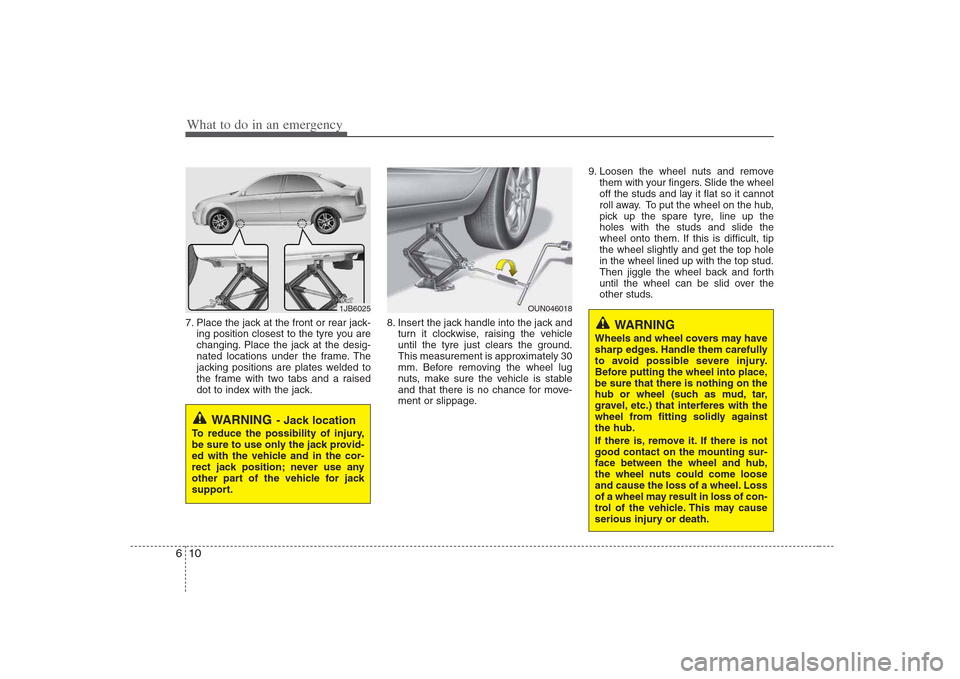
7. Place the jack at the front or rear jack-
ing position closest to the tyre you are
changing. Place the jack at the desig-
nated locations under the frame. The
jacking positions are plates welded to
the frame with two tabs and a raised
dot to index with the jack. 8. Insert the jack handle into the jack and
turn it clockwise, raising the vehicle
until the tyre just clears the ground.
This measurement is approximately 30
mm. Before removing the wheel lug
nuts, make sure the vehicle is stable
and that there is no chance for move-
ment or slippage. 9. Loosen the wheel nuts and remove
them with your fingers. Slide the wheel
off the studs and lay it flat so it cannot
roll away. To put the wheel on the hub,
pick up the spare tyre, line up theholes with the studs and slide the
wheel onto them. If this is difficult, tipthe wheel slightly and get the top holein the wheel lined up with the top stud.
Then jiggle the wheel back and forth
until the wheel can be slid over the
other studs.
WARNING - Jack location
To reduce the possibility of injury,
be sure to use only the jack provid-
ed with the vehicle and in the cor-
rect jack position; never use any
other part of the vehicle for jack
support.
1JB6025OUN046018
WARNING
Wheels and wheel covers may have
sharp edges. Handle them carefully
to avoid possible severe injury.
Before putting the wheel into place,be sure that there is nothing on the
hub or wheel (such as mud, tar,
gravel, etc.) that interferes with the
wheel from fitting solidly againstthe hub.
If there is, remove it. If there is not good contact on the mounting sur-face between the wheel and hub,
the wheel nuts could come loose
and cause the loss of a wheel. Loss
of a wheel may result in loss of con-
trol of the vehicle. This may cause
serious injury or death.
Page 261 of 308
Maintenance
36
7
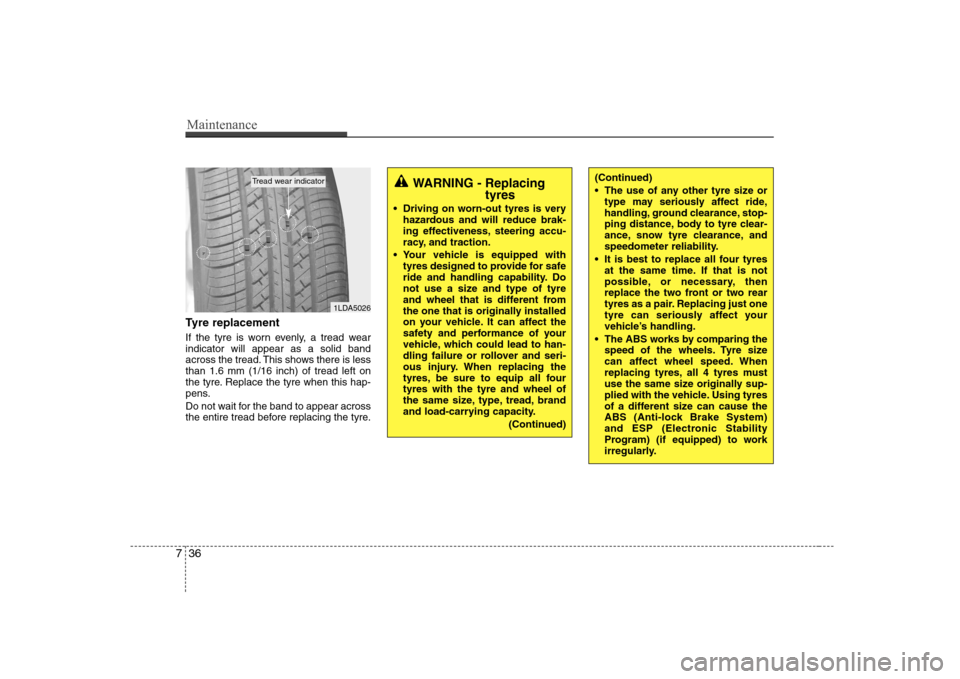
Tyre replacement
If the tyre is worn evenly, a tread wear indicator will appear as a solid band
across the tread. This shows there is lessthan 1.6 mm (1/16 inch) of tread left on
the tyre. Replace the tyre when this hap-
pens.
Do not wait for the band to appear across
the entire tread before replacing the tyre.
WARNING - Replacing
tyres
Driving on worn-out tyres is very hazardous and will reduce brak-
ing effectiveness, steering accu-
racy, and traction.
Your vehicle is equipped with tyres designed to provide for safe
ride and handling capability. Do
not use a size and type of tyre
and wheel that is different from
the one that is originally installed
on your vehicle. It can affect the
safety and performance of your
vehicle, which could lead to han-
dling failure or rollover and seri-
ous injury. When replacing the
tyres, be sure to equip all fourtyres with the tyre and wheel of
the same size, type, tread, brand
and load-carrying capacity.
(Continued)
1LDA5026
Tread wear indicator(Continued)
The use of any other tyre size ortype may seriously affect ride,
handling, ground clearance, stop-
ping distance, body to tyre clear-
ance, snow tyre clearance, and
speedometer reliability.
It is best to replace all four tyres at the same time. If that is not
possible, or necessary, then
replace the two front or two rear
tyres as a pair. Replacing just one
tyre can seriously affect your
vehicle’s handling.
The ABS works by comparing the speed of the wheels. Tyre size
can affect wheel speed. When
replacing tyres, all 4 tyres must
use the same size originally sup-
plied with the vehicle. Using tyres
of a different size can cause the
ABS (Anti-lock Brake System)
and ESP (Electronic Stability
Program) (if equipped) to work
irregularly.
Page 273 of 308
Maintenance
48
7
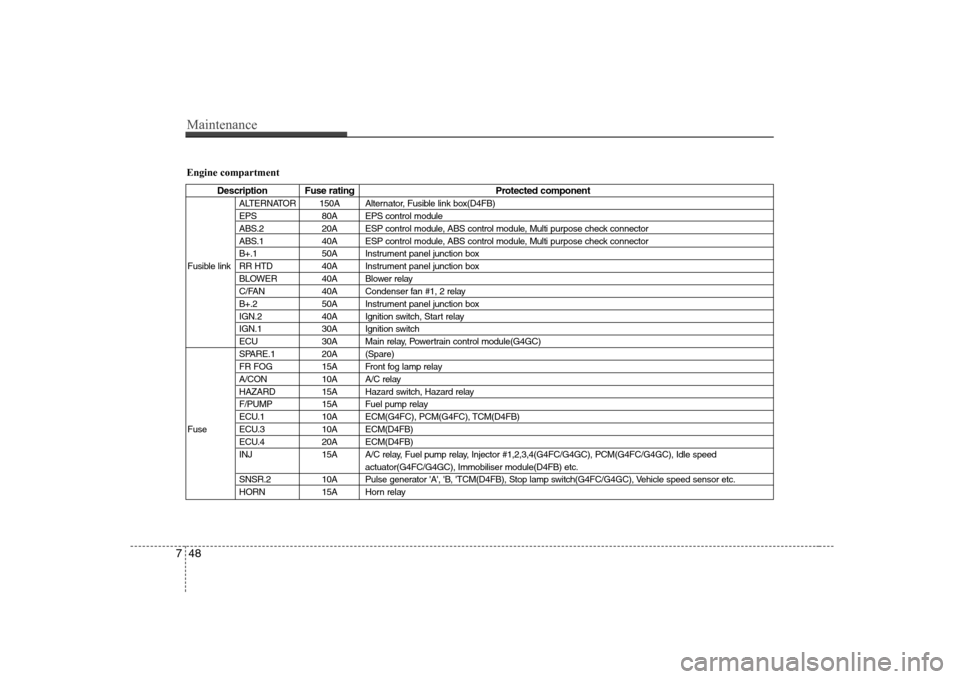
Engine compartment
Description Fuse rating Protected component
ALTERNATOR 150A Alternator, Fusible link box(D4FB)
EPS 80A EPS control module
ABS.2 20A ESP control module, ABS control module, Multi purpose check connector
ABS.1 40A ESP control module, ABS control module, Multi purpose check connector
B+.1 50A Instrument panel junction box
Fusible link RR HTD 40A Instrument panel junction box BLOWER 40A Blower relay
C/FAN 40A Condenser fan #1, 2 relay
B+.2 50A Instrument panel junction box
IGN.2 40A Ignition switch, Start relay
IGN.1 30A Ignition switch
ECU 30A Main relay, Powertrain control module(G4GC)
SPARE.1 20A (Spare)
FR FOG 15A Front fog lamp relay
A/CON 10A A/C relay
HAZARD 15A Hazard switch, Hazard relay
F/PUMP 15A Fuel pump relay
ECU.1 10A ECM(G4FC), PCM(G4FC), TCM(D4FB)
Fuse ECU.3 10A ECM(D4FB) ECU.4 20A ECM(D4FB)
INJ 15A A/C relay, Fuel pump relay, Injector #1,2,3,4(G4FC/G4GC), PCM(G4FC/G4GC), Idle speed actuator(G4FC/G4GC), Immobiliser module(D4FB) etc.
SNSR.2 10A Pulse generator 'A', 'B, 'TCM(D4FB), Stop lamp switch(G4FC/G4GC), Vehicle speed sensor etc.
HORN 15A Horn relay
Page 274 of 308
749
Maintenance
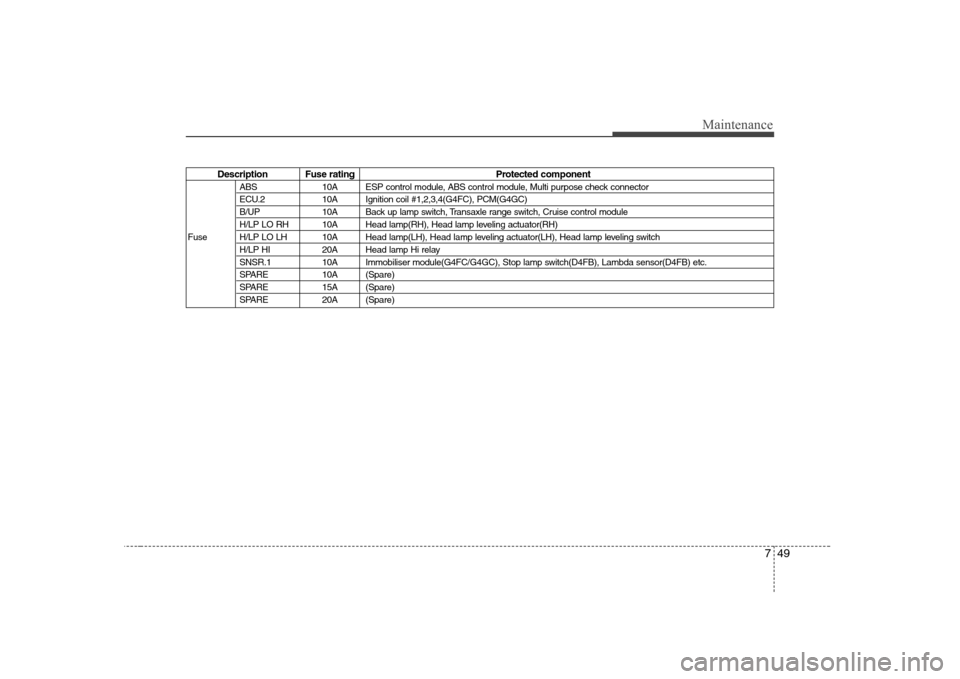
Description Fuse rating Protected componentABS 10A ESP control module, ABS control module, Multi purpose check connector
ECU.2 10A Ignition coil #1,2,3,4(G4FC), PCM(G4GC)
B/UP 10A Back up lamp switch, Transaxle range switch, Cruise control module
H/LP LO RH 10A Head lamp(RH), Head lamp leveling actuator(RH)
Fuse H/LP LO LH 10A Head lamp(LH), Head lamp leveling actuator(LH), Head lamp leveling switch H/LP HI 20A Head lamp Hi relay
SNSR.1 10A Immobiliser module(G4FC/G4GC), Stop lamp switch(D4FB), Lambda sensor(D4FB) etc.
SPARE 10A (Spare)
SPARE 15A (Spare)
SPARE 20A (Spare)
Page 277 of 308
Maintenance
52
7
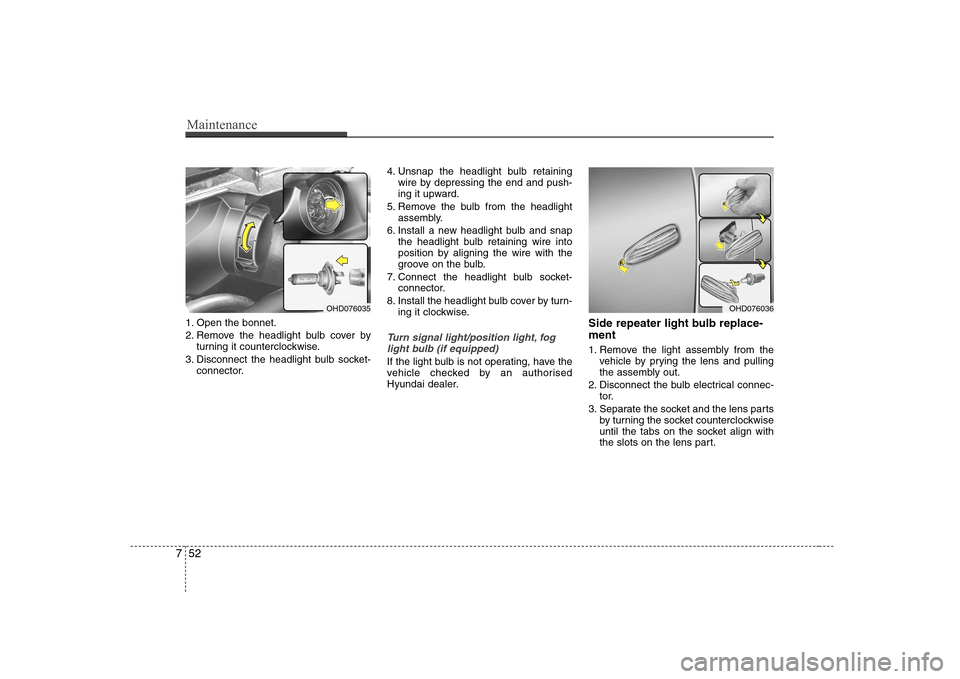
1. Open the bonnet.
2. Remove the headlight bulb cover by
turning it counterclockwise.
3. Disconnect the headlight bulb socket- connector. 4. Unsnap the headlight bulb retaining
wire by depressing the end and push-
ing it upward.
5. Remove the bulb from the headlight assembly.
6. Install a new headlight bulb and snap the headlight bulb retaining wire into
position by aligning the wire with the
groove on the bulb.
7. Connect the headlight bulb socket- connector.
8. Install the headlight bulb cover by turn- ing it clockwise.
Turn signal light/position light, fog
light bulb (if equipped)
If the light bulb is not operating, have the
vehicle checked by an authorised
Hyundai dealer. Side repeater light bulb replace- ment
1. Remove the light assembly from the
vehicle by prying the lens and pulling
the assembly out.
2. Disconnect the bulb electrical connec- tor.
3. Separate the socket and the lens parts by turning the socket counterclockwise
until the tabs on the socket align with
the slots on the lens part.
OHD076035OHD076036
Page 279 of 308
Maintenance
54
7
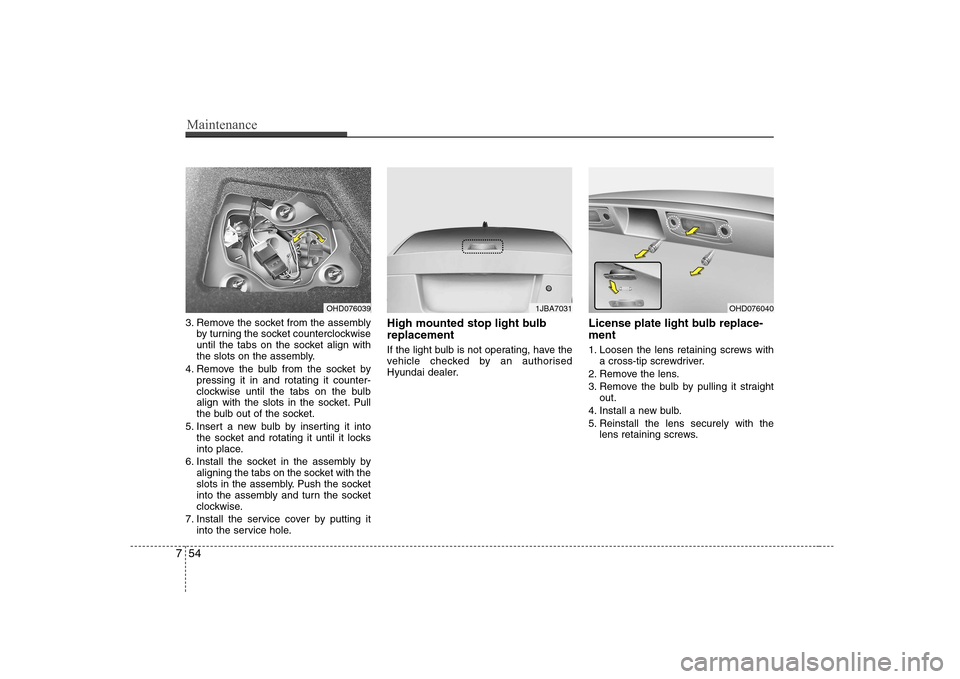
3. Remove the socket from the assembly
by turning the socket counterclockwise
until the tabs on the socket align with
the slots on the assembly.
4. Remove the bulb from the socket by pressing it in and rotating it counter-
clockwise until the tabs on the bulb
align with the slots in the socket. Pull
the bulb out of the socket.
5. Insert a new bulb by inserting it into the socket and rotating it until it locks
into place.
6. Install the socket in the assembly by aligning the tabs on the socket with the
slots in the assembly. Push the socket
into the assembly and turn the socket
clockwise.
7. Install the service cover by putting it into the service hole. High mounted stop light bulb replacement
If the light bulb is not operating, have the
vehicle checked by an authorised
Hyundai dealer.
License plate light bulb replace- ment
1. Loosen the lens retaining screws with
a cross-tip screwdriver.
2. Remove the lens.
3. Remove the bulb by pulling it straight out.
4. Install a new bulb.
5. Reinstall the lens securely with the lens retaining screws.
OHD0760391JBA7031OHD076040
Page 280 of 308
755
Maintenance
Interior light bulb replacement
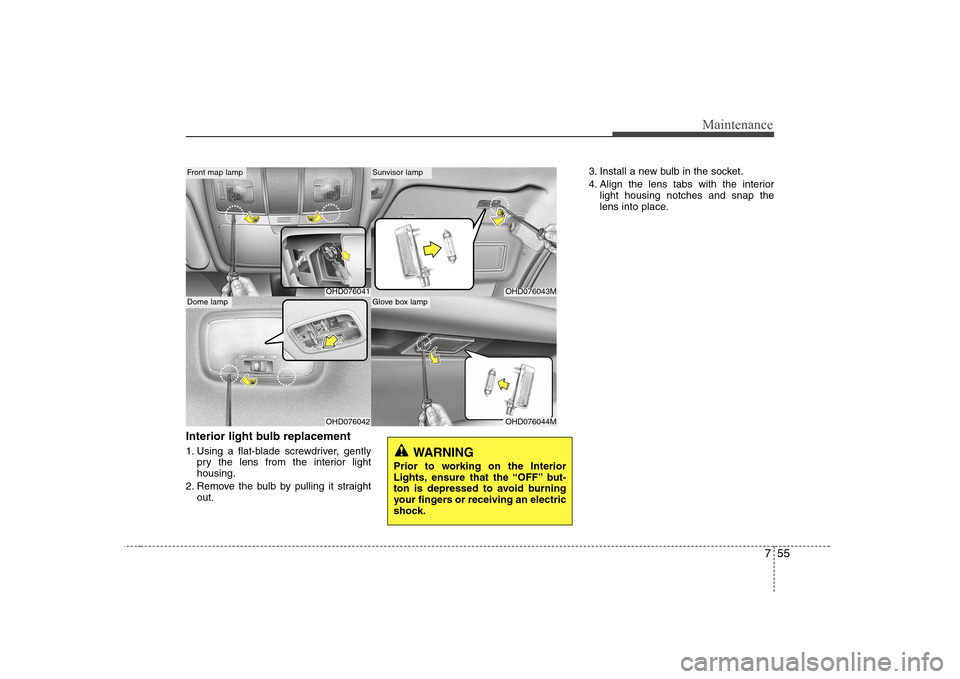
1. Using a flat-blade screwdriver, gentlypry the lens from the interior light housing.
2. Remove the bulb by pulling it straight out. 3. Install a new bulb in the socket.
4. Align the lens tabs with the interior
light housing notches and snap the
lens into place.
OHD076041
Front map lamp
OHD076042
Dome lampOHD076043M
Sunvisor lamp
OHD076044M
Glove box lamp
WARNING
Prior to working on the Interior
Lights, ensure that the “OFF” but-
ton is depressed to avoid burning
your fingers or receiving an electric
shock.
Page 287 of 308
Maintenance
62
7
EMISSION CONTROL SYSTEM
The emission control system of your
vehicle is covered by a written limited
warranty. Please see the warranty infor-
mation contained in the Service Passport
in your vehicle.
Your vehicle is equipped with an emis-
sion control system to meet all Australian
Design Rules (ADR) requirements. There are three emission control sys-
tems which are as follows.
(1) Crankcase emission control system
(2) Evaporative emission control system(3) Exhaust emission control system In order to assure the proper function of
the emission control systems, it is rec-
ommended that you have your car
inspected and maintained by an autho-
rised Hyundai dealer in accordance with
the maintenance schedule in this manu-al. Caution for the Inspection and
Maintenance Test (With Electronic
Stability Program (ESP) system)
To prevent the vehicle from misfir-
ing during dynamometer testing,
turn the Electronic Stability
Program (ESP) system off by press-
ing the ESP switch.
After dynamometer testing is com- pleted, turn the ESP system back on
by pressing the ESP switch again.
1. Crankcase emission control system
The positive crankcase ventilation sys-
tem is employed to prevent air pollution
caused by blow-by gases being emitted
from the crankcase. This system supplies
fresh filtered air to the crankcase through
the air intake hose. Inside the crankcase,
the fresh air mixes with blow-by gases,
which then pass through the PCV valveinto the induction system. 2. Evaporative emission control
System
The Evaporative Emission Control
System is designed to prevent fuel
vapours from escaping into the atmos-
phere.
Canister
Fuel vapours generated inside the fuel tank are absorbed and stored in the
onboard canister. When the engine is
running, the fuel vapours absorbed in the
canister are drawn into the surge tank
through the purge control solenoid valve.
Purge Control Solenoid Valve (PCSV)
The purge control solenoid valve is con-
trolled by the Engine Control Module
(ECM); when the engine coolant temper-
ature is low during idling, the PCSV clos-
es so that evaporated fuel is not taken
into the engine. After the engine warms-
up during ordinary driving, the PCSV
opens to introduce evaporated fuel to the
engine.