Page 366 of 532
If the system develops a problem,
you will see a ‘‘CHECK PARKING
SENSOR SYSTEM’’ message on the
multi-inf ormation display, and a
beeper sounds continuously. Very
of ten, a sensor covered with mud, ice,
snow,etc.isthecauseof this
message. Check the sensors f irst. If
the message stays on or the beeper
does not stop, have the system
checked by your dealer.
Distance
Beeper Short beeps
Continuous
beeps
Very short beeps
Bottom
indicator stays on
About 40-70 in
(1-1.8 m)
About 24-40 in
(0.6-1 m)
About 24 in
(0.6 m) or less
Bottom
indicator stays on Bottom
indicator stays on
Indicator
CONT INUED
Rear Cent er Sensor Operat ion
Parking Sensor System
Features
363
�\f���—�\f���—���
�y�
����\f������
�y���
�(���������\f�y�\f�������y
2009 Odyssey
Page 372 of 532
Bef ore ref ueling, make sure the rear
sliding door on the driver’s side is
closed.
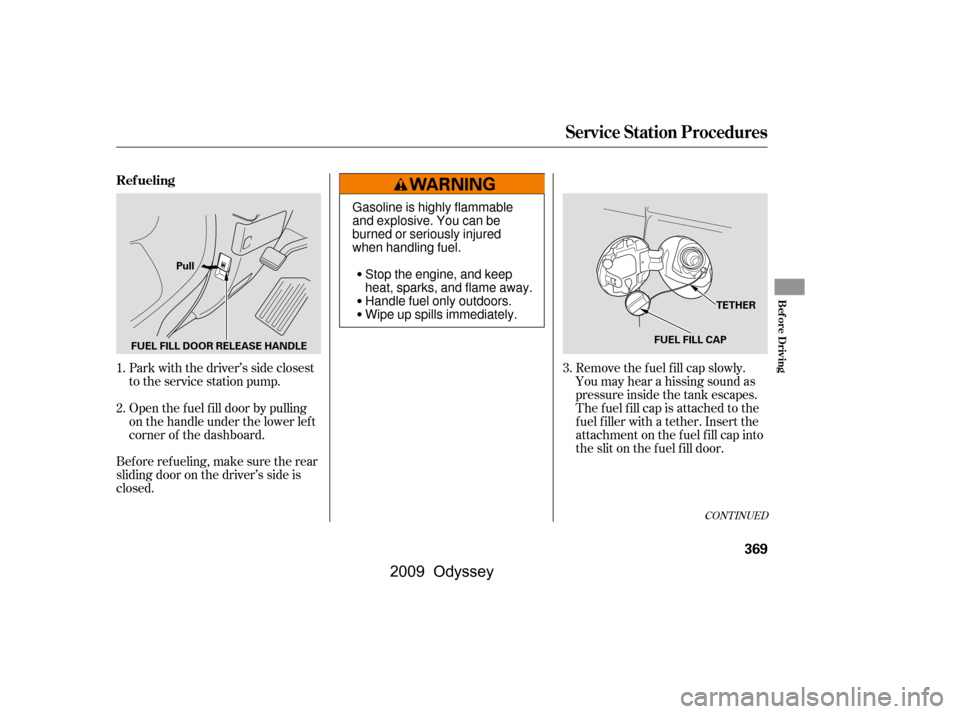
Park with the driver’s side closest
to the service station pump.
Open the f uel f ill door by pulling
on the handle under the lower lef t
corner of the dashboard.
Remove the f uel f ill cap slowly.
You may hear a hissing sound as
pressure inside the tank escapes.
The fuel fill cap is attached to the
f uel f iller with a tether. Insert the
attachment on the fuel fill cap into
the slit on the f uel f ill door.
1.
2.
3.
CONT INUED
Ref ueling
Service Station Procedures
Bef ore Driving
369
FUEL FILL CAP
Pull
FUEL FILL DOOR RELEASE HANDLE
TETHER
Gasoline is highly flammable
and explosive. You can be
burned or seriously injured
when handling fuel.
Stop the engine, and keep
heat, sparks, and flame away.
Handle fuel only outdoors.
Wipe up spills immediately.
�����—�����—���
�y�
�������������y���
�(�����������y���������y
2009 Odyssey
Page 373 of 532
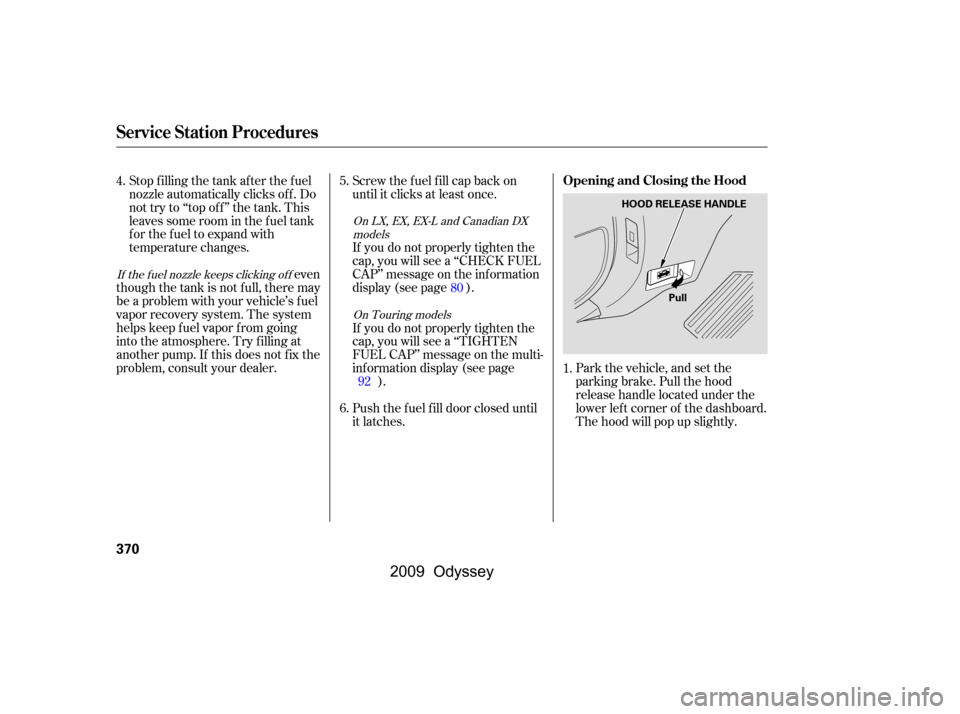
Park the vehicle, and set the
parking brake. Pull the hood
release handle located under the
lower lef t corner of the dashboard.
The hood will pop up slightly.
Screw the f uel f ill cap back on
until it clicks at least once.
Stop f illing the tank af ter the f uel
nozzle automatically clicks of f . Do
not try to ‘‘top off’’ the tank. This
leaves some room in the f uel tank
for the fuel to expand with
temperature changes.
If you do not properly tighten the
cap, you will see a ‘‘CHECK FUEL
CAP’’ message on the inf ormation
display (see page ).
even
though the tank is not full, there may
be a problem with your vehicle’s f uel
vapor recovery system. The system
helps keep f uel vapor f rom going
into the atmosphere. Try f illing at
another pump. If this does not f ix the
problem, consult your dealer. If you do not properly tighten the
cap, you will see a ‘‘TIGHTEN
FUEL CAP’’ message on the multi-
inf ormation display (see page
).
Push the f uel f ill door closed until
it latches. 1.
6.
5.
4.
80
92
If the f uel nozzle keeps clicking of f On LX, EX, EX-L and Canadian DX
models
On Touring models
Service Station Procedures
Opening and Closing the Hood
370
HOOD RELEASE HANDLE
Pull
�\f���—�\f���—���
�y�
����\f��������y���
�(���������\f�y�\f�������y
2009 Odyssey
Page 377 of 532

�µ�µ�µ �µ
�µ �µ
�µ
Aggressive driving (hard
acceleration and braking)
Excessive idling, accelerating and
braking in stop-and-go traf f ic
Cold engine operation (engines
aremoreefficientwhenwarmed
up)
Driving with a heavy load or the
air conditioner running
Improperly inf lated tires
An underinf lated tire increases
‘‘rolling resistance,’’ which reduces
f uel economy.
It puts a heavier
load on the engine, increasing f uel
consumption. In
particular, a build-up of snow or
mud on your vehicle’s underside
adds weight and rolling resistance.
Frequent cleaning helps your f uel
economy.
The f ollowing f actors can lower your
vehicle’s f uel economy:
A properly maintained vehicle
maximizes f uel economy. Poor
maintenance can signif icantly reduce
f uel economy. Always maintain your
vehicle according to the maintenance
messages displayed on the multi-
inf ormation display (see
on page ).
For example: Idling
results in 0 miles per gallon. If your vehicle has a
manual transmission, you can
boost your f uel economy by up
shif ting as early as possible.
Aerodynamic drag has a big ef f ect
on f uel mileage at speeds above 45
mph (75 km/h). Reduce your
speed and you reduce the drag.
Trailers, car top carriers, roof
racks and bike racks are also big
contributors to increased drag.
Rapid
acceleration, abrupt cornering,
and hard braking increase fuel
consumption.
423
Fuel Economy Factors
Use the recommended viscosity
motor oil, displaying the A PI
Certif ication Seal (see page ).
Maintain proper tire inf lation
A void carrying excess weight in
your vehicle
K eep your vehicle clean
Improving Fuel Economy
Owner’s
Maintenance Checks Avoid excessive idling
Always drive in the highest gear
possible
Observe the speed limit
Drive moderately 426
Drive Ef f icient ly
Vehicle Maint enance
Fuel Economy
374
�\f���—�\f���—���
�y�
����\f����
���y���
�(���������\f�y�\f�������y
2009 Odyssey
Page 381 of 532
�Î
�Î
�Î
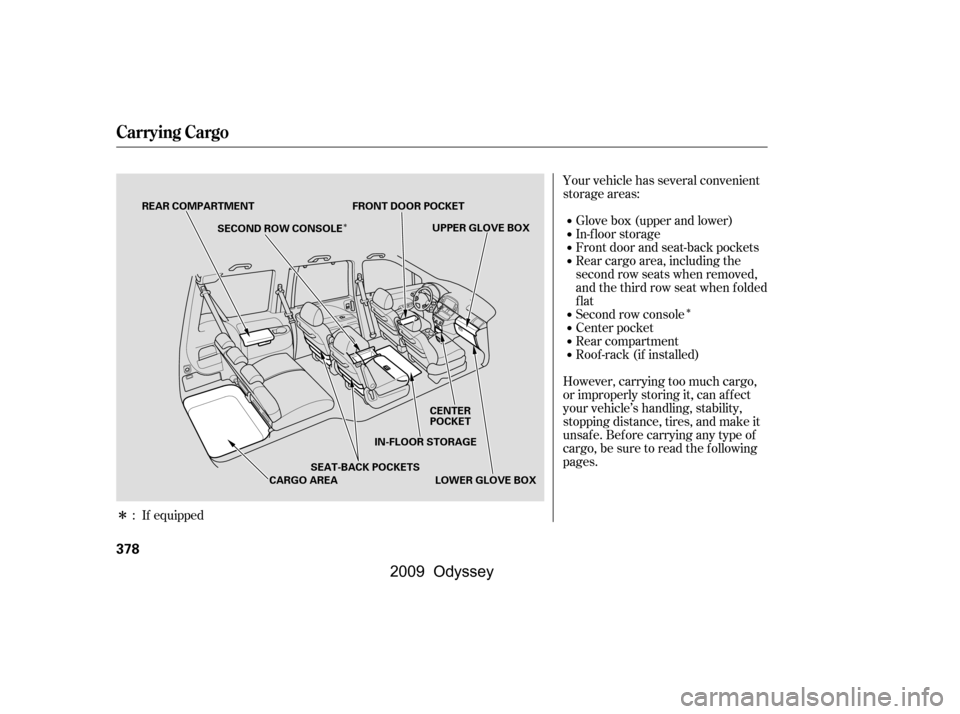
Your vehicle has several convenient
storage areas:Glove box (upper and lower)
In-f loor storage
Front door and seat-back pockets
Rear cargo area, including the
second row seats when removed,
andthethirdrowseatwhenfolded
flat
Second row console
Center pocket
Rear compartment
Roof -rack (if installed)
However, carrying too much cargo,
or improperly storing it, can af f ect
your vehicle’s handling, stability,
stopping distance, tires, and make it
unsaf e. Bef ore carrying any type of
cargo, be sure to read the f ollowing
pages.
: If equipped
Carrying Cargo
378
REAR COMPARTMENT FRONT DOOR POCKET
CENTER
POCKET
SEAT-BACK POCKETS UPPER GLOVE BOX
CARGO AREA LOWER GLOVE BOX
SECOND ROW CONSOLE
IN-FLOOR STORAGE
�\f���—�\f���—���
�y�
����\f��������y���
�(���������\f�y�\f�������y
2009 Odyssey
Page 384 of 532

Store or secure all items that could
be thrown around and hurt
someone during a crash.
Be sure items placed on the f loor
behind the f ront seats cannot roll
under the seats and interf ere with
the pedals, the seat operation, or
the proper operation of the
sensors under the seats.
Keep the glove boxes closed while
driving. If either are open, a
passenger could be injured during
a crash or sudden stop.If you remove or f old the rear seats
down, tie down items that could be
thrown about the vehicle during a
crash or sudden stop. Also, keep all
cargo below the bottom of the
windows. If it is higher than the
windows, it could interf ere with the
proper operation of the side curtain
airbags.
Distribute cargo evenly on the
f loor of the cargo area, placing the
heaviest items on the bottom and
as far forward as possible. Tie
down items that could be thrown
about the vehicle during a crash or
sudden stop.
If you carry large items that
prevent you f rom closing the
tailgate, exhaust gas can enter the
passenger area. To avoid the
possibility of
, f ollow the instructions
on page . 60
Carrying Cargo
Carrying Items in the Passenger
Compartment Carrying Cargo in the Cargo A rea
or on a Roof Rack
carbon monoxide
poisoning
Bef ore Driving
381
�\f���—�\f���—���
�y�
����\f��������y���
�(���������\f�y�\f�������y
2009 Odyssey
Page 390 of 532

�µ�µ�µ
This position mechani-
cally locks the transmission. Use
Park whenever you are turning of f or
starting the engine. To shif t out of
Park, you must press on the brake
pedal and have your f oot of f the
accelerator pedal. Press the release
button on the side of the shift lever
to move it.
If you have done all of the above and
still cannot move the lever out of
Park, see on
page . Use neutral if you
need to restart a stalled engine, or if
it is necessary to stop brief ly with
the engine idling. Shif t to the Park
position if you need to leave your
vehicle for any reason. Press on the
brake pedal when you are moving
the shift lever from neutral to
another gear.
To avoid transmission damage, come
to a complete stop bef ore shif ting
into Park. You must also press the
release button to shift into Park. The
shif t lever must be in Park bef ore
you can remove the key f rom the
ignition switch. Press the brake
pedal and press the release button
on the side of the shif t lever to shif t
f rom Park to reverse. To shif t f rom
reverse to neutral, come to a
completestopandthenshift.Press
the release button bef ore shif ting
into reverse f rom neutral.
389
CONT INUED
To shift from: PtoR
RtoP
NtoR
Dto2 2to1
1to2
2toD
DtoN
NtoD RtoN
DtoD
DtoD Do this:
Press the brake pedal, and
press the release button.
Press the release button.
Move the lever.
Press the D button.
3
3 3 3
Park (P)
Shif t L ock Release Neutral (N)
Reverse (R)
Automatic Transmission
Driving
387
�\f���—�\f���—���
�y�
����\f����\f���y���
�(���������\f�y�\f�������y
2009 Odyssey
Page 391 of 532

�µ
�µ
�µ �µ
If you exceed the maximum speed
f or the gear you are in, the engine
speed will enter into the tachometer’s
red zone. If this occurs, you may f eel
the engine cut in and out. This is
caused by a limiter in the engine’s
computer controls. The engine will
run normally when you reduce the
rpm below the red zone.
This position locks
thetransmissioninsecondgear.It
does not downshif t to f irst gear
when you come to a stop.
Use second gear: For more power when climbing.
To increase engine braking when
going down steep hills.
For starting out on a slippery
surf ace or in deep snow.
When driving downhill with a
trailer.
Use this position f or
normal driving. The transmission
automatically selects a suitable gear
f or your speed and acceleration.
To use D , press the
D button when the shif t lever is in
the ‘‘D’’ position. This position is simi-
lartoD,exceptonlythefirstthree
gears are selected instead of all f ive.
Use D when towing a trailer in hilly
terrain, or to provide engine braking
when going down a steep hill. D can
also keep the transmission f rom
cycling between third and f ourth
gears in stop-and-go driving. To shif t f rom second to
first, press the release button on the
side of the shif t lever. This position
locks the transmission in f irst gear.
By upshif ting and downshif ting
through 1, 2, D , and D, you can
operate the transmission much like a
manual transmission without a
clutch pedal.
3
3
3 3 3
Automatic Transmission
Engine Speed L imiter
Second (2)
Drive (D)
Drive (D ) First (1)
3
388
�\f���—�\f���—���
�y�
����\f����
���y���
�(���������\f�y�\f�������y
2009 Odyssey