2009 FIAT SEDICI gas type
[x] Cancel search: gas typePage 11 of 270
10
Gasoline/Ethanol blends
Blends of unleaded gasoline and ethanol
(grain alcohol), also known as gasohol, are
commercially available in some areas.
Blends of this type may be used in your ve-
hicle if they are no more than 10%
ethanol. Make sure this gasoline- ethanol
blend has octane ratings no lower than
those recommended for gasoline.
Gasoline/Methanol blends
Blends of unleaded gasoline and methanol
(wood alcohol) are also commercially avail-
able in some areas. DO NOT USE fuels
containing more than 5% methanol under
any circumstances. Fuel system damage or
vehicle performance problems resulting
from the use of such fuels are not the re-
sponsibility of Fiat and may not be covered
under the New Vehicle Warranty. Fuels containing 5% or less methanol may
be suitable for use in your vehicle if they
contain cosolvents and corrosion in-
hibitors.
NOTE If you are not satisfied with the dri-
veability or fuel economy of your vehicle
when you are using a gasoline/ alcohol
blend, you should switch back to unlead-
ed gasoline containing no alcohol.
IMPORTANT Be careful not to spill fuel
containing alcohol while refueling. If fuel is
spilled on the vehicle body, wipe it up im-
mediately. Fuels containing alcohol can
cause paint damage, which is not covered
under the New Vehicle Limited Warran-
ty.
DIESEL ENGINE
The diesel fuel should be with Cetane In-
dex higher than 50 and sulfur content less
than 50 ppm (parts per million). You
should use the diesel fuel conformable to
EN590 that corresponded to Euro V emis-
sion control. Do not use marine diesel fu-
el, heating oils and so forth. If you use im-
proper diesel fuel, it may cause serious en-
gine damage.
FUEL
RECOMMENDATION
GASOLINE ENGINE
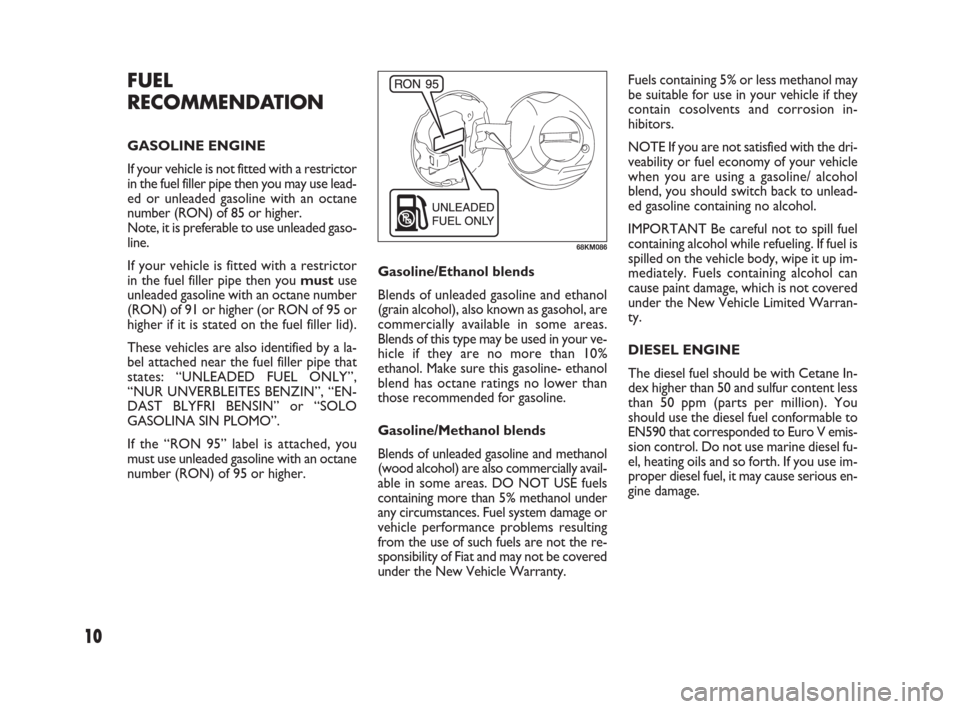
If your vehicle is not fitted with a restrictor
in the fuel filler pipe then you may use lead-
ed or unleaded gasoline with an octane
number (RON) of 85 or higher.
Note, it is preferable to use unleaded gaso-
line.
If your vehicle is fitted with a restrictor
in the fuel filler pipe then you mustuse
unleaded gasoline with an octane number
(RON) of 91 or higher (or RON of 95 or
higher if it is stated on the fuel filler lid).
These vehicles are also identified by a la-
bel attached near the fuel filler pipe that
states: “UNLEADED FUEL ONLY”,
“NUR UNVERBLEITES BENZIN”, “EN-
DAST BLYFRI BENSIN” or “SOLO
GASOLINA SIN PLOMO”.
If the “RON 95” label is attached, you
must use unleaded gasoline with an octane
number (RON) of 95 or higher.
68KM086
009-056 SEDICI LUM FL GB 1E 19-06-2009 14:11 Pagina 10
Page 53 of 270
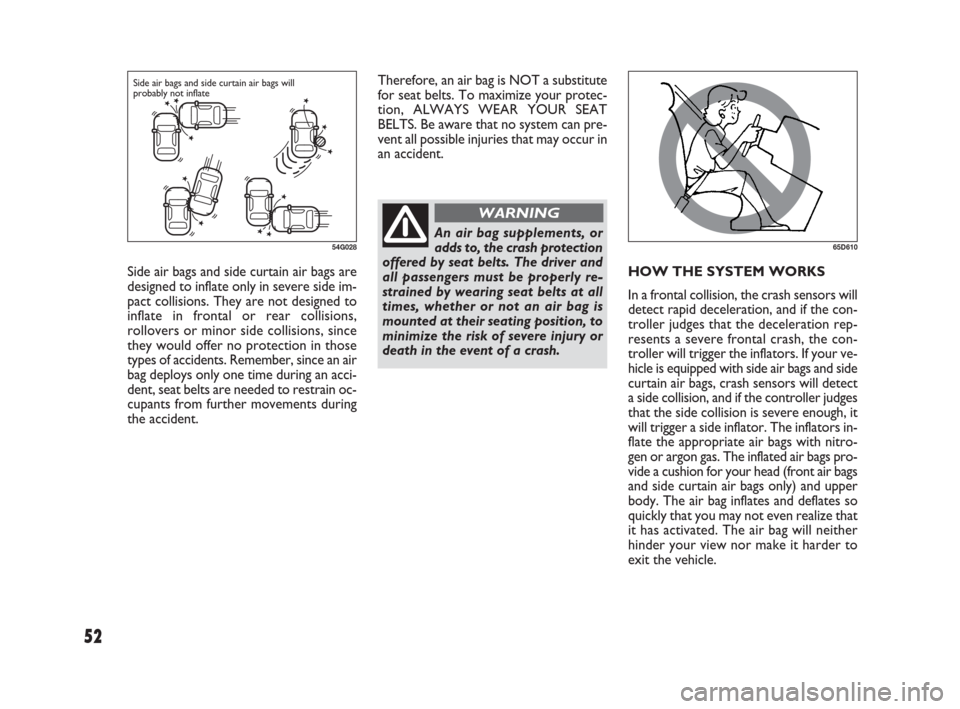
Side air bags and side curtain air bags are
designed to inflate only in severe side im-
pact collisions. They are not designed to
inflate in frontal or rear collisions,
rollovers or minor side collisions, since
they would offer no protection in those
types of accidents. Remember, since an air
bag deploys only one time during an acci-
dent, seat belts are needed to restrain oc-
cupants from further movements during
the accident.
54G028
Side air bags and side curtain air bags will
probably not inflate
HOW THE SYSTEM WORKS
In a frontal collision, the crash sensors will
detect rapid deceleration, and if the con-
troller judges that the deceleration rep-
resents a severe frontal crash, the con-
troller will trigger the inflators. If your ve-
hicle is equipped with side air bags and side
curtain air bags, crash sensors will detect
a side collision, and if the controller judges
that the side collision is severe enough, it
will trigger a side inflator. The inflators in-
flate the appropriate air bags with nitro-
gen or argon gas. The inflated air bags pro-
vide a cushion for your head (front air bags
and side curtain air bags only) and upper
body. The air bag inflates and deflates so
quickly that you may not even realize that
it has activated. The air bag will neither
hinder your view nor make it harder to
exit the vehicle. Therefore, an air bag is NOT a substitute
for seat belts. To maximize your protec-
tion, ALWAYS WEAR YOUR SEAT
BELTS. Be aware that no system can pre-
vent all possible injuries that may occur in
an accident.
An air bag supplements, or
adds to, the crash protection
offered by seat belts. The driver and
all passengers must be properly re-
strained by wearing seat belts at all
times, whether or not an air bag is
mounted at their seating position, to
minimize the risk of severe injury or
death in the event of a crash.
WARNING
65D610
52
009-056 SEDICI LUM FL GB 1E 19-06-2009 14:11 Pagina 52
Page 133 of 270
132
FUEL FILLER CAP
The fuel filler cap is located on the left rear
side of the vehicle. The fuel filler lid can be
unlocked by pulling up the opener lever lo-
cated on the outboard side of the driver’s
seat and locked by simply closing the lid.
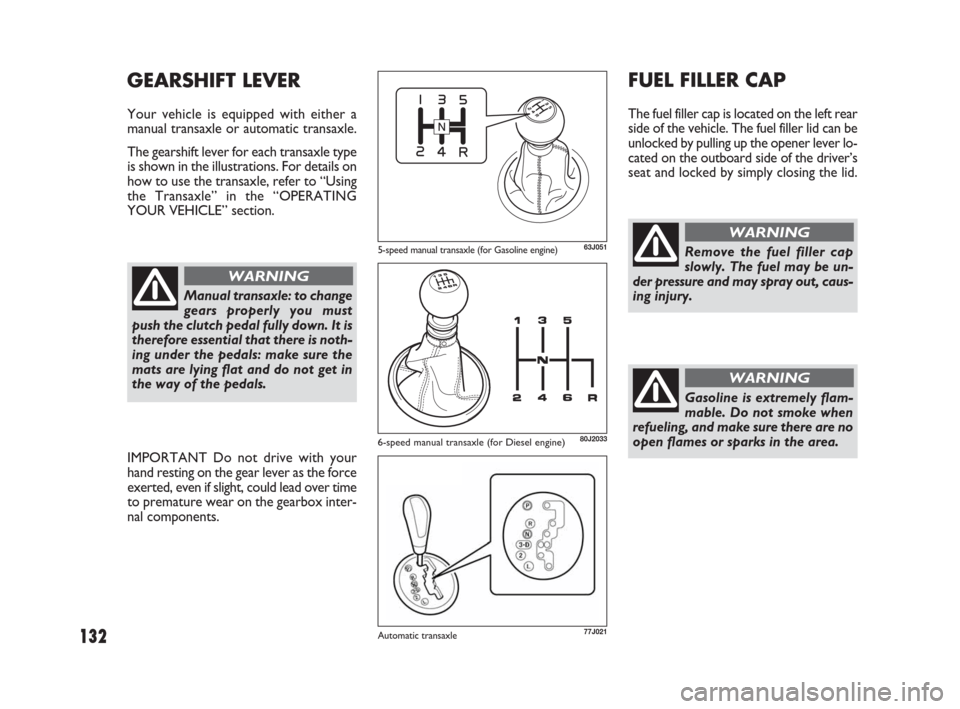
GEARSHIFT LEVER
Your vehicle is equipped with either a
manual transaxle or automatic transaxle.
The gearshift lever for each transaxle type
is shown in the illustrations. For details on
how to use the transaxle, refer to “Using
the Transaxle” in the “OPERATING
YOUR VEHICLE” section.
63J051
80J2033
Remove the fuel filler cap
slowly. The fuel may be un-
der pressure and may spray out, caus-
ing injury.
WARNING
Gasoline is extremely flam-
mable. Do not smoke when
refueling, and make sure there are no
open flames or sparks in the area.
WARNING
Manual transaxle: to change
gears properly you must
push the clutch pedal fully down. It is
therefore essential that there is noth-
ing under the pedals: make sure the
mats are lying flat and do not get in
the way of the pedals.
WARNING
IMPORTANT Do not drive with your
hand resting on the gear lever as the force
exerted, even if slight, could lead over time
to premature wear on the gearbox inter-
nal components.
5-speed manual transaxle (for Gasoline engine)
77J021Automatic transaxle
6-speed manual transaxle (for Diesel engine)
129-148 SEDICI LUM FL GB 1E 19-06-2009 13:31 Pagina 132
Page 191 of 270

MAINTENANCE RECOMMENDED UNDER SEVERE DRIVING CONDITIONS
If the vehicle is usually used under the conditions corresponding to any severe condition code given below, it is recommended that
applicable maintenance operation be performed at the particular interval as given in the chart below.
190
G----
HTrailer towing (if admitted)
Maintenance Operation
IInspect and correct or replace if necessary
RReplace or Change
NOTE 4WD: 4-wheel drive Severe condition code
ARepeated short trips
BDriving on rough and/or muddy roads
CDriving on dusty roads
DDriving in extremely cold weather and/or salted roads
ERepeated short trips in extremely cold weather
FLeaded fuel use
Severe Condition Code
B C D
A D
A C D E F H
A C D E H
A B C E F H
C
B E H
B C D H
B D E H
B E H
C D
Maintenance Interval
Every 15,000 km (9,000 miles) or 12 months
Every 45,000 km (27,000 miles) or 36 months
Every 36 months
Every 7,500 km (4,500 miles) or 6 months
Every 7,500 km (4,500 miles) or 6 months
Every 30,000 km (18,000 miles) or 24 months
Every 10,000 km (6,000 miles) or 8 months
Every 2,500 km (1,500 miles)
Every 30,000 km (18,000 miles) or 24 months
Every 30,000 km (18,000 miles) or 24 months
Every 15,000 km (9,000 miles) or 12 months
Every 15,000 km (9,000 miles) or 12 months
First time only:
15,000 km (9,000 miles) or 12 months
Second time and after:
Every 30,000 km (18,000 miles) or 24 months
reckoning from 0 km (0 mile) or 0 month
Every 15,000 km (9,000 miles) or 12 months
Every 45,000 km (27,000 miles) or 36 months Maintenance
Engine accessory drive belt (V-rib belt)
Camshaft timing belt (Diesel engine)
Engine oil and oil filter (Gasoline engine)
Engine oil and oil filter (Diesel engine)
Spark plugs
Air cleaner filter element
(Inspect or replace more frequently if necessary)
Automatic transaxle fluid change
Wheel bearings
Drive axle boots/Propeller shaft (4WD)
Manual transaxle oil/Transfer oil (4WD)
Differential oil (4WD)
Air conditioner filter element (for versions/markets, where provided)
(Clean more frequently if the air flow from the air conditioner
decreases)Maintenance
Operation
I
R
R
R
R
R
R
I
R
R
I
I
R
I
R Iridium plug
(Highly recommended)
Nickel plug
(Standard type)
183-230 SEDICI LUM FL GB 1E 19-06-2009 11:00 Pagina 190
Page 199 of 270
198
IMPORTANT
To avoid damaging your cooling system:
❒Always use a high quality ethylene gly-
col base non- silicate type coolant di-
luted with distilled water at the correct
mixture concentration.
❒Make sure that the proper mix is 50/50
coolant to distilled water and in no case
higher than 70/30. Concentrations
greater than 70/30 coolant to distilled
water will cause overheating conditions.
❒Do not use straight coolant nor plain
water.
❒Do not add extra inhibitors or addi-
tives. They may not be compatible with
your cooling system.
❒Do not mix different types of base
coolants. Doing so may result in accel-
erated seal wear and/ or the possibili-
ty of severe overheating and extensive
engine/automatic transaxle damage.
ENGINE COOLANT
SELECTION OF COOLANT
To maintain optimum performance and
durability of your engine, use PARAFLU
UP.
This type of coolant is best for your cool-
ing system as it:
❒Helps maintain proper engine temper-
ature.
❒Gives proper protection against freez-
ing and boiling.
❒Gives proper protection against cor-
rosion and rust.
Failure to use the proper coolant can dam-
age your cooling system. Your authorized
Fiat Dealership can help you select the
proper coolant.
56KN090
For Gasoline Engine
Model
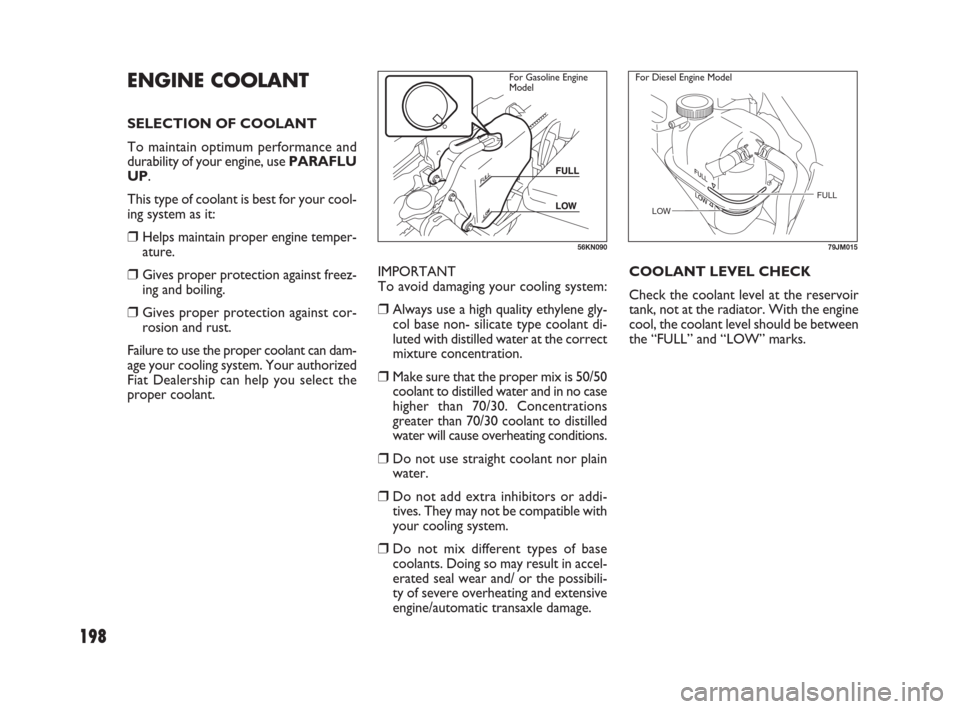
COOLANT LEVEL CHECK
Check the coolant level at the reservoir
tank, not at the radiator. With the engine
cool, the coolant level should be between
the “FULL” and “LOW” marks.
LOWFUL
L FULLFULL
79JM015
For Diesel Engine Model
183-230 SEDICI LUM FL GB 1E 19-06-2009 11:00 Pagina 198
Page 203 of 270

202
To remove the air cleaner element:
❒Remove the air cleaner inlet hose (1).
❒Remove the bolts (2), loosen the bolt
(3) and lift the air cleaner case (4) di-
rectly above.
IMPORTANT When lifting the air clean-
er, make sure the air cleaner does not in-
terfere the engine oil dipstick (5) to avoid
damage the dipstick.
❒Unclamp the side clamps, and remove
the element from the air cleaner case.
If it appears to be dirty, replace it with
a new one.
SPARK PLUGS
(Gasoline engine)
For Nickel spark plugs (traditional type):
You should inspect spark plugs periodi-
cally for carbon deposits. When carbon
accumulates on a spark plug, a strong
spark may not be produced. Remove car-
bon deposits with a wire or pin and adjust
the spark plug gap.
To access the spark plugs:
❒Remove the air cleaner case. Refer to
“Air Cleaner” in this section.
❒If necessary, disconnect the coupler (1)
while pushing the release lever.
❒Remove the ignitor bolts.
❒Pull the spark plug boots out.
NOTE When installation, make sure the
wires, couplers, sealing rubber of air clean-
er assy and washers, are correctly re-
turned in place.
(1)
80JM125
60G102
CorrectWrong
79JM016
For Diesel Engine Model
183-230 SEDICI LUM FL GB 1E 19-06-2009 11:00 Pagina 202