Page 416 of 498

WARNING!
•The warning words “DO NOT OPEN HOT” on
the cooling system pressure cap are a safety pre-
caution. Never add engine coolant (antifreeze)
when the engine is overheated. Do not loosen or
remove the cap to cool an overheated engine. Heat
causes pressure to build up in the cooling system.
To prevent scalding or injury, do not remove the
pressure cap while the system is hot or under
pressure.
•Do not use a pressure cap other than the one
specified for your vehicle. Personal injury or en-
gine damage may result.
Disposal of Used Engine Coolant
Used ethylene glycol-based engine coolant (antifreeze) is
a regulated substance requiring proper disposal. Check
with your local authorities to determine the disposalrules for your community. To prevent ingestion by ani-
mals or children, do not store ethylene glycol-based
engine coolant (antifreeze) in open containers, or allow it
to remain in puddles on the ground. If ingested by a
child, contact a physician immediately. Clean up any
ground spills immediately.
Coolant Level
The coolant bottle provides a quick visual method for
determining that the engine coolant (antifreeze) level is
adequate. With the engine cold, the level of the engine
coolant (antifreeze) in the coolant recovery bottle should
be between the ranges indicated on the bottle dipstick.
The radiator normally remains completely full, so there is
no need to remove the radiator cap unless checking for
engine coolant (antifreeze) freeze point or replacing en-
gine coolant (antifreeze). Advise your service attendant
414 MAINTAINING YOUR VEHICLE
Page 418 of 498

•Keep the front of the radiator clean. If your vehicle is
equipped with air conditioning, keep the front of the
condenser clean, also.
•Do not change the thermostat for Summer or Winter
operation. If replacement is ever necessary, install
ONLY the correct type thermostat. Other designs may
result in unsatisfactory engine coolant (antifreeze)
performance, poor gas mileage, and increased
emissions.
Brake System
Brake Master Cylinder — Fluid Level Check
The fluid level in the master cylinder should be checked
whenever the vehicle is serviced, or immediately if the
brake system warning light is on. If necessary, add fluid
to bring level to the full mark on the side of the reservoir
of the brake master cylinder. Be sure to clean the top of
the master cylinder area before removing the cap. With
disc brakes, fluid level can be expected to fall as the brakepads wear. Brake fluid level should be checked when
pads are replaced. If the brake fluid level is abnormally
low, check system for leaks.
Refer to “Fluids, Lubricants, and Genuine Parts” in this
section for the correct fluid type.
WARNING!
•Use of brake fluid that may have a lower initial
boiling point, or is unidentified as to specifica-
tions may result in sudden brake failure during
hard prolonged braking. You could have an
accident.
Use only brake fluid that has been in a tightly closed
container to avoid contamination from foreign matter or
moisture.
416 MAINTAINING YOUR VEHICLE
Page 426 of 498

Interior trim should be cleaned starting with a damp
cloth, a damp cloth with MOPAR�Total Clean, then
MOPAR�Spot & Stain Remover, if absolutely necessary.
Do not use harsh cleaners or Armorall. Use MOPAR�
Total Clean to clean vinyl upholstery.
Leather Seat Care and Cleaning
MOPAR�Total Clean is specifically recommended for
leather upholstery.
Your leather upholstery can be best preserved by regular
cleaning with a damp soft cloth. Small particles of dirt
can act as an abrasive and damage the leather upholstery
and should be removed promptly with a damp cloth.
Stubborn soils can be removed easily with a soft cloth
and MOPAR�Total Clean. Care should be taken to avoid
soaking your leather upholstery with any liquid. Please
do not use polishes, oils, cleaning fluids, solvents, deter-
gents, or ammonia based cleaners to clean your leatherupholstery. Application of a leather conditioner is not
required to maintain the original condition.
WARNING!
Do not use volatile solvents for cleaning purposes.
Many are potentially flammable, and if used in
closed areas they may cause respiratory harm.
Cleaning Headlights
Your vehicle has plastic headlights that are lighter and
less susceptible to stone breakage than glass headlights.
Plastic is not as scratch resistant as glass and therefore
different lens cleaning procedures must be followed.
To minimize the possibility of scratching the lenses and
reducing light output, avoid wiping with a dry cloth. To
remove road dirt, wash with a mild soap solution fol-
lowed by rinsing.
424 MAINTAINING YOUR VEHICLE
Page 464 of 498
† This maintenance is recommended by the manufacturer
to the owner, but is not required to maintain emissions
warranty.
WARNING!
You can be badly injured working on or around a
motor vehicle. Do only that service work for which
you have the knowledge and the right equipment. If
you have any doubt about your ability to perform a
service job, take your vehicle to a competent me-
chanic.
462 MAINTENANCE SCHEDULES
8
M
A
I
N
T
E
N
A
N
C
E
S
C
H
E
D
U
L
E
S
Page 470 of 498

the ownership experience. You’ll be pleased with their
sincere efforts to resolve any warranty issues or related
concerns.
WARNING!
Engine exhaust, some of its constituents, and certain
vehicle components contain, or emit, chemicals
known to the State of California to cause cancer and
birth defects, or other reproductive harm. In addi-
tion, certain fluids contained in vehicles and certain
products of component wear contain, or emit, chemi-
cals known to the State of California to cause cancer
and birth defects, or other reproductive harm.
WARRANTY INFORMATION (U.S. Vehicles Only)
See the Warranty Information Booklet for the terms and
provisions of Chrysler Motors LLC warranties applicable
to this vehicle.
MOPAR�PARTS
Mopar�fluids, lubricants, parts, and accessories are
available from an authorized dealer. They will help keep
the vehicle operating at its best.
REPORTING SAFETY DEFECTS
In The 50 United States And Washington, D.C.
If you believe that your vehicle has a defect that could
cause a crash or cause injury or death, you should
immediately inform the National Highway Traffic Safety
Administration (NHTSA) in addition to notifying the
manufacturer.
If NHTSA receives similar complaints, it may open an
investigation, and if it finds that a safety defect exists in
a group of vehicles, it may order a recall and remedy
campaign. However, NHTSA cannot become involved in
individual problems between you, your authorized
dealer, and the manufacturer.
468 IF YOU NEED CONSUMER ASSISTANCE
Page 473 of 498

Treadwear
The Treadwear grade is a comparative rating, based on
the wear rate of the tire when tested under controlled
conditions on a specified government test course. For
example, a tire graded 150 would wear one and one-half
times as well on the government course as a tire graded
100. The relative performance of tires depends upon the
actual conditions of their use, however, and may depart
significantly from the norm due to variations in driving
habits, service practices, and differences in road charac-
teristics and climate.
Traction Grades
The Traction grades, from highest to lowest, are AA, A, B,
and C. These grades represent the tire’s ability to stop on
wet pavement, as measured under controlled conditions
on specified government test surfaces of asphalt and
concrete. A tire marked C may have poor traction perfor-
mance.
WARNING!
The traction grade assigned to this tire is based on
straight-ahead braking traction tests, and does not
include acceleration, cornering, hydroplaning, or
peak traction characteristics.
Temperature Grades
The temperature grades are A (the highest), B, and C,
representing the tire’s resistance to the generation of heat
and its ability to dissipate heat, when tested under
controlled conditions on a specified indoor laboratory
test wheel. Sustained high temperature can cause the
material of the tire to degenerate and reduce tire life, and
excessive temperature can lead to sudden tire failure. The
grade C corresponds to a level of performance, which all
passenger car tires must meet under the Federal Motor
IF YOU NEED CONSUMER ASSISTANCE 471
9
Page 474 of 498
Vehicle Safety Standard No. 109. Grades B and A repre-
sent higher levels of performance on the laboratory test
wheel, than the minimum required by law.
WARNING!
The temperature grade for this tire is established for
a tire that is properly inflated and not overloaded.
Excessive speed, under-inflation, or excessive load-
ing, either separately or in combination, can cause
heat buildup and possible tire failure.
472 IF YOU NEED CONSUMER ASSISTANCE
Page 476 of 498
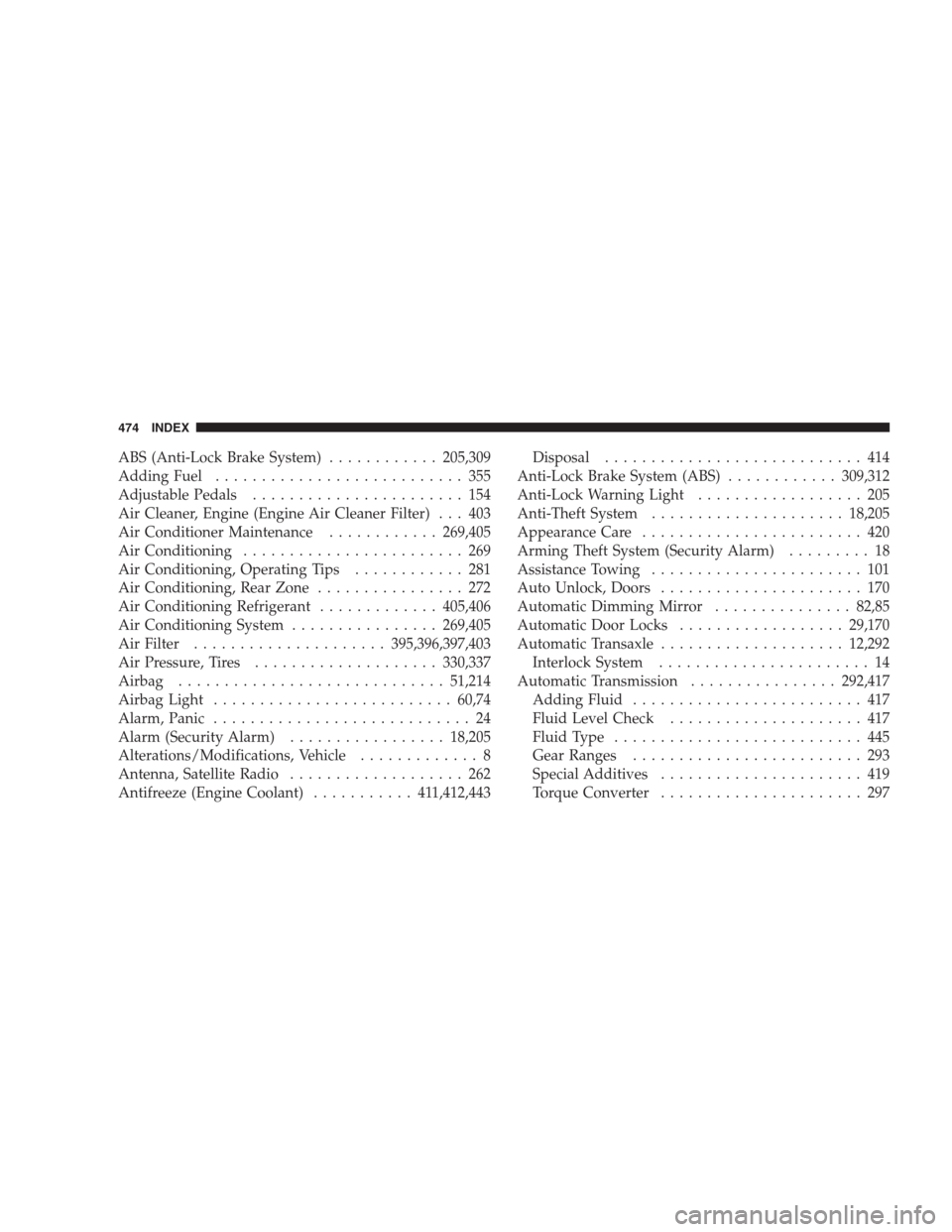
ABS (Anti-Lock Brake System)............205,309
Adding Fuel........................... 355
Adjustable Pedals....................... 154
Air Cleaner, Engine (Engine Air Cleaner Filter) . . . 403
Air Conditioner Maintenance............269,405
Air Conditioning........................ 269
Air Conditioning, Operating Tips............ 281
Air Conditioning, Rear Zone................ 272
Air Conditioning Refrigerant.............405,406
Air Conditioning System................269,405
Air Filter.....................395,396,397,403
Air Pressure, Tires....................330,337
Airbag.............................51,214
Airbag Light..........................60,74
Alarm, Panic............................ 24
Alarm (Security Alarm).................18,205
Alterations/Modifications, Vehicle............. 8
Antenna, Satellite Radio................... 262
Antifreeze (Engine Coolant)........... 411,412,443Disposal............................ 414
Anti-Lock Brake System (ABS)............309,312
Anti-Lock Warning Light.................. 205
Anti-Theft System.....................18,205
Appearance Care........................ 420
Arming Theft System (Security Alarm)......... 18
Assistance Towing....................... 101
Auto Unlock, Doors...................... 170
Automatic Dimming Mirror...............82,85
Automatic Door Locks..................29,170
Automatic Transaxle....................12,292
Interlock System....................... 14
Automatic Transmission................292,417
Adding Fluid......................... 417
Fluid Level Check..................... 417
Fluid Type........................... 445
Gear Ranges......................... 293
Special Additives...................... 419
Torque Converter...................... 297
474 INDEX

