Page 345 of 449
To Stow the Flat or Spare
Turn the wheel so that the valve stem is down. Slide the
wheel retainer through the center of the wheel and
position it properly across the wheel opening.
For convenience in checking the spare tire inflation, stow
with the valve stem toward the rear of the vehicle.
Rotate the winch mechanism until the wheel is drawn
into place against the underside of the vehicle. Continue
to rotate until you feel the winch mechanism slip or click
three times. It cannot be overtightened. Push against the
tire several times to be sure it is firmly in place.
NOTE:To Stow the Flat or Spare: Wheel retainer does
not fit through the center of the aluminum wheel. The tire
must be stored in a safe manner in the bed of the truck.
JUMP±STARTING
WARNING!
²Battery fluid is a corrosive acid solution; do not
allow battery fluid to contact eyes, skin or cloth-
ing. Don't lean over battery when attaching
clamps or allow the clamps to touch each other. If
acid splashes in eyes or on skin, flush the contami-
nated area immediately with large quantities of
water.
²A battery generates hydrogen gas which is flam-
mable and explosive. Keep flame or spark away
from the vent holes. Do not use a booster battery
or any other booster source with an output that
exceeds 12-Volts.
Check the Battery Test Indicator (if equipped). If a light or
bright colored dot is visible in the indicator, DO NOT
jump-start the battery.
WHAT TO DO IN EMERGENCIES 343
6
Page 346 of 449

If the indicator is dark or shows a green dot, proceed as
follows:
1. Wear eye protection and remove all metal jewelry such
as watch bands or bracelets, which might make an
unintended electrical contact.
2. Park the booster vehicle within cable reach but with-
out letting the vehicles touch. Set the parking brake, place
the automatic transmission in PARK and turn the ignition
OFF on both vehicles.
3. Turn off the heater, radio and all unnecessary electrical
loads.
4. Connect one end of a jumper cable to the positive
terminal of the booster battery. Connect the other end of
the same cable to the positive terminal of the discharged
battery.WARNING!
Do not permit vehicles to touch each other as this
could establish a ground connection and personal
injury could result.
5. Connect the other cable, first to the negative terminal
of the booster battery and then to the engine of the
vehicle with the discharged battery. Make sure you have
a good contact to a metal surface of the engine block.
WARNING!
²Do not connect the cable to the negative post of the
discharge battery. The resulting electrical spark
could cause the battery to explode.
(Continued)
344 WHAT TO DO IN EMERGENCIES
Page 347 of 449
WARNING! (Continued)
²During cold weather when temperatures are be-
low freezing point, electrolyte in a discharged
battery may freeze. Do not attempt jump-starting
because the battery could rupture or explode. The
battery temperature must be brought up above
freezing point before attempting jump-start.
6. Start the engine in the vehicle that has the booster
battery, let the engine idle a few minutes, then start the
engine in the vehicle with the discharged battery.
7. When removing the jumper cables, reverse the above
sequence exactly. Be careful of the moving belts and fan.
WARNING!
Any procedure other than above could result in:
²Personal injury caused by electrolyte squirting out
the battery vent;
²Personal injury or property damage due to battery
explosion;
²Damage to charging system of booster vehicle or
of immobilized vehicle.
WHAT TO DO IN EMERGENCIES 345
6
Page 351 of 449
MAINTAINING YOUR VEHICLE
CONTENTS
mEngine Compartment Ð 3.7L............. 351
mEngine Compartment Ð 4.7L............. 352
mOnboard Diagnostic System Ð OBD II....... 353
NLoose Fuel Filler Cap Message........... 353
mEmissions Inspection And Maintenance
Programs............................ 354
mReplacement Parts..................... 355
mDealer Service........................ 356
mMaintenance Procedures................. 356NEngine Oil......................... 356
NEngine Oil Filter..................... 358
NEngine Air Cleaner Filter............... 359
NMaintenance-Free Battery............... 359
NAir Conditioner Maintenance............ 360
NDrive Shaft Constant Velocity Joints....... 361
NBody Lubrication..................... 362
NWindshield Wiper Blades............... 362
NWindshield Washers................... 363
7
Page 353 of 449
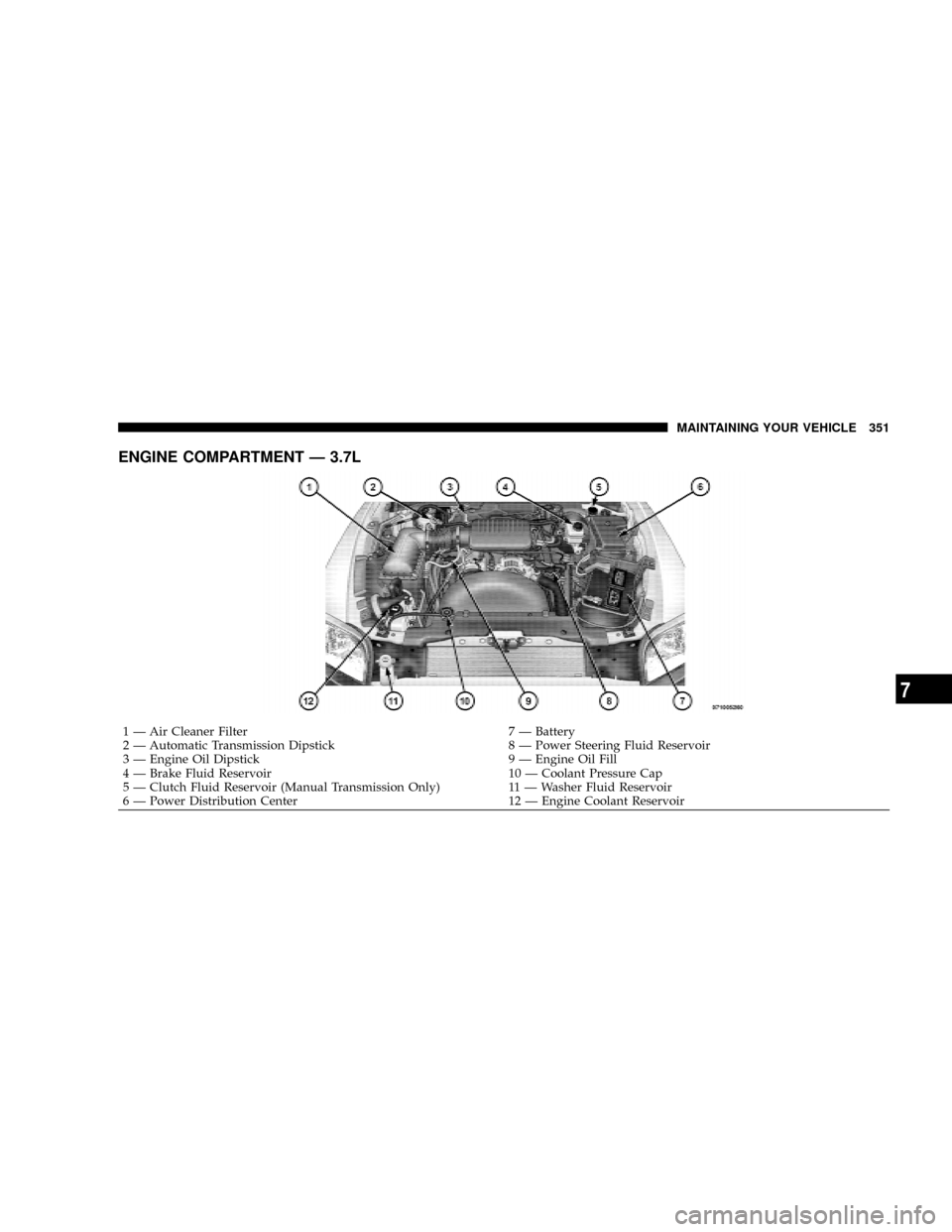
ENGINE COMPARTMENT Ð 3.7L
1 Ð Air Cleaner Filter 7 Ð Battery
2 Ð Automatic Transmission Dipstick 8 Ð Power Steering Fluid Reservoir
3 Ð Engine Oil Dipstick 9 Ð Engine Oil Fill
4 Ð Brake Fluid Reservoir 10 Ð Coolant Pressure Cap
5 Ð Clutch Fluid Reservoir (Manual Transmission Only) 11 Ð Washer Fluid Reservoir
6 Ð Power Distribution Center 12 Ð Engine Coolant ReservoirMAINTAINING YOUR VEHICLE 351
7
Page 354 of 449
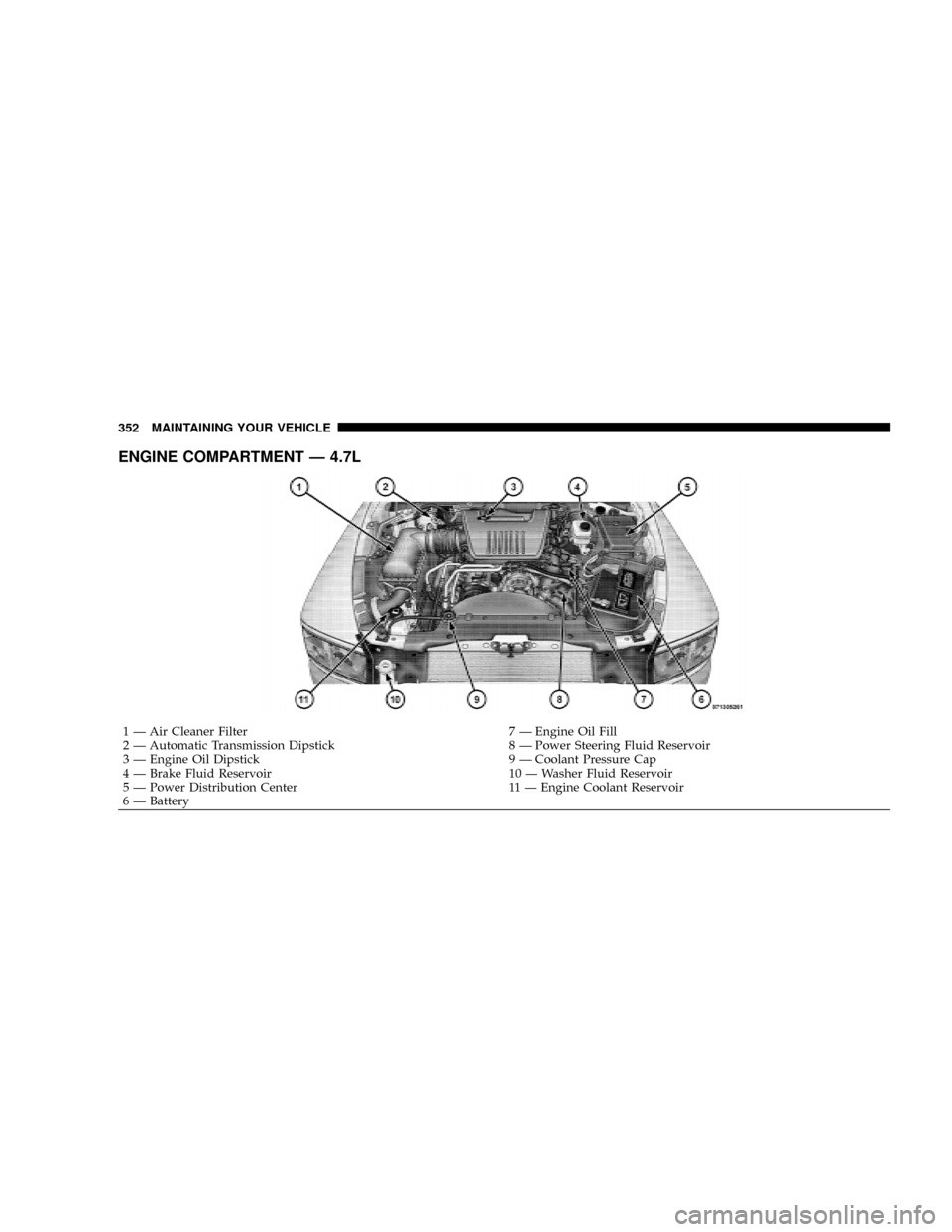
ENGINE COMPARTMENT Ð 4.7L
1 Ð Air Cleaner Filter 7 Ð Engine Oil Fill
2 Ð Automatic Transmission Dipstick 8 Ð Power Steering Fluid Reservoir
3 Ð Engine Oil Dipstick 9 Ð Coolant Pressure Cap
4 Ð Brake Fluid Reservoir 10 Ð Washer Fluid Reservoir
5 Ð Power Distribution Center 11 Ð Engine Coolant Reservoir
6 Ð Battery 352 MAINTAINING YOUR VEHICLE
Page 356 of 449
problem persists, the message will appear the next time
the vehicle is started. This might indicate a damaged cap.
If the problem is detected twice in a row, the system will
turn on the MIL. Resolving the problem will turn the MIL
off.
EMISSIONS INSPECTION AND MAINTENANCE
PROGRAMS
In some localities, it may be a legal requirement to pass
an inspection of your vehicle's emissions control system.
Failure to pass could prevent vehicle registration.
For states that require an Inspection and Mainte-
nance (I/M), this check verifies the Malfunction
Indicator Light (MIL) is functioning and is not on
when the engine is running, and that the OBD II system
is ready for testing.
Normally, the OBD II system will be ready. The OBD II
system maynotbe ready if your vehicle was recentlyserviced, recently had a dead battery, or a battery replace-
ment. If the OBD II system should be determined not
ready for the I/M test, your vehicle may fail the test.
Your vehicle has a simple ignition key-actuated test,
which you can use prior to going to the test station. To
check if your vehicle's OBD II system is ready, you must
do the following:
1. Insert your ignition key into the ignition switch.
2. Turn the ignition to the ON position, but do not crank
or start the engine.
3. If you crank or start the engine, you will have to start
this test over.
4. As soon as you turn your key to the ON position, you
will see the MIL symbol come on as part of a normal bulb
check.
354 MAINTAINING YOUR VEHICLE
Page 357 of 449
5. Approximately 15 seconds later, one of two things will
happen:
a. The MIL will flash for about 10 seconds and then
return to being fully illuminated until you turn OFF
the ignition or start the engine. This means that your
vehicle's OBD II system isnot readyand you should
notproceed to the I/M station.
b. The MIL will not flash at all and will remain fully
illuminated until you turn OFF the ignition or start the
engine. This means that your vehicle's OBD II system
isready, and you can proceed to the I/M station.
If your OBD II system isnot ready,you should see your
authorized dealer or repair facility. If your vehicle was
recently serviced or had a battery failure or replacement,
you may need to do nothing more than drive your
vehicle as you normally would in order for your OBD II
system to update. A recheck with the above test routine
may then indicate that the system is now ready.Regardless of whether your vehicle's OBD II system is
ready or not ready, if the MIL is illuminated during
normal vehicle operation, you should have your vehicle
serviced before going to the I/M station. The I/M station
can fail your vehicle because the MIL is on with the
engine running.
REPLACEMENT PARTS
Use of genuine MOPARtparts for normal/scheduled
maintenance and repairs is highly recommended to en-
sure the designed performance. Damage or failures
caused by the use of non-MOPARtparts for maintenance
and repairs will not be covered by the manufacturer's
warranty.
MAINTAINING YOUR VEHICLE 355
7