2009 DODGE DAKOTA warning
[x] Cancel search: warningPage 46 of 449
Seat Belt Pretensioners
The seat belts for front outboard seating positions are
equipped with pretensioning devices that are designed to
remove any slack from the seat belt system in the event of
a collision. These devices improve the performance of the
seat belt by assuring that the belt is tight about the
occupant early in a collision. Pretensioners work for all
size occupants, including those in child restraints.
NOTE:These devices are not a substitute for proper seat
belt placement by the occupant. The seat belt still must be
worn snugly and positioned properly.
The pretensioners are triggered by the Occupant Re-
straint Controller (ORC). Like the airbags, the pretension-
ers are single-use items. After a collision that is severe
enough to deploy the airbags and pretensioners, both
must be replaced.
Enhanced Driver Seat Belt Reminder System
(BeltAlertT)
If the driver's seat belt has not been buckled within
60 seconds of starting the vehicle, and if the vehicle speed
is greater than 5 mph (8 km/h), the Enhanced Warning
System (BeltAlertt) will alert the driver to buckle their
seat belt. The driver should also instruct all other occu-
pants to buckle their seat belts. If the driver unbuckles the
seat belt while the vehicle is in motion, an immediate
chime will be heard and, BeltAlerttwill continue to
chime and flash the Seat Belt Warning Light for 96 sec-
onds or until the driver's seat belt is buckled. BeltAlertt
will be reactivated if the driver's seat belt is unbuckled
for more than 10 seconds, and the vehicle speed is greater
than 5 mph (8 km/h).
BeltAlerttcan be enabled or disabled by your authorized
dealer, or by following these steps:
44 THINGS TO KNOW BEFORE STARTING YOUR VEHICLE
Page 47 of 449
NOTE:The following steps must occur within the first
60 seconds of the ignition switch being turned to the ON
or START position. Chrylser LLC does not recommend
deactivating BeltAlertt.
1. Turn the ignition switch to the OFF position and
buckle the driver's seat belt.
2. Turn the ignition switch to the ON position and wait
for the Seat Belt Warning Light to turn off.
3. Within 60 seconds of starting the vehicle, unbuckle
and then re-buckle the driver's seat belt at least three
times within 10 seconds, ending with the seat belt
buckled.
4. Turn off the engine. A single chime will sound to
signify that you have successfully completed the
programming.
BeltAlerttcan be reactivated by repeating this procedure.NOTE:Although the BeltAlertthas been deactivated,
the Seat Belt Warning Light will continue to illuminate
while the driver's seat belt remains unbuckled.
Seat Belts And Pregnant Women
We recommend that pregnant women use seat belts
throughout their pregnancies. Keeping the mother safe is
the best way to keep the baby safe.
Pregnant women should wear the lap part of the belt
across the thighs and as snug against the hips as possible.
Keep the belt low so that it does not come across the
abdomen. That way the strong bones of the hips will take
the force if there is a collision.
Seat Belt Extender
If a seat belt is too short, even when fully extended, your
authorized dealer can provide you with a seat belt
extender. This extender should be used only if the
existing belt is not long enough. When it is not required,
remove the extender and store it.
THINGS TO KNOW BEFORE STARTING YOUR VEHICLE 45
2
Page 48 of 449
WARNING!
Using a seat belt extender when not needed can
increase the risk of injury in a collision. Only use the
seat belt extender when the lap belt is not long
enough when it is worn low and snug, and in the
recommended seating positions. Remove and store
the extender when not needed.
Driver And Right Front Passenger Supplemental
Restraint System (SRS) ± Airbags
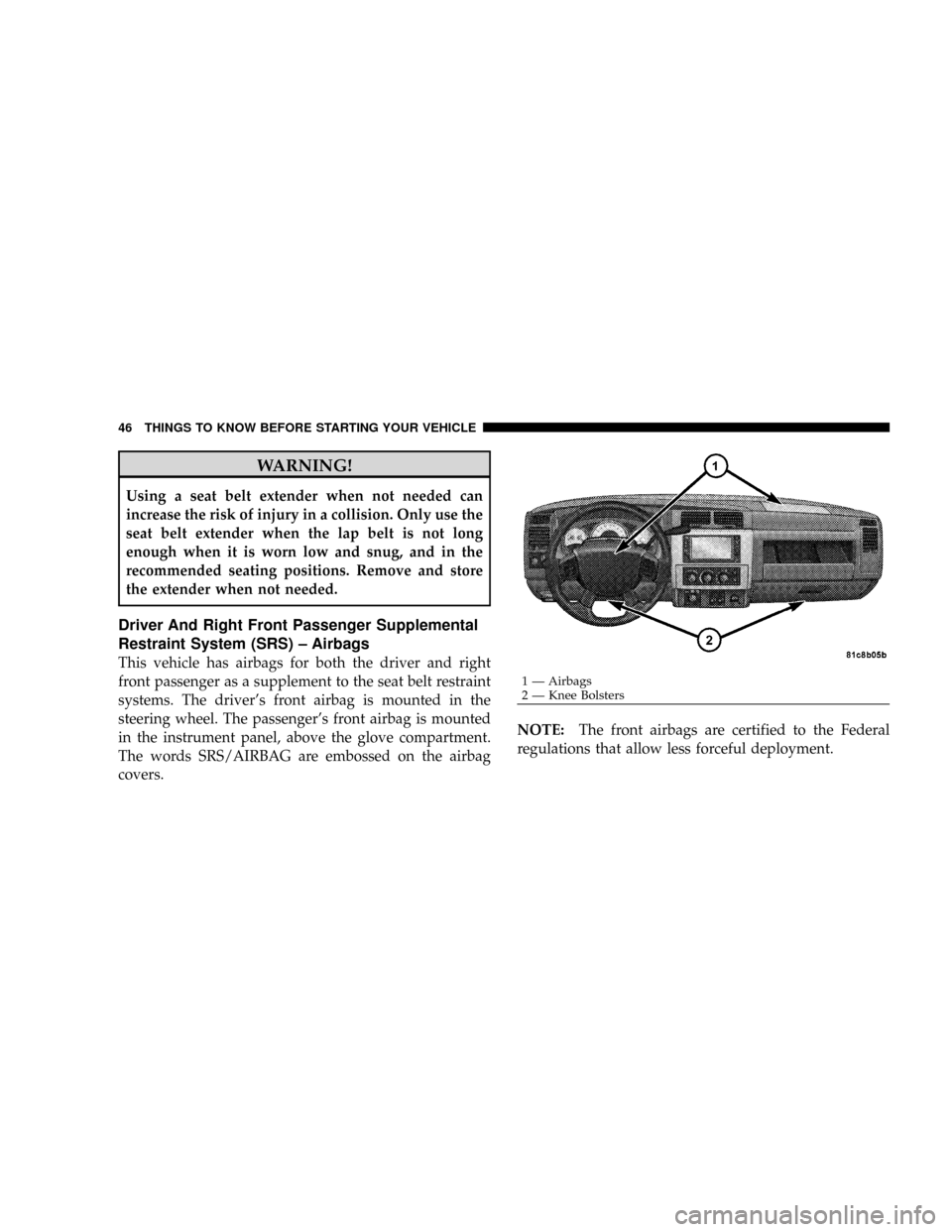
This vehicle has airbags for both the driver and right
front passenger as a supplement to the seat belt restraint
systems. The driver's front airbag is mounted in the
steering wheel. The passenger's front airbag is mounted
in the instrument panel, above the glove compartment.
The words SRS/AIRBAG are embossed on the airbag
covers.NOTE:The front airbags are certified to the Federal
regulations that allow less forceful deployment.
1 Ð Airbags
2 Ð Knee Bolsters 46 THINGS TO KNOW BEFORE STARTING YOUR VEHICLE
Page 49 of 449
The front airbags have a multistage inflator design. This
may allow the airbag to have different rates of inflation
that are based on collision severity and occupant size.
This vehicle may also be equipped with window bags to
protect the driver, and front and rear passengers sitting
next to a window. If the vehicle is equipped with window
bags, they are located above the side windows. Their
covers are also labeled SRS AIRBAG.
NOTE:Airbag covers may not be obvious in the interior
trim; but they will open to allow airbag deployment.WARNING!
²Do not put anything on or around the front airbag
covers or attempt to manually open them. You may
damage the airbags and you could be injured
because the airbags are no longer functional.
These protective covers for the airbag cushions are
designed to open only when the airbags are inflat-
ing.
²If your vehicle is equipped with window bags, do
not stack luggage or other cargo up high enough to
block the location of the window bag. The area
where the window bag is located should remain
free from any obstructions.
(Continued)
THINGS TO KNOW BEFORE STARTING YOUR VEHICLE 47
2
Page 50 of 449
WARNING! (Continued)
²If your vehicle is equipped with window bags, do
not have any accessory items installed that will
alter the roof, including adding a sunroof to your
vehicle. Do not add roof racks that require perma-
nent attachments (bolts or screws) for installation
on the vehicle roof. Do not drill into the roof of the
vehicle for any reason.
NOTE:Do not use a clothing bar mounted to the coat
hooks in this vehicle. A clothing bar will impede the
proper performance of the window bags.
Along with the seat belts, front airbags work with the
instrument panel knee bolsters to provide improved
protection for the driver and front passenger. Window
bags also work with seat belts to improve occupant
protection.The seat belts are designed to protect you in many types
of collisions. The front airbags deploy in moderate to
severe frontal collisions.
If your vehicle is so equipped, the window bag on the
crash side of the vehicle is triggered in moderate-to-
severe side collisions. But even in collisions where the
airbags work, you need the seat belts to keep you in the
right position for the airbags to protect you properly.
Here are some simple steps you can follow to minimize
the risk of harm from a deploying airbag.
1. Children 12 years and younger should always ride
buckled up in a rear seat, in an appropriate child re-
straint.
Infants, in rear-facing child restraints, shouldNEVER
ride in the front seat of a vehicle with a passenger front
airbag. An airbag deployment can cause severe injury or
death to infants in that position.
48 THINGS TO KNOW BEFORE STARTING YOUR VEHICLE
Page 51 of 449
If a child between the ages of 1 and 12 years old, must
ride in the front passenger seat because the vehicle is
crowded, move the seat as far back as possible, and use
the proper child restraint. Refer to9Child Restraint,9in
this section.
You should read the instructions provided with your
child restraint to make sure that you are using it properly.
2. All occupants should use their lap and shoulder belts
properly.
3. The driver and front passenger seats should be moved
back as far as practical to allow the airbag room to inflate.
4. If your vehicle has window airbags, do not lean
against the door or window. Airbags will inflate force-
fully into the space between you and the door.5. If the airbag system in this vehicle needs to be
modified to accommodate a disabled person, contact the
Customer Center. Refer to9If You Need Customer Assis-
tance9in Section 9.
WARNING!
²Relying on the airbags alone could lead to more
severe injuries in a collision. The airbags work
with your seat belt to restrain you properly. In
some collisions the airbags won't deploy at all.
Always wear your seat belts even though you have
airbags.
²Being too close to the steering wheel or instrument
panel during airbag deployment could cause seri-
ous injury. Airbags need room to inflate. Sit back,
comfortably extending your arms to reach the
steering wheel or instrument panel.
(Continued)
THINGS TO KNOW BEFORE STARTING YOUR VEHICLE 49
2
Page 52 of 449

WARNING! (Continued)
²If the vehicle has window bags, they also need
room to inflate. Do not lean against the door or
window. Sit upright in the center of the seat.
Airbag System Components
The airbag system consists of the following:
²Occupant Restraint Controller
²Side Remote Acceleration Sensors ± if equipped
²Airbag Warning Light
²Driver Airbag
²Passenger Airbag
²Window Bags above side windows ± if equipped
²Steering Wheel and Column
²Instrument Panel
²Interconnecting Wiring
²Knee Impact Bolsters
²Front Acceleration Sensors
²Driver and Front Passenger Seat Belt Pretensioners
How the Airbag System Works
²
TheOccupant Restraint Controller (ORC)determines
if a frontal collision is severe enough to require the
airbags to inflate. The front airbag inflators are de-
signed to provide different rates of airbag inflation
from direction provided by the ORC. The ORC will not
detect rollover.
The ORC also monitors the readiness of the electronic
parts of the system whenever the ignition switch is in
the START or RUN position. These include all of the
items listed above, except the steering wheel and
column, and knee bolsters. If the key is in the OFF
50 THINGS TO KNOW BEFORE STARTING YOUR VEHICLE
Page 53 of 449
position, in the ACC position, or not in the ignition,
the airbags are not on and will not inflate.
During a moderate-to-severe rear impact, the ORC may
only deploy the seat belt pretensioners.
²Also, the ORC turns on the AIRBAG warn-
ing light in the instrument cluster for six to
eight seconds for a self-check when the
ignition is first turned on. After the self-
check, the AIRBAG warning light will turn off. If the
ORC detects a malfunction in any part of the system, it
turns on the AIRBAG warning light either momen-
tarily or continuously. A single chime will sound if the
light comes on again after initial start up.
WARNING!
Ignoring the AIRBAG warning light in your instru-
ment panel could mean you won't have the airbags to
protect you in a collision. If the light does not come
on, stays on after you start the vehicle, or if it comes
on as you drive, have the airbag system checked right
away.
NOTE:Children 12 years and younger should always
ride buckled up in a rear seat, in an appropriate child
restraint.
²TheDriver and Passenger Airbag/Inflator Unitsare
located in the center of the steering wheel and the right
side of the instrument panel. When the ORC detects a
collision requiring the airbags, it signals the inflator
units. A large quantity of nontoxic gas is generated to
inflate the front airbags. Different airbag inflation rates
THINGS TO KNOW BEFORE STARTING YOUR VEHICLE 51
2