Page 359 of 449
Checking the oil while the vehicle is on level ground will
improve the accuracy of the oil level readings. Always
maintain the oil level within the SAFE zone on the
dipstick. Adding one quart/liter of oil when the reading
is at the bottom of the SAFE zone will result in a reading
at the top of the safe zone on these engines.
CAUTION!
Overfilling or underfilling the crankcase will cause
oil aeration or loss of oil pressure. This could damage
your engine.
Change Engine Oil
Refer to the ªMaintenance Scheduleº in Section 8 for
proper maintenance intervals.
Engine Oil Selection
For best performance and maximum protection under all
types of operating conditions, the manufacturer onlyrecommends engine oils that are API certified and meet
the requirements of Chrysler Material Standard MS-6395.
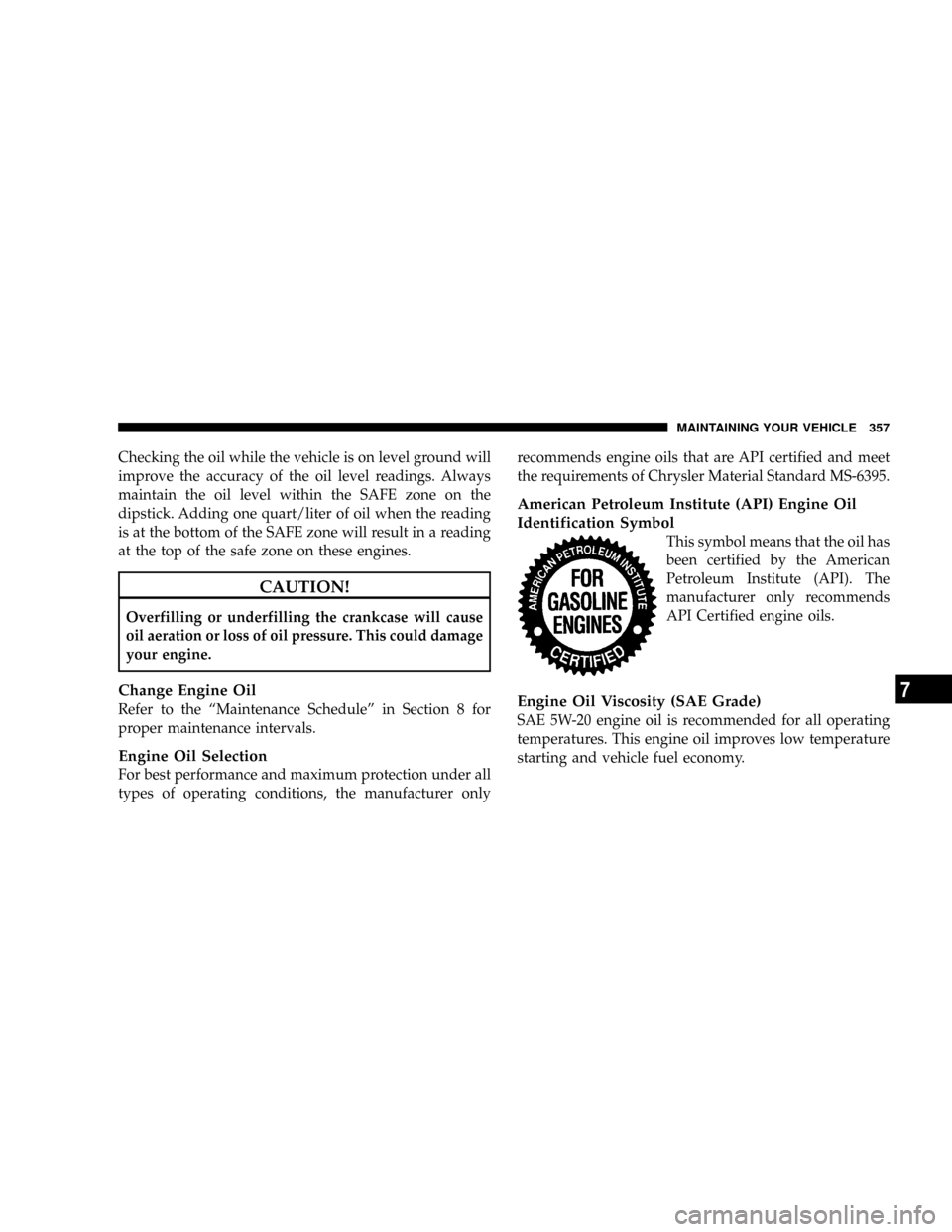
American Petroleum Institute (API) Engine Oil
Identification Symbol
This symbol means that the oil has
been certified by the American
Petroleum Institute (API). The
manufacturer only recommends
API Certified engine oils.
Engine Oil Viscosity (SAE Grade)
SAE 5W-20 engine oil is recommended for all operating
temperatures. This engine oil improves low temperature
starting and vehicle fuel economy.
MAINTAINING YOUR VEHICLE 357
7
Page 360 of 449
The engine oil filler cap also shows the recommended
engine oil viscosity for your vehicle. For information on
engine oil filler cap location, refer to ªEngine Compart-
mentº in this section.
Lubricants which do not have both the engine oil certi-
fication mark and the correct SAE viscosity grade num-
ber should not be used.
Synthetic Engine Oils
You may use synthetic engine oils, provided the recom-
mended oil quality requirements are met, and the recom-
mended maintenance intervals for oil and filter changes
are followed.
Materials Added to Engine Oils
The manufacturer strongly recommends against the ad-
dition of any additives (other than leak detection dyes) to
the engine oil. Engine oil is an engineered product and its
performance may be impaired by supplemental
additives.
Disposing of Used Engine Oil And Oil Filters
Care should be taken in disposing of used engine oil and
oil filters from your vehicle. Used oil and oil filters,
indiscriminately discarded, can present a problem to the
environment. Contact your authorized dealer, service
station, or governmental agency for advice on how and
where used oil and oil filters can be safely discarded in
your area.
Engine Oil Filter
The engine oil filter should be replaced at every engine
oil change.
Engine Oil Filter Selection
The manufacturer's engines have a full-flow type oil
filter. Use a filter of this type for replacement. The quality
of replacement filters varies considerably. Only high
quality filters should be used to assure most efficient
service. MOPARtengine oil filters are a high quality oil
filter and are recommended.
358 MAINTAINING YOUR VEHICLE
Page 361 of 449
Engine Air Cleaner Filter
Refer to the ªMaintenance Scheduleº in Section 8 for
proper maintenance intervals.
WARNING!
The air cleaner can provide a measure of protection
in the case of engine backfire. Do not remove the air
cleaner unless such removal is necessary for repair or
maintenance. Make sure that no one is near the
engine compartment before starting the vehicle with
the air cleaner removed. Failure to do so can result in
serious personal injury.
Engine Air Cleaner Filter Selection
The quality of replacement engine air cleaner filters
varies considerably. Only high quality filters should beused to assure most efficient service. MOPARtengine air
cleaner filters are a high quality filter and are
recommended.
Maintenance-Free Battery
The top of the maintenance-free battery is permanently
sealed. You will never have to add water, nor is periodic
maintenance required.
WARNING!
²Battery fluid is a corrosive acid solution and can
burn or even blind you. Do not allow battery fluid
to contact your eyes, skin or clothing. Do not lean
over a battery when attaching clamps. If acid
splashes in eyes or on skin, flush the area imme-
diately with large amounts of water.
(Continued)
MAINTAINING YOUR VEHICLE 359
7
Page 362 of 449
WARNING! (Continued)
²Battery gas is flammable and explosive. Keep
flame or sparks away from the battery. Do not use
a booster battery or any other booster source with
an output greater than 12 volts. Do not allow cable
clamps to touch each other.
²Battery posts, terminals and related accessories
contain lead and lead compounds. Wash hands
after handling.
CAUTION!
²It is essential when replacing the cables on the
battery that the positive cable is attached to the
positive post, and the negative cable is attached to
the negative post. Battery posts are marked (+)
positive and (-) negative and are identified on the
battery case.
²If a ªfast chargerº is used while the battery is in
the vehicle, disconnect both vehicle battery cables
before connecting the charger to the battery. Do
not use a ªfast chargerº to provide starting voltage.
Air Conditioner Maintenance
For best possible performance, your air conditioner
should be checked and serviced by an authorized dealer
at the start of each warm season. This service should
360 MAINTAINING YOUR VEHICLE
Page 366 of 449
WARNING!
Exhaust gases can injure or kill. They contain carbon
monoxide (CO) which is colorless and odorless.
Breathing it can make you unconscious and can
eventually poison you. To avoid breathing CO, fol-
low the preceding safety tips.
The catalytic converter requires the use of unleaded fuel
only. Leaded gasoline will destroy the effectiveness of the
catalyst as an emission control device.
Under normal operating conditions, the catalytic con-
verter will not require maintenance. However, it is im-
portant to keep the engine properly tuned to assure
proper catalyst operation and prevent possible catalyst
damage.
CAUTION!
Damage to the catalytic converter can result if your
vehicle is not kept in proper operating condition. In
the event of engine malfunction, particularly involv-
ing engine misfire or other apparent loss of perfor-
mance, have your vehicle serviced promptly. Contin-
ued operation of your vehicle with a severe
malfunction could cause the converter to overheat,
resulting in possible damage to the converter and the
vehicle.
NOTE:Intentional tampering with emissions control
systems can result in civil penalties being assessed
against you.
364 MAINTAINING YOUR VEHICLE
Page 369 of 449
rinsing to remove all deposits and chemicals. Properly
dispose of the old engine coolant (antifreeze) solution.
Refer to the ªMaintenance Scheduleº in Section 8 for
proper maintenance intervals.
Selection Of Coolant
Use only the manufacturer's recommended engine cool-
ant (antifreeze). Refer to ªFluids, Lubricants, and Genu-
ine Partsº in this section for correct fluid type.
CAUTION!
²Mixing of engine coolant (antifreeze) other than
specified HOAT engine coolant (antifreeze) may
result in engine damage and may decrease corro-
sion protection. If a non-HOAT coolant is intro-
duced into the cooling system in an emergency, it
should be replaced with the specified engine cool-
ant (antifreeze) as soon as possible.
(Continued)
CAUTION! (Continued)
²Do not use plain water alone or alcohol based
engine coolant (antifreeze) products. Do not use
additional rust inhibitors or antirust products, as
they may not be compatible with the engine cool-
ant (antifreeze) and may plug the radiator.
²This vehicle has not been designed for use with
Propylene Glycol-based engine coolant (anti-
freeze). Use of Propylene Glycol-based engine
coolant (antifreeze) is not recommended.
Adding Coolant
Your vehicle has been built with an improved engine
coolant (antifreeze) that allows extended maintenance
intervals. This engine coolant (antifreeze) can be used up
to 5 Years or 102,000 miles (170 000 km) before replace-
ment. To prevent reducing this extended maintenance
period, it is important that you use the same engine
coolant (antifreeze) throughout the life of your vehicle.
MAINTAINING YOUR VEHICLE 367
7
Page 374 of 449
Use only brake fluid that has been in a tightly closed
container to avoid contamination from foreign matter or
moisture.
CAUTION!
Do not allow a petroleum-base fluid to contaminate
the brake fluid. Seal damage may result.
Clutch Hydraulic System
The clutch hydraulic system is a sealed maintenance-free
system. In the event of leakage or other malfunction, the
system must be replaced.
Manual Transmission
Fluid Level Check
This fluid should be checked whenever other underhood
services are performed. The fluid level is checked by
removing the fill plug. If the level of the lubricant is more
than 1/4 in (6.35 mm) below the bottom of the filler holewhile the vehicle is level, enough lubricant should be
added to bring the level to the bottom of the filler hole.
This fluid does not require periodic changing. However,
if it becomes necessary to add or replace the fluid in these
transmissions, refer to ªFluids, Lubricants, and Genuine
Partsº in this section for the correct fluid type.
Automatic Transmission
NOTE:If equipped with a dipstick, use the following
procedure. If your vehicle has a capped dipstick, it is
sealed and should not be tampered with. Your authorized
dealer has the proper tools to ensure that the fluid level
is set properly.
Fluid Level Check
Check the fluid level while the transmission is at normal
operating temperature 180É F (82É C). This occurs after at
least 15 miles (24 km) of driving. At normal operating
temperature the fluid cannot be held comfortably be-
tween the fingertips.
372 MAINTAINING YOUR VEHICLE
Page 377 of 449
CAUTION!
Using a transmission fluid other than the manufac-
turer's recommended fluid may cause deterioration
in transmission shift quality and/or torque converter
shudder. Using a transmission fluid, other than the
manufacturer's recommended fluid, will result in
more frequent fluid and filter changes. Refer to
ªFluids, Lubricants, and Genuine Partsº in this sec-
tion for the correct fluid type.
Transfer Case
Inspect the transfer case for fluid leaks. If a fluid leak is
evident the transfer case fluid level may be low. Have the
transfer case serviced immediately.
CAUTION!
Damage may result from operation of the vehicle
with low transfer case fluid.
Drain and Refill
Refer to the ªMaintenance Scheduleº in Section 8 for the
proper maintenance intervals.
Lubricant Selection
Refer to ªFluids, Lubricants, and Genuine Partsº in this
section for the correct fluid type.
Axles
Drain and Refill
Refer to the ªMaintenance Scheduleº in Section 8 for the
proper maintenance intervals.
NOTE:The presence of water in the gear lubricant will
result in corrosion and possible failure of differential
MAINTAINING YOUR VEHICLE 375
7