Page 298 of 449

fault condition no longer exists. A system fault can occur
by any of the following scenarios: 1) Jamming due to
electronic devices or driving next to facilities emitting the
same radio frequencies as the TPM sensors; 2) Installing
some form of aftermarket window tinting that affects
radio wave signals; 3) Lots of snow or ice around the
wheels or wheel housings; 4) Using tire chains on the
vehicle; 5) Using wheels/tires not equipped with TPM
sensors.
NOTE: Your vehicle is equipped with a non-matching
full size spare wheel and tire assembly.
1. This spare tire does not have a tire pressure monitor-
ing sensor. Therefore, the TPMS will not monitor the tire
pressure in the spare tire.
2. If you install the full size spare tire in place of a road
tire that has a pressure below the low-pressure warninglimit, upon the next ignition key cycle a chime will sound
and the TPM Telltale Lamp will still turn ON due to the
low tire.
3. However, after driving the vehicle for up to 10 min-
utes above 15 mph (25 km/h), the TPM Telltale Lamp
will flash on and off for 75 seconds and then remain on
solid.
4. For each subsequent ignition key cycle, a chime will
sound and the TPM Telltale Light will flash on and off for
75 seconds and then remain on solid.
5. Once you repair or replace the original road tire, and
reinstall it on the vehicle in place of the full size spare tire,
the TPMS will update automatically and the TPM Telltale
Lamp will turn OFF, as long as no tire pressure is below
the low-pressure warning limit in any of the four active
road tires. The vehicle may need to be driven for up to
10 minutes above 15 mph (25 km/h) in order for the
TPMS to receive this information.
296 STARTING AND OPERATING
Page 321 of 449
4. Tongue weight rating for the trailer hitch utilized
(This requirement may limit the ability to always
achieve the 10% to 15% range of tongue weight as a
percentage of total trailer weight.)
Towing Requirements Ð Tires
þ
Do not attempt to tow a trailer while using a compact
spare tire.
þProper tire inflation pressures are essential to the safe
and satisfactory operation of your vehicle. For proper
tire inflation procedures, refer to ªTire Pressuresº
under ºTires±General Informationº in Section 5.
þAlso, check the trailer tires for proper tire inflation
pressures before trailer usage.
þCheck for signs of tire wear or visible tire damage
before towing a trailer. For the proper inspection
procedure, refer to ªTread Wear Indicatorsº under
ºTires±General Informationº in Section 5.
þWhen replacing tires, refer to ªReplacement Tiresº
under ªTires±General Informationº in Section 5. Re-
placing tires with a higher load carrying capacity will
not increase the vehicle's GVWR and GAWR limits.
Towing Requirements Ð Trailer Brakes
þ
Donotinterconnect the hydraulic brake system or
vacuum system of your vehicle with that of the trailer.
This could cause inadequate braking and possible
personal injury.
þAn electronically actuated trailer brake controller is
required when towing a trailer with electronically
actuated brakes. When towing a trailer equipped with
a hydraulic surge actuated brake system, an electronic
brake controller is not required.
þTrailer brakes are recommended for trailers over
1,000 lbs (454 kg) and required for trailers in excess of
2,000 lbs (907 kg).
STARTING AND OPERATING 319
5
Page 333 of 449
WHAT TO DO IN EMERGENCIES
CONTENTS
mHazard Warning Flasher................. 332
mChanging A Flat Tire................... 332
NJack Location....................... 332
NRemoving The Spare Tire............... 334
NTire Changing Procedure............... 337
NPreparations........................ 337
NInstructions......................... 338NTo Stow The Flat Or Spare.............. 343
mJump±Starting........................ 343
mFreeing A Stuck Vehicle................. 346
mEmergency Tow Hooks Ð If Equipped....... 346
mTowing A Disabled Vehicle............... 347
NFour-Wheel Drive Vehicles.............. 347
NTwo-Wheel Drive Vehicles.............. 348
6
Page 335 of 449
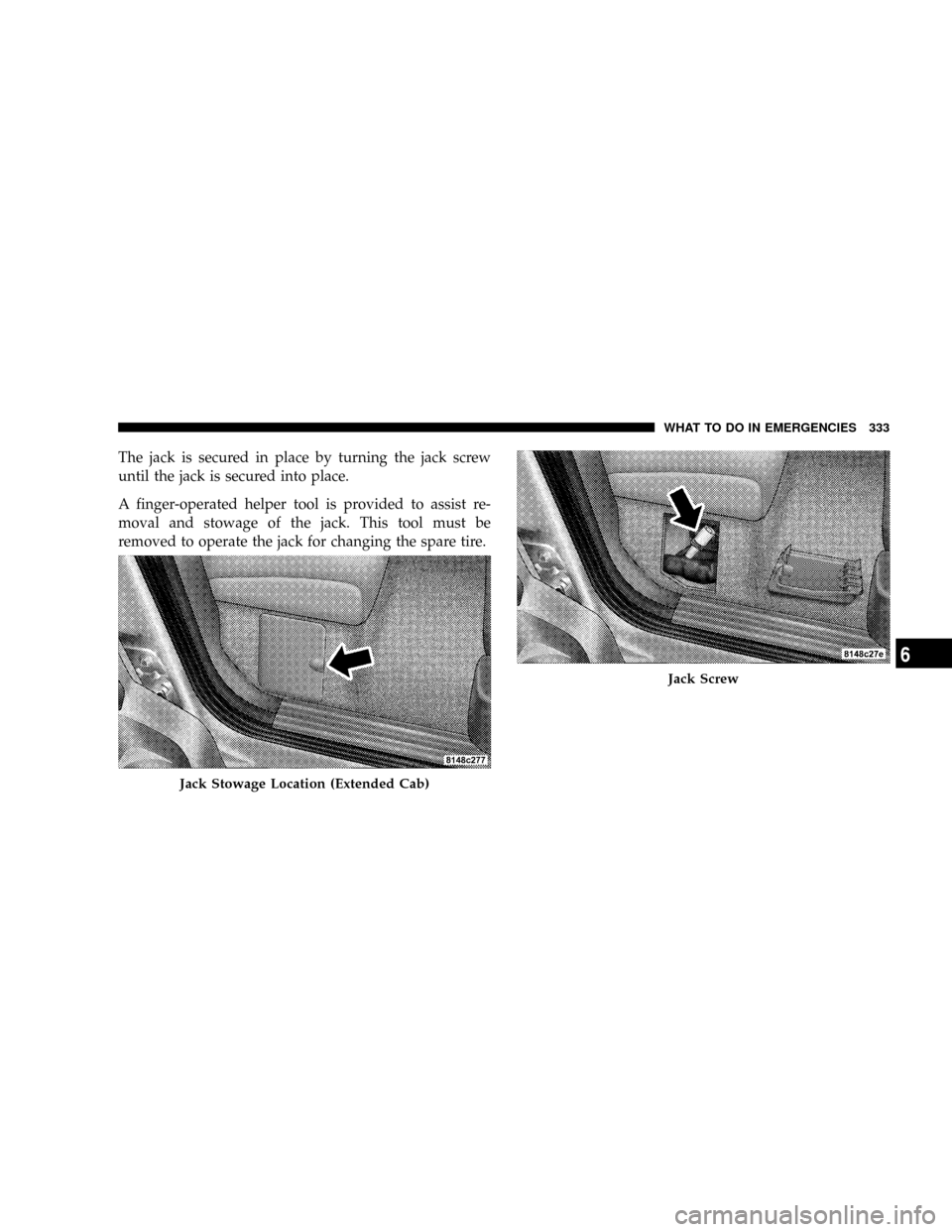
The jack is secured in place by turning the jack screw
until the jack is secured into place.
A finger-operated helper tool is provided to assist re-
moval and stowage of the jack. This tool must be
removed to operate the jack for changing the spare tire.
Jack Stowage Location (Extended Cab)
Jack Screw
WHAT TO DO IN EMERGENCIES 333
6
Page 336 of 449
WARNING!
The jack is designed as a tool for changing tires only.
The jack should not be used to lift the vehicle for
service purposes, unless suitable supports are placed
under the vehicle as a safety measure. The vehicle
should be jacked on a firm level surface only. Avoid
icy or slippery areas.
Removing The Spare Tire
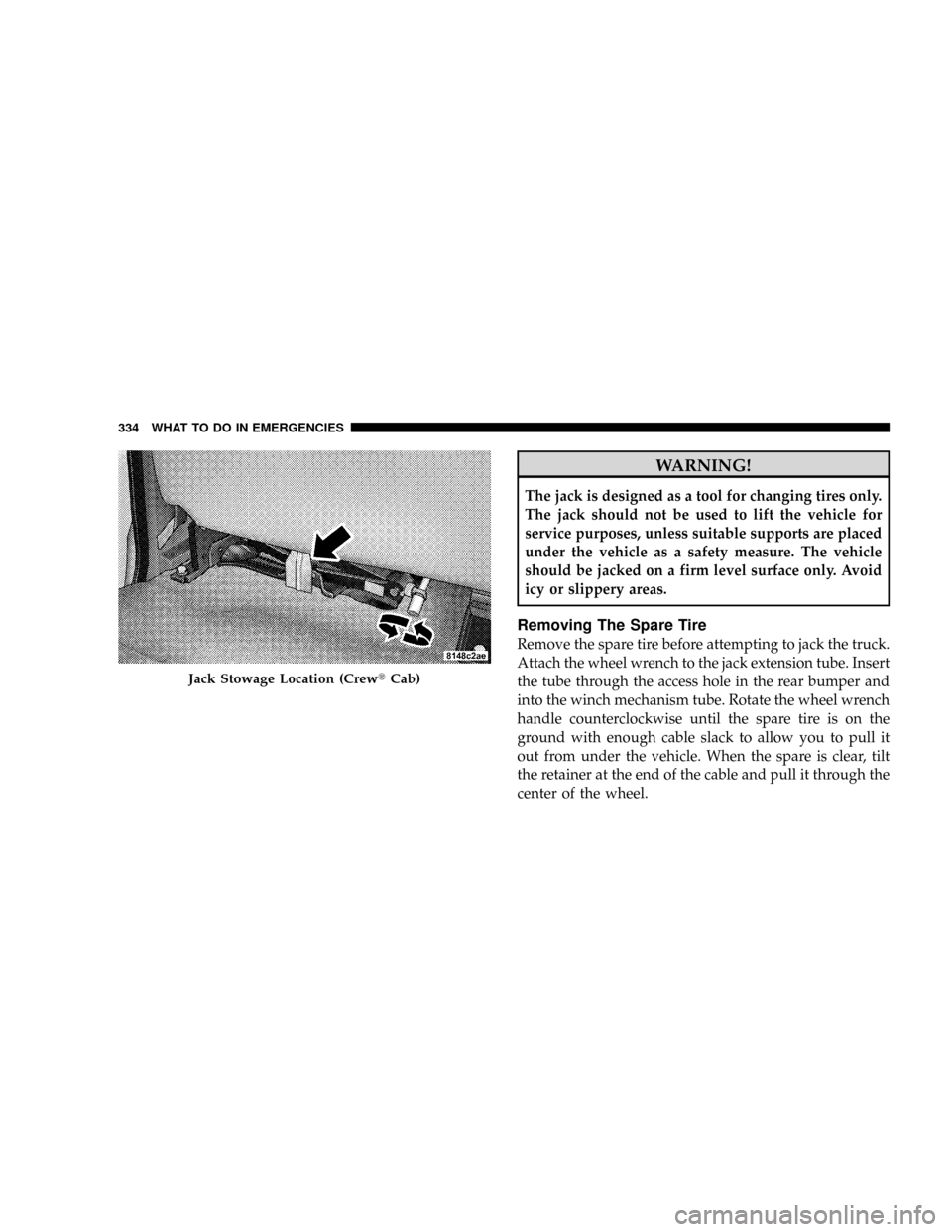
Remove the spare tire before attempting to jack the truck.
Attach the wheel wrench to the jack extension tube. Insert
the tube through the access hole in the rear bumper and
into the winch mechanism tube. Rotate the wheel wrench
handle counterclockwise until the spare tire is on the
ground with enough cable slack to allow you to pull it
out from under the vehicle. When the spare is clear, tilt
the retainer at the end of the cable and pull it through the
center of the wheel.
Jack Stowage Location (CrewtCab)
334 WHAT TO DO IN EMERGENCIES
Page 337 of 449
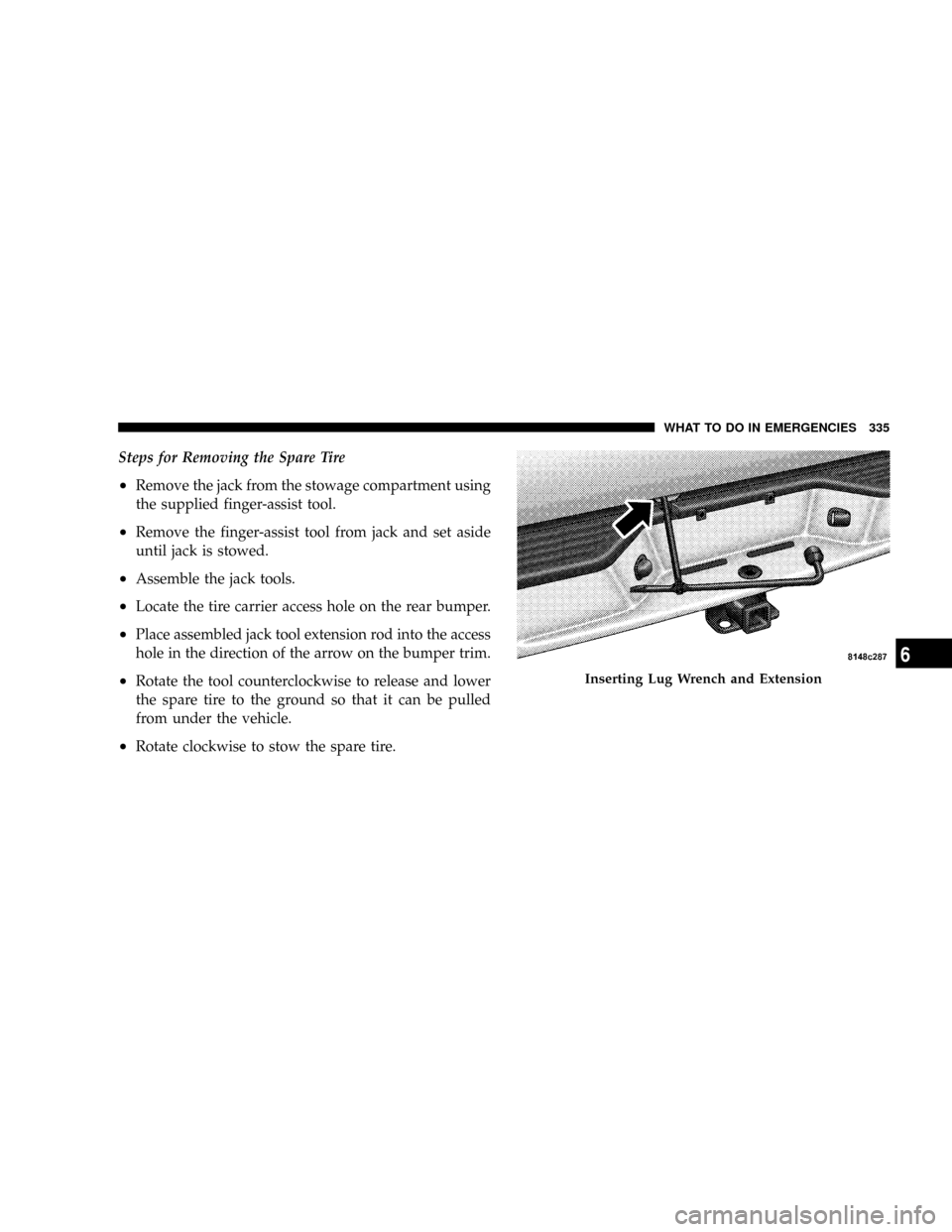
Steps for Removing the Spare Tire
²Remove the jack from the stowage compartment using
the supplied finger-assist tool.
²Remove the finger-assist tool from jack and set aside
until jack is stowed.
²Assemble the jack tools.
²Locate the tire carrier access hole on the rear bumper.
²Place assembled jack tool extension rod into the access
hole in the direction of the arrow on the bumper trim.
²Rotate the tool counterclockwise to release and lower
the spare tire to the ground so that it can be pulled
from under the vehicle.
²Rotate clockwise to stow the spare tire.
Inserting Lug Wrench and Extension
WHAT TO DO IN EMERGENCIES 335
6
Page 338 of 449
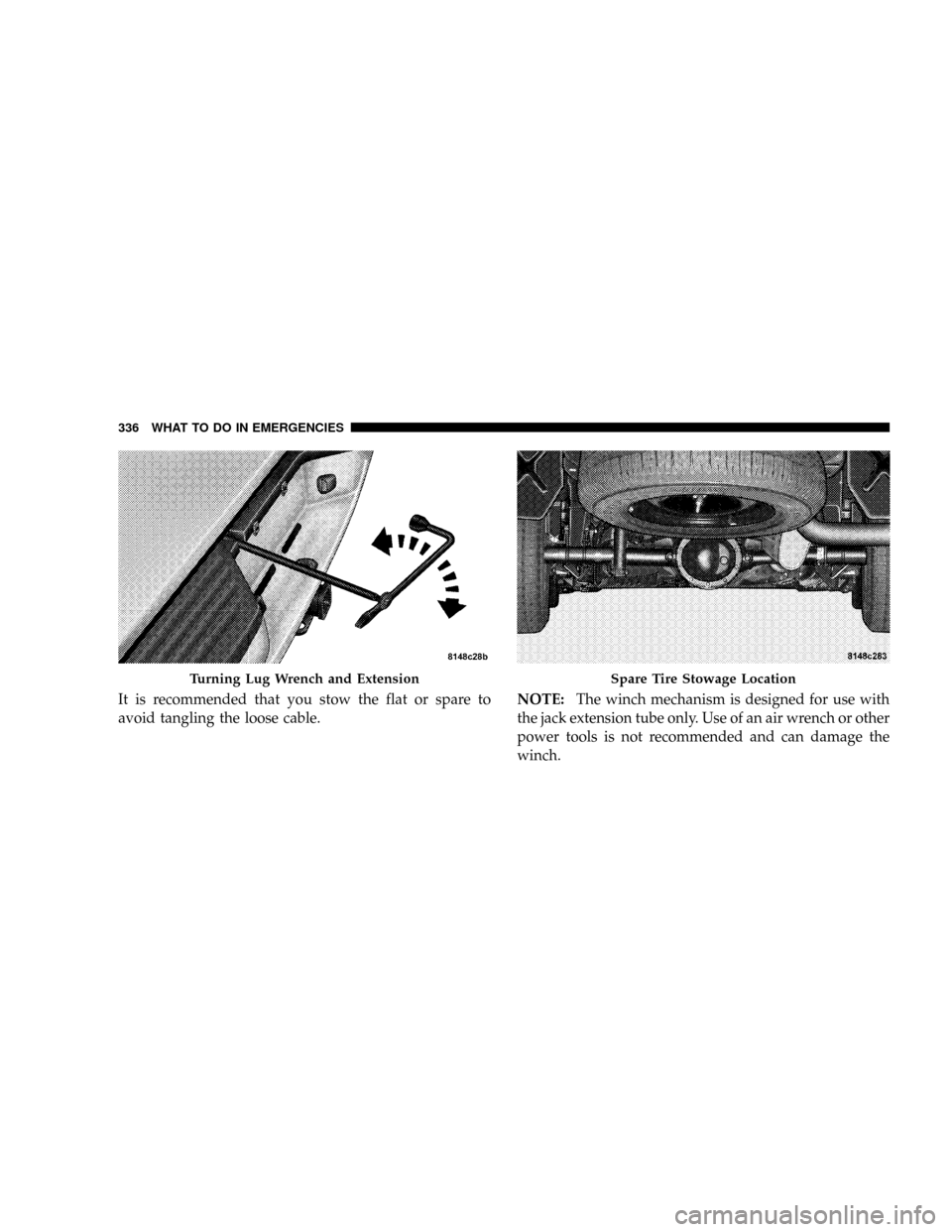
It is recommended that you stow the flat or spare to
avoid tangling the loose cable.NOTE:The winch mechanism is designed for use with
the jack extension tube only. Use of an air wrench or other
power tools is not recommended and can damage the
winch.
Turning Lug Wrench and ExtensionSpare Tire Stowage Location
336 WHAT TO DO IN EMERGENCIES
Page 341 of 449
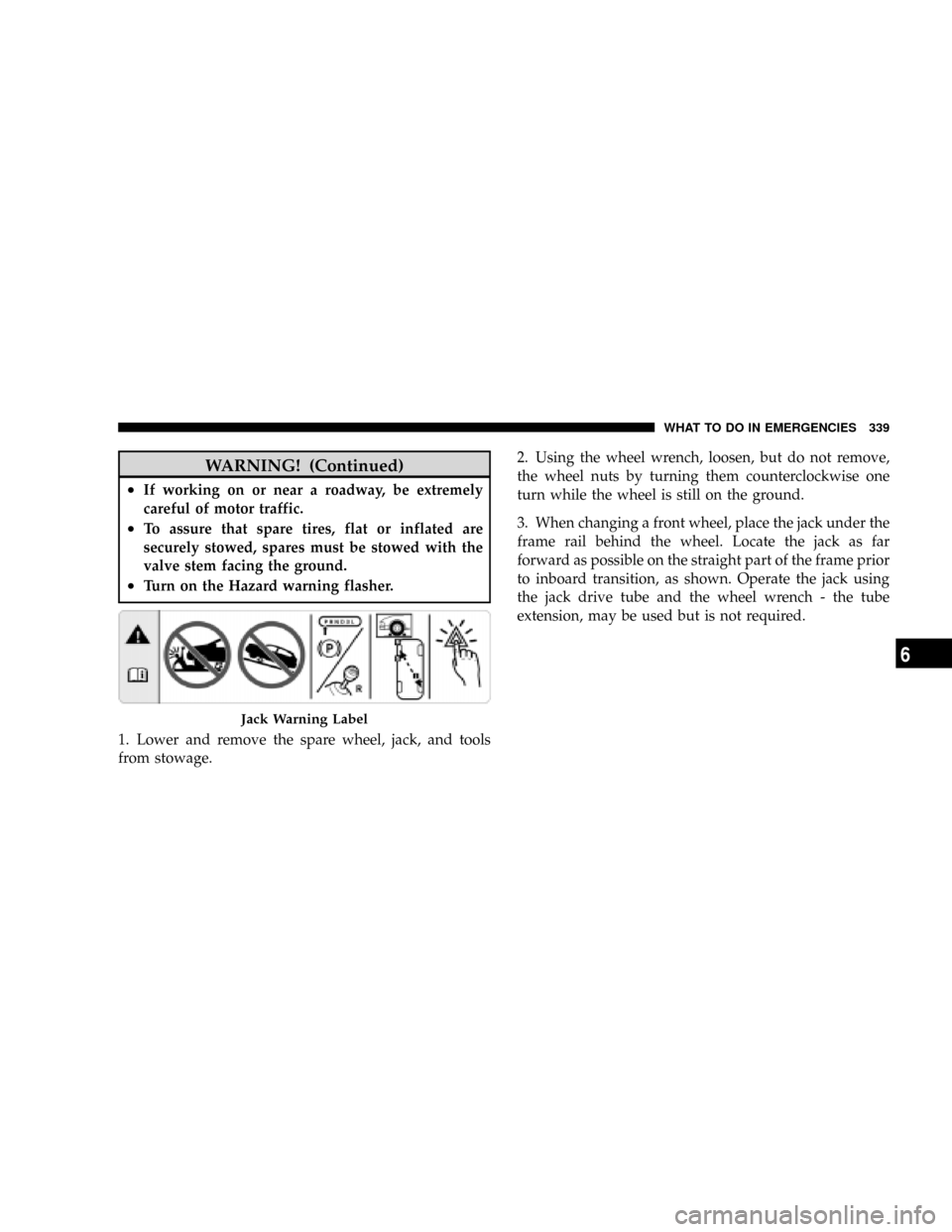
WARNING! (Continued)
²If working on or near a roadway, be extremely
careful of motor traffic.
²To assure that spare tires, flat or inflated are
securely stowed, spares must be stowed with the
valve stem facing the ground.
²Turn on the Hazard warning flasher.
1. Lower and remove the spare wheel, jack, and tools
from stowage.2. Using the wheel wrench, loosen, but do not remove,
the wheel nuts by turning them counterclockwise one
turn while the wheel is still on the ground.
3. When changing a front wheel, place the jack under the
frame rail behind the wheel. Locate the jack as far
forward as possible on the straight part of the frame prior
to inboard transition, as shown. Operate the jack using
the jack drive tube and the wheel wrench - the tube
extension, may be used but is not required.
Jack Warning Label
WHAT TO DO IN EMERGENCIES 339
6