Page 259 of 449
4. After the desired position indicator light is ON (not
flashing), shift transmission back into gear (release clutch
on manual transmissions).
NOTE:If steps 1 or 2, of either the Preferred or Alternate
Procedure, are not satisfied prior to attempting the shift,
or if they no longer are being met while the shift attempt
is in process, then the indicator light will flash and the
current transfer case position will be maintained. To retry
the selection, turn the control knob back to the current
position, wait five seconds, and retry shift.
NOTE:The ignition key must be ON for a shift to take
place and for the position indicator lights to be operable.
If the key is not ON then the shift will not take place and
no position indicator lights will be on or flashing.NV 244 Generation II Transfer Case Operating
Information / Precautions
The NV 244 Generation II is an electric-shift transfer case
and is operated by the 4WD Control Switch, which is
located on the instrument panel.
The NV 244 Generation II transfer case provides four
mode positions - Normal four-wheel drive (4WD) high
range, 4-wheel-drive lock (4WD LOCK), 4-wheel drive
low (4WD LOW) range, and NEUTRAL.
This transfer case is equipped with an inter-axle differ-
ential that allows driving the vehicle in the normal
all-wheel drive position (4WD) at all times on any given
road surface, including dry, hard-surfaced roads. The
4WD mode allows the front and rear wheels to rotate at
different speeds. This eliminates driveline binding and
component wear normally associated with driving the
vehicle in the 4WD LOCK position on dry, hard-surfaced
STARTING AND OPERATING 257
5
Page 324 of 449
Towing Tips
Before setting out on a trip, practice turning, stopping
and backing the trailer in an area away from heavy
traffic.
If using a manual transmission vehicle for trailer towing,
all starts must be in 1st gear to avoid excessive clutch
slippage.
Towing Tips Ð Automatic Transmission
The ªDº range can be selected when towing. However, if
frequent shifting occurs while in this range, the TOW/
HAUL feature should be selected.
NOTE:Using the TOW/HAUL feature while operating
the vehicle under heavy operating conditions will im-
prove performance and extend transmission life by re-
ducing excessive shifting and heat build up. This action
will also provide better engine braking.The automatic transmission fluid and filter should be
changed if you REGULARLY tow a trailer for more than
45 minutes of continuous operation. Refer to the ªMain-
tenance Scheduleº in Section 8 for proper maintenance
intervals.
NOTE:Check the automatic transmission fluid level
before towing.
Towing Tips Ð Tow/Haul (If Equipped)
To reduce potential for automatic transmission overheat-
ing, turn the TOW/HAUL feature ON when driving in
hilly areas or shift the transmission to Drive position 2 on
more severe grades.
Towing Tips Ð Electronic Speed Control (If
Equipped)
þ
Do not use in hilly terrain or with heavy loads.
322 STARTING AND OPERATING
Page 327 of 449
Recreational Towing Procedure
Use the following procedure to prepare your vehicle for
recreational towing.
CAUTION!
It is necessary to follow these steps to be certain that
the transfer case is fully in NEUTRAL before recre-
ational towing to prevent damage to internal parts.
1. Bring vehicle to a complete stop.
2. Shut engine OFF.
3. Turn the ignition key to the ON position but do not
start the engine.
4. Depress brake pedal.
5. Shift automatic transmission into NEUTRAL, or de-
press clutch on manual transmission.6. Using the point of a ballpoint pen or similar object,
depress the recessed transfer case NEUTRAL button for
4 seconds.
7. After shift is completed and the NEUTRAL light
comes on, release the NEUTRAL button.
8. Start engine.
STARTING AND OPERATING 325
5
Page 329 of 449
CAUTION!
Damage to the transmission may occur if the trans-
mission is shifted into PARK with the transfer case in
NEUTRAL and the engine running. With the transfer
case in NEUTRAL, ensure that the engine is off prior
to shifting the transmission into PARK.
Returning to Normal Operation
Use the following procedure to prepare your vehicle for
normal usage.
1. Reconnect the negative battery cable.
2. The vehicle must be at a complete stop.
3. Place the ignition key in the OFF position (if it has
been moved or the engine has been started).
4. Place ignition key in the ON position (engine off).
5. Depress brake pedal.6. Shift automatic transmission into NEUTRAL, or de-
press clutch on manual transmission.
7. Using the point of a ballpoint pen or similar object,
depress the recessed transfer case NEUTRAL button for
1 second.
8. After the NEUTRAL indicator light turns off, release
the NEUTRAL button.
9. After the NEUTRAL button has been released, the
transfer case will shift to the position identified by the
selector switch.
10. Start the engine. Shift the automatic transmission into
DRIVE, or place the manual transmission in 1st gear and
momentarily release the clutch, to verify that the transfer
case has engaged.
11. Set parking brake. Shift automatic transmission into
PARK or shift manual transmission into NEUTRAL.
STARTING AND OPERATING 327
5
Page 352 of 449
NExhaust System...................... 363
NCooling System...................... 366
NBrake System....................... 371
NClutch Hydraulic System............... 372
NManual Transmission.................. 372
NAutomatic Transmission................ 372
NTransfer Case....................... 375
NAxles............................. 375
NAppearance Care And Protection From
Corrosion.......................... 376
mFuses.............................. 381
NUnderhood Fuses (Power Distribution
Center)............................ 381
mVehicle Storage....................... 386mReplacement Light Bulbs................. 387
mBulb Replacement..................... 387
NHeadlight (Halogen)/Front Park And Turn
Lights............................. 387
NRear Side Marker, Taillamps/Stop Lamps,
And Turn Signal Bulbs Ð Replacement..... 389
NCenter High-Mounted Stop Light And Cargo
Lamp............................. 391
NLicense Lamps...................... 394
NFog Lights......................... 395
mFluids And Capacities................... 396
mFluids, Lubricants And Genuine Parts....... 397
NEngine............................ 397
NChassis............................ 398
350 MAINTAINING YOUR VEHICLE
Page 353 of 449
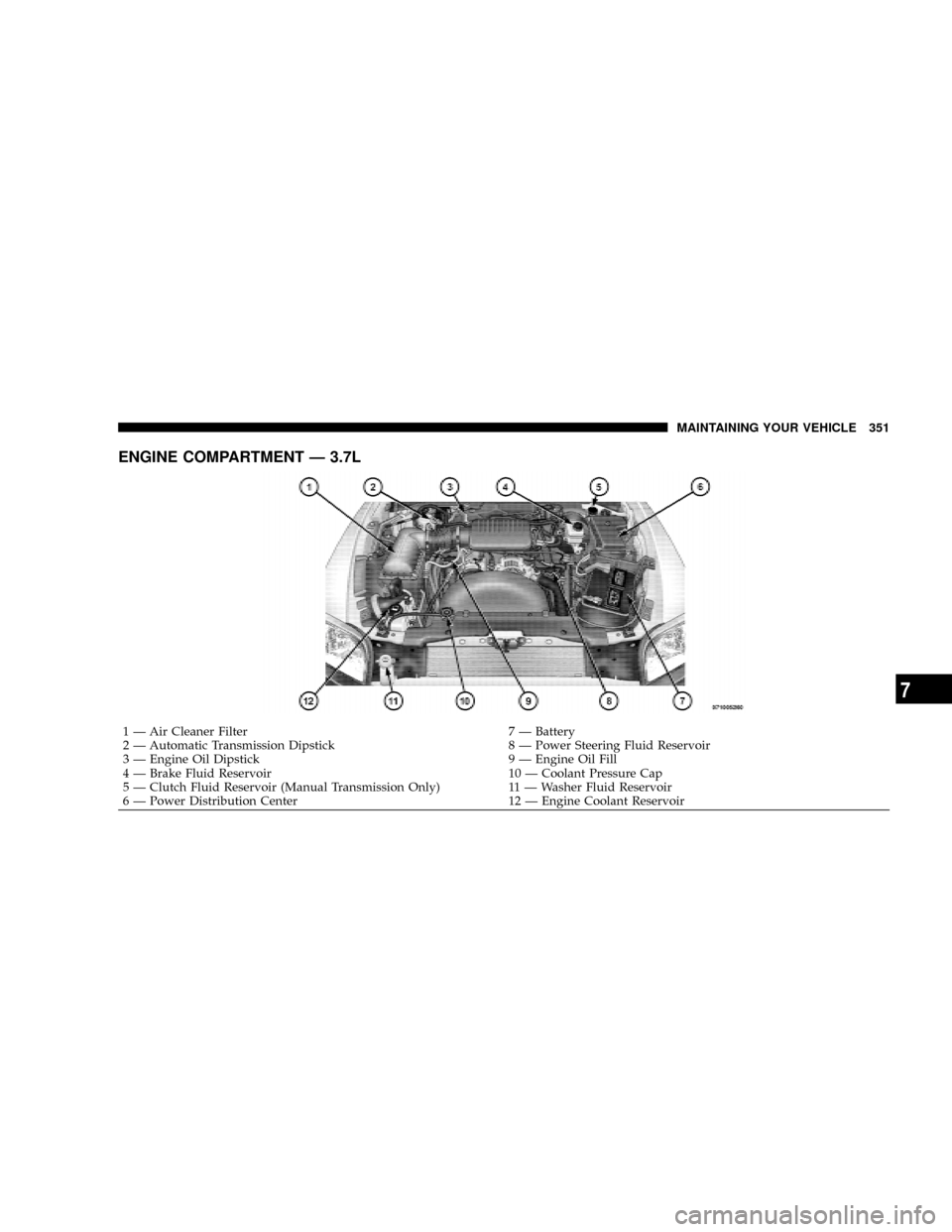
ENGINE COMPARTMENT Ð 3.7L
1 Ð Air Cleaner Filter 7 Ð Battery
2 Ð Automatic Transmission Dipstick 8 Ð Power Steering Fluid Reservoir
3 Ð Engine Oil Dipstick 9 Ð Engine Oil Fill
4 Ð Brake Fluid Reservoir 10 Ð Coolant Pressure Cap
5 Ð Clutch Fluid Reservoir (Manual Transmission Only) 11 Ð Washer Fluid Reservoir
6 Ð Power Distribution Center 12 Ð Engine Coolant ReservoirMAINTAINING YOUR VEHICLE 351
7
Page 374 of 449
Use only brake fluid that has been in a tightly closed
container to avoid contamination from foreign matter or
moisture.
CAUTION!
Do not allow a petroleum-base fluid to contaminate
the brake fluid. Seal damage may result.
Clutch Hydraulic System
The clutch hydraulic system is a sealed maintenance-free
system. In the event of leakage or other malfunction, the
system must be replaced.
Manual Transmission
Fluid Level Check
This fluid should be checked whenever other underhood
services are performed. The fluid level is checked by
removing the fill plug. If the level of the lubricant is more
than 1/4 in (6.35 mm) below the bottom of the filler holewhile the vehicle is level, enough lubricant should be
added to bring the level to the bottom of the filler hole.
This fluid does not require periodic changing. However,
if it becomes necessary to add or replace the fluid in these
transmissions, refer to ªFluids, Lubricants, and Genuine
Partsº in this section for the correct fluid type.
Automatic Transmission
NOTE:If equipped with a dipstick, use the following
procedure. If your vehicle has a capped dipstick, it is
sealed and should not be tampered with. Your authorized
dealer has the proper tools to ensure that the fluid level
is set properly.
Fluid Level Check
Check the fluid level while the transmission is at normal
operating temperature 180É F (82É C). This occurs after at
least 15 miles (24 km) of driving. At normal operating
temperature the fluid cannot be held comfortably be-
tween the fingertips.
372 MAINTAINING YOUR VEHICLE
Page 385 of 449
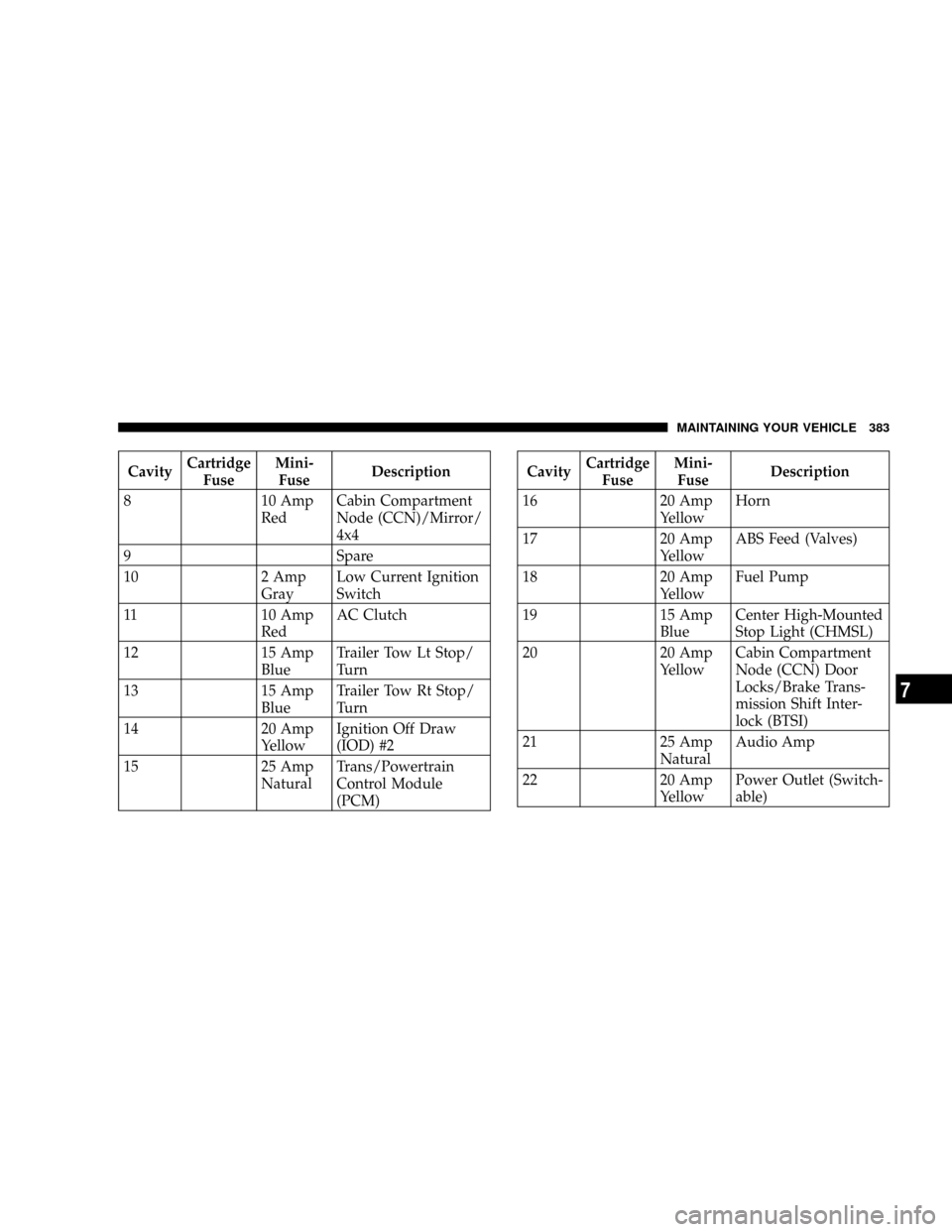
CavityCartridge
FuseMini-
FuseDescription
8 10 Amp
RedCabin Compartment
Node (CCN)/Mirror/
4x4
9 Spare
10 2 Amp
GrayLow Current Ignition
Switch
11 10 Amp
RedAC Clutch
12 15 Amp
BlueTrailer Tow Lt Stop/
Turn
13 15 Amp
BlueTrailer Tow Rt Stop/
Turn
14 20 Amp
YellowIgnition Off Draw
(IOD) #2
15 25 Amp
NaturalTrans/Powertrain
Control Module
(PCM)CavityCartridge
FuseMini-
FuseDescription
16 20 Amp
YellowHorn
17 20 Amp
YellowABS Feed (Valves)
18 20 Amp
YellowFuel Pump
19 15 Amp
BlueCenter High-Mounted
Stop Light (CHMSL)
20 20 Amp
YellowCabin Compartment
Node (CCN) Door
Locks/Brake Trans-
mission Shift Inter-
lock (BTSI)
21 25 Amp
NaturalAudio Amp
22 20 Amp
YellowPower Outlet (Switch-
able)
MAINTAINING YOUR VEHICLE 383
7