Page 241 of 449
STARTING PROCEDURES
Before starting your vehicle, adjust your seat, adjust both
inside and outside mirrors, and fasten your seat belts.
WARNING!
Do not leave children or animals inside parked
vehicles in hot weather. Interior heat buildup may
cause serious injury or death.
Manual Transmission
Apply the parking brake, place the shift lever in NEU-
TRAL and depress clutch pedal to the floor before
starting the vehicle. This vehicle is equipped with a
clutch interlocking ignition system. It will not start unless
the clutch is pressed to the floor.
Automatic Transmission
Start the engine with the shift lever in NEUTRAL or
PARK position. Apply the brake before shifting to any
driving range.
NOTE: This vehicle is equipped with a transmission
shift interlocking system. The brake pedal must be
depressed to shift out of PARK.
Tip Start Feature
Turn the ignition switch to START position and release it
as soon as the starter engages. The starter motor will
continue to run, but will automatically disengage itself
when the engine is running. If the engine fails to start, the
starter will disengage automatically in 10 seconds. If this
occurs, turn the ignition switch to the LOCK position,
wait 10 to 15 seconds, then repeat the normal starting
procedure.
STARTING AND OPERATING 239
5
Page 244 of 449
WARNING!
Remember to disconnect the cord before driving.
Damage to the 110-115 Volt electrical cord could cause
electrocution.
MANUAL TRANSMISSION
WARNING!
You or others could be injured if you leave the
vehicle unattended without having the parking
brake fully applied. The parking brake should al-
ways be applied when the driver is not in the vehicle,
especially on an incline.
CAUTION!
Never drive with your foot resting on the clutch
pedal, or attempt to hold the vehicle on a hill with the
clutch pedal partially engaged, as this will cause
abnormal wear on the clutch.
NOTE:During cold weather, you may experience in-
creased effort in shifting until the transmission fluid
warms up. This is normal.
242 STARTING AND OPERATING
Page 245 of 449
Shifting
Fully depress the clutch pedal before shifting gears. As
you release the clutch pedal, lightly depress the accelera-
tor pedal.
You should always use 1st gear when starting from a
standing position.
Recommended Vehicle Shift Speeds
To utilize your manual transmission efficiently for both
fuel economy and performance, it should be upshifted as
listed in recommended shift speed chart. Shift at the
vehicle speeds listed for acceleration. When heavily
loaded or pulling a trailer these recommended up-shift
speeds may not apply.
Manual Transmission Shift Speeds in MPH (KM/H)
En-
gineAxleAccel-
eration
Rate1to2 2to3 3to4 4to5 5to6
3.7L3.21
&
3.55ACCEL
&
CRUISE15
(24)
10
(16)24
(39)
19
(31)34
(55)
27
(44)47
(76)
37
(60)56
(90)
41
(66)
Shift Pattern
STARTING AND OPERATING 243
5
Page 246 of 449
Downshifting
Moving from a high gear down to a lower gear is
recommended to preserve brakes when driving down
steep hills. In addition, downshifting at the right time
provides better acceleration when you desire to resume
speed. Downshift progressively. Do not skip gears to
avoid overspeeding the engine and clutch.
WARNING!
Do not downshift for additional engine braking on a
slippery surface. The drive wheels could lose their
grip and the vehicle could skid.
CAUTION!
When descending a hill, be very careful to downshift
one gear at a time to prevent overspeeding the engine
which can cause valve damage, and/or clutch disc
damage even if the clutch pedal is depressed.
Maximum Recommended Downshift Speeds
CAUTION!
Failure to follow the maximum recommended down-
shifting speeds may cause the engine to overspeed
and/or damage the clutch disc even if the clutch pedal
is depressed.
244 STARTING AND OPERATING
Page 247 of 449
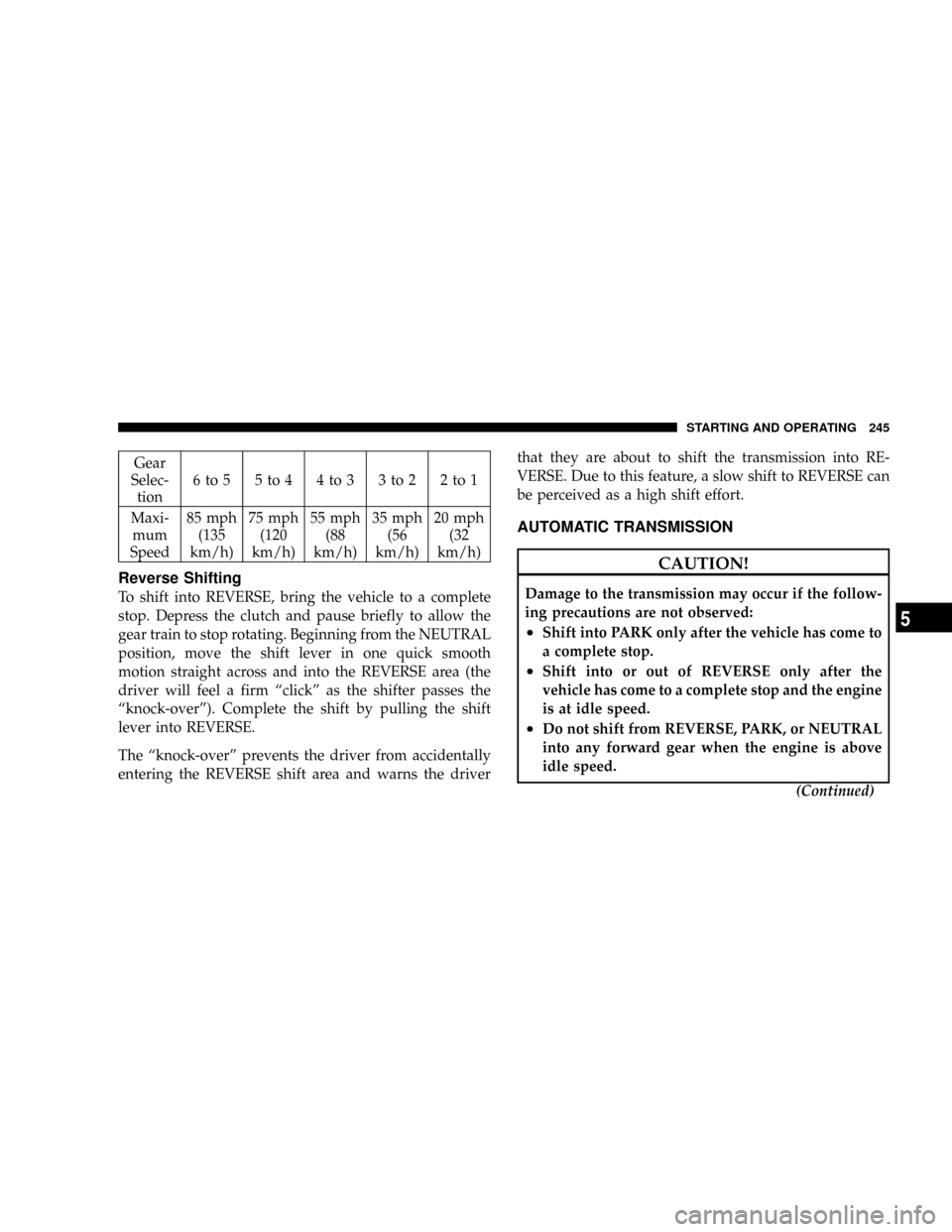
Gear
Selec-
tion6to5 5to4 4to3 3to2 2to1
Maxi-
mum
Speed85 mph
(135
km/h)75 mph
(120
km/h)55 mph
(88
km/h)35 mph
(56
km/h)20 mph
(32
km/h)
Reverse Shifting
To shift into REVERSE, bring the vehicle to a complete
stop. Depress the clutch and pause briefly to allow the
gear train to stop rotating. Beginning from the NEUTRAL
position, move the shift lever in one quick smooth
motion straight across and into the REVERSE area (the
driver will feel a firm ªclickº as the shifter passes the
ªknock-overº). Complete the shift by pulling the shift
lever into REVERSE.
The ªknock-overº prevents the driver from accidentally
entering the REVERSE shift area and warns the driverthat they are about to shift the transmission into RE-
VERSE. Due to this feature, a slow shift to REVERSE can
be perceived as a high shift effort.
AUTOMATIC TRANSMISSION
CAUTION!
Damage to the transmission may occur if the follow-
ing precautions are not observed:
²Shift into PARK only after the vehicle has come to
a complete stop.
²Shift into or out of REVERSE only after the
vehicle has come to a complete stop and the engine
is at idle speed.
²Do not shift from REVERSE, PARK, or NEUTRAL
into any forward gear when the engine is above
idle speed.
(Continued)
STARTING AND OPERATING 245
5
Page 250 of 449
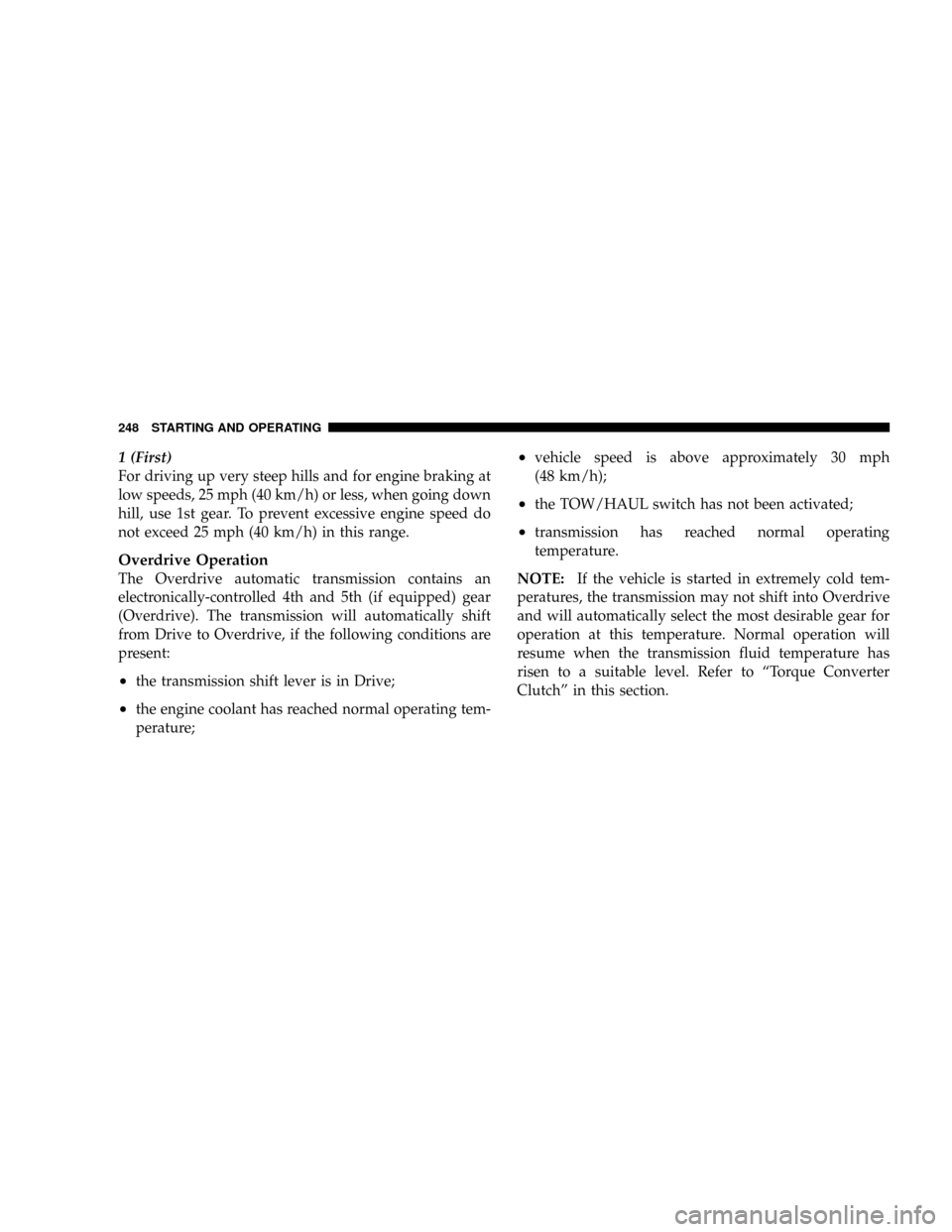
1 (First)
For driving up very steep hills and for engine braking at
low speeds, 25 mph (40 km/h) or less, when going down
hill, use 1st gear. To prevent excessive engine speed do
not exceed 25 mph (40 km/h) in this range.
Overdrive Operation
The Overdrive automatic transmission contains an
electronically-controlled 4th and 5th (if equipped) gear
(Overdrive). The transmission will automatically shift
from Drive to Overdrive, if the following conditions are
present:
²the transmission shift lever is in Drive;
²the engine coolant has reached normal operating tem-
perature;
²vehicle speed is above approximately 30 mph
(48 km/h);
²the TOW/HAUL switch has not been activated;
²transmission has reached normal operating
temperature.
NOTE:If the vehicle is started in extremely cold tem-
peratures, the transmission may not shift into Overdrive
and will automatically select the most desirable gear for
operation at this temperature. Normal operation will
resume when the transmission fluid temperature has
risen to a suitable level. Refer to ªTorque Converter
Clutchº in this section.
248 STARTING AND OPERATING
Page 252 of 449
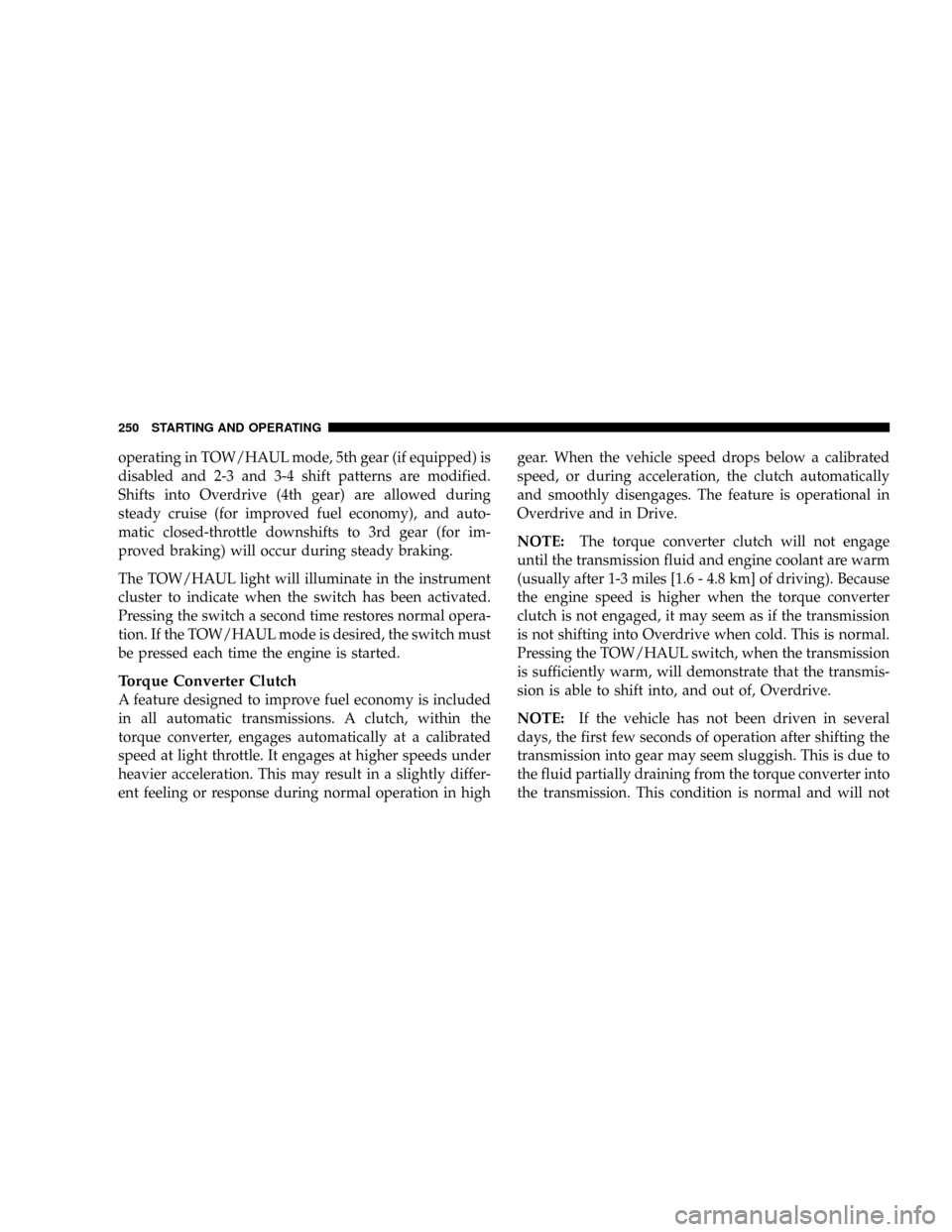
operating in TOW/HAUL mode, 5th gear (if equipped) is
disabled and 2-3 and 3-4 shift patterns are modified.
Shifts into Overdrive (4th gear) are allowed during
steady cruise (for improved fuel economy), and auto-
matic closed-throttle downshifts to 3rd gear (for im-
proved braking) will occur during steady braking.
The TOW/HAUL light will illuminate in the instrument
cluster to indicate when the switch has been activated.
Pressing the switch a second time restores normal opera-
tion. If the TOW/HAUL mode is desired, the switch must
be pressed each time the engine is started.
Torque Converter Clutch
A feature designed to improve fuel economy is included
in all automatic transmissions. A clutch, within the
torque converter, engages automatically at a calibrated
speed at light throttle. It engages at higher speeds under
heavier acceleration. This may result in a slightly differ-
ent feeling or response during normal operation in highgear. When the vehicle speed drops below a calibrated
speed, or during acceleration, the clutch automatically
and smoothly disengages. The feature is operational in
Overdrive and in Drive.
NOTE:The torque converter clutch will not engage
until the transmission fluid and engine coolant are warm
(usually after 1-3 miles [1.6 - 4.8 km] of driving). Because
the engine speed is higher when the torque converter
clutch is not engaged, it may seem as if the transmission
is not shifting into Overdrive when cold. This is normal.
Pressing the TOW/HAUL switch, when the transmission
is sufficiently warm, will demonstrate that the transmis-
sion is able to shift into, and out of, Overdrive.
NOTE:If the vehicle has not been driven in several
days, the first few seconds of operation after shifting the
transmission into gear may seem sluggish. This is due to
the fluid partially draining from the torque converter into
the transmission. This condition is normal and will not
250 STARTING AND OPERATING
Page 258 of 449
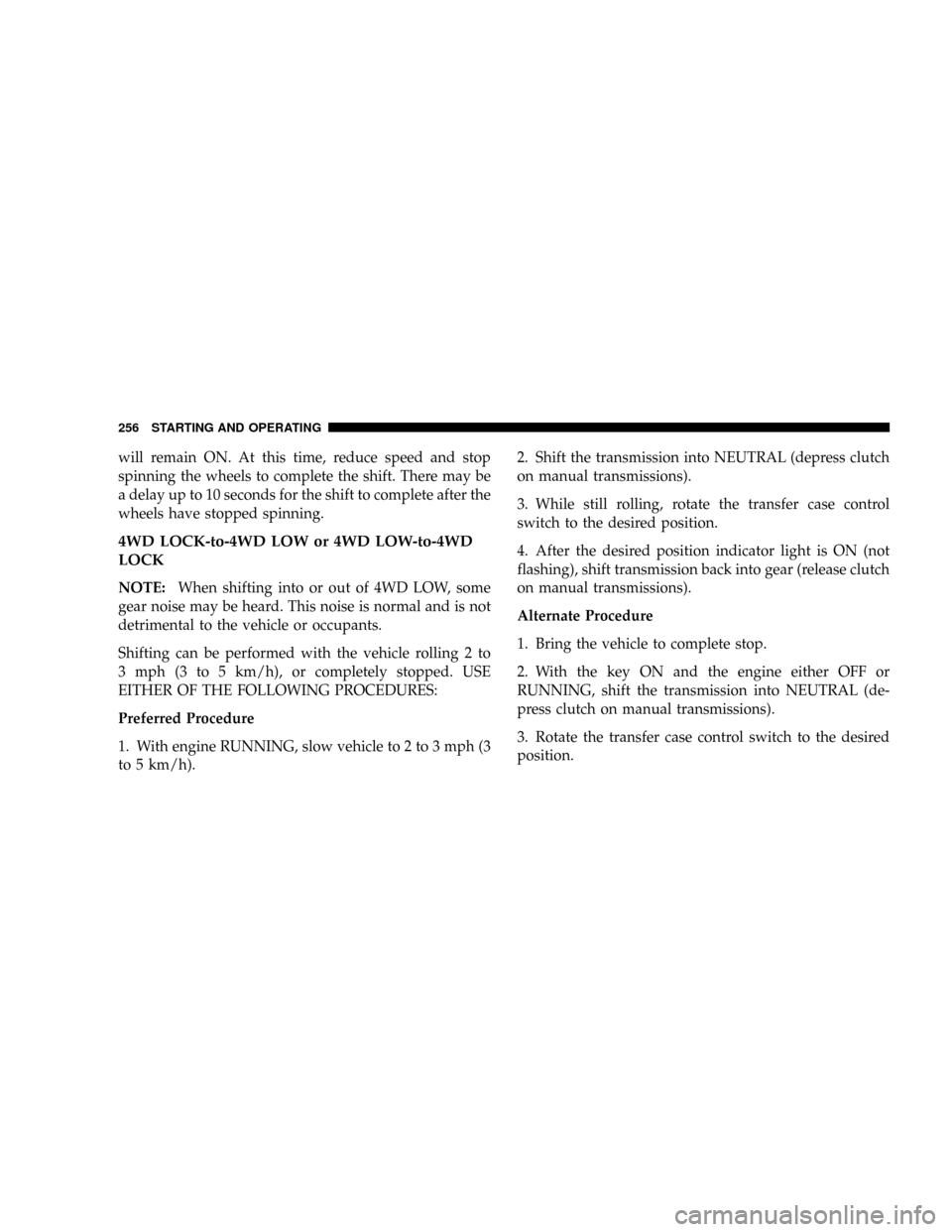
will remain ON. At this time, reduce speed and stop
spinning the wheels to complete the shift. There may be
a delay up to 10 seconds for the shift to complete after the
wheels have stopped spinning.
4WD LOCK-to-4WD LOW or 4WD LOW-to-4WD
LOCK
NOTE:When shifting into or out of 4WD LOW, some
gear noise may be heard. This noise is normal and is not
detrimental to the vehicle or occupants.
Shifting can be performed with the vehicle rolling 2 to
3 mph (3 to 5 km/h), or completely stopped. USE
EITHER OF THE FOLLOWING PROCEDURES:
Preferred Procedure
1. With engine RUNNING, slow vehicle to 2 to 3 mph (3
to 5 km/h).2. Shift the transmission into NEUTRAL (depress clutch
on manual transmissions).
3. While still rolling, rotate the transfer case control
switch to the desired position.
4. After the desired position indicator light is ON (not
flashing), shift transmission back into gear (release clutch
on manual transmissions).
Alternate Procedure
1. Bring the vehicle to complete stop.
2. With the key ON and the engine either OFF or
RUNNING, shift the transmission into NEUTRAL (de-
press clutch on manual transmissions).
3. Rotate the transfer case control switch to the desired
position.
256 STARTING AND OPERATING