Page 339 of 469
WHAT TO DO IN EMERGENCIES
CONTENTS
�Hazard Warning Flasher................ 338
�If Your Engine Overheats................ 338
�TIREFIT Tire Repair — If Equipped........ 339
�Jacking And Tire Changing............... 345
▫Jack Location/Spare Tire Stowage........ 345
▫Preparations For Jacking............... 347
▫Jacking And Changing a Tire............ 348
▫Compact Spare Tire................... 352
▫Wheel Cover Or Center Cap Installation
(If Equipped)....................... 353�Jump-Starting........................ 356
�FreeingAStuckVehicle ................. 359
�Towing A Disabled Vehicle............... 360
▫Without The Ignition Key.............. 360
▫Towing This Vehicle Behind Another Vehicle
(Flat Towing With All Four Wheels On The
Ground)........................... 360
▫Towing This Vehicle Behind Another Vehicle
WithATowDolly .................... 361
6
337
Page 343 of 469
WARNING!
•Do not attempt to repair a tire on the side of the
vehicle close to traffic. Pull far enough off the road
to avoid the danger of being hit when operating
the jack or repairing a tire.
•Cuts or punctures larger than approximately
0.16 in (4 mm), tire damage caused by driving with
extremely low tire pressure or on a flat tire, or a
damaged wheel can pose a hazard while driving.
TIREFIT should not be used in such circum-
stances. Do not drive the vehicle under such cir-
cumstances. Contact your nearest authorized
dealer for assistance.
(Continued)
WARNING! (Continued)
•Take care not to allow the contents of TIREFIT to
come in contact with hair, eyes or clothing. TIRE-
FIT is harmful if inhaled, swallowed, or absorbed
through the skin: It causes skin, eye, and respira-
tory irritation. Any contact with eyes or skin
should be flushed immediately with plenty of
water. If clothing comes in contact with TIREFIT,
change clothing as soon as possible.
•In case of allergic reaction or rash, consult a
physician immediately. Keep TIREFIT out of reach
of children. If swallowed, rinse mouth immedi-
ately with plenty of water and drink plenty of
water. Do not induce vomiting! Consult a physi-
cian immediately.
•Keep away from open flame or heat source.
6
WHAT TO DO IN EMERGENCIES 341
Page 347 of 469
•If TIREFIT is liquid, clean water and a damp cloth will
remove the material from the vehicle or tire and wheel
components. Once TIREFIT sealing material has dried,
it can easily be peeled off and properly discarded.
•Do not exceed 55 mph (90 km/h) until the tire has
been inspected.
JACKING AND TIRE CHANGING
WARNING!
•Do not attempt to change a tire on the side of the
vehicle close to moving traffic. Pull far enough off
the road to avoid the danger of being hit when
operating the jack or changing the wheel.
(Continued)
WARNING! (Continued)
•Getting under a jacked-up vehicle is dangerous.
The vehicle could slip off the jack and fall on you.
You could be crushed. Never get any part of your
body under a vehicle that is on a jack. Never start
or run the engine while the vehicle is on a jack. If
you need to get under a raised vehicle, take it to a
service center where it can be raised on a lift.
•The jack is designed to use as a tool for changing
tires only. The jack should not be used to lift the
vehicle for service purposes. The vehicle should
be jacked on a firm level surface only. Avoid ice or
slippery areas.
Jack Location/Spare Tire Stowage
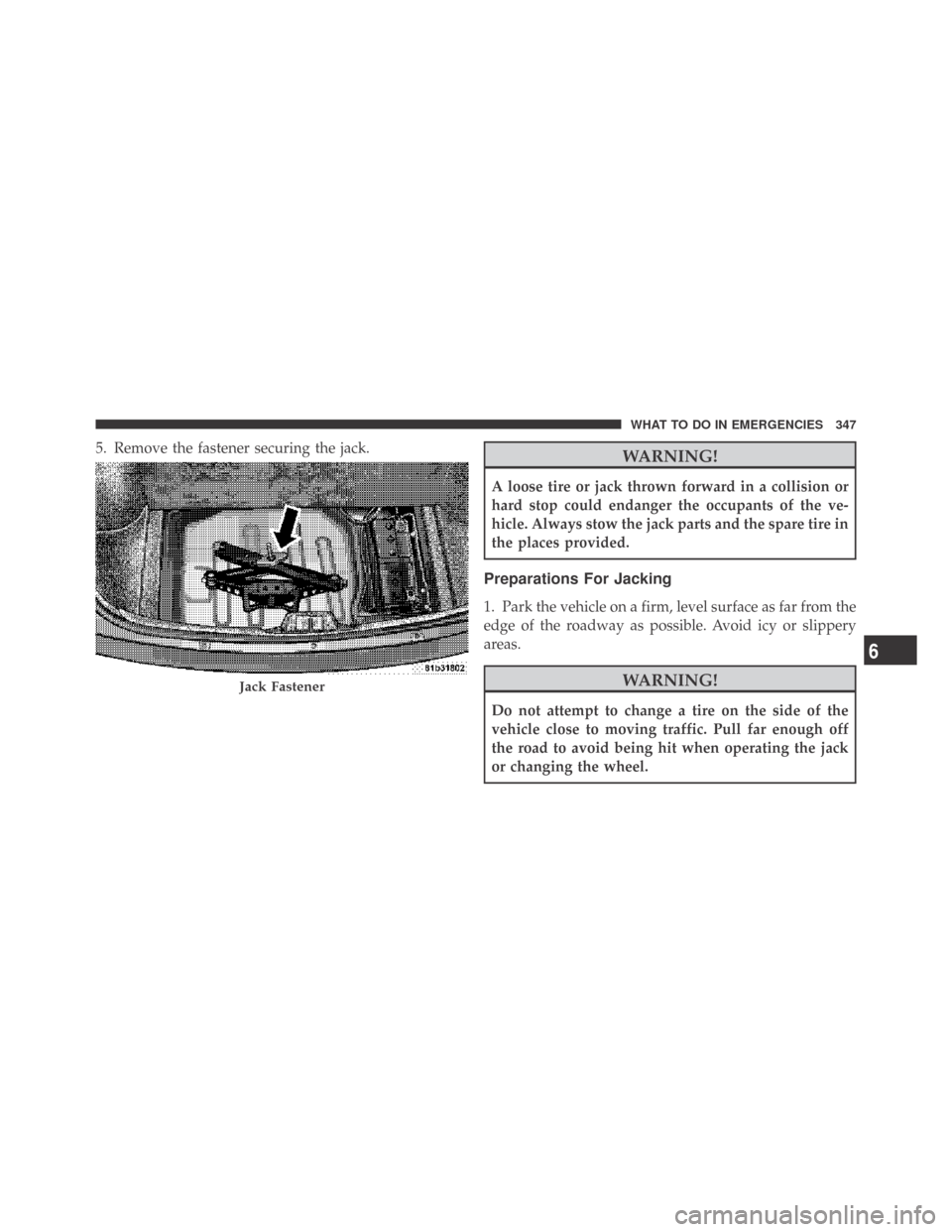
The jack and spare tire are both stowed under an access
cover in the trunk. Follow these steps to access the jack
and spare tire.
6
WHAT TO DO IN EMERGENCIES 345
Page 349 of 469
5. Remove the fastener securing the jack.WARNING!
A loose tire or jack thrown forward in a collision or
hard stop could endanger the occupants of the ve-
hicle. Always stow the jack parts and the spare tire in
the places provided.
Preparations For Jacking
1. Park the vehicle on a firm, level surface as far from the
edge of the roadway as possible. Avoid icy or slippery
areas.
WARNING!
Do not attempt to change a tire on the side of the
vehicle close to moving traffic. Pull far enough off
the road to avoid being hit when operating the jack
or changing the wheel.
Jack Fastener
6
WHAT TO DO IN EMERGENCIES 347
Page 350 of 469
2. Set the parking brake.
3. Place the shift lever into PARK (automatic transmis-
sion) or REVERSE (manual transmission).
4. Turn OFF the ignition.
5. Turn on the Hazard Warning flashers.
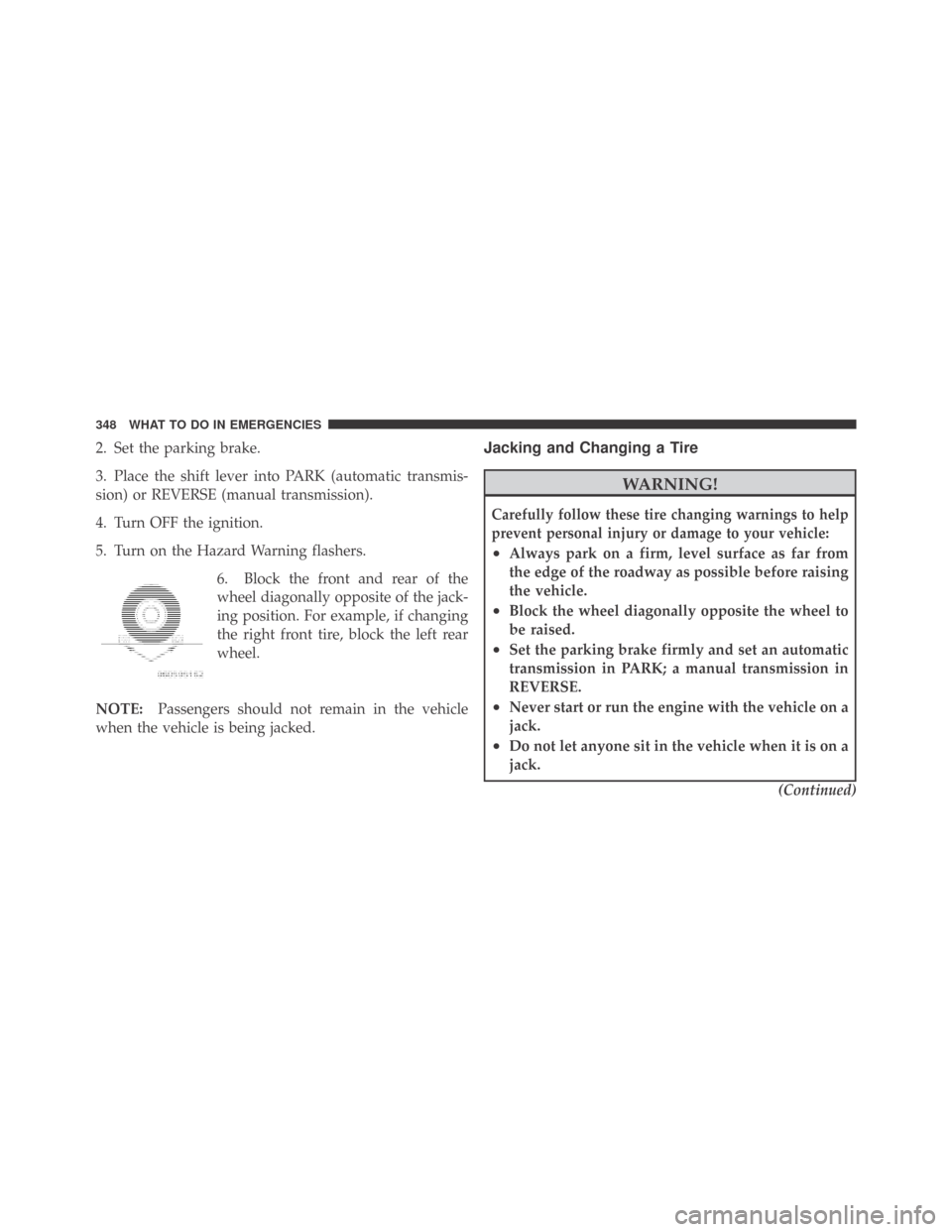
6. Block the front and rear of the
wheel diagonally opposite of the jack-
ing position. For example, if changing
the right front tire, block the left rear
wheel.
NOTE:Passengers should not remain in the vehicle
when the vehicle is being jacked.Jacking and Changing a Tire
WARNING!
Carefully follow these tire changing warnings to help
prevent personal injury or damage to your vehicle:
•Always park on a firm, level surface as far from
the edge of the roadway as possible before raising
the vehicle.
•Block the wheel diagonally opposite the wheel to
be raised.
•Set the parking brake firmly and set an automatic
transmission in PARK; a manual transmission in
REVERSE.
•Never start or run the engine with the vehicle on a
jack.
•Do not let anyone sit in the vehicle when it is on a
jack.
(Continued)
348 WHAT TO DO IN EMERGENCIES
Page 351 of 469
WARNING! (Continued)
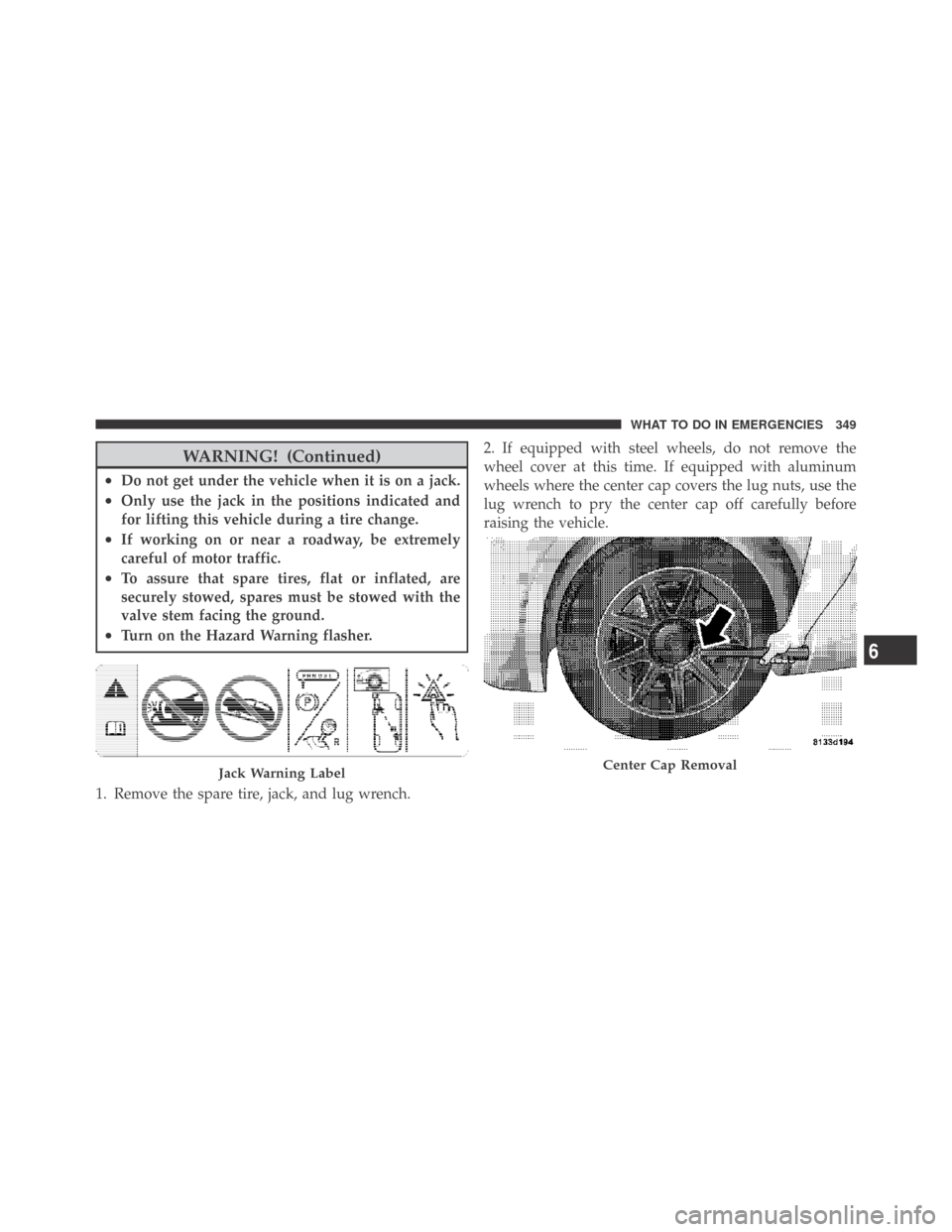
•Do not get under the vehicle when it is on a jack.
•Only use the jack in the positions indicated and
for lifting this vehicle during a tire change.
•If working on or near a roadway, be extremely
careful of motor traffic.
•To assure that spare tires, flat or inflated, are
securely stowed, spares must be stowed with the
valve stem facing the ground.
•Turn on the Hazard Warning flasher.
1. Remove the spare tire, jack, and lug wrench.2. If equipped with steel wheels, do not remove the
wheel cover at this time. If equipped with aluminum
wheels where the center cap covers the lug nuts, use the
lug wrench to pry the center cap off carefully before
raising the vehicle.
Jack Warning LabelCenter Cap Removal
6
WHAT TO DO IN EMERGENCIES 349
Page 352 of 469
WARNING!
To avoid possible personal injury, handle the wheel
covers with care to avoid contact with the metal edges
and retention teeth.
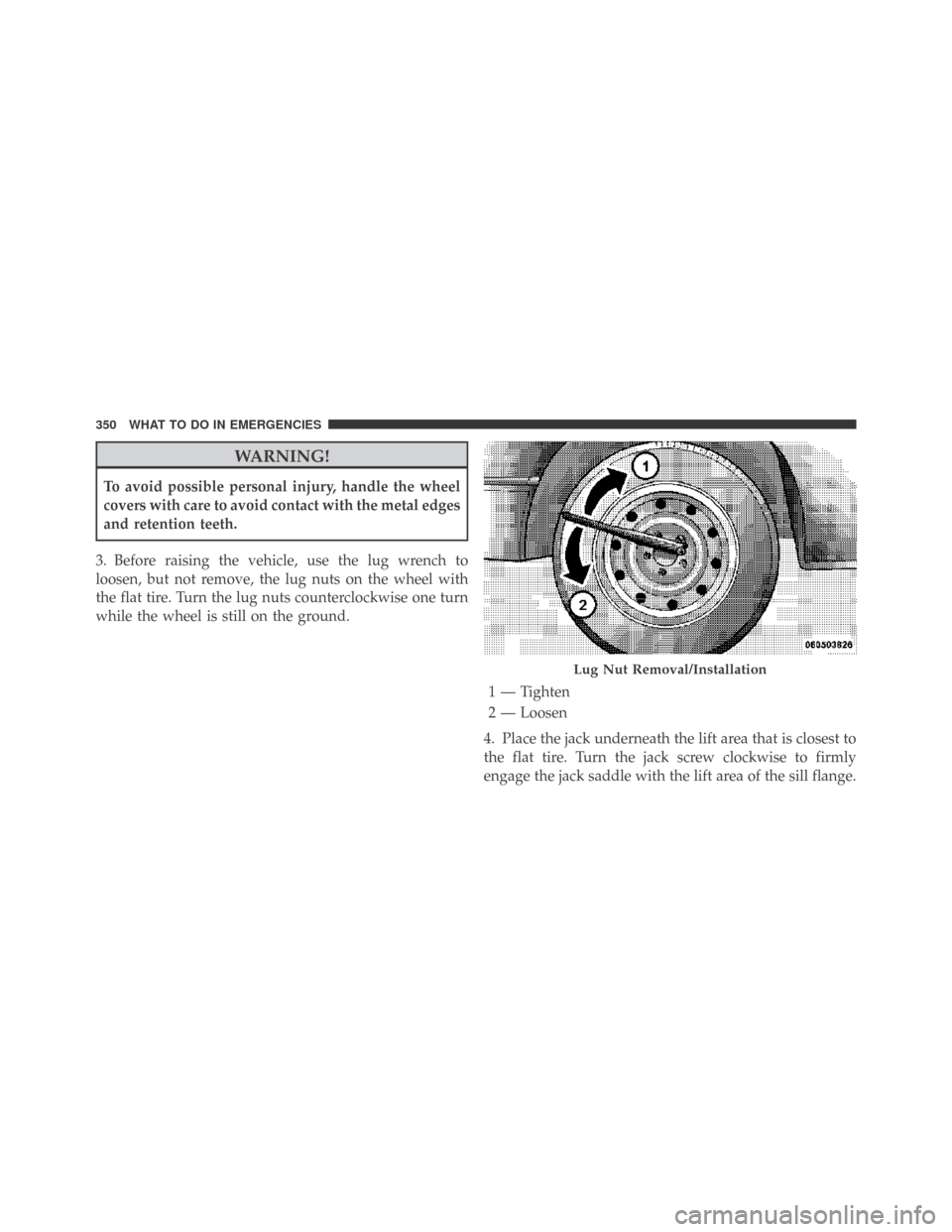
3. Before raising the vehicle, use the lug wrench to
loosen, but not remove, the lug nuts on the wheel with
the flat tire. Turn the lug nuts counterclockwise one turn
while the wheel is still on the ground.
4. Place the jack underneath the lift area that is closest to
the flat tire. Turn the jack screw clockwise to firmly
engage the jack saddle with the lift area of the sill flange.
Lug Nut Removal/Installation
1 — Tighten
2 — Loosen
350 WHAT TO DO IN EMERGENCIES
Page 353 of 469
5. Raise the vehicle just enough to remove the flat tire
and install the spare tire.
WARNING!
Raising the vehicle higher than necessary can make
the vehicle less stable. It could slip off the jack and
hurt someone near it. Raise the vehicle only enough
to remove the tire.
6. Remove the lug nuts, wheel cover (if equipped), and
tire. Remove the cover by hand. Do not pry it off.
7. Mount the spare tire.
NOTE:For vehicles so equipped, do not attempt to
install a center cap or wheel cover on the compact spare.
However, when reinstalling the road tire, follow the
procedure under “Wheel Cover or Center Cap Installa-
tion” in place of the remaining steps in this procedure.
Jack Engagement Locations6
WHAT TO DO IN EMERGENCIES 351