Page 354 of 469

8. Install the lug nuts with the cone shaped end of the
nut toward the wheel. Lightly tighten the lug nuts. To
avoid the risk of forcing the vehicle off the jack, do not
tighten the lug nuts fully until the vehicle is lowered to
the ground.
9. Lower the vehicle to the ground by turning the jack
handle counterclockwise.
10. Finish tightening the lug nuts. Push down on the
wrench while tightening for increased leverage. Alternate
lug nuts until each nut has been tightened twice. The
correct tightness of each lug nut is 100 ft/lb. (135 N·m). If
in doubt about the correct tightness, have them checked
with a torque wrench by your authorized dealer or at a
service station.11. Stow the jack, tools and flat tire. Make sure the base
of the jack faces the rear of the vehicle before tightening
down the fastener.
WARNING!
A loose tire or jack thrown forward in a collision or
hard stop could endanger the occupants of the ve-
hicle. Always stow the jack parts and the spare tire in
the places provided.
Compact Spare Tire
The compact spare tire is for temporary emergency use
with radial tires. It is engineered to be used on your style
vehicle only. Since this tire has limited tread life, the
original tire should be repaired (or replaced) and rein-
stalled at the first opportunity.
352 WHAT TO DO IN EMERGENCIES
Page 355 of 469
•Keep tire inflated to 60 psi (414 KPa) cold inflation
pressure.
•This tire is designed as an emergency spare only. Do
not exceed 50 mph (80 km/h) speed.
WARNING!
The limited-use spare tires are for emergency use
only. Installation of this limited-use spare tire affects
vehicle handling. With this tire, do not drive more
than 60 mph (100 km/h). Keep inflated to the cold tire
inflation pressure listed on either your tire placard or
limited-use spare tire and wheel assembly. Replace
(or repair) the original tire at the first opportunity
and reinstall it on your vehicle. Failure to do so could
result in loss of vehicle control.
Wheel Cover or Center Cap Installation (If
Equipped)
NOTE:Do not attempt to install a center cap or wheel
cover on the compact spare.
1. Mount the road tire on the axle. For vehicles equipped
with wheel covers, perform Steps 2 and 3. For vehicles
equipped with center caps, proceed to Step 4.
6
WHAT TO DO IN EMERGENCIES 353
Page 356 of 469
2. Install two lug nuts on the mounting studs, which are
on each side of the stud that is in alignment with the
valve stem. Install the lug nuts with the cone shaped end
of the nut toward the wheel. Lightly tighten the lug nuts.
To avoid the risk of forcing the vehicle off the jack, do not
tighten the lug nuts fully until the vehicle is lowered to
the ground.
Tire and Wheel Cover Or Center Cap
1 — Valve Stem 4 — Wheel Cover
2 — Valve Notch 5 — Mounting Stud
3 — Wheel Lug Nut 354 WHAT TO DO IN EMERGENCIES
Page 357 of 469
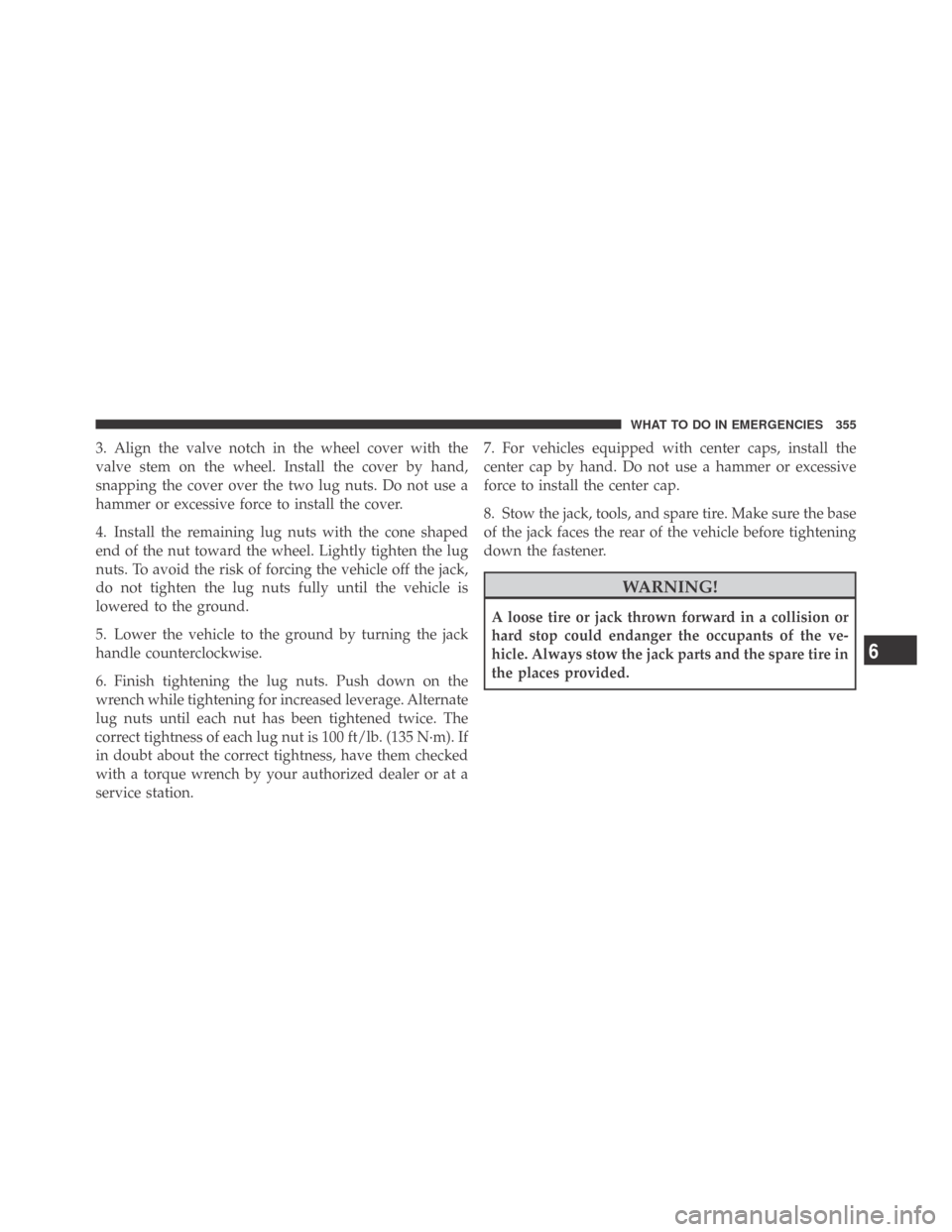
3. Align the valve notch in the wheel cover with the
valve stem on the wheel. Install the cover by hand,
snapping the cover over the two lug nuts. Do not use a
hammer or excessive force to install the cover.
4. Install the remaining lug nuts with the cone shaped
end of the nut toward the wheel. Lightly tighten the lug
nuts. To avoid the risk of forcing the vehicle off the jack,
do not tighten the lug nuts fully until the vehicle is
lowered to the ground.
5. Lower the vehicle to the ground by turning the jack
handle counterclockwise.
6. Finish tightening the lug nuts. Push down on the
wrench while tightening for increased leverage. Alternate
lug nuts until each nut has been tightened twice. The
correct tightness of each lug nut is 100 ft/lb. (135 N·m). If
in doubt about the correct tightness, have them checked
with a torque wrench by your authorized dealer or at a
service station.7. For vehicles equipped with center caps, install the
center cap by hand. Do not use a hammer or excessive
force to install the center cap.
8. Stow the jack, tools, and spare tire. Make sure the base
of the jack faces the rear of the vehicle before tightening
down the fastener.
WARNING!
A loose tire or jack thrown forward in a collision or
hard stop could endanger the occupants of the ve-
hicle. Always stow the jack parts and the spare tire in
the places provided.
6
WHAT TO DO IN EMERGENCIES 355
Page 361 of 469
WARNING!
•You should not try to start your vehicle by pushing
or towing.
•Do not connect the cable to the negative post of the
discharged battery. The resulting electrical spark
could cause the battery to explode.
•During cold weather when temperatures are be-
low the freezing point, electrolyte in a discharged
battery may freeze. Do not attempt jump-starting
because the battery could rupture or explode. The
battery temperature must be brought above the
freezing point before attempting jump-start.
FREEING A STUCK VEHICLE
If your vehicle becomes stuck in mud, sand, or snow, it
can often be moved by a rocking motion. Turn your
steering wheel right and left to clear the area around thefront wheels. Then shift back and forth between RE-
VERSE and DRIVE. Using minimal accelerator pedal
pressure to maintain the rocking motion, without spin-
ning the wheels, is most effective.
NOTE:Turn off the Electronic Stability Program (ESP)
before rocking the vehicle. Refer to “Electronic Stability
Program,” or “Traction Control” in Section 5.
CAUTION!
•When “rocking” a stuck vehicle by moving be-
tween “1st” and REVERSE, do not spin the wheels
faster than 15 mph (24 km/h), or drivetrain damage
may result.
•Racing the engine or spinning the wheels too fast
may lead to transmission overheating and failure.
It can also damage the tires. Do not spin the
wheels above 35 mph (55 km/h).
6
WHAT TO DO IN EMERGENCIES 359
Page 362 of 469
WARNING!
Fast spinning tires can be dangerous. Forces gener-
ated by excessive wheel speeds may cause tire dam-
age or failure. A tire could explode and injure some-
one. Do not spin your vehicle’s wheels faster than
35 mph (55 km/h) when you are stuck, and don’t let
anyone near a spinning wheel, no matter what the
speed.
TOWING A DISABLED VEHICLE
Without The Ignition Key
Special care must be taken when the vehicle is towed
with the ignition in the LOCK position. The only ap-
proved method of towing without the ignition key is
with a flatbed truck. Proper towing equipment is neces-
sary to prevent damage to the vehicle.
Towing This Vehicle Behind Another Vehicle (Flat
Towing With All Four Wheels On The Ground)
Flat towing of vehicles is permitted within the following
limitations:
With The Ignition Key
Your vehicle may be towed under the following condi-
tions:
•The shift lever must be in NEUTRAL
•The distance to be traveled must not exceed 15 miles
(24 km)
•The towing speed must not exceed 30 mph (48 km/h)
CAUTION!
Exceeding these towing limits may cause a transmis-
sion failure.
360 WHAT TO DO IN EMERGENCIES
Page 398 of 469
•Use a high quality cleaner wax, such as MOPAR�
Cleaner Wax to remove road film, stains and to protect
your paint finish. Take care never to scratch the paint.
•Avoid using abrasive compounds and power buffing
that may diminish the gloss or thin out the paint
finish.
CAUTION!
Do not use abrasive or strong cleaning materials such
as steel wool or scouring powder that will scratch
metal and painted surfaces.
Special Care
•
If you drive on salted or dusty roads or if you drive
near the ocean, hose off the undercarriage at least once
a month.
•It is important that the drain holes in the lower edges
of the doors, rocker panels, and trunk be kept clear
and open.
•If you detect any stone chips or scratches in the paint,
touch them up immediately. The cost of such repairs is
considered the responsibility of the owner.
•If your vehicle is damaged due to an accident or
similar cause that destroys the paint and protective
coating, have your vehicle repaired as soon as pos-
sible. The cost of such repairs is considered the respon-
sibility of the owner.
•If you carry special cargo such as chemicals, fertilizers,
de-icer salt, etc., be sure that such materials are well
packaged and sealed.
•If a lot of driving is done on gravel roads, consider
mud or stone shields behind each wheel.
396 MAINTAINING YOUR VEHICLE
Page 399 of 469
•Use MOPAR�Touch Up Paint or equivalent on
scratches as soon as possible. Your authorized dealer
has touch up paint to match the color of your vehicle.
Wheel and Wheel Trim Care
All wheels and wheel trim, especially aluminum and
chrome-plated wheels should be cleaned regularly with a
mild soap and water to prevent corrosion. To remove
heavy soil and/or excessive brake dust, use MOPAR�
Wheel Cleaner or equivalent or select a nonabrasive,
non-acidic cleaner. Do not use scouring pads, steel wool,
a bristle brush, or metal polishes. Only MOPAR�or
equivalent is recommended. Do not use oven cleaner.
Avoid automatic car washes that use acidic solutions or
harsh brushes that may damage the wheels’ protective
finish.
Stain Repel Fabric Cleaning Procedure — If
Equipped
Stain Repel seats may be cleaned in the following man-
ner:
•Remove as much of the stain as possible by blotting
with a clean, dry towel.
•Blot any remaining stain with a clean, damp towel.
•For tough stains, apply MOPAR�Total Clean or a mild
soap solution to a clean, damp cloth and remove the
stain. Use a fresh, damp towel to remove soap residue.
•For grease stains, apply MOPAR�Multi-Purpose
Cleaner or equivalent to a clean, damp cloth and
remove the stain. Use a fresh, damp towel to remove
soap residue.
•Do not use any harsh solvents or any other form of
protectants on Stain Repel products.
7
MAINTAINING YOUR VEHICLE 397