Page 262 of 469

When parking on a flat surface, place the shift lever in the
PARK position first, and then apply the parking brake.
When parking on a hill, it is important to set the parking
brake before placing the shift lever in PARK, otherwise
the load on the transmission locking mechanism may
make it difficult to move the shift lever out of park. As an
added precaution, turn the front wheels toward the curb
on a downhill grade and away from the curb on an uphill
grade.
WARNING!
Never use the PARK position as a substitute for the
parking brake. Always apply the parking brake fully
when parked to guard against vehicle movement and
possible injury or damage.
The following indicators should be used to ensure that
you have engaged the shift lever in the PARK position:
•When shifting into PARK move the shift lever all the
way forward and left until it stops and is fully seated.
•Look at the shift indicator display on the instrument
panel to ensure it is in the PARK position.
CAUTION!
Damage to the shifter could result if the shift lever is
moved out of PARK before the ignition is turned
from the LOCK to ON position.
REVERSE
This range is used for moving the vehicle rearward.
Always stop before moving the shift lever to REVERSE.
NEUTRAL
This range is used when the vehicle is standing for
prolonged periods with the engine running. The engine
may be started in this range. Set the parking brake if you
must leave the vehicle.
260 STARTING AND OPERATING
Page 267 of 469

When parking on a flat surface, place the shift lever in the
PARK position first, and then apply the parking brake.
When parking on a hill, it is important to set the parking
brake before placing the shift lever in PARK, otherwise
the load on the transmission locking mechanism may
make it difficult to move the shift lever out of PARK. As
an added precaution, turn the front wheels toward the
curb on a downhill grade and away from the curb on an
uphill grade.
WARNING!
Never use the PARK position on an automatic trans-
mission as a substitute for the parking brake. Always
apply the parking brake fully when parked to guard
against vehicle movement and possible injury or
damage.The following indicators should be used to ensure that
you have engaged the shift lever in the PARK position:
•When shifting into PARK, move the shift lever all the
way forward and to the left until it stops and is fully
seated.
•Look at the shift indicator display on the instrument
panel to ensure it is in the PARK position.
CAUTION!
Damage to the shifter could result if the shift lever is
moved out of PARK before the ignition is turned
from the LOCK to ON position.
REVERSE
This range is for moving the vehicle backward. Use only
after the vehicle has come to a complete stop.
5
STARTING AND OPERATING 265
Page 277 of 469
When parking on a hill, it is important to apply the
parking brake before placing the shift lever in PARK,
otherwise the load on the transmission locking mecha-
nism may make it difficult to move the shift lever out of
PARK. As an added precaution, turn the front wheels
toward the curb on a downhill grade and away from the
curb on an uphill grade.
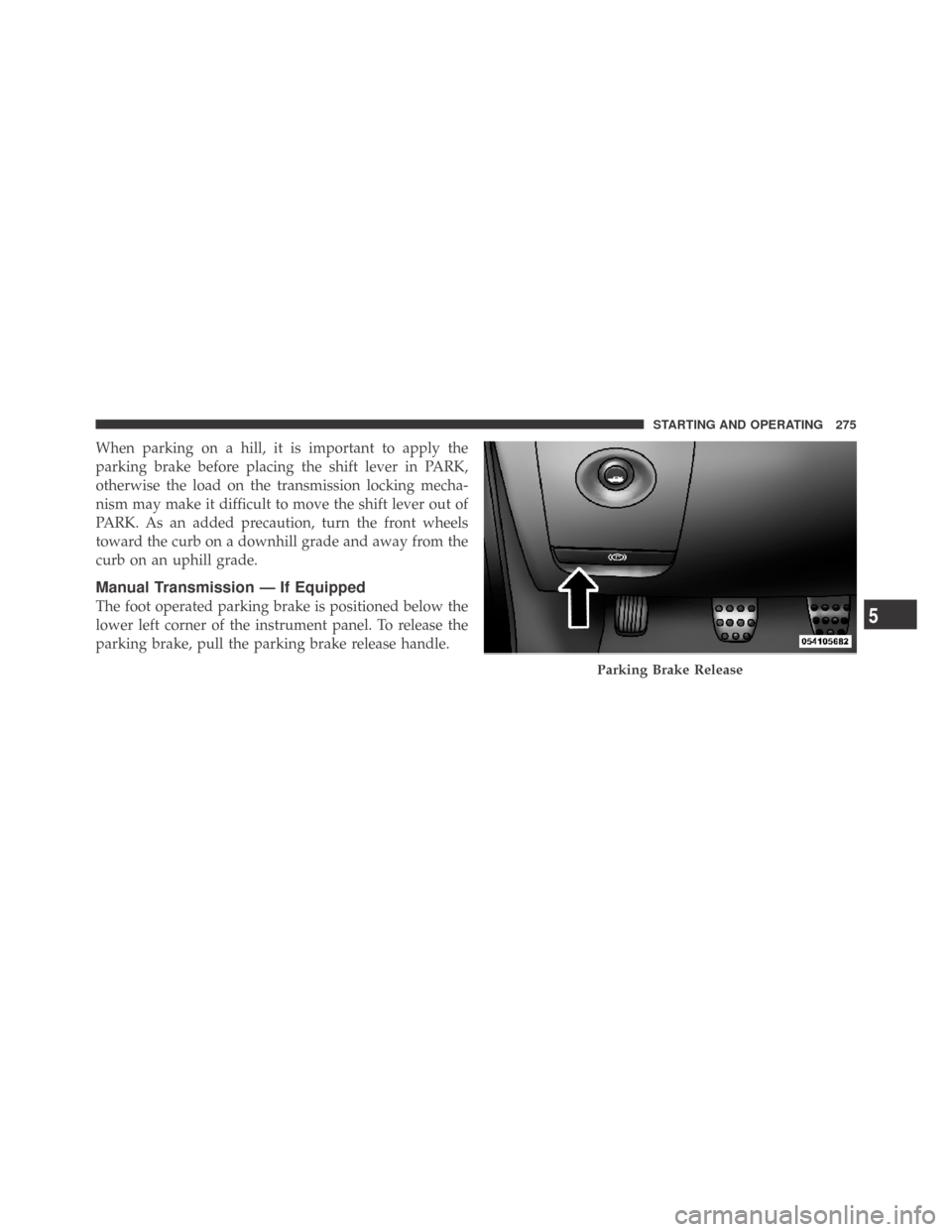
Manual Transmission — If Equipped
The foot operated parking brake is positioned below the
lower left corner of the instrument panel. To release the
parking brake, pull the parking brake release handle.
Parking Brake Release
5
STARTING AND OPERATING 275
Page 278 of 469
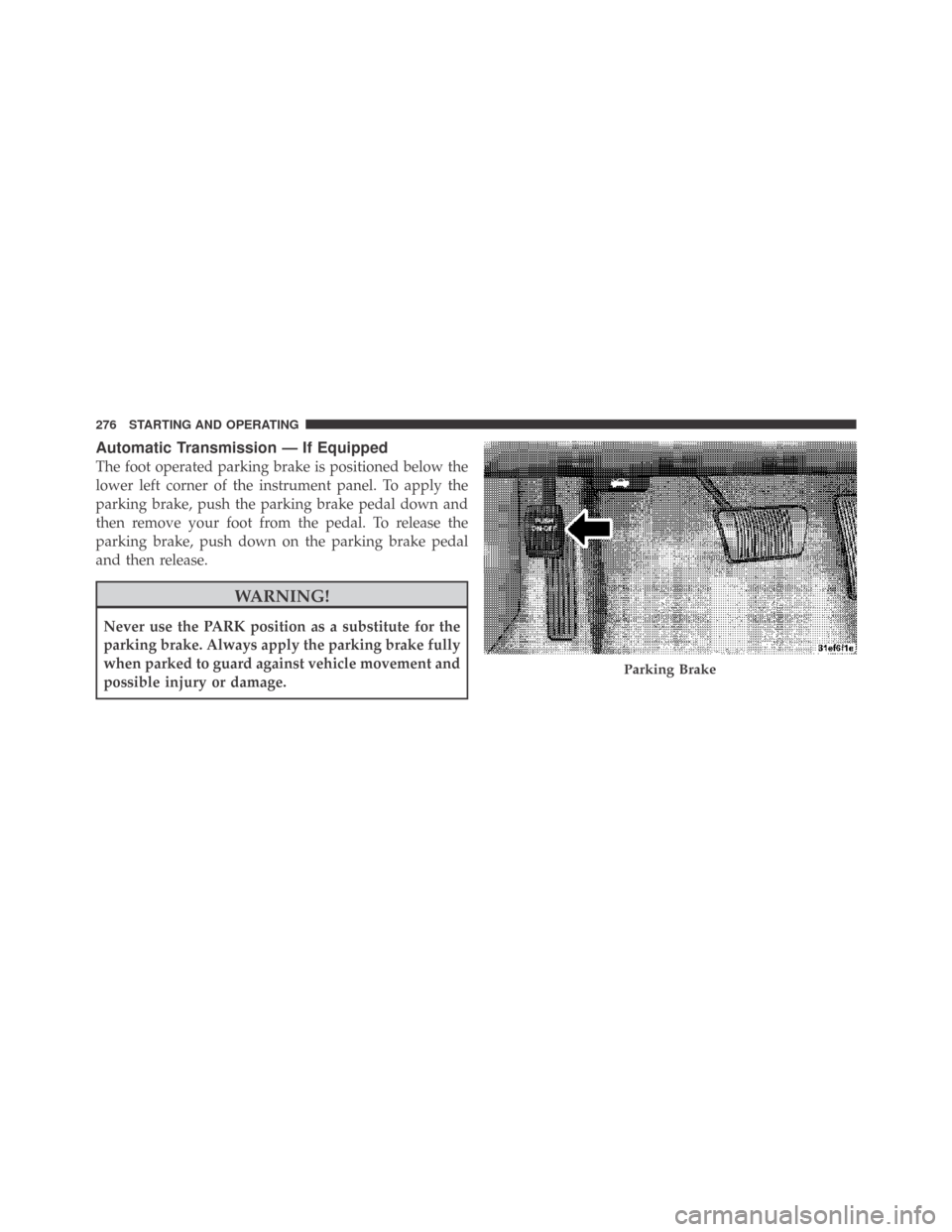
Automatic Transmission — If Equipped
The foot operated parking brake is positioned below the
lower left corner of the instrument panel. To apply the
parking brake, push the parking brake pedal down and
then remove your foot from the pedal. To release the
parking brake, push down on the parking brake pedal
and then release.
WARNING!
Never use the PARK position as a substitute for the
parking brake. Always apply the parking brake fully
when parked to guard against vehicle movement and
possible injury or damage.
Parking Brake
276 STARTING AND OPERATING
Page 288 of 469
The ESP system has two available operating modes:
ESP On
This is the normal operating mode for the ESP. Whenever
the vehicle is started, the ESP system will be in this mode.
This mode should be used for most driving situations.
The ESP should only be turned OFF for specific reasons
as noted in the following paragraphs.
Partial Off
The “Partial Off” mode is intended for times when a
more spirited driving experience is desired. It is also
intended for driving in deep snow, sand, or gravel. This
mode disables the TCS portion of the ESP and raises the
threshold for ESP activation, which allows for more
wheel spin than what ESP normally allows.
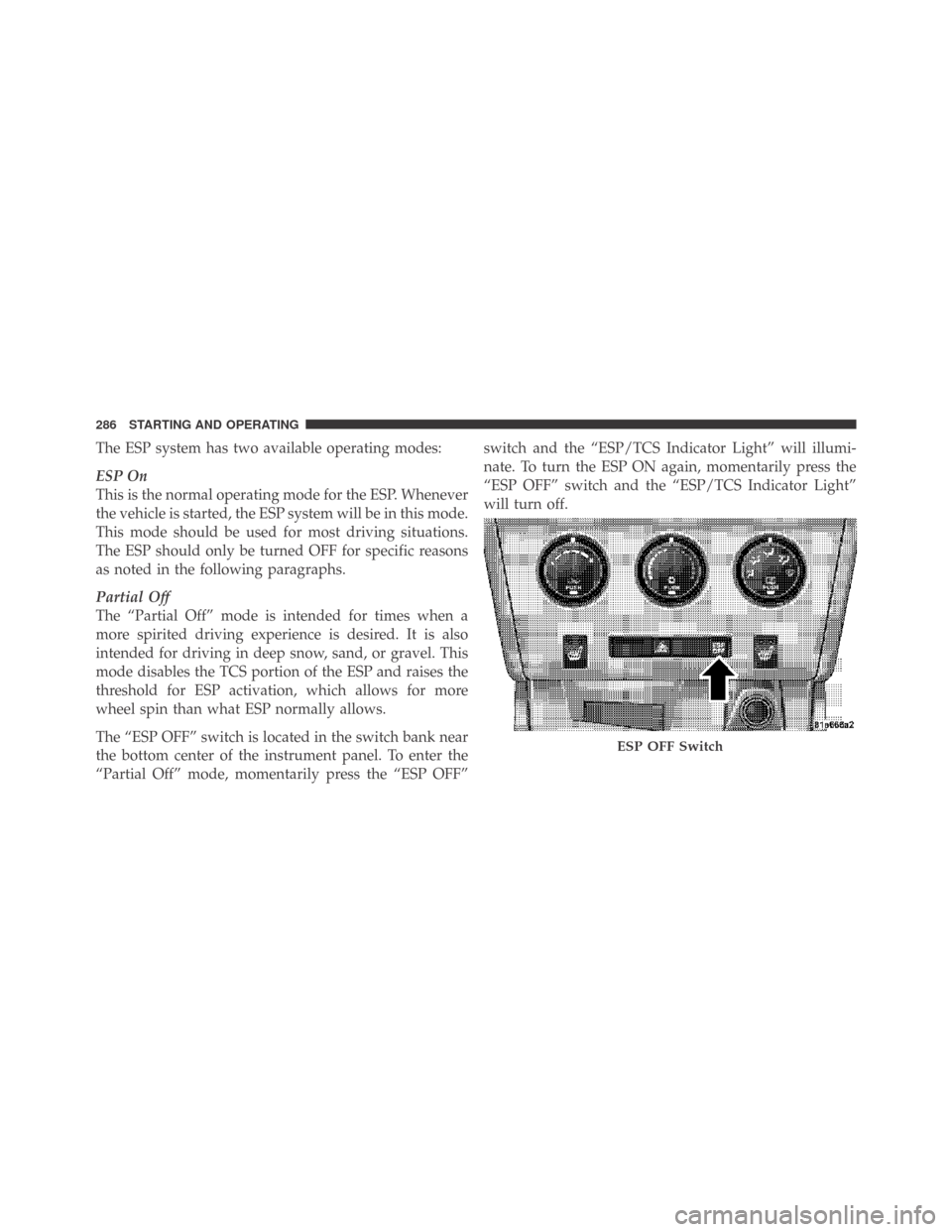
The “ESP OFF” switch is located in the switch bank near
the bottom center of the instrument panel. To enter the
“Partial Off” mode, momentarily press the “ESP OFF”switch and the “ESP/TCS Indicator Light” will illumi-
nate. To turn the ESP ON again, momentarily press the
“ESP OFF” switch and the “ESP/TCS Indicator Light”
will turn off.
ESP OFF Switch
286 STARTING AND OPERATING
Page 340 of 469

HAZARD WARNING FLASHER
The Hazard Warning flasher switch is located in the
switch bank near the bottom center of the instrument
panel.
Press the switch to turn on the Hazard Warning
flasher. When the switch is activated, all directional
turn signals will flash on and off to warn oncoming
traffic of an emergency. Press the switch a second time to
turn off the Hazard Warning flasher.
This is an emergency warning system and it should not
be used when the vehicle is in motion. Use it when your
vehicle is disabled and it is creating a safety hazard for
other motorists.When you must leave the vehicle to seek assistance, the
Hazard Warning flasher will continue to operate even
though the ignition switch is in the LOCK position.
NOTE:With extended use, the Hazard Warning flasher
may wear down your battery.
IF YOUR ENGINE OVERHEATS
In any of the following situations, you can reduce the
potential for overheating by taking the appropriate ac-
tion.
•On the highways — slow down.
•In city traffic — while stopped, put transmission in
NEUTRAL, but do not increase engine idle speed.
338 WHAT TO DO IN EMERGENCIES
Page 344 of 469
Sealing Tire with TIREFIT
1. Turn on the Hazard Warning Flashers.
2. Move the shift lever into PARK (automatic transmis-
sion) or in gear (manual transmission), turn OFF the
engine and set the parking brake.
3. Remove the TIREFIT kit from the trunk.
4. Pull the power plug 2 and the TIREFIT sealant hose 6
out from the TIREFIT kit.
5. Unscrew the valve cap from the valve on the deflated
tire.
6. Screw the fitting at the end of TIREFIT sealant hose 6
coming from the sealant bottle 5 onto the tire valve.
7. Insert the power plug 2 into the power point on the
instrument panel.8. Leave the parking brake set and the shift lever in
PARK (automatic transmission) or NEUTRAL (manual
transmission) and start the engine.
9. Press the switch 3 on the air pump to I (ON). The air
pump should start to inflate the tire and the tire sealant
(white fluid) will flow from the sealant bottle 5 through
the TIREFIT sealant hose 6 and into the tire.
10. Allow the air pump to run for five minutes and then
read the pressure gauge 4. If the tire inflates to 26 psi
(1.8 bar) or greater, proceed to Step 19 of this procedure.
If not, proceed to the following step.
11. Press the AIR PUMP switch 3 to 0 (OFF). Then,
disconnect the TIREFIT system from the tire and place it
back in the vehicle.
12. Release the parking brake and drive the vehicle back
and forth approximately 30 ft (9.1 m) to distribute the
sealant more evenly within the tire.
342 WHAT TO DO IN EMERGENCIES
Page 454 of 469
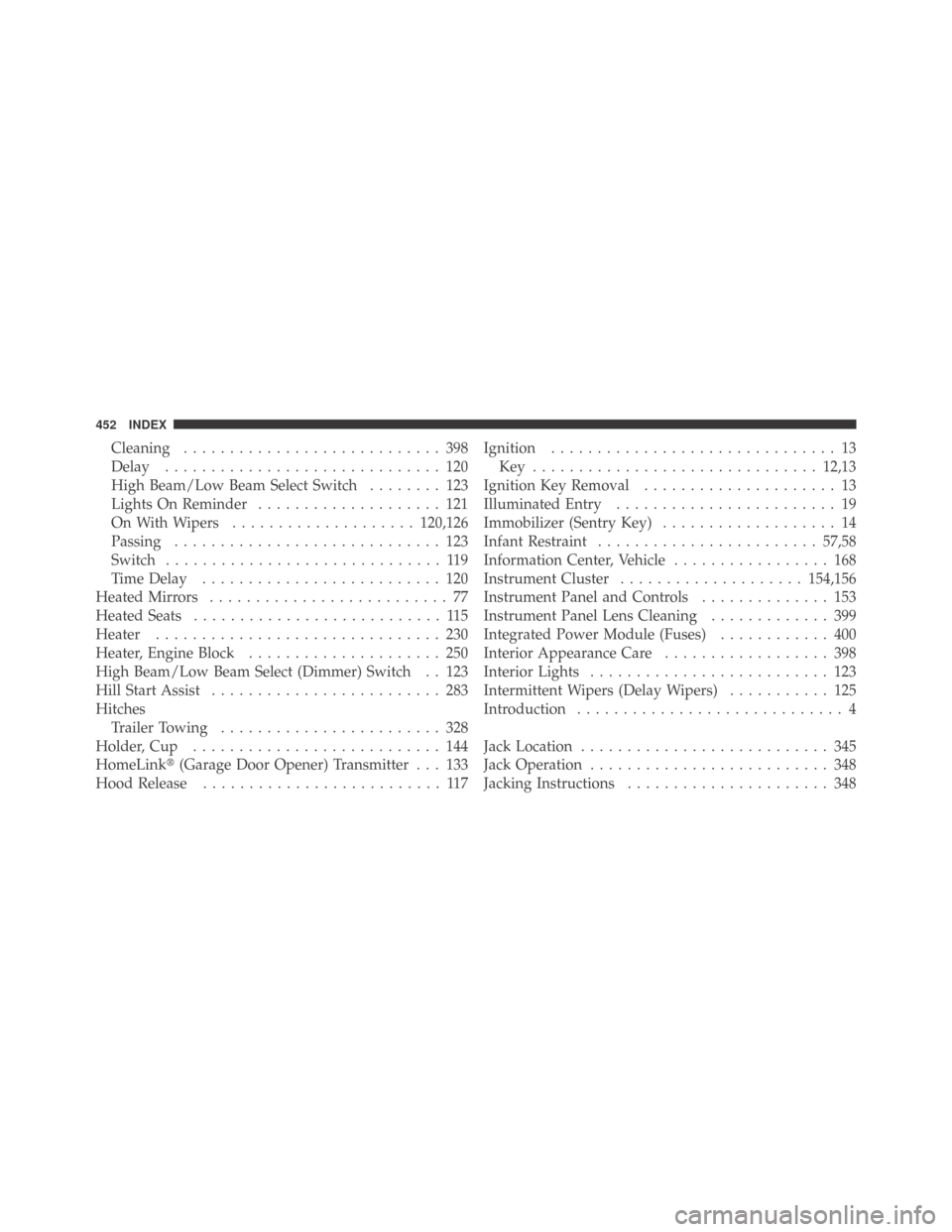
Cleaning............................ 398
Delay .............................. 120
High Beam/Low Beam Select Switch........ 123
Lights On Reminder.................... 121
On With Wipers....................120,126
Passing............................. 123
Switch .............................. 119
TimeDelay .......................... 120
Heated Mirrors.......................... 77
Heated Seats........................... 115
Heater............................... 230
Heater, Engine Block..................... 250
High Beam/Low Beam Select (Dimmer) Switch . . 123
Hill Start Assist......................... 283
Hitches
TrailerTowing ........................ 328
Holder,Cup ........................... 144
HomeLink�(Garage Door Opener) Transmitter . . . 133
Hood Release.......................... 117Ignition............................... 13
Key ............................... 12,13
Ignition Key Removal..................... 13
Illuminated Entry........................ 19
Immobilizer (Sentry Key)................... 14
Infant Restraint........................ 57,58
Information Center, Vehicle................. 168
Instrument Cluster....................154,156
Instrument Panel and Controls.............. 153
Instrument Panel Lens Cleaning............. 399
Integrated Power Module (Fuses)............ 400
Interior Appearance Care.................. 398
InteriorLights .......................... 123
Intermittent Wipers (Delay Wipers)........... 125
Introduction............................. 4
Jack Location........................... 345
Jack Operation.......................... 348
Jacking Instructions...................... 348
452 INDEX